Mainstream Online Web Portal
LoginInvestors can view their accounts online via a secure web portal. After registering, you can access your account balances, periodical statements, tax statements, transaction histories and distribution statements / details.
Advisers will also have access to view their clients’ accounts online via the secure web portal.

Tim Hext: Unemployment keeps going up. Are rate cuts next?
Unemployment is rising faster than the Reserve Bank expected. Pendal’s head of government bond strategies TIM HEXT explains what this means for rate cuts and bond investors
- Unemployment is rising faster than RBA expected
- Investors should look to lock in term rates
- Find out about Pendal Government Bond Fund
- Browse Pendal’s fixed interest funds
THE latest rise in unemployment to 4.9% (4.8% trend), along with the loss of 43,500 jobs, came as a surprise to most economists.
None more so than those employed at the Reserve Bank, who were not expecting this kind of number before the end of next year.
The RBA had been anticipating “a stable near-term outlook for labour demand” according to the minutes of its board meeting earlier this month.
Perhaps the three rate hike dissenters on the RBA board were reading the consistent headlines of layoffs rather than listening to the Reserve Bank staff.
Within the data there are some interesting observations.
Firstly, the unemployment rate rose despite a lower participation rate (66.6% from 66.8%), which is unusual and highlights the scale of job losses.
Secondly, the job losses in the last two months have largely been part time, meaning the underemployment rate is rising slower than the unemployment rate.
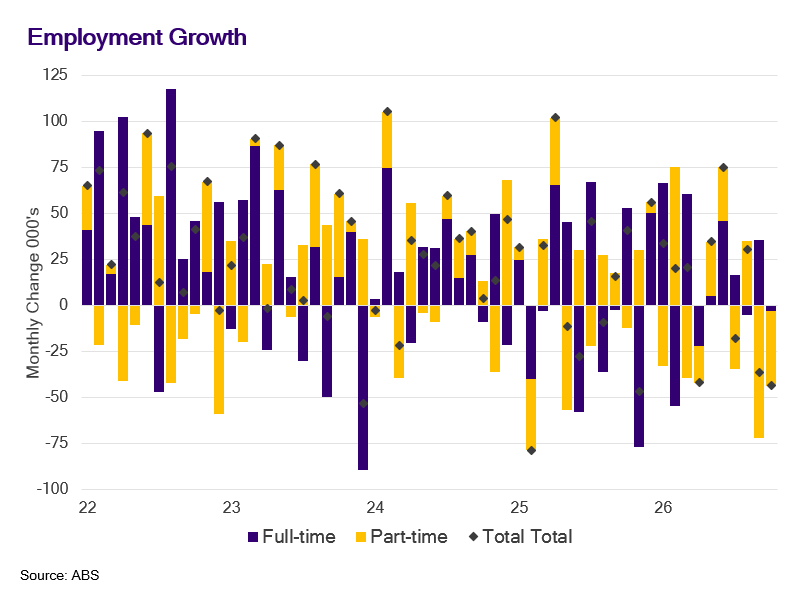
Thirdly, hours worked fell by 0.2% and are only 0.7% higher than a year ago, despite 1.5% population growth.
The one bright spot is that GDP is holding up better than jobs, indicating productivity gains.
The flipside of this is that maybe we are beginning to see early signs of everyone’s fears – AI and other technology outsourcing might see improving productivity but largely via a lot less workers.
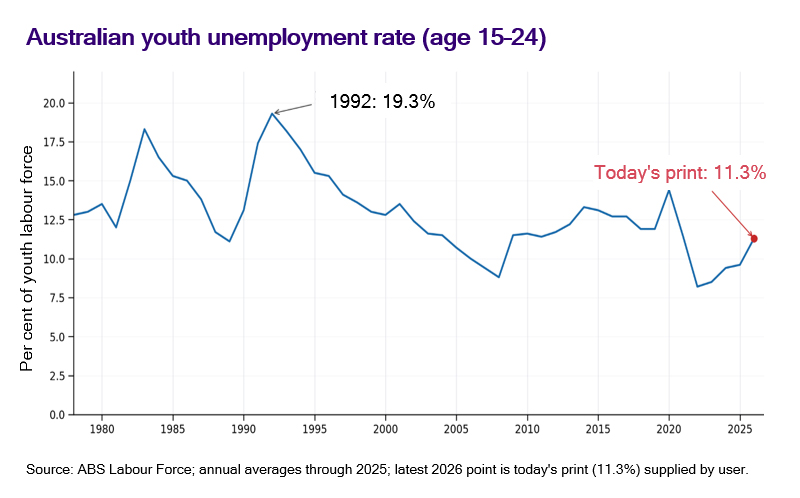
Finally, of special concern is the rise in youth unemployment. According to the Australian Bureau of Statistics (ABS), in the post COVID period youth unemployment averaged 9.2%.
It is now 11.3% and rising. The long-term average over the last 50 years is 13%, so its disappointing to be back near there.
Implications for monetary policy
Labour force data has been notorious for month-by-month volatility, but the trend and momentum here is clear.
The Reserve Bank is achieving much earlier than expected what it set out to do with the five rate hikes this year – freeing up capacity to counter inflation. Unemployment began the year at 4.1%.
I won’t begin a tirade around sacrificing jobs rather than reining in government spending to tackle inflation, but the trouble with starting a fire is it can get out of control.
The virtuous employment circle since COVID is now fast becoming a vicious circle. Job losses reduce confidence that reduces consumer spending that in turn leads to further job losses. All with rate hikes fuelling the fire.
Markets now have a full rate cut priced for August next year, and one and almost two cuts by the end of 2027, removing the two recent rate hikes.
If rate cuts begin next year the cycle will be deeper than just two cuts.The Reserve Bank will be cautious until inflation starts turning.
Q4 this year will remain high but by mid next year it is likely trimmed mean inflation will be around 0.7% per quarter from current levels nearer 1%.
Investment implications
Although bonds are now almost 0.5% off the yield highs, 10-year bonds are still around 5%. Investors should continue to look for opportunities to lock in term rates as the cycle begins to turn.
While the RBA may be cautious about rate cuts, if we begin to see signs of a recession caution will disappear quickly as the RBA focuses on its dual mandate – price stability and full employment.
Floating rate notes and term deposits will see returns fall sharply with cash rates. Fixed rate bonds will finally start to perform their role as insurance.
Find out about
Pendal Government Bond Fund
Tim Hext, Head of Government Bond Strategies
If you’d like to hear more about how Pendal’s Income & Fixed Interest team is positioning for this environment, please contact us through our accounts team
About Tim Hext and Pendal’s Income & Fixed Interest boutique
Tim Hext is a Pendal portfolio manager and head of government bond strategies in our Income and Fixed Interest team.
Tim has extensive experience in banking, financial markets and funding including senior positions with NSW Treasury Corporation (TCorp), Westpac Treasury, Commonwealth Bank of Australia, Deutsche Bank, Bain & Co and Swiss Bank Corporation.
Pendal’s Income and Fixed Interest boutique is one of the most experienced and well-regarded fixed income teams in Australia.
Find out more about Pendal’s fixed interest strategies here
About Pendal
Pendal is a global investment management business focused on delivering superior investment returns for our clients through active management.
In 2023, Pendal became part of Perpetual Limited (ASX:PPT), bringing together two of Australia’s most respected active asset management brands to create a global leader in multi-boutique asset management with autonomous, world-class investment capabilities and a growing leadership position in ESG.
This report has been prepared by Pendal Fund Services Limited (PFSL) ABN 13 161 249 332 AFSL 431426.
It is general information only and is not intended to provide you with financial advice or take into account your objectives, financial situation or needs. You should consider whether the information is
suitable for your circumstances and we recommend that you seek professional advice.
The product disclosure statement (PDS) for the Pendal Government Bond Fund (Fund), issued by PFSL, should be considered before deciding whether to acquire, dispose, or hold units in the Fund. The PDS and Target Market Determination can be obtained by calling 1300 346 821 or visiting our website www.pendalgroup.com.
To the extent permitted by law, no liability is accepted for any loss or damage as a result of any reliance on this information. No company in the Perpetual Group (Perpetual Limited ABN 86 000 431
827 and its subsidiaries) guarantees the performance of any fund or the return of an investor’s capital. All investing involves risk including the possible loss of principal.