
Here’s what’s driving Australian equities this week according to Pendal’s head of equities Crispin Murray (pictured above). Reported by portfolio specialist Chris Adams.
Find out about Pendal’s Focus Australian Share Fund here.
MARKETS rallied last week as the sell-off in bonds slowed down and data suggested the US economy was about to kick into a phase of strong growth.
The rotation to value continued. However on Friday we saw some signs of a rebound in tech names from a significantly oversold level.
The S&P/ASX 300 rose 0.98%, while the S&P 500 was up 0.84%
Covid and vaccine outlook
The rate of decline in new cases in the US slowed last week, but this likely reflects a lag in reporting after winter storms.
Hospitalisation rates continue to improve substantially, prompting speculation that restrictions in some countries may be eased sooner than expected.
The vaccine roll-out continues to accelerate in the US. It’s now reached 2.3 million per day. This will rise with greater supply. The number of people who have been vaccinated now exceeds the total number of reported cases in the US.
The gap in vaccination rates between the US (and UK) versus Europe continues to widen. This has implications for the economic outlook and may account for some of the strength in the US dollar last week.

Novavax released data from a trial in South Africa. Placebo group results revealed that people who had previously caught the original strain of Covid were just as likely to catch the new South African strain – and to become as sick.
This is an issue to watch. It may have implications for where and when international border restrictions are eased.
Economics and policy outlook
The US payroll data was very strong for February. It is likely to be the first of a number of strong data prints as the economy begins to reopen and the next wave of stimulus kicks in.
There is nevertheless a lot of slack left in the economy. The payroll data is still 10 million jobs below the previous peak. At the worst point of the GFC the payroll data had fallen by 9 million. This excess capacity is why policy makers believe they can stimulate and keep rates near zero for an extended period without triggering inflation.
Many of these lost jobs are in leisure and hospitality, which still has a long way to recovery. As the economy re-opens this sector could see a lot of job growth in the next few months. We are seeing signs of a potential breakout in mobility data above its range of the last nine months.
The Biden stimulus package is set to go ahead – US$1.9 trillion is more than most expected. This underpins our expectation of support for higher corporate earnings – and equity markets – as some 9% of annualised GDP is injected into the market in the next few months.
Focus now shifts to the infrastructure bill. Consensus is a US$2 trillion package, though there is chatter of something up to US$4 trillion.
We see indication of enormous pent-up demand globally, though the US stands out. Once the latest US$1400 stimulus cheques go out, the US savings rate is expected to hit 18%. That compares to 7% pre-Covid. This is supportive of economic activity, as are surveys suggesting a material pick-up in corporate capex later in the year.
Market outlook
Bonds yields continued to move higher last week, though in a more orderly manner.
Comments from the Fed suggest it’s comfortable with yields gradually rising towards 2%, given they reflect a better outlook for growth. The Fed is unlikely to move pre-emptively to control yields unless they start to break out in a disorderly manner and threaten to choke off growth.
US 10-year yields rose 16bps to 1.57% for the week. The Australian equivalent fell 8 bps to 1.83%.

Brent crude rose 4.9% on the OPEC decision to extend restrictions on production. Other commodities consolidated as the US dollar bounced.
We started to see a bounce in some growth names late last week. They may make a recovery form oversold levels from here. That said, we may see divergence between the larger cash-generating plays and the loss-making, higher-growth sub-sectors.
The Top 20 stocks drove the Australian equity market higher. The ASX 20 gained 1.8% versus a 1.5% fall in the Small Ordinaries. The banks played a key role, up 6.6% as the effect of higher bond yields flowed through. ANZ (ANZ, +10.2%) was the best performer in the ASX 100.
Resources (-0.6%) saw some consolidation as commodities softened, although Energy (+3.3%) saw the benefits of a higher oil price. Gold miners were among the worst performers in the market.
There was limited company news in the wake of reporting season.
Xero (XRO, -4.4%) announced its $280 million acquisition of Planday, a cloud-based workforce management solution based in Copenhagen. This extends XRO’s product suite, potentially helping further its expansion into Europe. The shares were caught up in a rotation away from growth, but we believe the deal is a good one. XRO remains among our preferred exposure in tech.
About Crispin Murray and Pendal Focus Australian Share Fund
Crispin Murray is Pendal’s Head of Equities. He has more than 27 years of investment experience and leads one of the largest equities teams in Australia.
Crispin’s Pendal Focus Australian Share Fund has beaten the benchmark in 12 years of its 16-year history (after fees), across a range of market conditions , as this graph shows:
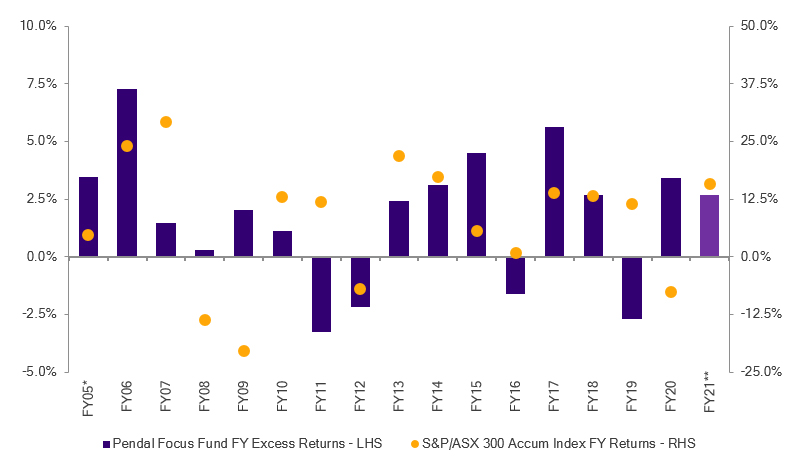
Source: Pendal. Performance is after fees and before taxes. *From 01 Apr 05; **as at 28 Feb 21. Past performance is not a reliable indicator of future performance.
Pendal is an independent, global investment management business focused on delivering superior investment returns for our clients through active management.
Find out more about Pendal Focus Australian Share Fund here.
Environmental, Social and Governance factors are now critical in asset allocation decision-making says Pendal’s Head of Multi-Asset Michael Blayney.
THE BIGGEST secular shift over the next decade is arguably the continuing emergence of — and demand for — Environmental, Social and Governance (ESG) factors in investment portfolios.
In the past ESG may have been considered, but it seldom had a meaningful value ascribed to its risk and wasn’t thought of in terms of asset allocation.
But ESG has emerged as a secular theme, alongside demographics, debt levels and productivity — and investors must think more deeply about how it fits into a portfolio.
“In the past, when an investor put together an ESG-focused portfolio, it would basically have the same asset allocation as a conventional fund,” says Michael Blayney, who head up Pendal’s multi-asset investment team.
“Now it’s essential to think about how we can incorporate ESG and sustainability factors into both strategic and active asset allocation decisions.”
Critical big-picture factor
ESG has not only emerged as a long-term secular consideration, it’s becoming the most critical “big picture” factor for the next decade.
“The time between a scandal breaking out and a CEO being shown the door has shortened considerably,” says Blayney. “Community expectations have shifted, particularly on the environmental side.”
Find out about
Pendal Multi-Asset Funds
“We’re seeing it in Europe with the new Green Deal. With the change in the White House, the US economy will shift that way too. There’s clearly a long-term thematic going on. People are focused on how they can contribute to – and benefit from — long-term, positive solutions.”
Of the different ESG factors, the environment provides one of the clearest links to economic growth factors.
“If you take Australia, we actually look a lot worse on environmental performance because we dig a lot of fossil fuels out of the ground and still use a lot of coal for our energy,” Blayney says.
Because the Australian economy and market is more exposed to environmental issues, it creates a secular headwind. About three quarters of Australia’s energy mix is from coal and we are the world’s third biggest fossil fuel exporter according to recent research by the Australia Institute.
“As a result, the home bias in asset allocation should be reduced from historical levels and more so for sustainable funds,” Blayney says. “The Australian economy scores very well on the S and G factors of ESG, but the equity market is let down by our high carbon intensity.”
Governance and social issues matter as well, and are particularly critical considerations in emerging markets.
“There have been studies that show well-governed businesses tend to perform better,” Blayney says. “But there are nuances in that. The rate of change of governance can be very important too.
“We’ve invested in Korean and Japanese equities at times in the last couple of years and a key element of the investment thesis has been improved governance in those countries.”
Opportunity for better returns
ESG is moving beyond risk management. “Previously investors tended to focus on the bad stuff, and how that could trigger a fall in a share price,” Blayney says.
“It’s obviously still important … but nowadays we also think about ESG and sustainability in terms of the opportunity to generate better returns from the portfolio.
“It’s very much a big shift in thinking and it’s coming into the mainstream. But it has evolved more in some markets around the world, notably Europe. There’s a bit of ground to make up in the United States, Australia and parts of Asia. That provides opportunity,” Blayney says.
“When you consider how some big investors allocate their assets, there’s still quite a lot more that can be done to better align with both ESG risks and opportunities. Many investors know about ESG, but they’re not sure if it’s already factored into the price [of an asset]. That’s where we can help.”
There’s a pressing need for investors to consider ESG factors when allocating assets.
“In our research, the integration of ESG risks added weight to decisions to decrease exposure to Australian shares,” he says. “It also indicated investors should increase weightings to some offshore opportunities.”
“While a lot of environmentally aligned assets have had a strong run, we still think there’s good opportunity in the longer term.”
About Michael Blayney and Pendal’s Multi-Asset capabilities
Michael Blayney leads Pendal’s multi-asset team.
Michael has more than 20 years of investment management and consulting experience. He was previously Head of Investment Strategy at First State Super and head of Diversified Strategies at Perpetual.
Pendal’s diversified funds provide investors with a variety of traditional and alternative asset classes and strategies.
The team — which includes Stuart Eliot, Allan Polley and Rita Fung — manages our multi-asset portfolios with a focus on strategic asset allocation, active management and tactical asset allocation.
Pendal Horizon Fund (APIR: RFA0025AU, ARSN: 096 328 219)
With effect from 15 March 2021, the “Pendal Ethical Share Fund” will be renamed the “Pendal Horizon Fund” (Fund).
The change of name will more accurately reflect the investment framework and responsible investment priorities of the Fund which extend beyond just ethical screens being applied.
The investment processes of the Fund (including new and tighter screens and a framework that places a greater focus on selecting stocks and industries that meet our investment criteria, responsible investment priorities and philosophy) were implemented in October 2020.
The responsible investment priorities of the Fund centre on a future-ready Australia, by participating in and supporting the transition to a more sustainable economy.
There will be no changes to the investment strategy, objective or distribution frequency of the Fund.
An updated Product Disclosure Statement (PDS) will be issued on 15 March 2021 and made available on www.pendalgroup.com.
Our head of equities Crispin Murray makes the case for a continued rise in equity markets in a presentation to Portfolio Construction Forum’s Markets Summit. Here’s a quick summary.
Key points
- Government stimulus and accommodative monetary policy driving stock markets
- Policy push to lift wages and reduce inequality
- Focus on clean energy and economic resilience
A DESIRE to correct the policy mistakes of the post-GFC era should underpin a continued rise in equity markets as the global economy recovers from COVID-19, believes one of Australia’s most experienced portfolio managers.
A unique combination of supportive government policy and the re-opening of the global economy should unleash of a wave of pent-up demand for consumption and investment, driving stock markets to new highs, believes Crispin Murray, who heads up one of Australia’s biggest equities teams at Pendal.
Unlike previous booms, this time governments will tolerate excesses in some parts of the market in the hope of improving wages, reducing inequality and building the infrastructure to support a clean energy future, he believes.
“There’s been a fundamental shift in the motivations and mission of policymakers,” says Murray in a presentation to the Portfolio Construction Forum Markets Summit 2021.
“They have observed what’s happened with the rise of populism, they’ve seen what happened as a result of COVID and they’ve looked back at what happened in the post-GFC era and there are a number of wrongs – a number of policy mistakes – that they are now addressing.
“And in doing that, they’re actually helping to support the equity market.”
Murray identifies three key policy mistakes that governments are seeking to correct:
- The first is inequality, which intensified post-GFC as policymakers kept tight hold of fiscal and monetary policy, while globalisation and the growth of the technology industry kept a lid on real wages.
- The second is a growing fragility in the world economy produced by global supply chains, just-in-time production and finely tuned corporate balance sheets.
- And the third is policy complacency about the environment and the need to move to clean energy, with little urgency to meet carbon emissions targets.
“COVID showed that existential threats can happen and they can happen very quickly.
“These things focus policymakers’ minds. They had to respond to a cyclical issue, but it also focused their minds on these structural issues.”
Policy changes underway
Murray says policy changes are occurring in three areas.
A new era of monetary policy has abandoned containing inflation as a short-term goal in favour of driving social cohesion and full employment.
Real interest rates have been negative for some time and will stay lower over the course of this cycle, says Murray.
Monetary stimulus is also causing money supply growth that has not been seen since after the war.
“When you’ve got that level of stimulus coming into the economy, it has to go somewhere. This is why you’ll see equities benefiting from that sort of monetary policy environment.”
Fiscal policy is also supportive.
“I’d have to go back to World War Two to see anything like this level of fiscal deficit, this fiscal stimulus.
Uniquely, fiscal and monetary stimulus is occurring simultaneously as a decade of fiscal austerity comes to an end.
“It will be supportive for the economy, and for earnings.”
Until now, expansionary policy has been held back by the headwind of the COVID-19 pandemic and its associated government shutdowns.
“But now what we’re seeing is those headwinds turning to tail winds. We’re going to see the excess savings, the benefit of pent-up demand as vaccines are rolled out, you’re going to see continued loose monetary policy and fiscal policy.”
Murray says the stimulus has produced close to US$3 trillion of excess savings in the US alone, equivalent to more than 16 per cent of actual consumption which is the major driver of the US economy.
Meanwhile, available capital in private equity funds and special purpose acquisition companies is at record levels.
As this excess cash starts to find its way into the economy it will drive both higher consumer spending and higher investment.
“There’s going to be an underlying support for the market because of that level of liquidity.”
About Crispin Murray and Pendal Focus Australian Share Fund
Crispin Murray is Pendal’s Head of Equities. He has more than 27 years of investment experience and leads one of the largest equities teams in Australia.
Crispin’s Pendal Focus Australian Share Fund has beaten the benchmark in 12 years of its 16-year history (after fees), across a range of market conditions , as this graph shows:
Source: Pendal. Performance is after fees and before taxes. *From 01 Apr 05; **as at 28 Feb 21.
Past performance is not a reliable indicator of future performance.
Pendal is an independent, global investment management business focused on delivering superior investment returns for our clients through active management.
Find out more about Pendal Focus Australian Share Fund here.
Regnan’s impact investment team … (l-r) Mohsin Ahmad, Maxine Wille, Maxime Le floch and Tim Crockford
Regnan’s impact investment team has released its maiden quarterly impact report for the Regnan Global Equity Impact Solutions fund.
It’s the first report since senior fund manager Tim Crockford and his impact investment team moved to Regnan — a global leader in responsible investing. Regnan is part of Pendal Group.
In the report, which can be downloaded here, Crockford and his team demonstrate how innovation in agriculture is “spawning a multitude of new technologies and business models, providing attractive investment opportunities”.
The report also outlines investments in German recycling innovator Befesa and Brazil-based educator YDUQS.
“The team and I are excited to be up and running again, having successfully launched the Regnan Global Equity Impact Solutions strategy in October 2020 in the UK, and more recently in Australia,” Crockford says in the report.

Impact investing aims to generate both a financial return and a positive impact on society.
It’s the latest stage in the evolution of responsible investing, which began in the 1980s with the emergence of ethical funds created by faith-based groups looking to align their investments with their values.
Ethical funds were originally about screening out companies such as tobacco growers, casinos and weapons makers. But impact investing goes further, recognising that portfolios can be biased towards companies that generate positive outcomes for the world, while also delivering strong returns.
“This is the evolution of the project we started together back in early 2016,” Crockford says in the report.
“Our ambition has always been to create an exciting, differentiated core global equity solution for our clients… A solution that allows investors to deliver a genuine positive impact by investing in mission-driven companies that create the environmental and social solutions which drive the advancement of our productive systems.”
Download the Regnan Global Equity Impact Solutions Fund Quarterly Impact Report (Q1 2021)
Who is Regnan?
Regnan is a responsible investment leader with a long and proud history of providing insight and advice to investors with an interest in long-term, broad-based or values-aligned performance.
Building on that expertise, in 2019 Regnan expanded into responsible investment funds management, backed by the considerable resources of Pendal Group.
The Regnan Global Equity Impact Solutions Fund invests in mission-driven companies we believe are well placed to solve the world’s biggest problems.
The Regnan Credit Impact Trust (available in Australia only) invests in cash, fixed and floating rate securities where the proceeds create positive environmental and social change.
Both funds are distributed by Pendal in Australia.
Find out about Regnan Global Equity Impact Solutions Fund
Find out about Regnan Credit Impact Trust
For more information on these and other responsible investing strategies, contact Head of Regnan and Responsible Investment Distribution Jeremy Dean at jeremy.dean@regnan.com.
Where are the opportunities for investors as trade re-opens post-pandemic? Here’s a quick overview from Pendal’s head of multi-asset Michael Blayney (pictured).
EQUITY markets in developed economies have run hard. Wall Street is trading close to record highs.
The local S&P/ASX200 is heading the same way. European share markets have been trending higher since November last year.
So where are the opportunities for investors? Is the bull run petering out, or is there still plenty of steam?
“Obviously markets have run incredibly hard and the recovery has been fast,” says head of Multi-Asset at Pendal, Michael Blayney.
“And there’s still lots of positive cyclical factors. There’s all this massive fiscal spend. You’ve got easy monetary policy and there’s a boost to confidence from vaccines and the potential reopening of economies.”
But — and it’s a big but — valuations are nowhere near as attractive today as they were a few months back, Blayney says.
“Some things are getting quite expensive. Australian equities are on the marginally expensive side.
“There’s always a margin of error so we’re not at the point where we’d do any serious underweighting. But the opportunity to buy things cheap is behind us.”
It’s the same story in many developed markets.
“US large caps have been expensive for a while,” Blayney says. “They have been the clearest beneficiary from the stay-at-home trade. It will take time, but as the economy reopens and the recovery picks up, you might see a bit of a rotation [into US equities] but the starting point is quite expensive.
“A lot of the European markets have rallied pretty hard as well,” he says. “The United Kingdom still stands out as the value market in that region.”
Opportunities in Emerging Markets
There are a handful of opportunities in emerging markets, such as Mexico, but the gorilla amid those economies is China, accounting for close to 30 per cent of the emerging markets index.
“It’s run pretty hard and starting to look pretty expensive as well. There’s not as many opportunities in China as in other emerging economies,” he says.
The Shanghai Composite has easily matched the performance of most of the major equity markets in 2021 and is trading around five-year highs. Robust economic data is underpinning the investor buying.
With opportunities harder to come by, it might be time for investors to rethink their allocation to equities, Blayney says.
“We are not at a point where people should run for the hills and sell everything. It is nothing like that. But it is appropriate for people to start thinking about lightening up, particularly from equities that have run hardest.”
“There are still some opportunities. With cash rates virtually zero, it’s very hard to put a meaningful part of a portfolio in cash. So you need to look for options. Some of the listed real assets – listed REITS (Real Estate Investment Trusts) for example – are still reasonably cheap,” he says.
“We have an overweight [view] because REITS will be beneficiaries of the re-opening of the economy. There are still a few structural headwinds, particularly around shopping centres, but people are heading back to the office.
“They haven’t rallied as hard as other parts of the market and we are at this point of incredibly low yields. So people will go: where can I find some income?”
The “re-opening trade”
Critical is the roll-out of the vaccination program in Australia and elsewhere. If successful, economies will pick up again and real assets should benefit. In investor parlance, it’s the “re-opening trade”.
“REITs have decent yields backed by real assets. You might see a bit of inflation which people have been forecasting for a long time. It hasn’t happened yet, but the ingredients of fiscal and monetary stimulus are there,” Blayney says.
“You’ve seen inflation flow through to house prices already. Who would have thought in a recession and with rising unemployment you’d get a pop in house prices?”
What about outside equites and real assets?
“Australian and US bonds look better than they did a month or two ago,” Blayney says. “But they could go a bit lower over the remainder of the year. There is a one in the front of the yield, and they can at least give a decent return over cash.”
“But investors need to be looking at high-grade bonds because with a lot of the high-yield stuff, you are just not being paid for the risk you are taking.”
Blayney says, candidly, that there just aren’t as many attractive opportunities in the market at the moment.
As a result, multi-asset funds need to be thinking about the relative value of assets.
“It might be large caps versus small caps. We’ve put on a couple of positions like that. It’s very difficult for a retail investor to do that unless they take on a multi-asset fund like ours,” he says.
“A lot of the opportunities now are in relative trades. Even if you think about value stocks, which were smashed by COVID-19 and were trading on low price-to-earnings multiples.
“That tailwind isn’t quite as strong. Even in growth assets, the opportunity is more around relative value opportunities,” he says.
“It’s really a relative value opportunity now, rather than the great buying bonanza that it was back in March and April.”
About Michael Blayney and Pendal’s Multi-Asset capabilities
Michael Blayney leads Pendal’s multi-asset team.
Michael has more than 20 years of investment management and consulting experience. He was previously Head of Investment Strategy at First State Super and head of Diversified Strategies at Perpetual.
Pendal’s diversified funds provide investors with a variety of traditional and alternative asset classes and strategies.
The team — which includes Stuart Eliot, Allan Polley and Rita Fung — manages our multi-asset portfolios with a focus on strategic asset allocation, active management and tactical asset allocation.
The Fund’s investment strategy, including how we take labour standards and environmental, social and ethical considerations into account when selecting, retaining or realising investments of the Fund, will be changing from 7 April 2021.
Investment strategy
Effective from 7 April 2021, Pendal will apply our sustainability assessment framework to the Fund’s investments which draws on both qualitative and quantitative inputs to determine which companies meet our sustainability criteria.
Our sustainability assessment framework considers a company’s characteristics, including:
- The extent to which its products or services are beneficial to the environment and/or society;
- The manner in which it conducts its business and employs leading sustainability practices; and
- Its management of its environmental, social and governance (ESG) risks.
The Fund typically favours companies which demonstrate leading sustainability characteristics under this assessment framework, and typically avoids those which rate poorly. The Fund may invest in companies which do not rate well but otherwise meet our minimum sustainability and exclusionary screen criteria. Any investment in the Fund, regardless of its sustainability assessment, must also pass our rigorous fundamental investment criteria before being owned in the portfolio.
In addition to employing a sustainability assessment framework, the Fund utilises exclusionary screens to avoid companies involved in industries or business activities which cause significant social and/or environmental harm.
In managing the Fund, we avoid investing in companies which:
Fossil Fuels
- Directly extract or explore for fossil fuels (specifically, coal, oil and gas); or
- Derive 10% or more of their total revenue from fossil fuel-based power generation, or from fossil fuel refinement or distribution (coal, oil and gas)*; or
- Derive 10% or more of their total revenue from the provision of supplies or services which relate specifically to fossil fuel extraction or exploration (coal, oil and gas)*
*Companies with a climate transition plan may be exempted from this exclusion, provided that they have in place a Paris Agreement aligned transition plan and produce climate-related financial disclosures annually, which in both cases we consider credible.
Uranium
- Derive 10% or more of their total revenue from directly mining uranium for the purpose of nuclear power generation
Logging
- Derive 10% or more of their total revenue from unsustainable forestry or forest products, including non-Forest Stewardship Council certified forest products or non-Roundtable on Sustainable Palm Oil certified palm oil production
Gambling
- Directly manufacture, own or operate gambling facilities, gaming services or other forms of wagering; or
- Derive 10% or more of their total revenue from the indirect provision of gambling (for example, through telecommunications platforms)
Pornography
- Produce pornography; or
- Derive 10% or more of their total revenue from the distribution or retailing of pornography
Weapons
- Manufacture or distribute controversial weapons (such as cluster munitions, landmines, biological or chemical weapons, nuclear weapons, blinding laser weapons, incendiary weapons, and/or non-detectable fragments); or
- Manufacture non-controversial weapons or armaments (including civilian firearms or military equipment); or
- Derive 10% or more of their total revenue from the distribution or retailing of non-controversial weapons or armaments (including civilian firearms or military equipment)
Alcohol
- Derive 10% or more of their total revenue from the distribution or retailing of alcoholic beverages
Tobacco
- Produce tobacco (including e-cigarettes and inhalers); or
- Derive 10% or more of their total revenue from the distribution of tobacco (including e-cigarettes and inhalers) or supply of goods or services specifically related to the tobacco industry (for example, packaging or promotion)
Animal cruelty
- Directly undertake animal testing for cosmetic products
- Directly undertake live animal export
Predatory lending practices
Directly provide products or services with lending practices that are unfair or deceptive to ordinary borrowers, including small amount short term loans at higher than commercial rates of interest (for example, payday loans, pawn loans or the use of aggressive sales tactics)
Breaches/Misconduct
We consider to have been found to have significant breaches of social or environmental norms or regulations, or are subject to serious and substantiated allegations of unethical conduct, which we consider have not been remedied or adequately addressed
Most notably, investors in sustainable funds have increasingly sought to avoid allocating capital to companies whose activities significantly contribute to climate change. For this reason, we will be applying tighter fossil fuel-related screens in the Fund.We believe it is in the best interests of investors for the new and tighter exclusionary criteria to be implemented for the Fund. These screens are expected to better meet investors’ expectations regarding the holdings of a sustainable fund, which have evolved considerably since the Fund was launched in 2001.
Why are we making the changes?
Transition into the new investment strategy
The changes will require a number of stocks in the Fund to be sold from 7 April 2021, as these stocks do not meet the new exclusionary criteria. These stocks are relatively liquid and we expect to be able to complete the sell down within one day under normal market conditions.
Management fee
There is no change to the management fee of the Fund which will remain at an issuer fee of 0.85% p.a.
About the Fund’s Portfolio Manager
The Fund will continue to be managed by Rajinder Singh in Pendal Australian Equities Team who has more than 18 years’ industry experience.
In managing the Fund, he will be supported by the Pendal Australian Equities Team, a team of 20, one of the largest fundamental Australian Equities Team in the market.
Here’s what’s driving Australian equities this week according to Pendal’s head of equities Crispin Murray (pictured above). Reported by portfolio specialist Chris Adams.
Find out about Pendal’s Focus Australian Share Fund here.
EQUITIES dropped and bond yields rose as markets tested policy makers’ commitment to keep rates lower for longer in the face of fiscal stimulus.
The pace of rising bond yields was material in a historical context. It implied the first rate rise would be brought forward to 2022. Central banks stepped in by the end of last week in a co-ordinated move to stabilise yields.
The challenge facing central banks is not so much how to drive yields lower again — but ensuring the pace of increases remains slow and controlled. The next few weeks will be a key test of their ability to do so.
The S&P 500 fell 2.4% to finish the month up 2.8%. The S&P/ASX 300 lost 1.5% for the week and is up 1.5% for February. The move in bond yields saw a further rotation from growth to cyclicals.
Reporting season ended up as one of the strongest in years including upgrades for F21 EPS from about 7% to 14%. This was driven by sharper bounces in earnings from resource-related stocks and Covid “winners” like retail.
That said, the latter were some of the worst performers for the month as growing confidence in the vaccine roll-out – coupled with the bond sell-off – dragged on momentum names.
In context of the overall market, the biggest shift in market expectations came from the banks. Expectation for FY21 EPS growth shifted from flat in January to more than 20% by the end of February.
We continue to expect equity markets to remain well supported following this period of consolidation, helped by good in-flows and strong earnings growth.
Covid and vaccine outlook
It is more of the same on the Covid front internationally. Countries rolling out vaccines continue to see falling new cases and hospitalisation rates.
Poor weather weighed a little on the rate of vaccinations. But in recent days the US has been nearing 2.3 million shots a day as the pharmacy network is brought into distribution. The approval of Johnson & Johnson’s vaccine — plus increased production of existing vaccines — has the potential to drive US to more than 3 million shots a day.
The UK’s program is also showing momentum. But European vaccination rates remain far lower, apparently due to greater public scepticism. This is likely to see Europe’s recovery lag the US. This could also act as a dampener on US bond yields. If the spread between European and US bonds widens we could see a shift in capital flows between them.
Policy and economics outlook
Bond yields are the current key issue. The bond sell-off is material in a historical context — particularly given its speed. It was exacerbated by a poor auction of US 7-year bonds, with the worst bid-to-cover ratio in ten years.
There are two factors to note:
- The increase in short-term rates indicates expectations of a first rate hike at the end of 2022. Expected rates for mid-2023 are now 40bps higher than they were at the start of the month. These expectations are well ahead of the Fed’s stated position. This effectively tests its resolve given the expected scale of growth coming through.
- The volatility occurred in real rates as opposed to break-even rates. The market is effectively saying they don’t buy real rates staying this low given the fiscal stimulus. The question is whether the Fed can hold its nerve as we see growth and inflation begin to rise.
One paradox was that inflation expectations actually started to roll over. This would be inconsistent with a continued rise in real yields.
The yield curve continued to steepen, which has been supportive for financials in the equity market.
We saw a bigger move in Australian bonds than US. This has taken our yield curve to its steepest in more than 20 years. The RBA increased Quantitative Easing to hold the 3-year yield. This worked, but also reinforced concerns about the 10-year yield.
We have seen a concerted effort by central banks to ease concerns in response to these moves. The issue for countries outside the US is that they are seeing the rise in yields, but do not have the same degree of stimulus as the US. Therefore the rise in rates is a negative for any recovery.
The Fed is the only central bank not to respond so far. But we’ve seen two new speeches placed in the diary: Lael Brainard pre-market open on Monday and Chair Powell on Wednesday. We expect both to be more explicit on not raising rates and not announcing specific bond market intervention yet.
In the near term the current extreme positioning in terms of bond shorts — coupled with Fed jawboning — could see a relief rally in bonds which would support a rotation back to growth.
Beyond this, we think the trend in US 10-year yields towards 2% will remain in pace. The Fed’s aim is not drive to yields down from here, but to make sure the increase is gradual and orderly.
A continued accelerated surge in yields would be an issue for equity markets. But we believe the underlying data will allow the Fed to maintain its current approach, rather than being forced into a dramatic U-turn.
Markets
Equities sold off last week, led by growth stocks. US 10-year bond yields stabilised to end last week up only 7bps — but they are up 34bps for the month. Australian 10-year yields rose 48bps for the week and 78bps for the month.
There was strength in commodities as an inflation hedge. Brent crude was up 6.3% and copper 4.3%. If we do see a relief rally in bonds we could see a near-term reversal in commodities.
The rotation from value to growth — when seen via proxies such as US regional banks (value) and Cloud-tech ETFs (growth) — had a move of similar scale to November’s, when the first surge in vaccine optimism occurred. Banks may be due a pause here following strong gains.
Equity fund inflows across the globe have remained very strong. US$414 billion has flowed into equity funds in the past four months, dwarfing anything seen since the GFC. This — along with solid corporate earnings — should help support the market if we see a stabilisation in bonds.
Reporting season
Overall it was a strong reporting season. FY21 EPS growth increased from +6.9% at the start of February, to +14.8%.
The ratio for companies upgrading guidance by more than 5%+ to downgrading by 5%+ was two-to-one. It was the same for dividends.
Banks delivered the biggest surprise sector-wise. Lower bad-and-doubtful debts, better margins and volumes encouraged FY21 earnings growth expectation to climb from 0% earlier in the year to more than 20%.
Our preference here remains Westpac (WBC) and ANZ (ANZ) which have the greatest leverage to positive trends.
Stock-wise reporting season was very much a story of inflation hedges and less-loved stocks turning the corner while tech, gold and high-performing retailers all got hit.
Crispin Murray is Pendal’s Head of Equities. He has more than 27 years of investment experience and leads one of the largest equities teams in Australia.
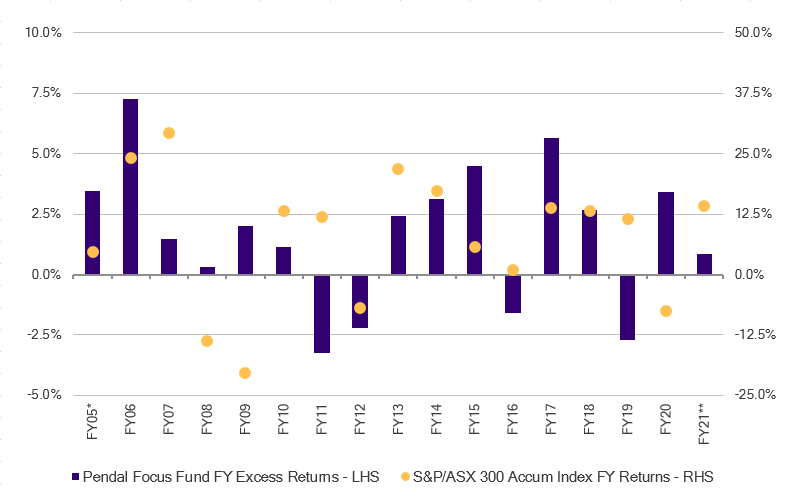
Crispin’s Pendal Focus Australian Share Fund has beaten the benchmark in 12 years of its 16-year history (after fees), across a range of market conditions , as this graph shows:
Pendal is an independent, global investment management business focused on delivering superior investment returns for our clients through active management.
Which emerging markets have the fiscal firepower and structural advantages to benefit from the next phase of the global recovery?
James Syme (pictured), co-manager of Pendal’s Global Emerging Markets Opportunities Fund, shares his insights in a new Pendal webinar. This is a summary of the webinar.
- Watch: View James Syme’s Emerging Markets webinar (18 mins, registration required)
- Presentation: Download the webinar presentation (pdf)
- Brochure: Download a Pendal Global Emerging Markets Opportunities fund brochure (pdf)
- Web page: Visit the Pendal Global Emerging Markets Opportunities fund web page
EMERGING MARKETS are at an historic inflection point as the US dollar begins to reverse a decade of strength, setting the scene for a strong rally in regional equity markets.
The US dollar is the currency of choice for at least half of all international trade invoices — around five times greater than the US share in imports — giving the dollar an out-sized role in the global economy.
This means emerging markets are highly sensitive to movements in the US currency, London-based senior fund manager James Syme tells clients in a new webinar. Syme co-manages Pendal’s Global Emerging Markets Opportunities strategy with Paul Wimborne.
“Periods of dollar weakness have led to the great economic market booms in emerging markets,” Syme says in the webinar. “Dollar strength has led to some great stresses in parts of the emerging world.”
The US dollar has been strong since 2011, putting significant stress on parts of the emerging world. But from last year, it has started to enter a period of weakness.

In strong dollar environments since 1989, investors in emerging markets equities have, on average, lost money, Syme says.
“In contrast, the annualised equity return in US dollars since 1989 in weak dollar environments is nearly 27% per year.
“It’s a pattern that still exists – in the last eight months of 2020 with a weaker dollar, emerging markets as an asset class rallied over 40 per cent.”
Still, Syme suggests investors should use care when selecting emerging market investments and should take a genuinely diversified, selective approach to asset selection.
Types of Emerging markets
Syme divides emerging markets into three broad groups:
- High current account deficit markets with high sensitivity to the US dollar like much of Latin America, South Africa and Russia
- Countries with strong domestic demand that are less exposed to the global economic cycle like India and south east Asia
- Current account surplus manufacturing exporters like China, Korea and Taiwan that are significantly exposed to the global economic cycle.
“A genuinely diversified portfolio would contain some exposure to each group but would still have the opportunity to be highly selective,” he says.
Syme cautions that the major indexes may not offer investors true diversification as they become dominated by the mega-cap tech stocks of the region.
Four mega-cap tech stocks – China’s Alibaba and Tencent, Taiwan Semiconductor Manufacturing Company and Korea’s Samsung Electronics – now make up 21.3 per cent of the MSCI Emerging Markets Index.
Many emerging market funds hold all four of the mega-caps, concentrating risk and lifting exposure to China where he is becoming more cautious on the outlook.
China’s regulatory crackdown on Alibaba in late 2020 has the potential to affect the whole sector while US government restrictions are creating a tricky investment environment for Chinese state-owned enterprises.
Taiwan and Korea have much better fundamentals with strong operating conditions, but valuations are starting to look stretched in some parts of the market, particularly in Taiwan.
“If we use consensus earnings estimates as a marker of recovery … we can see strong recoveries in Korea and Taiwan as well as the clear signs of a slowdown in China,” he says.
Recovery in India
Elsewhere, India enjoyed the shallowest earnings downturn in the region during COVID and is experiencing a powerful recovery, Syme says.
“We also know that India has some of the best prospects for coronavirus vaccination. It is the world’s largest exporter of pharmaceuticals and is gearing up for a very significant vaccination program. India is one of our favourite emerging markets.”
South east Asia is suffering from the tourism downturn and the commodity sectors have not made up the shortfall.
On the contrary, the macroeconomic environment is very supportive of the big emerging markets commodity exporters like Brazil, Mexico and South Africa.
“Support for exports from terms of trade, mostly driven by commodity prices and the resulting strong trade balances, suggest that currencies are cheap and that the recoveries we’re seeing in domestic demand could be quite sustained for a long period of time,” he says.
“There is also significant potential for positive earnings revisions, which would therefore have the potential to lift those equity markets.
“These are very positive macro attributes that we think have been ignored by many investors in emerging markets, who have been focused on the large cap tech space.”
James Syme is a senior portfolio manager and co-manager of Pendal’s Global Emerging Markets Opportunities fund.
Find out more about the fund HERE.
Pendal is an independent, global investment management business focused on delivering superior investment returns for our clients through active management.
Here’s what’s driving Australian equities this week according to Pendal’s head of equities Crispin Murray (pictured above). Reported by portfolio specialist Chris Adams.
Find out about Pendal’s Australian share funds here.
RISING bond yields last week reflected concerns about inflation. In equities, higher yields saw a rotation away from growth and defensives to financials and resources.
News flow was driven mainly by reporting season. In aggregate, results were better than expected for the banks, resource companies and a number of industrials. However this was not reflected in the S&P/ASX 300’s muted reaction (+0.01%). This is tied to the market’s strength going into reporting season, as well as the headwind of rising bonds.
Ultimately we believe there is a strong chance that decent earnings, more stimulus and pent-up demand following the vaccine rollout will underpin and drive markets further following some consolidation.
Covid and vaccines
New daily cases and hospitalisation rates continue to fall in the US, UK and Europe. Vaccination rates stalled a little, due to poor weather. With the involvement of pharmacies it is possible to see vaccinations in the US continue to accelerate into Spring.
Economics and market
We finally saw a crack in the bond market with sentiment around vaccines improving, cases continuing to fall, increased fiscal stimulus size increasing and central banks determined to hose down any suggestions of tightening. Ten-year government yields backed up 13bp in the US and 21bp in Australia as inflation risks were priced in.
Interestingly, this move in yields is more linked to rising real yields. This suggests the market is questioning the Fed’s resolve to maintain its commitment to current rate settings in the face of huge fiscal stimulus.
So far there is no sign of the Fed feeling the need to react and buy bonds. Equities have also absorbed the move well, credit spreads are stable and liquidity remains plentiful. A steeper yield curve is also good for banks and ultimately will encourage credit growth.
The usual flow-on effects occurred, with a rotation to value (notably financials) and growth underperforming. Traditional defensives such as utilities and consumer defensives were worst hit.
Commodity prices rose after the Lunar New Year. Oil stalled with the Texas freeze supporting prices, but was offset by signs Saudi may ease up on supply restrictions.
There were potential early signs of sentiment rolling over towards some recent pockets of excess such as IPO ETFs, Tesla and renewable energy ETFs. Bitcoin, however, surged onwards.
Results summary
Overall reporting season has been good so far, with strong free cash flow generation and positive momentum on earnings. So far consensus EPS expectations are up 5.3% from last month (+2.4% ex-resources).
Good results
The banks delivered surprisingly good results. Westpac (WBC, +8.8%), ANZ (ANZ, +7.2%) and Bendigo Bank (BEN, +5.7%) all reported bad and doubtful debts (BDDs) were falling away – particularly so at WBC. More importantly better margin performance — driven by the deposit side — lifted pre-provision profits forecasts about 5% and out-year earnings some 10%+. ANZ and WBC are our preferred exposures: they sit at big valuation discounts to Commonwealth Bank (CBA, -5%) and National Australia Bank (NAB, +0.7%).
BHP (BHP, +5.8%) and Rio Tinto (RIO, +5.0%) delivered solid operational results. Stronger prices saw an uplift from their copper divisions. Cash flow was through the roof and management are returning it to shareholders. Both companies surprised on the upside in terms of dividends. BHP’s, for example, was up 55% on the same half last year. Both companies are likely to yield in the 7-8% range.
Fortescue Metals (FMG, +0.6%) also delivered strong cash flow and dividends — its interim yield was almost 6%. But the attention was focused on the immediate departure of several managers and slashed bonuses for a couple more, including the CEO. This was related to a delay and $400 million (15%) increase in cost of the Ironbridge development. The sanctions appear to be related to concerns over how senior managers have been focused on the issue – and how it has been communicated internally — rather than indicating a more serious problem. We are mindful of keeping watch on FMG’s future investment program. The company is suggesting that up to 10% of profits will be channelled into renewable energy and green hydrogen investments. This is a lot of money at current iron ore prices and investors will need to make sure this capital is used productively.
Domino’s Pizza (DMP, +12%) was the strongest performer in the ASX100. Covid provided a tailwind for its European and Japanese businesses in particular. Its business model has a circularity — more profit growth enables faster franchisee store roll-out.
Tabcorp’s (TAH, +3.4%) earnings came in about 5% above expectations due to strength in lotteries. The wagering turnover was reasonable, growing 5%, but yields were a bit light. This highlights continued competitive pressure in the segment. The market remains focused on the price they may be able to extract from suitors for their wagering business.
Treasury Wines (TWE, +10.2%) delivered good performance in the parts of its market unaffected by trade disputes. Cash flow was good and management were able to demonstrate how they are reallocating wine away from China without hurting their margin. This was a better outcome than many expected, but the company still has a long way to go to.
JB Hi-Fi (JBH, -2.3%) continues to see strong sales growth in 2021, in stark contrast to trends at Coles (see below). In January JB Hi-Fi Australia enjoyed 18.6% sales growth versus the same month last year, while the Good Guys was up 14.4%. At this point, pent-up demand appears to be still be coming through in consumer electronics.
Cochlear (COH, +7.4%) is seeing a quicker return to normality than expected. While Q1 sales fell 8%, they rose 7% in Q2. There are signs the company is winning market share.
Goodman (GMG,-4.1%) delivered a good result and earnings upgrade. But expectations were high heading into the result and the stock got caught in a rotation away from growth and defensives.
Mixed results
CSL (CSL, -0.8%) delivered a very strong first half. The company is not yet seeing the impact of plasma collection issues from last year. But management were particularly cautious on the next two halves, before signalling a strong recovery beyond that. Recent performance suggests the market looks like it hasn’t the patience to wait near term, given funding needs to raise weights in resources and banks. Looking through the near-term supply challenge, we continue to see strong growth in demand.
As always QBE (QBE, +3.8%) was complicated. Recent provision top-ups remain an issue in the near term. But the company is seeing the benefits of accumulated premium growth which suggests decent margin improvement next year and double-digit top-line growth. As long as provisions remain under control QBE could be heading into a sweet spot for the next few years.
Star Entertainment (SGR, +0.3%) and Crown (+3.6%) remain disrupted by lockdowns and restrictions, though these are easing. Management have taken out costs and both are at the end of an extended period of capex spend, so becoming more interesting. The key risk is a regulatory burden that is more onerous than expected. On this front the disappearance of overseas VIP as a profit source is positive.
Origin Energy (ORG, +2%) told a tale of two very divergent businesses. Its LNG division is benefitting from higher prices and lower costs, generating a lot of cash flow. However it energy markets business is under enormous pressure from falling prices, which are not being fully offset by costs.
Disappointing
Gold stocks were hit hard on the rise in real yields and were the market’s worst performers. This was not helped by poor communication from Evolution (EVN, -10.6%) on development of its recently acquired Red Lake mine.
Coles (COL, -9.6%) disappointed. Like-for-like sales growth slowed to 3.3% in the first six weeks of 2021 – sooner than most expected. There is a positive read-through for our preferred position in Metcash (MTS, -4.6%). COL management called out their large CBD stores as the key source of weakness. In contrast, regional and convenience-style stores continue to do well. This is helpful for MTS’s IGA franchise.
Crispin Murray is Pendal’s Head of Equities. He has more than 27 years of investment experience and a strong track record leading Australian and European equities funds.
Crispin manages a number of our flagship funds along with one of the largest equities teams in Australia.
Pendal is an independent, global investment management business focused on delivering superior investment returns for our clients through active management.