
Here’s the latest outlook for Australian equities from Pendal’s head of equities Crispin Murray (pictured above). Reported by portfolio specialist Chris Adams.
FEARS of a second wave of infections are weighing on markets. This pushed the S&P/ ASX 300 down -0.74% last week.
We are at a critical point in this regard. The next week or two will reveal if the US rise in cases will lead to a surge in hospitalisations, stress on intensive care units and deaths. This is a heightened and material risk with important ramifications for market confidence.
However it is not a foregone conclusion — for reasons discussed below.
The economic data remains supportive and the policy response remains robust. There is political will to do more if needed.
At this point we do not expect recent weakness to morph into a second sharp drop in markets:
-
-
- We believe sufficient measures are underway or will be taken to avoid the resurgence in US cases from triggering material new shutdowns, which would see a big hit to confidence. However this remains a key risk.
- The Victorian outbreak should be containable. While delaying border re-opening it does not represent a significant deterioration in the economic outlook.
- The current case rise will likely cement the need for more stimulus in US and Australia
- Economic momentum is still positive
- Significant liquidity remains on the sidelines in cash, which can support equity markets
-
That said, we expect this period of consolidation to continue. The rate of improvement in economic data will now slow down, the market’s short-term positioning remains too bullish and policy news flow is in a lull to the end of July.
COVID-19 outlook
While second-wave clusters in China and Germany appear contained, cases continue to rise in the US.
This alone is not causing economic issues. But there are fears of a re-run of March/April, with cases leading to stress in hospitals and ICUs and a surge in deaths. This would likely be a material set-back for market sentiment.
Hospitalisation and mortality data in the next week or two are critical for how the market will trade in coming months.
As China and Germany have demonstrated, a replay of April — in terms of case-loads, hospitalisations and mortality —is not a foregone conclusion. Today’s situation is different in several important ways:
-
-
- The outbreaks are in less densely populated areas compared to New York
- The age profile of new cases is a lot lower this time — an average of 20 years younger.
- There is substantially more testing. This may result in worse-looking numbers. But it means the problem is being identified earlier than in April
- There is more physical distancing and use of face masks — despite well-publicised incidents to the contrary.
- Knowledge of how to treat the virus is now far better. Previous treatment had focused on lung issues, which are now thought to be symptomatic in nature. Treatment is now focused on anti-inflammatories, with better outcomes as a result.
-
We continue to monitor key US data points.
At this point we don’t believe it will escalate to levels seen in New York several months ago. However this cannot be ruled out. Material risks remain in play. Our portfolio continues to reflect a range of possible outcomes.
One silver lining to the US surge is a strong, continuing focus on vaccine development. Pfizer’s CEO alluded to the possibility of a vaccine being available this year. Results of a 30,000-person trial are due in September. If successful he suggested 100 million doses might be available this year, growing to 1 billion in 2021.
Economic data
Economic data remains broadly supportive, off-setting negative news on case-loads.
Last week’s Purchasing Manager’s Indices — PMIs are a leading indicator of economic momentum — showed a sharp rebound from earlier depths.
Credit card data also suggests consumption continues to rebound. Government payments have prompted savings rates to surge. In combination with pent-up demand this can help support higher consumer demand.

Recent data suggests the Australia’s GDP has fallen about 4% from its pre-pandemic level, placing it among the least-affected nations. It is interesting to note China and Sweden have also fared better than most, given the very different approaches taken by all three countries.
Impact on the US is estimated at about 6.5%. GDP expectations have also been improving in recent weeks.
Fed balance sheet
There have been some concerns about the Fed shrinking its balance sheet and the implications for liquidity.
We do not think this should be interpreted as a signal of Fed tightening. Rather, we think it reflects reduced risk aversion from foreign central banks as they run down their swap lines.
The Fed balance sheet can be looked at in three ways:
-
-
- The Quantitative Easing portfolio: This is unchanged. The Fed continues to buy US$80 billion in Treasuries and US$40 billion in mortgage-backed securities per month.
- The liquidity programs: The FX swaps provided to foreign central banks to ensure they could access US dollars reached US$450 billion at the peak of crisis. This is now down to US$275 billion as USD funding issues have eased.
- Direct credit programs — primary and secondary market corporate credit facilities: These are ramping up more slowly than planned. There has been US$10 billion provided so far, mainly into the secondary program (ie credit ETFs). Part of this is the complexity of getting program running. Also, the availability of credit has not proven to be as big an issue as many feared. The market has seen record levels of credit issuance in recent weeks.
-
While there are a lot of moving parts, we still see at least US$1 trillion in liquidity to be added by the end of 2020 — and a commitment to keep adding potentially $1.5 trillion next year.
Markets
Equities have sold off and sentiment has shifted negatively. But there has been no breakdown in other key indicators we are watching.
US 2-year yields remain flat, oil rose 5%, the EUR/USD was only up 1%, gold was only up 2% and the copper/gold price ratio held firm. Credit spreads widened — but not outside recent ranges.
At this point it still feels like a market consolidation rather than a reversal and a new phase of crisis. But a lot will come down to hospitalisations in coming weeks.
Crispin Murray is Pendal’s Head of Equities. He has more than 27 years of investment experience and a strong track record leading Australian and European equities funds. He manages a number of our flagship funds along with one of the largest equities teams in Australia.
Pendal is an independent, global investment management business focused on delivering superior investment returns for our clients through active management.
Find out more about our investment capabilities:
https://www.pendalgroup.com/about/investment-capabilities
Contact a Pendal key account manager:
https://www.pendalgroup.com/about/our-people/sales-team/
Important Updates
Pendal Dynamic Income Fund (APIR: BTA8657AU, ARSN 622 750 734)
Pendal Enhanced Credit Fund (APIR: RFA0100AU, ARSN 089 937 815)
Pendal Fixed Interest Fund (APIR: RFA0813AU, ARSN 089 939 542)
Pendal MicroCap Opportunities Fund (APIR: RFA0061AU, ARSN 118 585 354)
Pendal Monthly Income Plus Fund (APIR: BTA0318AU, ARSN 137 707 996)
Pendal Sustainable Australian Fixed Interest Fund (APIR: BTA0507AU, ARSN 612 664 730)
Effective 30 June 2020, prior notice will no longer be provided in the event of a material increase to the buy-sell spreads of the above mentioned funds (Funds). Section 6, ‘Fees and costs’, of the PDS of the Funds has been updated to reflect these changes.
The buy-sell spread is an additional cost to you and is generally incurred whenever you invest in a Fund. The buy-sell spread is retained by the Fund (it is not a fee paid to us) and represents a contribution to the transaction costs incurred by the Fund such as brokerage and stamp duty, when the Fund is purchasing and selling assets as a result of applications to or redemptions from the Fund. The buy-sell spread also reflects the market impact of buying and selling the underlying securities in the market.
During periods of heightened volatility, as experienced during the COVID-19 pandemic, the cost of buying and selling securities can increase significantly, and suddenly. As a result, a Fund’s buy-sell spread may need to be adjusted to reflect the increase in transaction costs at short notice. This is to ensure all unit holders are treated fairly by attributing the costs of trading securities to those unit holders who are buying and selling units in a Fund.
You should review current buy-sell spread information before making a decision to invest or withdraw from a Fund. Please refer to our website www.pendalgroup.com and click ‘Products’ for the latest buy-sell spread for each of the Funds.
What is the role of fixed income in a portfolio right now? Pendal portfolio manager Amy Xie Patrick explains here and outlines the team’s strategy for its Dynamic Income Fund.
Watch the video above or read the transcript below.
TRANSCRIPT
What is the role of fixed income in a portfolio?
Fixed interest has two main roles in the portfolio: to provide diversification and generate income. Now, with diversification, let’s face it, nobody likes to see one part of their portfolio fall, even though other parts of their portfolio, maybe rising. But we all need some portion of our portfolio to be defensive in times of market stress.
And that’s what we really mean when we talk about diversification. Interest rates exposure, through high-quality government bonds, provides this kind of defensiveness.
The Pendal Dynamic Income fund seeks primarily to play the role of income through maintaining an ability to shift between asset classes — some that are income and risk-seeking, such as investment-grade credit and emerging markets; and others that are more defensive such as government bonds.
As a result, it is a much more defensive product, than most high yield or hybrid funds, but is unlikely to provide the same degree of shelter and crisis liquidity as composite cell products, such as the Pendal Fixed Interest fund.

Why has Pendal’s Dynamic Income Fund experienced a faster recovery?
The Dynamic Income Fund benefits from tried-and-tested design, where we have focused on switching off the riskiest piece quickly and efficiently. For this fund, this is emerging market sovereigns. As risks mounted earlier this year, we made two key asset allocation decisions.
The first was to reduce emerging market risk from 25% to almost zero in just a matter of days. Had this portfolio been a quarter exposed to offshore high yield bonds or Australian hybrids, this kind of de-risking simply could not have happened as market liquidity dried up.
Although the fund suffered losses over this period, our swift de-risking out of Emerging Markets (EM), meant that we avoided the worst of those losses. And more importantly, it allowed us to add back some of that exposure at much better levels during April.
The second was increasing our government bond exposure.
The market continues to doubt government bonds because yields are so low. But time and again, they proved themselves to be defensive when things go awry.
Our decision to add here generated positive returns at the height of the crisis. But our decision to pull back our exposure since then has allowed us to book some of those gains. It’s just precisely this active asset allocation approach that has driven the strong recovery of this Fund over the last two months.
What is the most supportive environment for the fund?
The fund relies on Australian investment-grade credit as its core income engine. While less defensive than government bonds, it is far better at generating income, which is important in a world where interest rates are going to be glued to the floor for some time.
Also unlike equities, a slow-growth environment is actually quite supportive for investment-grade bonds, because corporates choose balance sheet repair over aggressive expansion, and investors flocked to the asset class in search of yield.
As for emerging markets, this is likely to do well as long as the recovery continues, at whatever pace. Especially so considering the extreme levels to which emerging markets had sold off during the crisis.
And unlike most composites style funds, this fund has the ability to tolerate a much wider range of interest rate scenarios because we can choose to hold no government bond exposure whatsoever, should we feel that a significant rise in interest rates is around the corner.
Most importantly, this fund has the room to top up on income-generating potential, which can take the portfolio’s yield to close to 4%.
This is not to be sniffed at considering that term deposits can’t even pay close to 1%.
Amy Xie Patrick is a portfolio manager with Pendal’s Bond, Income and Defensive Strategies team.
Pendal is an independent, global investment management business focused on delivering superior investment returns for our clients through active management.
Find out more about our investment capabilities:
https://www.pendalgroup.com/about/investment-capabilities
Contact a Pendal key account manager:
PENDAL is placing higher importance on sustainability factors in its Multi-Asset Target Return Fund amid growing need for liquid sustainable alternative assets in balanced portfolios.
Watch a short video above to hear our Head of Multi-Asset Michael Blayney explain the move.
PENDAL is increasing consideration of sustainability factors within the existing investment process of its Multi-Asset Target Return Fund, in response to the growing need for liquid sustainable alternative assets in balanced portfolios.
Pendal’s Multi-Asset team collaborated with Regnan — Pendal’s in-house ESG research, advisory, and engagement firm — to examine the impact of a stronger focus on sustainability and ESG on risk-adjusted returns.
The research project was led by industry veteran Michael Blayney, who heads up Pendal’s Multi-Asset investment team.
“This is a first for a real return multi-asset fund in Australia and provides investors with more diverse options that factor in social and environmental outcomes over long term time horizons,” Mr Blayney said.
The fund aims to provide a return of 5 per cent per annum above the Australian Consumer Price Index (gross of fees and tax) over rolling five-year periods. There will be no change to this objective, or to the existing fee structure for clients.
The fund will continue to generate returns and reduce risk by blending a highly active asset allocation process with both active security selection and top-down relative value strategies. A greater focus on ESG and sustainability will underpin these sources of return.
A powerful combination of changes in consumer behaviour, stakeholder expectations, and regulatory intervention, we believe, will significantly influence earnings and asset prices across all asset classes in the next decade and beyond.
Of course, we have already seen ample research that shows the outperformance of stocks with stronger ESG credentials.
A landmark Oxford University research report identified a positive correlation between sustainability and good financial performance in 80 per cent of studies analysed.
“Our analysis found that negatively screened companies are in sectors more susceptible to adverse regulatory changes or the loss of a social licence to operate,” Mr Blayney said.
“Furthermore, we will favour sustainable implementation with positive impacts where possible.”
Sustainable investing has become the fastest-growing part of the investment management industry.
Pendal has offered sustainable diversified funds via its Sustainable Conservative and Sustainable Balanced Funds launched by the Bankers Trust group in 1984 as the BT Australia Charities Trust.
Since then we have continued to enhance our consideration of ESG issues, in both fundamental analysis as well as specific strategies.
“We see this type of fund transformation part of the new way of investing where you can target positive returns plus achieve better outcomes for society,” said Richard Brandweiner, CEO of Pendal Australia.
Michael Blayney leads Pendal’s Multi-Asset team.
Pendal is an independent, global investment management business focused on delivering superior investment returns for our clients through active management.
Find out more about our investment capabilities:
https://www.pendalgroup.com/about/investment-capabilities
Contact a Pendal key account manager:
How will the risk of a second wave of virus infections impact investors? Pendal’s Head of Bond, Income and Defensive Strategies Vimal Gor explains in a new video interview with online business channel Ausbiz.com.au.
Watch the video above or read the transcript below.
TRANSCRIPT
AUSBIZ.COM.AU INTERVIEWER: Vimal Gor is Head of Bond, Income and Defensive Strategies at Pendal, and he’s joining us live via Skype. Vimal, great to see you there again. Good to have you on Ausbiz. We have this very real risk of a second wave of COVID — some say still the first wave. Are you concerned that it seems the US Government is going with the Swedish approach — to just let it ride out?
VIMAL GOR: YesIf you look across the numbers coming out of the US, there’s a very strong bifurcation between the States that voted for Trump and the States have voted for Clinton. The Clinton States, obviously California, US, seeing their numbers fall quite markedly in line with a lot of the developed countries across the world.
And then you’ve got the other States, which were the Trump-voting States, which are the Midwest etc., where you’re seeing in the southeast the numbers pick up really quite materially. And I don’t know what the US does now because we haven’t got a vaccine, there’s, there’s no impetus or willingness to do further lockdowns.
And the numbers are picking up. I mean, what is the response for the countries, which can’t or won’t do lockdowns and no vaccines? I don’t see what the response is there. And this is going to be super interesting to watch this play out over the next few weeks.
INTERVIEWER: It’s pretty mind-blowing to think of the sheer number of Americans who have fallen victim to this pandemic. How do you, as an investor, gauge the psychological impact, the flow-on effects of a disaster of that magnitude?
VIMAL GOR: Yes, that’s a tough question. I’m coming to the view that there are two things that are kind of useless to look at right now, but take up a lot of time and effort. One is the COVID numbers, because absent an idea for how the response is going to be by the government, we don’t know what the impact is going to be on economic data.
And second is the underlying economic data by itself. The problem with the data right now is that the size of the moves we’re seeing are so large that they’re just unable to be comprehended in terms of what that means for the market.
So the way I generally approach this is, markets generally move in line with the economic cycle and the best way to determine what the economic cycle is, new orders to inventories ratios and PMI, because the manufacturing sector leads the US economy, even though consumption’s larger, consumption, kind of does this, whereas manufacturing does this.
And so it’s the one that leads the economy into and out of recessions. But the problem is the numbers are so large and swinging around so much that they’re kind of pointless. And also because the amount of liquidity that the central banks have flooded the system with, it means that there’s this growing divergence between the underlying economic data in the markets.
So the only thing you can look at to try and get a gauge on where the markets are going or determine what value is purely the central bank packages. And so then, we saw last week that they’re coming out and buying investment-grade credit bonds in the US now, even though they’re pretty much at their all-time highs.
It seems a bit silly, but that’s one thing they’re doing. So you’ve got a green light to buy as much as you can in that space. We talked about fallen angels in the high yield market last time. They very clearly want the equity market to go up, they very clearly want bond yields to stay low.
They’re pretty much supporting every asset market under the world. So what COVID does to the underlying economic data and what the underlying economic data means for the markets is kind of broken now. The markets, we talked about this last time, the market’s largely fixed. That’s the problem.
INTERVIEWER: So if we were to see a vaccine, if we really do see that next stage, are we expecting to see a further rally in equities, a further fall in bond prices? Is that how the markets would play out? Would they be rational?
VIMAL GOR: Yes, I think it’s definitely positive for equity markets and that if we were to see a vaccine that would be great. Yes, it would definitely lead to a strong rally in equity markets. But I don’t think bond yields will sell-off because the central bank very clearly doesn’t want bonds to sell-off.
And because we’ve seen a massive increase in total debt, whether that be a household, corporate or government debt across the world. They don’t want bond yields to sell-off, which slows the economy. So they will continue to hold bond yields down, equity markets would rally, and then ultimately you would expect there to be inflation. And that’s something that I think we need to get our heads around.
That we’ve been in a deflationary environment really since the 1980s. And at some point, given the amount of fiscal largesse we’re seeing, we will be shifting to an inflationary environment. It’s just a question of when and how quickly that happens.
INTERVIEWER: So Vimal if you’re going to be long bonds, what is your preferred exposure?
VIMAL GOR: Well the front ends everywhere a lot now, I still think they’re going to go to negative rates. But you can buy US 10-year Treasury at probably 70 basis points today. And I still think they’re probably going to go sub-zero, probably down to -1.
Now to put that in context, if they go from 70 to -1, you’ve probably got a 40% return on those. So there’s still a lot of money to be left in the bond markets, and therefore I don’t believe you should be underweight bonds.
I think you should be max long bonds at this juncture.
Vimal Gor leads Pendal’s Bond, Income and Defensive Strategies team.
Pendal is an independent, global investment management business focused on delivering superior investment returns for our clients through active management.
Find out more about our investment capabilities:
https://www.pendalgroup.com/about/investment-capabilities
Contact a Pendal key account manager:
Here’s the latest outlook for Australian equities from Pendal’s head of equities Crispin Murray (pictured above). Reported by portfolio specialist Chris Adams.
CONCERNS about a material second wave of COVID-19 infections have increased over the past week. This reflects a rise in cases in some parts of the US and other countries.
Here in Australia the spike in Victorian cases needs to be watched. Although small in number it may challenge the theory of a faster re-opening here.
The market rose +1.6% last week despite these issues emerging. This was driven by continued constructive economic data and optimism on further policy support. There was some rotation back to growth — the market sees value stocks more at risk in a potential second wave.
Second-wave risks
Concerns of a second wave are focused mainly on the US. However there are also clusters in Beijing, Germany, and an acceleration of cases in Latin America and India along with an increase in Victorian cases.
The issue from the market’s perspective is the degree to which this will impede the recovery. We think it unlikely the US will return to a broad lockdown, but targeted restrictions will limit some activity. The larger risk is the possible negative effect on consumer and business confidence.
This is a critical test of the US’s ability to absorb periodic increases in infections. If it can be managed, this may begin to build further confidence.
The headline numbers from the US are not encouraging. New daily cases have almost returned to where they were at the previous peak. The concern is this may lead to more hospitalisations, more stress on ICU units and more deaths.
Increases in US cases are concentrated in certain States. For example, Texas has seen cases double in the last few days while Florida is experiencing new daily cases at double the rate of its peak. Declines continue in north-eastern States that were hit hard earlier.
At this point hospitalisations are not picking up on a nationwide basis. The increases in Texas and Florida are not at concerning levels.
Since the previous peak a number of medical developments have emerged — notably awareness of the importance of anti-coagulants and steroids which can help reduce the severity of cases. ICU capacity has also increased.
The key issue to watch this week is whether the combination of much higher testing, physical distancing and better care prevents a significant escalation in severity.
While the uptick in Victorian cases is relatively small in number, it may be highly significant for the market. The consensus view is that disease has been successfully suppressed in Australia, which has led to a more optimistic view on the Australian economy relative to other countries.
If people start to expect restrictions around the country will remain in place longer than first thought, it will have a meaningful impact on market optimism and positioning within it.
Economy
Economic data remains constructive and is doing enough to offset burgeoning concerns over a second wave at this point.
Indicators out of the US remain strong. This partly reflects the fact that the north-eastern States so far avoiding a second wave make up a larger part of the economy than those facing the need for potential new restrictions.
Last week’s US retail sales data were better than expected. The Citi economic surprise index – which tracks the outcome of various data points versus expectations — is at its highest level in 18 years.
In Australia employment data was also better than expected. Monthly hours worked fell -10% from March, versus the -15% to -20% that the market had predicted.
Valuation versus liquidity
Liquidity is helping prop up the market despite more negative news – and is trumping concerns about near-term valuations.
The Fed and other central banks have pumped money into the system, most of which has found its way into cash and bonds.
This is reflected in the surge in FUM in retail money market funds. There has also been record issuance of investment-grade and high-yield bonds.
The overall market position has become more a neutral than a supporting factor. But it is far from a headwind. The liquidity program has allowed access to capital so companies can sort out their balance sheets and become more resilient.
Crispin Murray is Pendal’s Head of Equities. He has more than 27 years of investment experience and a strong track record leading Australian and European equities funds. He manages a number of our flagship funds along with one of the largest equities teams in Australia.
Pendal is an independent, global investment management business focused on delivering superior investment returns for our clients through active management.
Find out more about our investment capabilities:
https://www.pendalgroup.com/about/investment-capabilities
Contact a Pendal key account manager:
https://www.pendalgroup.com/about/our-people/sales-team/
What are the different ypes of sustainable investments, how did they develop and why are they growing so quickly? Pendal CEO Richard Brandweiner explains in this Lonsec webinar from June 10, 2020.
Watch the video above or read the transcript below.
RICHARD BRANDWEINER: Sustainability is a particularly relevant topic right now for many reasons.
This is not just because of what we’ve experienced recently through bushfires, floods, famine — and the perspective that the economy is intrinsically linked to these events and our behaviours.
But also because regulators around the world and people are starting to evolve and adapt and change.
Your clients — and yourselves — are starting to buy goods and services based not just on what a company does, but how they go about doing it.
These are fundamental shifts in our psyche that are underpinning a wholesale move towards greater thinking about how we invest.
I’d like to take you on the journey of how we’ve got here and how we’ve evolved in the investment profession from “ethical investing” all the way to “impact investing”.
Then I’ll give you some thoughts about how we at Pendal are adapting to that and have adapted to that over many years.
Then I’ll put that in perspective around the latest development — positive impact.
Ethical investing — where it started
This all really started years ago as ethical funds began to emerge in the 1980s and 1990s.
The idea of “ethical investing” then was very much about values. It was mainly church-based or faith-based groups investing in ways that were aligned with their moral code or their values.
It was really about screening: about not owning tobacco, not owning gaming, not owning other types of companies that do harm.
Externalities
This movement grew in the first part of the 2000s around the concept of “externalities”.
Externalities is an economic concept that refers to an activity’s second and third-order effects on the broader ecosystem.
It is best illustrated by an economic problem known as “the Tragedy of the Commons”, which was first talked about in the early 19th century by an English economist, William Forster Lloyd.
Lloyd observed that if I graze my cattle on common land, it’s in my interests to put more cattle on the land. But if everyone did that, acting in their own best interests, the external impact was the devastation of the land for everybody.
So there was a conflict between your internal motivations and what’s best for society — and ultimately for you in the long term.
Now we recognise pollution is an externality. We recognise supply chains generate externalities. Even employment generates externalities.
Little by little, as we became more sophisticated, we understood you could measure those externalities — and they weren’t free. The costs were borne by society.
As regulation evolved and as we became more aware of externalities, it became clear they ended up affecting your earnings over time — as regulations shifted or consumer demand changed.
And that ultimately leads to a change in your cost base.
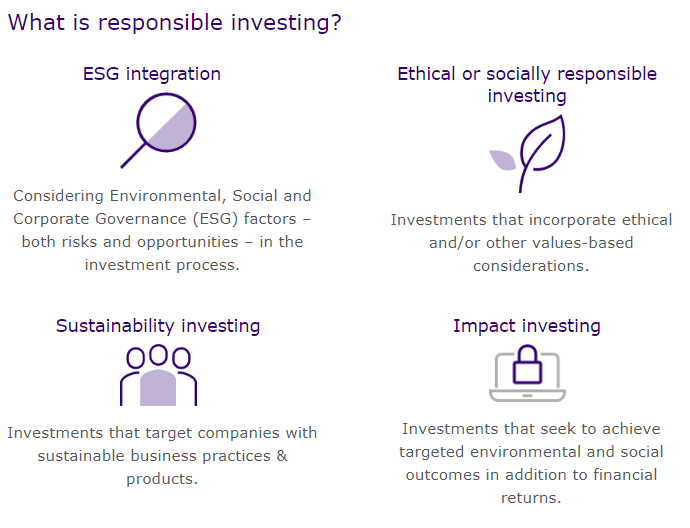
A good friend of mine from asset consultant Willis Towers Watson wrote a wonderful article that said “past performance is not even a good guide to past performance”.
What he means is the performance of stocks and securities over a period of time is not fully reflective of the true, intrinsic earnings of those companies — because they didn’t factor in a lot of the externalities those companies were generating.
A good example is tobacco.
Tobacco was the best-performing sector in the world over the last century. I don’t think that will be the case over the next century. But the reason why it performed so well in the past is that as a society we didn’t understand the externalities.
We didn’t understand the impact of the products being sold. We weren’t factoring that properly into an assessment of the companies.
Environmental, Social and Governance (ESG) factors
So the United Nations principles for Responsible Investments grew and the emphasis on this new idea of ESG — environmental, social and governance criteria — became an idea around long-term risk management.
ESG recognised that if these externalities are real — and if we expect over time they will be increasingly factored into the price of securities — then as investors we should start thinking about these factors now.
It wasn’t about values. It wasn’t about what you believe is right or is wrong. This evolution from ethical investing to ESG was in its early incarnation about long-term risk management of making an investment decision.
Sustainable investing
Then things evolved another step.
We recognised these externalities — these second and third-order impacts — were real. And as investors we recognised the potential to build portfolios in a way that was more sustainable and recognised the impact of these externalities.
We could build a “sustainable portfolio” that not only managed ESG risks and factored them into the pricing of securities. It could also bias a portfolio towards more sustainable companies or sectors over time.
Why might you do that? There are two reasons.
You might believe there’s an alpha source there. You might believe those sorts of companies will perform better over time.
As consumer behaviour changes, they’ll be more attracted to products and companies that are sustainable. Companies that are less sustainable will actually do worse over time.
The other reason is because you want your capital to be invested in positive ways.
This is happening more and more. Sustainable investing is one of the fastest-growing parts of the investment management universe.
About nine out of 10 Australians in recent Roy Morgan research have said they expect their investments to be managed in a sustainable way.
That is something we really can’t ignore.
Impact investing
But there’s a final step to this — and that is impact investing.
Impact investing not only recognises those externalities, it deliberately builds a portfolio targeting the creation of positive externalities.
It’s not simply asking: “is this a sustainable company in a sustainable industry?” It’s recognising a company can generate very positive and profound outcomes for the world.
Impact investing is about targeting those sorts of investments and then measuring the outcomes beyond the financial returns of the company.
Impact investing is the point of the arrow. This is the bit where we actually recognise that capital has real power and that all of us — financial advisors, fund managers, asset owners — are in a very unique position.
We are in a position of responsibility. A position to operate as fiduciaries recognising the way we invest matters.
There is a purpose to our financial system. The purpose is not money in its own right. It’s not an end in of itself.
The purpose is to channel capital towards productive enterprise and to create our future.
There’s about $130 trillion globally that sits in pension funds, super funds, sovereign wealth funds advised by financial advisors, fund managers, insurance companies. That’s almost twice the value of annual global GDP.
The way that money is invested will help shape the world that your clients and you and me will retire into.
That makes impact investing hugely important for us as fiduciaries, advisors and allocators of capital.
This is about our growth as investors — as humans recognising the world is not two-dimensional. It is a complex, adaptive system.
The third axis
We can think of this as the third axis of investing.
In the beginning there was one axis — returns. Back in the 1940s and 1950s we really only spoke to our clients about the returns we generated.
Then with modern portfolio theory the idea of risk emerged and we had two axes — risk and return.
Today it seems like madness to think about return without understanding the risk we’re taking to get that return. But it was always there — we just didn’t measure it.
Now we realise there is a third axis — the impact of the investment or the company or government we are lending money to.
Again — the third axis was always there. We just didn’t measure it like we are starting to do now.
Pendal and Regnan
We helped found an organisation called Regnan, which is now one of the leading ESG research and engagement providers in Australia.
Regnan’s business originated with work done in conjunction with Monash University in Melbourne in the 1990s to think about the impact of environmental change on company earnings.
Recently, Pendal bought out our other Regnan partners to bring it a lot closer to our investment decision-making.
We’re now using Regnan to grow the impact investing space.
We recently launched a product called the Regnan Credit Impact fund, which lends money to investment-grade borrowers, governments, super nationals and corporates for green and social bonds. Then we measure the outcomes of all that lending.
Even at launch with a small initial seeding of $30 million, the fund is already taking something like 13,000 tons of carbon dioxide out of the atmosphere on an annual basis.
It’s restored 60 hectares of forests.
It’s generated 16,000 megawatts of renewable energy a year.
It’s provided 340 jobs.
It’s created 50 loans to female-owned small enterprises.
And all of that with high-quality, investment grade credit paying strong returns.
So you’re getting liquidity and high-quality, investment-grade credit. And at the same time these externalities are being measured and targeted.
For us, that’s a huge leap.
Pendal sustainable funds
Pendal offers a range of sustainable products across different asset classes. We have been doing this for a long time and they are well-rated.
- Pendal Sustainable Balanced – Est. 1984 – Diversified/Multi-Asset
- Pendal Sustainable Conservative – Est. 1989 – Diversified/Multi-Asset
- Pendal Ethical Share – Est. 2001 – Australian Equities
- Pendal Sustainable Australian Share – Est. 2001 – Australian Equities
- Pendal Sustainable Australian Fixed Interest – Est. 2016 – Australian Fixed Income
- Pendal Sustainable International Fixed Interest – Est. 2016 – International Fixed Income
- Pendal Sustainable International Share – Est. 2016 – International Equities
- Pendal Sustainable Future Australian Shares SMA – Est. 2018 – Australian Equities
Regnan funds
This year we are launching high-impact investment strategies globally under our Regnan brand:
- Regnan Credit Impact Trust – Est.2020 – Australian Fixed Income
- Regnan Global Equity Income Solutions – To be launched in late 2020 – Global Equities
Richard Brandweiner is Pendal’s Chief Executive Officer, Australia. Richard has more than 20 years of experience in investment management and is responsible for the Australian arm of Pendal Group, including asset management, operations, sales and marketing.
Pendal is an independent, global investment management business focused on delivering superior investment returns for our clients through active management.
Find out more about our investment capabilities:
https://www.pendalgroup.com/about/investment-capabilities
Contact a Pendal key account manager:
https://www.pendalgroup.com/about/our-people/sales-team/
Murray Ackman, Anna Hong and Thomas Ciszewski (l-r) have joined Pendal’s Bond, Income and Defensive Strategies team
PENDAL’s Bond, Income and Defensive Strategies team is excited to share details of three new appointments and a promotion.
The new hires will focus on areas of growth in the boutique and support our ambition to be a leader in Environmental, Social and Governance (ESG) fixed income investing while providing objective-based income solutions and defensive strategies.
Assistant Portfolio Manager
Oliver Ge, a portfolio analyst who has been with the team for six years, has been promoted to Assistant Portfolio Manager in recognition of his increased experience and responsibilities.
Volatility Analyst
Thomas Ciszewski has been appointed a Volatility Analyst. He will work on the Active Long Volatility Strategy Fund as well as structuring defensive strategies across a range of funds. Tom joins us from SouthPeak Investment Management where he successfully implemented volatility risk premia and delta one strategies. Prior to this Tom held a number of positions in a trading capacity for Deutsche Bank in Hong Kong and Sydney, managing global equity derivatives, delta one, ETF and cash facilitation trading teams.
Tom has also worked in Chicago for Actis Capital as an equity options Volatility Portfolio Manager. He holds a Master of Applied Finance with a focus in derivatives valuation, exotic options and risk and portfolio management from Macquarie University, Sydney. He also has a Bachelor of Arts in Economics and Business Administration from the University of Vanderbilt, Nashville.
Assistant Portfolio Manager
Anna Hong is joining the team as an Assistant Portfolio Manager working on the Australian Composite and Cash Funds. She is currently a Portfolio Manager at Uniting Ethical Investors for their enhanced cash and fixed income funds. Prior to this Anna held positions at BlackRock and Challenger and was responsible for investment analytics and quantitative solutions. Anna holds a Master of Business Finance from the University of Technology, Sydney and a Bachelor of Science in Mathematics from the University of New South Wales.
Credit/ESG Analyst
Murray Ackman has been hired into the team as an ESG Credit Analyst. He will work across our range of credit funds with a particular emphasis on Pendal’s new Credit Impact Fund (CRIMP). Most recently Murray worked as an independent consultant for Australian private equity firms reporting on ESG measurements of Australian companies with less than $1 billion market cap.
Prior to this Murray was a Research Fellow at the Institute for Economics and Peace where he led research for the Institute on SDGs, violent extremism and engagement with business which included projects determining the strategic priorities and direction of clients such as UNDP and the OECD. Murray holds a Bachelor of Arts in Politics and International Relations, a First Class Honours degree and a Bachelor of Law specialised in International Law from the University of New South Wales.
Finally, Arpit Mathur, one of our quantitative analysts, has resigned to join a friend’s business. We wish him well for his next role and thank him for his contribution and the hard work he has given Pendal.
Pendal is an independent, global investment management business focused on delivering superior investment returns for our clients through active management.
Find out more about our investment capabilities:
https://www.pendalgroup.com/about/investment-capabilities
Contact a Pendal key account manager:
https://www.pendalgroup.com/about/our-people/sales-team/
How will the journey from deflation to inflation impact portfolio construction, defensiveness and income in this zero-rate world?
On May 28, 2020, Pendal’s Head of Bond, Income and Defensive Strategies Vimal Gor and senior team members Amy Xie Patrick and Tim Hext and outlined the implications for investors in their half-yearly “Lighthouse Series” live webinar.
This is a recording of Amy’s presentation which addresses fixed income investing in a zero-rate world.
Watch the video above or read the transcript below.
This presentation will focus on what bonds are supposed to do in your portfolio.
What do we want from our fixed income portfolios and how do we make sure that in this disappearing yield world, your fixed income allocation is still able to do the jobs that you need it to do?
Looking at the chart below, this really is what underlies the income problem we are all having.
What we’ve shown here is starting yield at the beginning of every crisis you’ve had since the tech crash in 2002.

In the yellow bar is the starting yield in Australian government bonds. The 10-year part of the curve.
In the purple is the US. Obviously what happens in Australian yields is governed quite a lot by what goes on off shore as well.
Now, time and time again, and especially in the more recent crises, you’ve seen that all these yields have come down and it’s a structural trend that’s been happening for a long time.
But what it means is that at the beginning of every crisis, we’ve got seemingly less and less room to play with.
So a lot of investors that we’ve spoken with, not just over this most recent period, although this most recent period has clearly accelerated things further, but over the last three, four, five downmarket cycles in equities, what use really is bonds to me, when yields are this low? Can bonds still be defensive?
And the answer to this is, even through that period in 2018, when the Fed was incredibly belligerent about that hiking cycle, when push came to shove, when you saw stress in the equity markets that negative correlation still comes through.
But what’s really obvious at these very low yields is that there’s just a glaring asymmetry in terms of where yields can go. Not to say that we don’t think they can go into negative territory.
Quite clearly they have gone into negative territory in certain parts of the world, but with yields being quite so low, what we say is that now more than ever, you need your fixed income allocation to be constructed in a very active way.
Active not only in terms of the direction that you face, and whether you’re long or short bonds, but also active in the way that you think about your overall fixed income portfolio composition as well.
Now, as yields have come all the way down, the role of fixed income is to be a defensive part of your portfolio, but it’s also supposed to generate income, because led by risk-free yields, income levels have been coming down across the world, what you’ve seen is our response to it, which has facilitated this to happen.
The chart bellows illustrates the growth in global debt, that’s been issued mostly by way of bonds through a multiple of different sectors.
As you can see, post the GFC debt was growing all over the world anyway, during the GFC, but post the GFC, you had a massive shift down in global rates equilibrium.

And all of a sudden, you had this massive savings glut.
It’s normal to see savings books come out at the end of every crisis, every pandemic, and every war.
And so all of these were looking for yield and income — at first relatively safe and good yield and income, but eventually as yields continue to fall, we look for more and more.
Most of this debt expansion in the world has been taken up by corporates, not so much government debt.
Government debt has obviously grown as well, but a lot of the growth in bonds and bond debt that we’ve seen in the world has essentially been us investors saying to these corporates, please give us more. Please issue more and more because we have certain return targets, we have certain income targets.
If it means that we need to be holding less high quality portfolios, if it means that we need to reach further out on that liquidity and that risk curve, then so be it.
Probably for most investors that consideration of having gone down the quality spectrum, isn’t front and centre in their minds, because that is buying the overall return hurdle or that overall yield hurdle has been front of mind.
A key problem with the way that fixed income portfolios shifted in the pre versus post GFC era. In the pre GFC era fixed income was largely considered to be a purer asset class. The dominant sub asset class of your fixed income piece was really high quality government bonds.
But obviously as yields continue to drift lower, they don’t offer you enough income. They don’t offer you enough yield. So you reach further and further up the curve and off shore, especially what you’re seen is that investment grade no longer is synonymous with that same high level of quality that you used to see before the GFC era.
Now that means a very important key difference in terms of the way your fixed income portfolio behaves. In the pre GFC era when investment grade as an asset class was truly viewed as quite a safe haven asset class. What you saw in times of equity market stress was slightly negative correlation to equity markets.
So investment grade belonged with that high-quality government bucket in terms of offering that safe haven portfolio, that safe haven allocation. But now, as we have seen, these investment grade entities become victim to this quality drift, this ratings drift down the quality spectrum.
In the post-GFC era, what you get with investment grade credit is actually positive equity beta, and on top of this, what a lot of global asset managers also been happy to do is to harvest more carry, more yield, more return in their portfolios, by sacrificing liquidity in those portfolios.
Here on this chart, what we show you is that both in equities portfolios in the yellow line and your bond portfolios, asset managers have generally not prioritised liquidity. Apart from when the crisis hits like the GFC you can see in the purple line all of a sudden managers go to the defensive part of the portfolio, that fixed income part of the portfolio, looking for liquidity.
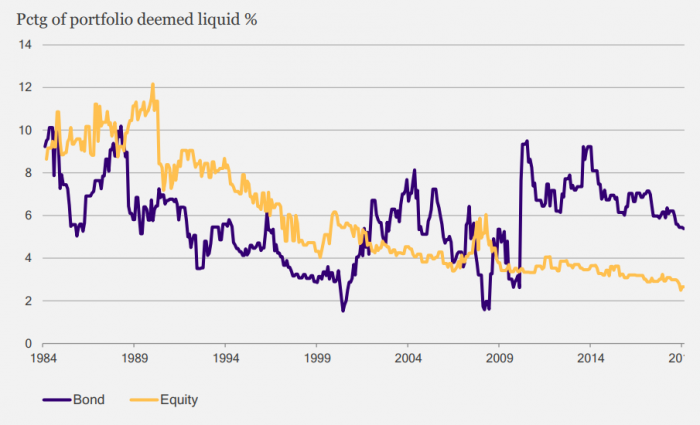
And it’s not there.
It’s a wake-up call to go back and restore liquidity in that part of their portfolio. But again, since that crisis was a long time ago, this longer term trend of wanting to sacrifice not only quality, but also liquidity in their portfolios, has polluted traditional fixed income allocations with more and more problems as time goes on.
Now, all of these problems with going down the quality curve, and going up the liquidity curve is all the more exacerbated in Australian portfolios. And on this next slide what we show you on the left-hand side, how much Australia remains a global outlier in terms of just how much we don’t like fixed income.
We see no use for it in our portfolios, we like equities and we like property.
And so the key point to make here is that even within that small fixed income piece in the average Australian portfolio, what most investors probably don’t realise or don’t want to think about too much, is how much of that truly behaves like fixed income and how much of that has morphed slightly into the land of equity beta.
And then to the portion that is truly pure fixed income, that is truly defensive, how much of that is really active?
Portfolio Construction within Fixed Income
We mentioned that when yields are this low, you need that active lever to be able to pull, because of that asymmetry, in where yields can go when they’re this low. If all of that pure fixed income allocation is in passive, then you’re not really able to retain a very nimble fixed income portfolio as uncertainty remains quite high.
So in Australia, I think we have an even bigger conflict within ourselves. On the one hand our portfolios, the way we position them, tell us that we want risk, and not so much for the sake of risk, but we want returns, we want yield.
But then when crises hit, we complain that our fixed income allocations don’t do the job that they’re supposed to. But all the while we’ve positioned them to look more and more risky.
So all of that is probably a big spoiler to how I’m going to talk about the way that we approach constructing fixed income portfolios. Particularly with this idea of wanting to test this by a certain threshold in this very low-yield environment.
Now, necessarily we look at fixed income buckets along this risk-reward spectrum like everybody else.

But we do pay a lot more attention to what is the inherent liquidity characteristics of each of these buckets of fixed income.
Because yields are so low, high-quality government bonds, their main job in your portfolio these days, while they do still exhibit some positive carry, because that traditional sense of being able to get, carry and roll out of a pure government bond portfolio is long gone and we don’t think it’s going to come back any time soon.
So high-quality government bonds live in your fixed income allocation, not because they’re your primary yields generator, but because they still act as that defensive part of your portfolio, that pure fixed income part of your portfolio.
So naturally you go up the risk spectrum a little bit, but you stay in what we think is quite important to prioritise -good quality investments. So when you go into the land of corporate credit, while acknowledging that these days, by going into investment grade credit you are naturally taking on more equity beta, nevertheless, you need that allocation to be as high quality as possible.
Why? Because if you’re constructing a fixed income portfolio, presumably you want to be able to rely on that income. And if you’re putting a lot of, let’s say hybrids, into this part of the portfolio, well hybrids aren’t fixed income, bank hybrids exist in the part of the capital structure so that the bank can access that capital when they most need it, and when they most need it, is probably when you, as the security holder, wants your income the most.
And it’s when they’re most likely to switch off the coupons on those hybrids.
So as you go out the quality spectrum, the less you can count on that stability of income from those assets. So here being high in quantity really does matter. High in quality in this piece though, one point to stress, not because you think that this is also supposed to provide you liquidity in times of crisis.
Since the GFC, we haven’t really been able to find liquidity anywhere further than high-quality government bonds anytime the equity market’s been through significant stress. It’s just not the way the world works anymore.
Liquidity in terms of secondary market trading liquidity, all those incentives by banks to provide that liquidity has significantly changed, because of the GFC and all the banking regulations that have come on board since the GFC.
Because yields are so depressed because spreads have been crunched before this Covid crisis you naturally had to reach out that quality spectrum further and go into the land of maybe high-yield, maybe offshore, maybe loans.
A lot of investors talked to us about liking private debt, because there’s no live mark to market. So it seems like it’s not very volatile. I think all of that comes with very obvious risks.
But here we say that when you’re reaching for the higher risk assets, while acknowledging that you need boosters in your portfolio, be mindful of how much that makes up of your overall fixed income allocation.
You want it to complement not dominate your fixed income portfolio.
And more of the point you want to be able to implement it in such a way that when you start to get concerned that the market’s are no longer benign, that you can turn this off very quickly.
So, when push comes to shove, do I want to sacrifice liquidity for quality or quality for liquidity?
I would argue that when constructing an income portfolio and you’re going out the risk spectrum, you actually need to prioritise liquidity.
What are the Opportunities?
Crisis brings about dislocation. One of the areas that we do prefer is Australian investment grade.
On the table below very simplistically illustrates the current market spreads in each of these major fixed income asset classes from Australian investment grade, to US investment grade, emerging market sovereigns and US high yield.

What is the implied five-year cumulative default rate at current spreads?
As you can see Australia is a massive stand-out. What this chart is really telling you is that the sell-off we’ve had is about liquidity premiums spiking. It’s about everyone wanting to hoard cash.
It’s not necessarily the case that the market is pricing market genuinely thinks that in Australian investment grade 10% of the index is going to default in the next five years.
Relative to the worst-realised default rates in the history of each of these asset classes Australia clearly remains a stand-out. And unlike some of those offshore investment grade indices, we’ve not seen quality drift to nearly the same extent in Australian investment grade.
Another one to highlight on this slide for us is emerging markets sovereign.
It does belong in that higher risk bucket that we just showed you, but it retains features that are unlike corporate credit, and it’s worthwhile thinking about in terms of making your fixed income portfolio mix if you are going to reach for more risk in that way.
In terms of what’s implied for the next five years for default rates, very high compared to the worst that’s ever been realised in emerging markets.
But to highlight a point, which is perhaps misleading, just because the spreads are so high, is US high yield. Trading around 600 basis points at the moment. Seems amazing in a world of zero rates and cash rates…
But what we see on the left or the right hand side of the slide is that just taking it on face value, Moody’s base forecasts the US high-yield default rates, you can see that even though the market’s widened out a lot, for their base case, and even their optimistic case default rate forecast, the market hasn’t moved nearly enough.
Not nearly enough risk has been priced in and similarly when you look at current breakevens to see how much cushion in available there simply isn’t enough for the potential risks.
Markets have already moved a lot and at current spreads they’re forging another level of cushion. Different thickness of that cushion in different markets, again in Australia, particularly attractive.
And when you compare that with what’s the typical end cycle, move that whole widening move in all of these asset classes in previous historical cycles, you can see relative to what’s going on in the past, what we’re currently going through right now, break evens that are currently embedded look quite attractive, especially for Australian investment grade.
And the last exercise we did here was just taking the most liquid representation of Australian investment grade, which is iTraxx, to look at previous episodes of crises and say, nobody can time getting into the markets at the wides, but let’s say after the first say, 100 basis points worth of widening in that index, had you gone long then, in the GFC, in the European sovereign crisis, and after the China crash in 2015, what would your total return outlook have been like over the next three months, six months, one year and two-year?
And these returns are not been annualised, they’re just total returns. And it’s really just to highlight that outside of the GFC, on a medium-term outlook, these are incredibly attractive medium-term return opportunities to be looking at right now.

And the last point I wanted to highlight is just that, why don’t we think this is like the GFC?
In many ways, this crisis is worse. It’s involving the real economy. It’s a real sort of stop to the global economy and, questions as to whether the policies in place can reignite all of that again. But the crucial difference with the GFC is, in the GFC we had these key points of stresses, that largely pertained to our financial system, that we don’t see today.
And the reason we don’t see them today is partly because of all the regulations that have been put in place since the GFC, but also risk aversion is a little bit higher in the financial world.
So you’re not going to go through this protracted period of forced deleveraging.
This protracted period of forced deleveraging is really what caused those return protocols in the six months to one-year period in the GFC time for investment grade credit and credit as an asset class overall, to underperform for such a significant period of time.
If you don’t believe that the system needs to go through a disorderly and protracted period of deleveraging this time, and it doesn’t seem to be the case, then all the more reason to start engaging with investment grade, a bit more as part of thinking about your income solution.
So going back to my earlier point, because the mix of fixed income portfolios has naturally gravitated to taking on more and more risk, more and more positive equity beta, we’ve got to be cognisant that, all the while you have to be balancing that with still very traditional high quality government bonds and with yields this low, a very active approach to managing those government bonds.
Amy Xie Patrick is a portfolio manager with Pendal’s Bond, Income and Defensive Strategies team
Amy joined Pendal Group in February 2017 to focus on emerging markets and global credit indices. Amy is a Multi-Asset Fixed Income Fund Manager with extensive experience and expertise in emerging markets, global high yield, and investment grade credit.
Pendal is an independent, global investment management business focused on delivering superior investment returns for our clients through active management.
Find out more about our investment capabilities:
How will the journey from deflation to inflation impact portfolio construction, defensiveness and income in this zero-rate world?
On May 28, 2020, Pendal’s Head of Bond, Income and Defensive Strategies Vimal Gor and senior team members Tim Hext and Amy Xie Patrick outlined the implications for investors in their half-yearly “Lighthouse Series” live webinar.
This is a recording of Tim Hext’s presentation which addresses the end of the Central Bank era and what that means for investors.
Watch the video above or read the transcript below.
I’LL HIT the two key themes straight away, and then we can talk more about them.
The first one is that we are at the end of an era. And I’m calling it the era of the central bank. Central banks, as we all know and are now tapped out.
Rates are at zero. And from this, a new economic framework will emerge. Really we’re entering the era of fiscal policy.
The second thing I’ll be talking about is the fact that, of course, under that year of fiscal policy, it’s government, not central banks who need to step up.
My concerns, which I’ll talk a bit about, are the fact that I don’t think all governments are going to be in the mindset that we are in this new era.
And that some of the conventional thinking is going to slip back in as we come out of this immediate crisis. And what that will mean potentially a double-dip recession next year.
So let’s move on to what I’m calling the cult of the central bank.
Now cult might seem a strong word. I doubt we all worshipped our central bankers, but certainly for people like myself, we’ve been in markets for around 30 years, we’ve lived in an era where central banks have been front and centre of everything.
Now I’ve putting a picture of two US central bankers up there. I think Alan Greenspan loved the fact that he wants the high priest of the central banks.
I spent many an early morning trying to decipher what the hell he was saying.
So he certainly pushed that idea. I think Bernanke who ended up being sort of Superman through the GFC and saving the US economy, I put a quote showing he’s a little bit more circumspect about the role of the central bank.
But there is no doubt for all of our careers and I’m not just talking about our careers in markets, but the economic framework we’ve operated under, has the central banks front and centre. To sum it up in one line, the government outsourced cyclical control to central banks.
End of an era
The era of course is now over. It’s just a fact when you’re at zero rates, your arsenal of things you can do becomes very limited.
And there are a few little things they can do, but in terms of shifting the dial significantly, they are out of the game.
So it’s the end of an era. It’s an era from which we’re about to emerge, and we need to consider what the new framework looks like.
I’m just going to quickly recap what happened during that era, because it gives us a good understanding.
So the golden age of central banks, if you like was from ’93 to ’07. I use ’93 in Australia because that’s when inflation targeting came in.
Of course it came in slightly earlier in other countries, particularly New Zealand. Now under this era, fiscal policy was basically resigned to trying to balance the budget through the cycle.
Of course it would go up and down as the economy went up and down.
For the federal government, the two main things of course are taxation and welfare spending. So you would get surpluses and deficits.
But the aim of fiscal policy under this narrative was it should try and balance things through the cycle.
And it was left the monetary policy to be the accelerator and the brake under which we operated.
We had a nice framework targeting inflation and full employment.
And from that came all sorts of other ideas, which we sort of took as second nature and we started to believe were sort of almost like a natural order.
So there’s two concepts.
One was NAIRU, of course, where unemployment starts to become inflationary.
And the other idea was the idea of a neutral rate and I even heard people talk about it over the last 10 or 20 years as the natural rate of inflation.
And I think that speaks to the fact, a lot of people thought we’d finally landed on a framework, which somehow was a natural framework, that the economy was a bit like science.
It had rules that followed and here we had finally uncovered the magic on how to make it work for us.
Of course there was very good economic management through that period from central banks. They didn’t get everything right, but largely they did.
Two tailwinds
But what people only now really looking back realise is just how significant two tailwinds were.
The first was they were operating under very positive demographics.
We all know this story, that through the ’90s and into the Noughties, there was a massive increase in the percentage of the working age population.
Supply and economy was expanding and you could expand it under those circumstances. The second tailwind of course was globalisation, which was a massive move towards goods price deflation, which offset what you were seeing elsewhere. And you put those two together. And it was really the golden age.
As I mentioned, GDP in Australia, averaged 3.75 per cent through this period, inflation almost spot on the 2.5 per cent target, and I think everyone agrees it was a success.
And then of course it wasn’t. The GFC hit.
Now the GFC in a sense should have put some serious dents.
But two things happened. Firstly, fortunately for central banks rates were high enough that they could do massive interest rate cuts to help the economy in Australia.
It was almost 4 per cent worth of cuts.
The second thing, more offshore than in Australia, was the emergence of QE [Quantitative Easing].
The two of them together as we emerged from the GFC appeared to have solved the crisis.
So we entered the next era from ’07 to 2010 where the cult of the central bank in fact was strengthened, not loosened by the crisis.
It looked like they had saved the day. So as we entered this decade, we just finished, central banks were very much again front and centre.
But then the cracks started to appear. Not for a while, but they slowly started ekeing out here in the last decade.

We all know this story, but it’s just good to recap it. For a while there it looked like things were returning to the pre-GFC normal. That we could target growth about 3% and inflation at 2.5%.
What we found as the decade went on, of course, is that we just weren’t hitting those targets consistently.
And despite interest rate cuts, we just weren’t getting there. Fiscal policy should have been balancing. Unemployment was going down.
Yet we seem to have almost structural deficits.
Monetary policy, even though, there were numerous rate cuts through this period, inflation was going down, not up. But, and here’s the important part, the narrative was still held by everyone, including importantly to central banks. In Australia, the Reserve Bank kept forecasting that we were going to get back to these levels.
It was just going to take maybe a year or two years.
But right through this period their forecast always had inflation going back to 2.5% and GDP above 3%.
Of course, what followed were consistent downgrades.
So what started to happen in the second part of the last decade was a few question marks appearing.
Was there something structural coming on and you heard Phil Lowe talk about this.
Was it technology? Was it changes in the workforce that were causing these moves to happen? No one was quite sure. But what we started to see was the realisation that what was going on is far more structural than cyclical.
Now we’ve been going down this path for a long time and all the recent crisis has really done is accelerate it.
I wouldn’t say it’s the crisis we had to have because it did come completely out of the blue.
But in a sense it revealed these cracks, made them wider, and made the whole system come under severe pressure.
So there is no doubt that we need a new economic model.
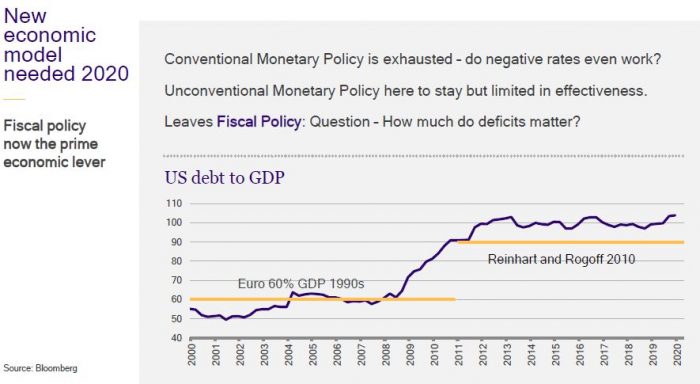
Conventional monetary policy is exhausted.
Negative rates may be tried in some places. I think the Reserve Bank’s attitude in Australia is they don’t work.
They do more harm than good.
End of conventional monetary policy
So conventional monetary policy is over. Unconventional monetary policy – well, that’s here to stay.
There’s certainly a lot more they can do. You can expand yield control, you can do a larger QE. But really they are playing around the edges.
Remember the aim of unconventional monetary policy is just to bring term rates down because you can’t necessarily control them without directly controlling them towards zero. And that may yet happen, but that’s quite limited.
It’s not going to save the day. It’s not going to really move the dial a lot.
So we are left with fiscal policy. Now we should, in a sense, be comfortable with that.
We should go ‘well, the government has a lot of power’. Because remember the government, the federal government I’m talking about here, has something that no individual company or even State government has, and that’s the ability to create money.
So they should use that super power that we’ve given them to really help the economy when it’s needed.
But here’s the problem.
Conventional economics has created a strong narrative that debt and deficits are bad things. It’s a narrative which is very hard to shift.
And it’s a narrative which I grew up with studying economics in the 1980s. And there’s a narrative that it’s been reinforced constantly since.
So the minute you start running high deficits, of course, all the worry starts to come out from this group of people and conventional thinking. So back in the ’90s the magic number of debt to GDP, and I’ve put the US debt to GDP here, was 60%.
That’s what you needed to get into Euro.
If you flash forward to the GFC, we had famous papers like Reinhart and Rogoff who told us that if we went through 90%, that you were going to severely impact the economy.
And of course the US has since sailed through that. And that hasn’t happened.
The poster child, of course, Japan, has got a lot higher than this and they are still functioning well.
So you’re going to get this happening in the next few months, and indeed the next few years.
You’re going to get that group of conventional-thinking economists talking about why this is all heading towards doom and disaster. The terms they’ll use I’ve even heard used in the last month by the prime minister himself.
Terms like: how are we going to pay for this? We’re going to burden our children with this debt.
And they really talk about the government as though it’s like a household or something else, which has to sort of live within its means, otherwise people stop giving it money.
The government doesn’t need people to give it money. It creates the money itself.
As Vimal will mentioned, done a whole paper on this so I won’t go into too many details.
So the new economic model where fiscal policy is at the centre, needs new economic thinking, if it’s to be used properly. And unfortunately, a lot of the economic thinking we have is still found in times gone by.
This concern about debt and deficits. Of course, we’ve seen the national debt clock in the US, the Tea Party jumped on the back of that.
And they were very vocal for a long time there, coming out of the GFC, that apparently the government being active and running deficits was going to cause all sorts of problems. Well they’ve gone quiet.
Of course, Tony Abbott has since left the building down in Canberra. Although I fear the ghosts of Tony Abbott still lurk around the corridors, but of course when he got elected in 2013, one of his big slogans was to end wasteful spending and pay back Labor’s debt.
The myth of government surplus
So the myth, I say, is that a government surplus is good policy.
Now don’t get me wrong. It would be great if the government could run a surplus, but a budget surplus should be the result of a strong economy.
It should not be an end in itself. And the fact that last year, as recently as last year, the government was trying to run a surplus, despite a lot of excess capacity in the economy, is just plain ridiculous.
And it’s not just me saying that. I think even Phil Lowe was down in Canberra, voicing similar sentiments.
Now you’ve got to remember the flip side of a budget surplus is a private sector deficit.
A budget surplus means a government is taking more money out of the economy than it’s putting in. You only really want to drain money from the economy if the economy has an inflation problem.
And you only get that inflation problem, if the economy is at or close to full capacity. I think we can all agree it’s a long way from there at the moment.
So what is a budget deficit?
The word deficit sounds terrible, but really a budget deficit is you’re putting more money into the economy then you’re taking out. You’re actually creating a private sector surplus.
And more importantly, you’re creating activity in the private sector, which should see it come back. So it’s entirely appropriate.
You should be running deficits. And in fact, I would argue a budget deficit should almost be the natural state of things when you have the ability to print money. We can come back to that in a minute.
The myth of inflation
So just moving on, the second myth I think I’m hearing a lot more of in the last couple of months after this dramatic escalation in the budget deficit, is that the government printing money directly creates inflation.

It’s the idea that as the government puts all this money in, as the Reserve Bank does QE, all this money enters the system and creates inflation as more money chases goods.
An important thing to remember here, and this is a topic for a whole other presentation, but a couple of key points just for now.
Firstly, the private sector always nets to zero in the money system.
If you think about it, every dollar that we borrow comes from someone else. Every dollar we spend goes to someone else.
The private sector system always nets to zero. So if a government creates extra cash or drains extra cash, it has to do the opposite to offset it.
Now, normally running a budget deficit, what the offset is, of course, is the government then borrows that money back from the private sector, via the AOFM.
But it can choose to do another thing. And we’ve seen this in the last few months. It can choose to actually have the Reserve Bank create the money itself and the money therefore comes back by excess reserves.
Now it’s quite technical, but for those who follow these things, those excess reserves have gone up
considerably. But here’s the important point.
The government printing money does not directly create inflation. Only the private sector who does credit creation can do that.
And we saw that 15 years ago at the peak of the last boom, when we had a massive investment boom.
The private sector was running double digit credit creation. And therefore we got 3% to 4% inflation.
At the time the government was actually draining money via a surplus.
So the only way the government influences is by creating activity, which therefore creates confidence in the economy, which therefore creates investment in the economy, which therefore creates a lot more broad money.
And therefore we can start getting inflation back to where it should be.
So again, entirely appropriate for deficits to be run and if needs be for the Reserve Bank themselves to create that money.
As, as I mentioned, please look at my paper. If you don’t have it, ask for it. It’s a much better explanation that I’ve just given you there.
A new model emerging
So what is the new model that’s emerging?
As I said, monetary policy is basically dead. Now it hurts me to say this.
As I mentioned, I’ve made a whole career out of watching all the movements coming out of Martin Place and Washington and other central banks. We’ve hung on their every word. We’ve lived and breathed everything they’re doing.
And as an investment manager it’s been front and centre of our decision making.
But they’re out of the game effectively. They’re now spectators.
Sure, they’ve got still an important part to play in liquidity and if the crisis were to worsen again. I think the job they did in March and April was excellent.
And they’re still there to do that. But they are not there anymore to create inflation. Only the government can do that.
Now what concerns me, is does the government fully realise this?
The government, of course, again has done a great job in this crisis. A crisis like the GFC brings out this
side of government that they have to act.
They have to do something and suddenly they’re not scared of deficits.
But you can see as we emerge, we’re already seeing this creep back to the old way of thinking.
Not just at a federal level, but at a State level.
People are talking about, wow we have to have budget repair to claw back all this money
we spent. That is not the case.
And if that thinking comes in it virtually guarantees a double dip recession.
Now the themes under this new model, (Amy, as mentioned, will be talking about these), clearly
“carry and roll” are your strong friends.
Income is something, investment grade’s got an important part to play.
Inflation
And of course you can look at yield enhancements. Now for the last part, I’m going to talk about inflation because it’s a question I get asked a lot.
Really with short rates stuck at zero for the next five or maybe even 10 years, the long end will be buffeted around by what’s going on in inflation.
Clearly, the COVID-19 crisis has thrown the whole thing up in the air.
What we’ve seen over the last decade was a lot of merge towards that 2%. It was very little dispersion between various parts of the CPI basket.
Everything seems to go around there.
What we’re going to see now is a lot of dispersion between various factors.
Some will actually be stronger than they were pre the crisis, but a lot will be considerably weaker.
Inflation catalysts
So what are some of the upside catalysts to inflation that we’re thinking about in our framework? The first two, trade disruptions and supply chain reorganisation, would probably go under the theme of the peak of globalisation.
We are seeing some unwind.
Again, that was already happening through the crisis, but the crisis has dramatically escalated that.
Now it’s fairly obvious that if you’re going to source a lot more locally and you’re going to lose some of that benefits of globalisation or specialisation as we were taught back at university.
You will see some inflation emerge in certain product areas. That’s a given.
The second thing, which is actually pro inflation is the cyclical rebound won’t be weighed down by the same de-leveraging we saw after the GFC, particularly in Australia.
Maybe in the US less so. But the third one’s going to be very interesting.
There are certain sectors of the economy where we’ve got to suffer structural supply shocks from this
crisis.
In other words, certain things just won’t be coming back. A lot of marginal businesses will be closed forever. You can even see things like Target stores recently. You can see things like Virgin Airlines. If it were to come back, talk about being a lot smaller scale.
You are going to see some areas where as demand returns it’ll be pushing up against a much lower supply and you will see inflation in certain sectors.
However, those sectors as part of the CPI basket overall are not that high.
Which turns us to what the deflationary factors are.
Unemployment
The first one is obvious across the economy. High unemployment means zero wage growth.
Even the RBA themselves don’t have unemployment coming back anywhere near what’s needed for the next three or four years.
Slowing population growth
The second one is a new one, and this is the first time we’ve faced this in decades.
The population not growing.
Now it is temporary. But it is temporary for at least 12 or 18 months. We’ve seen a lot spoken about this recently.
This has big implications for housing particularly. Not so much house prices, which will be partially
saved by zero rates, but in the areas which actually feed into the CPI basket of rents and building costs.
Now rents, building costs, together with with utilities and rates make up almost a quarter of the CPI basket.
And we’re going to see rents and building costs go negative over the next 12 months.
In the case of rents, perhaps significantly negative. And they’re a huge part of what’s going on.
I actually had a different view the end of last year. I thought we’re starting to signs of a recovery, but it is a massive shift when you go from immigration of the levels we have seen down to zero.
In fact the population will only probably be positive by natural bursts in the next 12 months. That, as I said, will eventually come back, but it is years away.
Government-led zero inflation
The third one though, which really has me concerned, is what I call government-led zero inflation.
This is a version of the paradox of thrift, where all of us save, it might be in our own interest to save, but if all of us keep saving, the economy goes backwards.
Now this is a similar thing with inflation. A lot of government policies during the crisis and emerging from the crisis, all look good in their own right.
For example, the NSW government announced a wage freeze for public servants this last week for the next 12 months.
Now on the surface, that might look good. You might think that the private sector has got no wage growth, it’s the responsible thing to do.
Their budgets have been hit. They need to pull back spending. The trouble is as that thinking seeps into more and more areas, it starts to become self-fulfilling that you get zero inflation.
You can even look at things like the free childcare, which of course is going to cause a negative inflation print for this quarter, but will the government decide to keep that going long or maybe decide to keep some sort of subsidy in place above and beyond the crisis?
No matter where you turn governments seem to be adopting a policy that no growth in rates – and remember we’ve had a healthcare charge freeze as well – there’s going to be a lot of things that used to tick over at 2%, 3% or 4%, are now going to be at 0% possibly for years to come.
This will lock in that zero-rate inflation rate environment and be a big factor.
And it worries me that this thinking seems to be creeping in more and more. Particularly at the federal level
where they should be doing the opposite.
They should be trying to create activity.
Credit creation
Finally sluggish credit creation. There’s hardly an earnings call that goes by, where rather than mention the great opportunity this crisis provides to buy more businesses, people talk about having to shelve investment plans to repair the balance sheets.
All of these things together mean that we very much land on the side of inflation is going to be a problem to the downside. Excess capacity, quite simply is too high.
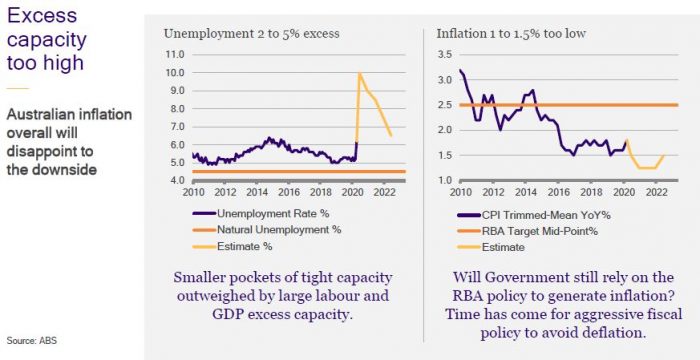
As you can see here – unemployment. This yellow line is the RBA’s forecast.
You could argue 4.5% for NAIRU was too high anyway. We’re not going to get within cooee of that. So we have a major problem.
And finally inflation, as you can see there has very little chance of getting – this is underlying inflation, not headline – headline will be negative.
Underlying inflation has very little opportunity.
So what we call upon in a sense, and the conclusion I make is that unless we get a rethinking of the framework by the federal government, unless we start to see them truly step up and use fiscal policy to avert the crisis that the RBA previously would have averted, then we’re going to head for a double dip recession, and we’re going to head towards zero inflation.
I hope they wake up to that, but for a fiscally conservative party, it’s going to be a difficult road to trade. So I’ll leave it there now and I’m going to pass on to Amy to talk about how we’re looking at fixed income investing in a zero rate environment. Thank you for your time.
Tim Hext is a portfolio manger with Pendal’s Bond, Income & Defensive Strategies team.
Tim joined Pendal Group in February 2017 with responsibility for managing Australian Bond portfolios. Tim has extensive experience in banking, financial markets and funding.
Pendal is an independent, global investment management business focused on delivering superior investment returns for our clients through active management.
Find out more about our investment capabilities:
https://www.pendalgroup.com/about/investment-capabilities