
We assess and score every country in the emerging markets index on a 5-point framework: growth, liquidity and monetary environment, currency, politics and governance, and valuation. We are investing based on where trends are going, not where they have been. In this latest piece James Syme assesses the currency situation particular to China and the flow-ons from the US-China trade war.

In August, the Trump administration formally designated China a “currency manipulator” (following a tweet to this effect from the presidential Twitter account). The term has formal meaning in US law, with the US Treasury required to produce an annual report identifying countries engaging in currency manipulation. China does not meet the technical criteria laid out in 2015 legislation (current account surplus, bilateral trade surplus and evidence of one-sided intervention), and, although legislation from 1988 does give more flexibility, the timing of this designation, away from the formal annual review, suggests a political rather than technical motivation.
China’s current account surplus is forecast by the IMF to be only 0.4% of GDP, which is effectively at balance. China does run a bilateral trade surplus with the United States (currently averaging US$ 27b/month), but there really is no evidence of ‘one-sided intervention’. Chinese foreign exchange reserves have been steady at around US$3.1 trillion for several years now, the currency moves broadly in line with the reference rate from a basket of currencies and, crucially, if the currency has deviated from the basket reference rate in recent months, it is to the stronger side.
Followers of our process will be aware of our view that a focus on currency valuation is a core part of the work when investing in emerging markets, as well as our preference for real effective exchange rate (REER)-based methods to do this. We are big fans of the IMF’s External Sector Report, in which every July, the IMF guides towards its views on the fundamental valuations of 26 leading currencies, focusing on how much a country’s REER would need to move to drive stability in that country’s current account balance. The 2019 External Sector Report concluded that “China’s external position was assessed to be in line with fundamentals and desirable policies, as its current account surplus narrowed further”. It also noted that “the identified policy gaps are small on net (-0.3%), reflecting largely mutually offsetting forces: loose fiscal policy and excessive credit growth on the one hand and inadequate health spending on the other hand.”
What is most interesting in the report is the consistent focus on policy-driven external imbalances in other economies: “In many countries with higher-than-warranted current account balances (Germany, Korea, Netherlands, Thailand), a tighter-than-desirable fiscal stance contributed to those external imbalances”. There is plenty of imbalance that the US Treasury could be focusing on given 2019 current account surpluses in those four countries are forecast by the IMF to be 7.0%, 4.6%, 9.3% and 7.1% of GDP, respectively. For the record, in the last three years the foreign exchange reserves of Thailand have increased by 23%, very much suggesting one-sided intervention there.
In a sense, China is merely the lightning rod for American perceptions that the US dollar is overvalued. The IMF’s report concludes that the dollar was 8% overvalued at the end of 2018, and the desire of US policymakers to have a more competitive exchange rate is clear. Unfortunately, the desire of other countries to accumulate US dollar assets is very rational. As Mark Carney, Governor of the Bank of England, noted in a speech in August, the US represents 10% of world trade and 15% of global GDP but 50% of global trade invoices, while two-thirds of EM external debt and global foreign exchange reserves are in US dollars.
We remain, then, in a position where structural economic imbalances are driving global geopolitical tensions, and the potential exists both for an escalation of US-Chinese conflict as well as an extension of these stresses to other countries, both developed and emerging. Someday, this war’s going to end. That would be just fine for emerging market investors. Until then caution is warranted.
About the Pendal Global Emerging Markets Opportunities Fund
Be a part of the world’s fastest growing economies

With just over 12 months to go before the Americans return to the polling booths, Pendal Head of Bond, Income & Defensive Strategies Vimal Gor published his thoughts in the AFR on why the US economy is on a near-certain path to recession, and why President Trump’s new world order on trade is a success in the making.
View the AFR article
Global asset manager Pendal Group has announced the appointment of Nick Good as chief executive of the J O Hambro Capital Management (JOHCM) operations in the US.
This follows a decision to appoint dedicated CEOs for the JOHCM business in UK, Europe and Asia and a CEO for the US business to support growth in offshore markets.
Alexandra Altinger was appointed CEO of JOHCM’s UK, Europe and Asia business in July. Ms Altinger starts September 9.
“The US region is a key growth engine for the Pendal Group,” said Pendal’s Group Chief Executive Officer Mr Emilio Gonzalez.
“Building on our success to date we believe there are significant opportunities to continue to materially grow our funds under management in the region.
“Nick’s leadership and success with leading global asset managers made him the prime candidate to lead our business in the US.
“He is recognised for his achievements in building and growing successful businesses, his deep knowledge of the market, and track record of delivering results.”
Mr Good was most recently Executive Vice President, Chief Growth and Strategy Officer at State Street Corporation.
In this role, he has been responsible for setting overall business strategy and leading corporate development for State Street.
Prior to this role he was co-head of State Street Global Advisors Global ETF Business, with primary responsibility for the North America and Latin America regions.
During his tenure, the Global ETF business grew assets under management by 50 per cent between the end of the 2015 and 2017 financial years.
Prior to joining State Street Mr Good worked at Blackrock (initially Barclays Global Investors), including five years as Head of the iShares ETF business in Asia-Pacific based in Hong Kong, where he led the rapid growth of the iShares business in the region.
Strong position
Mr Good said: “The strong position JOHCM has carved out in the US in such a short time is impressive and I see the real potential to accelerate that growth.
“I am excited by the opportunity presented by JOHCM’s US business and attracted by the firm’s investment-led pedigree and entrepreneurial culture.
“I look forward to joining the global leadership team and helping to grow the US business.”
Mr Gonzalez said: “Since the JOHCM business was acquired in 2011, Pendal’s offshore presence has grown significantly and provided an increasing contribution to the Group’s Funds Under Management (FUM) and profit.
“Pendal Group had closing FUM of $101.3 billion as at 30 June 2019, of which $22.0 billion is managed on behalf of US clients.
“Nick’s appointment reflects the importance of the US business to the Group and its future potential.”
Mr Good has a Master of Arts in Biochemistry from the University of Oxford. After graduating in 1996, he started his career in management consulting including five years at Boston Consulting Group.
Mr Good will report to Pendal Group CEO Emilio Gonzalez.
He will be a member of the Pendal Group Global Executive Committee.
His appointment is effective December 2 and he will be based in Boston.
Regnan has released its annual report on ESG Engagement and Advocacy activity throughout FY19. Climate risk remains an ongoing engagement theme with ASX200 companies and Regnan has increased engagement on climate related issues through the year. Human capital management and ethical conduct has been another key area of focus and Regnan has undertaken increased levels of engagement in this area. Full details are available in the report.
Download Regnan’s Annual Engagement and Impact Report here:
About Regnan
Regnan – Governance Research & Engagement Pty Ltd was established in 2007 to evaluate the relationship between environmental, social and corporate governance (ESG) factors and investment value. Regnan has evolved to become a global leader in long term value, systemic risk analysis and responsible investment advisory.
Regnan provides ESG integration, advisory and stewardship services on behalf of institutional investors including asset owners, fund managers, wealth managers, retail and investment banks to drive improved ESG performance in S&P/ASX200 listed companies. Regnan meets with directors and senior company leaders, in a constructive manner, to influence change on issues with the potential to impact value over the long term.
Regnan is also a regular contributor to the public debate on long term value and sustainability, and is an active commentator in the media and at corporate and financial industry events. Regnan also provides submissions to government and other policy makers to improve both sustainable investment and the identification of systemic risks.
Regnan’s research insights are applied to Pendal’s Sustainable, Ethical and mainstream funds where relevant, as well as enabling us to work with other institutional investors in meeting their sustainability objectives.
DISCLAIMER
This document has been prepared by Regnan Governance Research and Engagement Pty Limited (ABN 93 125 320 041), (“Regnan”) and is republished with Regnan’s permission. It is for general informational purposes only and should not be relied upon in making a decision to invest or a decision in relation to an existing investment. It has been prepared without taking into account any recipient’s personal objectives, financial situation or needs. Because of this, recipients should, before acting on this information, consider its appropriateness having regard to their individual objectives, financial situation and needs. This information is not to be regarded as a securities recommendation.
The information relates only to Regnan’s assessment, based on its research and the information available to it, of the performance of a company in relation to environmental, social and governance issues and should not be regarded as a recommendation or statement of opinion by Regnan on:
i. any other aspect of the company’s performance;
ii. the prospects of the company; or
iii. the company’s suitability or attractiveness from an investment perspective.
The views expressed in this document are exclusively those of Regnan and the information contained within is current as of the date of publication. Pendal Group is the owner of Regnan and commissioned the company to provide research and engagement services for use as inputs into the decision making processes for Pendal’s investment activities. The views of Regnan expressed in this article may differ from those held by Pendal Group.
Fund Manager commentary for the month ended 31 July 2019 covering market reviews, Pendal fund performance and our outlook for the period ahead.
Access the monthly commentary here.
Ashley Pittard, Head of Global Equities at Pendal recently presented his thoughts on the extent of risk that has developed in global equity markets at the Portfolio Construction Forum’s Strategies Conference 2019 – “20/20 Vision” . This article outlines the insights shared around why investors need to adopt a different mindset when it comes to investing in global equities in the 2020s.
Today global equities investors are facing into markets where the risks go well beyond trade wars and currency tantrums.
I’m proud of the first quartile performance Pendal’s Concentrated Global Share Fund has achieved since we commenced.
But it’s now more important than ever for investment managers in the global equities sector to have the right active strategy for the 2020s.
The extreme risk in global equities right now requires a different mindset as we enter the new decade.
September 15 marks the 11th anniversary of the Lehman bankruptcy and Global Financial Crisis (GFC).
That event sparked one of the greatest credit and equity bull markets in history as central banks adopted extreme and unprecedented monetary policies.
Along with conventional monetary policy actions including 735 interest rate cuts around the world, central banks took unconventional actions such as $US13 trillion worth of quantitative easing which essentially refers to “printing money”, preventing debt default and deflation.
End of the post-GFC era
Over the past ten years broad investment in global equities has been a great investment decision.
Investing in an index fund, exchange traded fund or a growth theme such as tech stocks would have done very well for your retirement savings instead of holding money in the bank.
After the GFC investors benefited from tail winds that drove share prices higher – such as falling interest rates, lower volatility, a declining Australian dollar and quantitative easing.
But that’s now changing.
The 2020s will be very different to the past decade.
In the new environment investors will need to be very selective rather than pursuing broad market exposure for their portfolios.
Macro supports such as cheap money and big government balance sheets won’t provide a blanket for all listed companies.
At Pendal we are contrarian, long-term fundamental stock pickers when it comes to global equities — so this environment plays to our strengths.
Markets in the new phase
Why am I so confident that these 10-year tail winds will become headwinds – even when volatility measures suggest risk is low in global equities?
It’s a hard ask for market valuations to be compelling when the market is trading at all-time highs. Price-to-Earnings ratios are over 17x and the S&P500 Index has grown to nearly four times its value since its GFC lows.
Bifurcation in the market is extreme and distortions are occurring within equity markets. We have a handful of mega cap technology-related stocks that have carried the market higher, while at the other end of the spectrum sectors deemed to be eternally disrupted have languished.
Growth sectors are significantly over-valued on traditional historical measures while value sectors are shunned.
This year just 6 % of the MSCI World Index stocks have accounted for 53% of the return for the global equity index.
Meanwhile, interest rates are down a long way. We have had 29 cuts from central banks in 2019 and government bond yields for the largest economies are at a 120-year low.
It is hard to say they will be going significantly lower. Consider the US 10-year bond as a proxy. In 2012 when the market believed the euro would break up and European banks would be nationalised, the US 10-year bond touched 1.36%. In 2016 when the ‘Brexit’ vote occurred, it touched 1.36%. In August it has drifted past the 1.75% level.
The Aussie dollar has collapsed from $1.10 over the last decade to hover around the US$0.70 level within a small range. Currency volatility for the major economies is at the lowest level since 1992.
But we have just started to see the US officially label China a currency manipulator.
It is timely to recall the 1995 Plaza Accord, a joint-agreement between France, West Germany, Japan, the United States and the United Kingdom, to depreciate the US dollar in relation to the
Japanese yen and German Deutsche Mark by intervening in currency markets. This event turned currencies upside down at the time and placed Japan into its lost decade. This event turned currencies upside down at the time and placed Japan into its lost decade.
It’s interesting that many economists saw this accord as a direct response from the US to the threat from Japan’s growing status as an economic superpower.
In my view equity risk is the highest in more than 20 years – regardless of what traditional volatility measures suggest.
When you have $US13.7 trillion of negative yielding debt globally investors have been pushed up the risk curve to chase ever decreasing yields.
And when you fundamentally change the value of cash massive distortions occur. We are seeing this on many levels.
Global debt is now 3.2 times the size of global GDP – again at an all-time high.
We have been here before
The tech sector – especially the FAANGs (Facebook, Amazon, Apple, Netflix and Google)- have been the darlings of the bull market for the last 10 years.
Real estate and utilities stocks have also been drivers of market returns, thanks largely to declining interest rates.
But the elephant in the room is the tech sector.
It has tripled its index weight since the GFC and doubled its index weight in the US market over the past five years.
Tech has been at the epicentre of this self-fulfilling circle — declining interest rates, exploding debt and rampant passive investing have helped to triple its representation of the market.
No doubt these are great businesses but it’s amazing how big their market capitalisations are — especially when compared to the GDP of some countries.
If we use the 2000 technology bubble as another proof point, the valuations again are stark.
It’s uncanny how AOL at its peak traded at similar levels to Netflix today.
Look at the metrics on the right hand side of this graph:
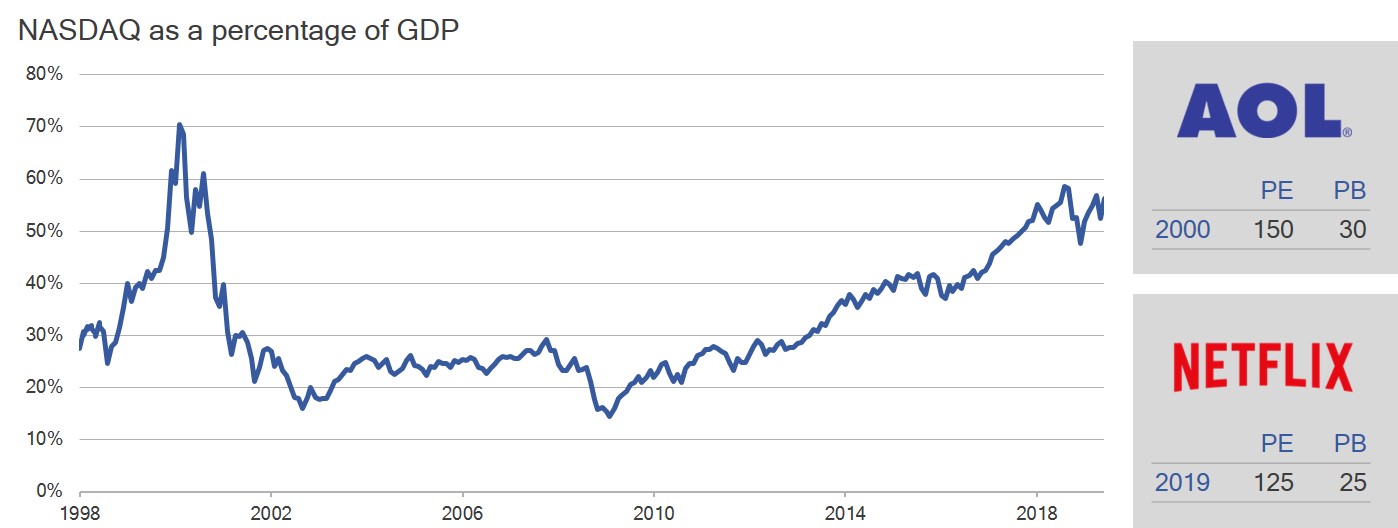
* Source: Bloomberg, Pendal. PE refers to price-earnings ratio, PB refers to price-book ratio.
You could argue about the relevance of using a price-book ratio for these tech names but as a long term valuation tool across different sectors, price-book is still a clean gauge of value.
And Nasdaq as a percentage of GDP is near historical bubble levels.
The extreme size of valuation premiums is a key risk driver.
Passively fulfilling a virtuous cycle
Here’s another aspect of the self-fulfilling circle. Passive and index-hugging strategies are reinforcing these valuation trends.
Over the past 10 years $US4.1 trillion has gone into passive investment funds versus outflows of $US1.5 trillion out of active.
In the year-to-date we have seen 65% of stocks in the MSCI World proceed into bear markets as passive inflows top $US7.4 billion and outflows from active strategies top $US22.4 billion.
The issue here is index and traditional strategies — by their inherent design — see more and more investors bet on higher growth for what has already risen.
This creates distortions in the market as passive ETFs focus on the largest companies in a sector, not the best companies.
Why we’re different
At Pendal, we are clearly very different.
We don’t look at the largest companies — just the best companies.
We focus on leading number one or number two franchises in their space when they are out of favour — regardless of size.
That is the lowest cost producer if it’s a commodity or largest market share if it’s a bank. We like monopoly assets.
We look at industries horizontally — not vertically as do many traditional index strategies.
We focus on fewer higher quality businesses and build a deep understanding of them like a business owner would.
We launched our Concentrated Global Share Fund three years ago and we have been very happy with the 1st quartile performance over the three-year period which reflects this very different approach compared to passive index following strategies.
Our philosophy and process has been the same since I started at BT Australia (the former entity name of Pendal) more than 20 years ago.
We have a universe of about 500 leading businesses that we follow.
We spend a lot of time focusing on disruption in industries. Usually we are buying businesses when we think they are cyclically depressed — while the market may think they are structurally impaired.
In our experience, only 15-20% of the market is attractive at any point in time. 
You need to be very selective to grow wealth over the long term. Our top 10 holdings (see table) are very different to the index. We have a very large active positions.
We hold specific industry leaders such as Anheisser Busch Inbev – a leader in the beverage market.
We hold Colgate – makers of toothpaste around the world. We hold Total – Europe’s leader in oil and gas production.
We don’t hold these companies because they’re included in the Index or have driven returns. We hold them for very different reasons.
Consider the recent Amazon Wholefoods acquisition as an example.
The consumer staples sector shows how we like to research, stay patient and use disruption to our advantage.
We focus on the best businesses, understand fundamentally how they work, then stay patient and wait until they are out of favour.
There is no doubt the Amazon Wholefoods deal will change food distribution globally.
As a result of this disruption the market discounted the sector as they questioned the brand value longer term post the deal.
We looked at the industry differently and focused on market share and their return on investment (ROI).
It was clear you only wanted to focus on P&G and Colgate with greater than 60% market share and 100% ROI.
We never wanted to own Kraft Heinz, Campbell soup or Kellogg’s due to their lower market shares — even though they were larger in the index.

Think differently to drive different results
Overall I believe you need to think differently, have a concentrated highly active and very selective stock picking approach,
Think like an owner in a group of #1 unique premium assets, be patient on valuation and get paid a dividend to wait while the business normalises.
This will serve you well as we enter the next decade.
The global technology giants have dominated market attention for much of the past few years. But taking a deeper perspective on the industry highlights the importance of being very selective.
Hear from Ashley Pittard on where he is selectively investing in the digital media industry.
Find out more about the Pendal Concentrated Global Share Fund.
– Developed market yields continue to slide on concerns regarding the outlook for growth; trade tensions continue to increase; the US dollar continues to strengthen; and Chinese growth continues to gently disappoint.
– However, within these broad drivers, there are concerns that some policies and reaction functions are changing.

Despite the volume of newsflow in recent weeks, it does not seem as though there has been a regime shift in the broad drivers of emerging markets. Developed market yields continue to slide on concerns regarding the outlook for growth; trade tensions continue to increase, obviously the US-China relationship, but also others, eg Japan-South Korea; the US dollar continues to strengthen; and Chinese growth continues to gently disappoint. This remains a challenging environment for the emerging world, and we believe that emerging market equities should continue to be seen as a source of country-specific opportunities rather than as an opportunity in the whole. Alpha, not beta.
However, within these broad drivers, there are concerns that some policies and reaction functions are changing. Specifically, the developments of the last few days have raised concerns regarding Chinese currency policy. At the start of August, President Trump announced a 10% tariff on the remaining USD 300b of imports from China. In response (it is assumed), both the domestically-traded CNY and the internationally-traded CNH weakened substantially and, significantly, broke the 7/USD level. Subsequently, China suspended purchases of US agricultural products and the US Treasury announced its intention to investigate China as a currency manipulator.
We do not believe the move through 7/USD represents a shift in China’s currency policy. In the first instance, the official policy is to manage CNY against a basket of currencies, and the steady strengthening of the US dollar against the currencies of China’s other trade partners implies a weaker CNY/USD exchange rate. Secondly, whatever goes into PBoC’s ‘countercyclical factor’, it is clear that the effects of tariffs absolutely justify a relative weakening of CNY.
On the other hand, it has seemed that PBoC has previously defended the 7 level. In both late 2016 and late 2018, CNY approached 7 but did not trade through it, despite the powerful risk-off sentiment in emerging markets at those times, so it does seem as though there has been a behavioural shift within the latitude of policy. Whatever concerns Chinese policymakers have about domestic sentiment towards the exchange rate have clearly been overcome by macro circumstance.
In terms of what this means for investors, we think the environment hasn’t changed. The intensifying trade war and the slide in US yields suggest a difficult environment ahead for export-based economies (very much including China), while the strengthening US dollar suggests the positive effect of lower yields on the domestic-demand/carry-trade led emerging markets will be delayed.
If we wanted to create a positive narrative from this week’s events, we would observe that the 2015-16 Chinese stimulus was led by a steep devaluation in CNY in August 2015, potentially relieving pressure on the exchange rate before aggressive injections of liquidity. While this is a compelling story, some of the statements from Chinese leaders (“Now there is a new Long March, and we should make a new start,” – President Xi Jinping) don’t point to an overwhelming desire to take the easy road.
The US decision to label China a currency manipulator is a surprising one, both because it was not in line with the normal semi-annual assessment cycle, and because China doesn’t meet the US’s own definition. There is a lot of interesting stuff happening around currencies and global imbalances, which deserves its own report, but the short version is that China has a robust history of currency manipulation but really isn’t guilty at the moment.
In terms of the regime change, when it comes, there would seem to be two likely ends: The first is that the trade war reaches a ceasefire, because one or both sides cannot take the pain any more – that would be hugely bullish for export EM (China, Korea, Taiwan, Mexico); the second would be that the rally in the dollar ends – with low yields that would be hugely bullish for domestic/carry-trade EM (particularly commodity importers such as Turkey, India and Pakistan). Until such point, we will remain selective in both groups.
Regnan has delved into the benefits and risks of corporate virtue signaling in its latest opinion piece. How should companies approach issues with financial and societal implications when choosing to articulate their stance?
Download a copy of Brand risk: social licence to operate, corporate virtue signaling and brand assets and visit Regnan.com.au for additional insights and research reports on responsible investing.
About Regnan
Regnan – Governance Research & Engagement Pty Ltd was established in 2007, co-founded by Pendal Group to evaluate the relationship between environmental, social and corporate governance (ESG) factors and investment value. Regnan has evolved to become a leader in long term value, systemic risk analysis and sustainable investment advisory.
Regnan provides ESG integration, advisory and stewardship services to Pendal to drive improved ESG performance in S&P/ASX200 listed companies. Regnan meets with directors and senior company leaders, in a constructive manner, to influence change on issues with the potential to impact value over the long term.
Regnan is also a regular contributor to the public debate on long term value and sustainability, and is an active commentator in the media and at corporate and financial industry events. Regnan also provides submissions to government and other policy makers to improve both sustainable investment and the identification of systemic risks.
Regnan’s research insights are applied to Pendal’s Sustainable, Ethical and mainstream funds where relevant, as well as enabling us to work with other institutional investors in meeting their sustainability objectives.
DISCLAIMER
This document has been prepared by Regnan Governance Research and Engagement Pty Limited (ABN 93 125 320 041), (“Regnan”) and is republished with Regnan’s permission. It is for general informational purposes only and should not be relied upon in making a decision to invest or a decision in relation to an existing investment. It has been prepared without taking into account any recipient’s personal objectives, financial situation or needs. Because of this, recipients should, before acting on this information, consider its appropriateness having regard to their individual objectives, financial situation and needs. This information is not to be regarded as a securities recommendation.
The information relates only to Regnan’s assessment, based on its research and the information available to it, of the performance of a company in relation to environmental, social and governance issues and should not be regarded as a recommendation or statement of opinion by Regnan on:
i. any other aspect of the company’s performance;
ii. the prospects of the company; or
iii. the company’s suitability or attractiveness from an investment perspective.
The views expressed in this document are exclusively those of Regnan and the information contained within is current as of the date of publication. Pendal Group is the owner of Regnan and commissioned the company to provide research and engagement services for use as inputs into the decision making processes for Pendal’s investment activities. The views of Regnan expressed in this article may differ from those held by Pendal Group.
Amazon brings threats as well as opportunities if you know where to look says Ashley Pittard, Pendal Group’s head of global equities
AMAZON’S $US13.7 billion acquisition of upmarket grocer Wholefoods a few years ago put big pressure on consumer goods stocks.
At the time, investors thought Amazon would disrupt the US retail landscape – and stocks such as Colgate-Palmolive, P&G, Kraft, Heinz and Kellogg’s came under pressure.
Some investors questioned whether consumer staples companies had been earning greater-than-normal profits and would come under severe pressure to reduce prices as the Amazon phenomenon took hold.
“The stockmarket de-rated these businesses because they were concerned Amazon would commoditise food exactly like they did with books and all the other products they’d gone into over time,” said Ashley Pittard, who heads up global equities at asset management group Pendal.
>> For more information on Pendal’s global equities capabilities click here
But not all consumer stocks were in the same boat after Amazon’s move.
Mr Pittard believed brands that had a strong affinity with consumers were likely to retain considerable bargaining power when it came to pricing negotiations with Amazon and other major distributors.
In the wake of the Amazon-Wholefoods deal, Mr Pittard saw a number of opportunities.
“We look for crown jewel assets that are out of favour – those where the stock price has been flat for a number of years or are down 30 to 50 per cent near term.
“Here we focused on Colgate-Palmolive and Procter & Gamble.”
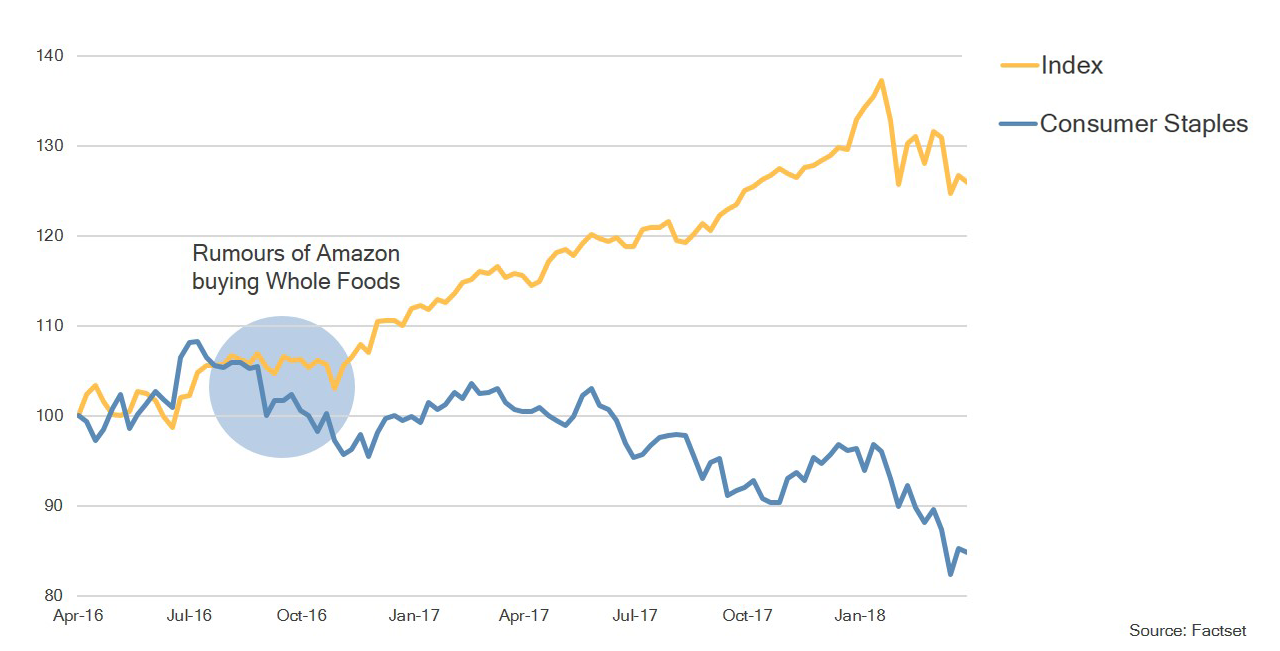
Consumer were stocks sold down in the wake of Amazon’s move on Whole Foods
Colgate – a global household name in oral health – and P&G – makers of a wide range of iconic brands in home and personal care products – had the highest market shares and the highest return on capital, Mr Pittard said.
“Colgate’s market shares range between 40 and 80 per cent. When you have that type of market share, you have pricing power.
“You can innovate, setting you apart from other market players.”
Premium positioning drives price
Colgate has been able to attract higher margins by enhancing flagship products in relatively minor ways such as incorporating elements of nature, sustainable sourcing or adding vitamins or supplements.
“Remember as a kid you cleaned your teeth with white toothpaste – now look at the range of toothpaste,” said Mr Pittard.
“It’s white, it’s coloured, it’s got mints in it, it’s got natural products, it’s for sensitive teeth…”
“And the difference in price is from about $1 all the way up to $14.”
As an investment, Colgate stood out for a number of reasons, Mr Pittard said:
– The stock had been de-rated and had gone sideways for five years
– Management was focused on reducing costs and generating a good dividend yield
– Longer term there was pricing power and room to innovate because of a large market share
Hear more from Ashley Pittard on finding value in consumer stocks
Disrupting the distribution, not the brand
“When you look back at what people were buying on Amazon, it was the exact same type of well-known brands they were buying at the shop,” Mr Pittard said.
“The only difference was, it was the convenience of using the Amazon delivery.”
“So yes, Amazon are disrupting the space – but they’re not disrupting the brand, they’re disrupting the distribution.”
For more information on Pendal’s global equities capabilities click here.