

“Xiang Junbo, chairman of China Insurance Regulatory Commission (CIRC), is currently under probe, according to China’s top anti-graft authority.” – Xinhua,9 April 2017
April’s news that the third of China’s three financial regulators would have a surprise change of leadership was not immediately attention-grabbing. With CSRC, the markets regulator, changing its head in February 2016, and CBRC, the banking regulator, following the same move in February 2017, there has now been complete change at the top of this part of the regulatory system (Zhou Xiaochuan remains Governor of the People’s Bank of China (PBoC), the central bank). Whilst all three regulatory heads would be expected to change in a Party Congress year, we can now see that something different is happening.
“Any bureaucrat pursuing policies that threaten the stability of China should be prepared to be replaced.”
James Syme, Portfolio Manager
We have written extensively about our concerns that the credit stimulus applied to the Chinese economy in mid-2015 would have negative side effects and would ultimately prove to be unsustainable. Our concerns were that some combination of the growing risks from leverage within the financial system, rising inflation, downward pressure on the currency and/or worsening urban pollution would cause a reversal in policy. Ultimately, we see the primary objective of the Chinese Communist Party as not being growth, as is often thought, but rather stability. Any bureaucrat pursuing policies that threaten the stability of China should be prepared to be replaced.
We have recently seen a number of data points that confirm we are in a period of substantially tighter monetary policy in China. As is normally the case, monetary policy is being administered through a mixture of interest rates and macro-prudential rules and quotas.
Firstly, it is definitely the case that all-system claims are growing at a much slower rate than a year ago. The most recent increase, 14.1% in the year to May 2017, is the lowest since the 2008-9 financial crisis, and compares to an increase of 20.8% in the year to May 2016. Interestingly, it is the non-bank financials where the slowdown has been hardest. On a related note, the three month Shanghai interbank interest rate has been above 4.5% for the last few weeks a sharp increase on a rate of 2.8% as recently as November 2016.
Secondly, in late June the CBRC ordered China’s banks to review the ‘systemic risk’ from a group of high-profile Chinese conglomerates that have been aggressively making overseas acquisitions in recent years. The targeted groups appear to be Dalian Wanda, Fosun International, HNA and Anbang (the unlisted insurer whose CEO, Wu Xiaohui, was recently arrested). These groups have been borrowing significantly and have bought some trophy assets including the Waldorf Astoria hotel in New York. It seems that policy makers are as concerned about the specific uses of credit as they are about the overall rate of increase.
Thirdly, in the offshore bond market, June saw a massive US$6.6 billion bond issue by property developer, Evergrande, which surprised investors. It means that so far in 2017, Chinese property developers have raised US$14.9 billion through offshore bond financing, which is a huge increase on the total of US$14.4 billion for the whole of 2016.
Hence, slower credit creation particularly outside of the banking sector, new regulators, regulatory crackdowns on the most aggressive borrowers, and heavy users of the bond market turning to the offshore market, means that the stimulus is over for now. The implications of this for emerging markets are mixed and have to be considered alongside other factors such as a recovering Eurozone and lower US bond yields. But what we can say is that this is unambiguously negative for commodities, commodity stocks and commodity-exporting countries.

“I’ve been turning over in my mind the question of nostalgia, and whether I suffer from it. If nostalgia means the powerful recollection of strong emotions and a regret that such feelings are no longer present in our lives, then I plead guilty.” – Julian Barnes, The Sense of an Ending.
In commemorating the 20th anniversary of the handover of Hong Kong to China on 1st July 2017, I’ve taken the liberty of the author’s gavel and the indulgence of my colleagues overseeing the editorial oversight to stray a bit off the beaten path with this article.
I landed at Kai Tak Airport in Hong Kong (HK) on 22nd February 1997. Flying seemingly a hair’s breadth away from those dilapidated low-rise buildings reminded me of similar ones I’d seen before. Television antennas grew from terraces while roads below were narrow and crowded. My first impression of HK – ‘this is no different from Bombay; here too they hang their clothes to dry in the balcony’.
The drive into the city was short and as I approached the central business district (CBD), HK’s famed skyline came into view. Much of that view has changed in the past two decades. The CBD’s waterfront boundary has edged ever closer towards Kowloon across the harbour. It is an enduring lesson about HK and capitalism – selling reclaimed land is probably the best business model in the world for the Government of HK. That reclaimed waterfront land sells at astronomical values once it is filled up with rocks and debris, which costs almost nothing.

Source: Rating and Valuation Department, CEIC
Little did I know that I had arrived in HK on the cusp of the Asian Financial Crisis. My mind was preoccupied with thoughts on adjusting to life in a new city. Born and raised in India, this was my first time living abroad. After the luxury of a two-week fully paid stay at the Ritz Carlton (courtesy the investment bank I worked with), I found a tiny apartment with no view in a matchstick-thin building in the Mid-Levels. The monthly rental was US$2,800 for 540 square feet of liveable area. After the SARS epidemic in 2003, its rent had halved to US$1,400 but today that same place rents for US$4,000/month.
Life settled into a routine between an escalator commute up and down the hill to work, Sunday dim sum at the City Hall past the bird-like cacophony of helpers on their day off, occasional hikes to easily accessible scenic country parks and exploring HK’s neighbourhoods and its British legacy. By June 1997, Asian financial markets were in a frenzied, bullish phase. My colleagues were actively investing in stocks or properties funded by leverage. I was bewildered and awestruck, having grown up in a Nehruvian socialist India where wealth was frowned upon. Newspapers featured the imminent handover of HK from the UK to China under the ‘one country two systems’ arrangement. In 1982, negotiations between the diminutive, expressionless Deng Xiao Ping and the stern faced iron woman Thatcher to resolve the issue of sovereignty of HK were acrimonious. A middle ground was reached where HK would become part of China on 1st July 1997, though with a special status for 50 years. Leading up to the handover in 1997, there was renewed confidence in HK and China.
30th June 1997 was a holiday to mark the Queen’s birthday. As I wandered through Central, I noticed a serpentine queue outside the GPO. With a passing interest in philately I joined the line to buy some official memorabilia commemorating the historic event. I returned on 1st July, the day of the handover, this time to get the newly issued Hong Kong Special Administrative Region (HKSAR) postage stamps. As the wait for first day covers was rather long, I opted for the shorter line to get our envelopes with postage stamps franked. Uniformed staff sat behind long tables mechanically franking the ’date chop’ on postage stamps as the queue shuffled along. I presented my envelopes. A couple of minutes into his routine, the official stopped abruptly. He stared down at the envelope and looked up at me. In that instant it struck me. I snatched the whole pile. He thundered, ”Hand It Over!” By then, I had darted out of the door.
Serendipitously, I had managed to get envelopes with postage stamps of the Queen’s head but with a HKSAR official frank dated 1st July. Those postage stamps had ceased to be legal tender on midnight of 30th June 1997. Thus I believe I have in my possession the only known postage stamps issued by a British colony but franked and dated 1st July 1997 by the HKSAR under Chinese sovereignty; a unique piece of history.
I now live in another clean, efficient and vibrant city – Singapore. But I do miss HK. The good friendships, the Hong Kong Cricket Club, HK’s rolling hills and walks, the hustle and frenzy of city life, resilience of its people and the seasons. The Asian Financial Crisis and SARS are distant memories. Its people have survived through good times and bad and so much has changed over the past 20 years. The city has definitely prospered as reflected by the gleaming new buildings. Life for the average person seems tougher as evidenced by the protests against increasing mainland Chinese influence. Attitudes towards China went from apathy pre-1997 to euphoric embrace during the 2000’s to suspicion and fear in the past couple of years. Yet, whenever I return, the view of the skyline still mesmerises me.
To give nostalgia its due, much like the enduring question binding Americans of a certain generation, “what were you doing when JFK was assassinated?”, when queried about my most memorable moment of the HK handover, the answer is simply a resounding clerical shriek: “Hand it Over!”
While Emerging markets (‘EMs’) have underperformed Developed markets (‘DMs’) over the period 2011-2016, as we stand today there are clear and compelling opportunities in EMs. However, there are also countries facing stiff challenges and political malaise. The key is to be selective in what you own.
The challenges in EMs include central banks tightening – higher DM rates and less liquidity has historically been a headwind for those EMs with current account deficits (Latin America, ASEAN). Expectations about the pace and terminal value of the US rate cycle have been waning in recent months. Nevertheless, countries such as Brazil are battling to control the FX depreciation and inflation that has resulted from capital outflows. In several instances – again, like Brazil – this process is complicated by the political instability and populist backlash that can accompany an economic reversal. As we suspected, the market’s euphoria surrounding President Rousseff’s impeachment proved premature.
There are also those EMs who enjoy current account surpluses and who benefit from the improvement in growth implied by higher rates – notably the East Asian exporters (Korea, Taiwan).
Our current positioning:
• Buy global cyclical growth – especially in Korea and Taiwan
• Buy India for the domestic recovery
• Remain cautious on China as stimulus slows – own growth/consumer stocks
• Underweight Latin America – commodities, politics, economic malaise
• Avoiding Turkey; Mexico is looking interesting
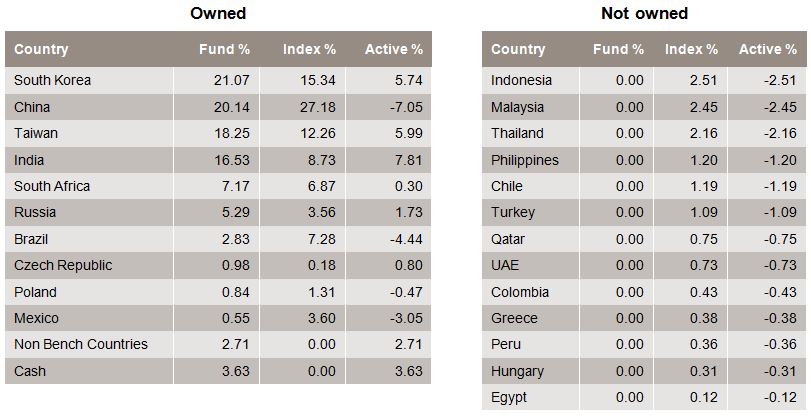
Figure 1 below shows the Fund’s country positions as at end May 2017. This demonstrates the high-conviction approach we take to country allocation.
Figure 1: BT Global Emerging Markets Opportunities Fund – Wholesale country allocation end May 2017
The table below demonstrates our current views on four countries within the context of our five-point framework: three of our largest overweight (India, Russia and Korea) and our largest underweight (China).
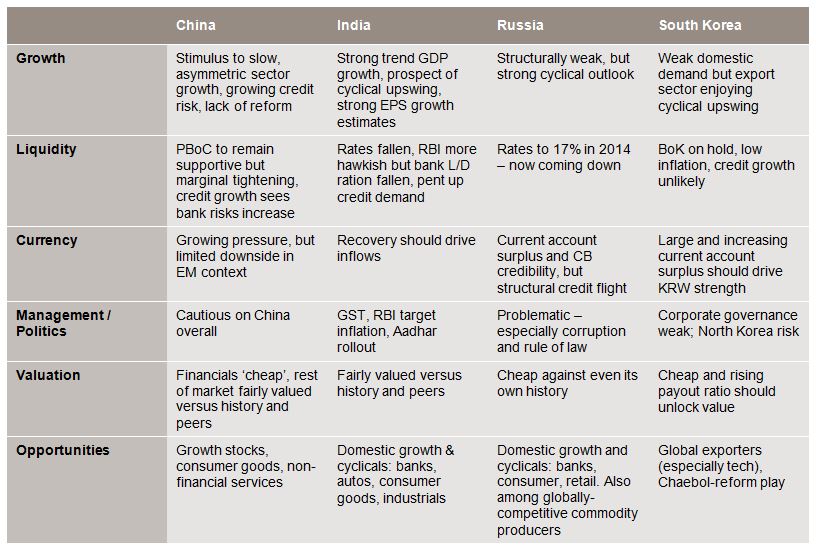
The key point is that EMs, given their diversity, do not perform in the same way in a given environment. As always, there are countries that look very attractive at these levels. There are also those that you want to avoid. This is why a country-driven approach is crucial.

The Australian retail sector is facing two challenges: a cyclical challenge caused by a slowing economy and a long-term structural threat from digital disruption (ie Amazon). In this brief note we will leave the digital challenge for another day and take a look at the retail slowdown and its implications for the retail property sector.
The weakness we’re seeing in the retail property sector is reflective of some key underlying dynamics. It is therefore instructive to understand the background issues before discussing how to navigate this new slower environment.
Firstly, it is fairly intuitive to draw a link between the performance of retailers and consumer activity. There is a well-observed flow-on effect from changes in household incomes, inflation and consumer sentiment towards an individual’s future financial position. An environment where incomes grow, employment conditions remain stable and the price of goods and services grow at a moderate rate bodes well for spending. This was quite prevalent in the cyclical upturn following the GFC when retail sales in the malls accelerated to around 5% pa. However, retail sales growth is back to just below 2% pa. This slowdown is occurring despite a large uplift in residential property values, especially in Sydney and Melbourne.

What is causing weakness in the consumer sector here in Australia? The following charts help to explain how the consumer feels. Firstly, there is very little wages growth; in fact the series is at its lowest level since 1997 and wages have been tracking below inflation for almost two years. In response to falling real wages, the consumer is hunkering down and devoting a greater proportion of household disposable income to servicing debt.
Australian wages growth is anaemic
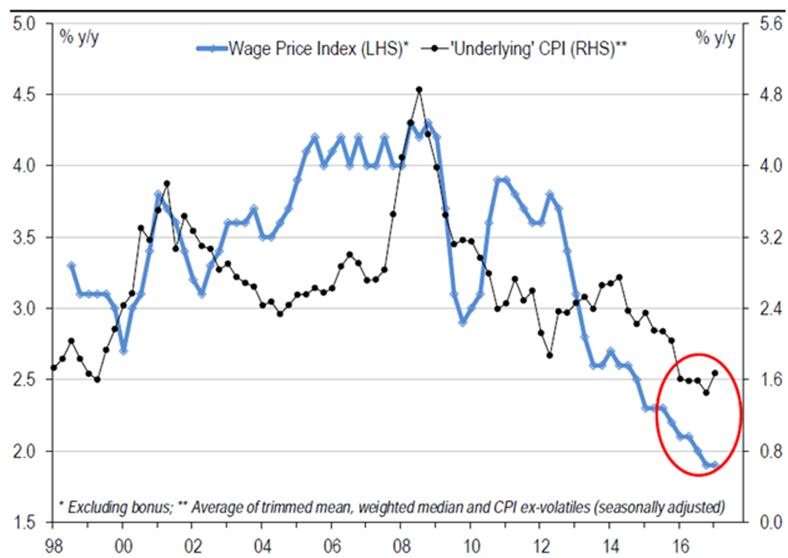
Source: UBS
One of the reasons behind weak wages growth is simply that the workforce is more casualised and participation rates are falling. Not everyone who wants to work gets a job or gets enough hours when they are working. In fact, if you held participation rates and hours worked constant, the underlying unemployment rate would be almost 10%.
Australian underemployment is rising

Source: Macquarie Equities
Another background issue is the repricing of mortgage books by Australian banks. There is roughly $1.6 trillion of mortgage debt in Australia. Surprisingly, 40% of that debt is within interest-only loans. That high share of interest-only Ioan debt has caused concerns for the RBA and APRA which have those interest-only debt books firmly in their sights. In response, we have seen out-of-cycle rate hikes by the banks in an attempt to rebalance the books away from interest-only debt. The table below highlights the rate increases that have occurred over the past year. The interest-only book has increased by an average of 80 basis points. Based on $660 billion worth of interest-only debt, that equates to an additional $5 billion in interest costs per year. Putting that into perspective, the higher interest costs equate to 1.5% of retail sales, which goes some way to explaining the flow-on effect at the point of sale.
Dynamic loan pricing at Australia’s major banks – interest rate hikes in 2016-17

Source: BT Investment Management
Finally, the consumer also faces rising school fees, healthcare, electricity and gas prices (+20%), all of which will constrain spending at the malls.
Positioning for consumer weakness
Given the weak environment for retail, our portfolios have an underweight position in the sector, with exposure to retail focused on Scentre Group – the highest quality retail name in Australia. Scentre Group owns 14 of the top 20 shopping centres in Australia which includes prime Westfield malls like Bondi Junction, Sydney and Doncaster in Melbourne.
The vertically integrated structure of Scentre Group’s operating platform provides the business with a very strong competitive advantage. The company controls all elements of the asset operations development, design and construction, leasing, marketing and management. This has enabled the group to achieve development returns and operating metrics that are superior to its industry peers. The favourable development returns generated by Scentre Group in part reflect the quality of the assets, which forms a strong working model for generally high productivity in the existing centres and this experience is applied to new developments.
Trends in retail sales and consumer sentiment suggest the retail industry in Australia will be operating through a challenging environment in the months ahead. Our approach is to limit exposure to the retail sector to high quality names and weight our portfolios to towards other segments such as high grade commercial property.
14 June 2017
Notice of Termination: BT Australian Share PST (ABN: 40 573 184 010)
The BT Australian Share PST (Fund) will terminate effective Wednesday, 20 September 2017 following the required notice period set out in the trust deed of the Fund.
The Fund will be closed to any further investments or withdrawals from 14 June 2017. To allow us to make any final tax adjustments proportionally, investors will not be able to access their investment until termination is completed.
The Fund will terminate effective Wednesday 20 September 2017 and as soon as practicable, the remaining assets in the Fund will be realised and the proceeds distributed to all investors in proportion to their unit holding. This payment is currently expected to be made in early October 2017.
A letter has been sent to existing investors and advisers with clients invested in the Fund providing additional information regarding the termination.
14 June 2017
Notice of Termination: BT Conservative Outlook PST (ABN: 83 493 016 882)
The BT Conservative Outlook PST (Fund) will terminate effective Wednesday, 20 September 2017 following the required notice period set out in the trust deed of the Fund.
The Fund will be closed to any further investments or withdrawals from 14 June 2017. To allow us to make any final tax adjustments proportionally, investors will not be able to access their investment until termination is completed.
The Fund will terminate effective Wednesday 20 September 2017 and as soon as practicable, the remaining assets in the Fund will be realised and the proceeds distributed to all investors in proportion to their unit holding. This payment is currently expected to be made in early October 2017.
A letter has been sent to existing investors and advisers with clients invested in the Fund providing additional information regarding the termination.
14 June 2017
Notice of Termination: BT DIY Active Balanced PST (ABN: 90 963 319 535)
The BT DIY Active Balanced PST (Fund) will terminate effective Wednesday, 20 September 2017 following the required notice period set out in the trust deed of the Fund.
The Fund will be closed to any further investments or withdrawals from 14 June 2017. To allow us to make any final tax adjustments proportionally, investors will not be able to access their investment until termination is completed.
The Fund will terminate effective Wednesday 20 September 2017 and as soon as practicable, the remaining assets in the Fund will be realised and the proceeds distributed to all investors in proportion to their unit holding. This payment is currently expected to be made in early October 2017.
A letter has been sent to existing investors and advisers with clients invested in the Fund providing additional information regarding the termination
14 June 2017
Notice of Termination: BT Core Australian Share PST (ABN: 71 753 267 021)
The BT Core Australian Share PST (Fund) will terminate effective Wednesday, 20 September 2017 following the required notice period set out in the trust deed of the Fund.
The Fund will be closed to any further investments or withdrawals from 14 June 2017. To allow us to make any final tax adjustments proportionally, investors will not be able to access their investment until termination is completed.
The Fund will terminate effective Wednesday 20 September 2017 and as soon as practicable, the remaining assets in the Fund will be realised and the proceeds distributed to all investors in proportion to their unit holding. This payment is currently expected to be made in early October 2017.
A letter has been sent to existing investors and advisers with clients invested in the Fund providing additional information regarding the termination
14 June 2017
Notice of Termination: BT International Share PST (ABN: 40 573 184 010)
The BT International Share PST (Fund) will terminate effective Wednesday, 20 September 2017 following the required notice period set out in the trust deed of the Fund.
The Fund will be closed to any further investments or withdrawals from 14 June 2017. To allow us to make any final tax adjustments proportionally, investors will not be able to access their investment until termination is completed.
The Fund will terminate effective Wednesday 20 September 2017 and as soon as practicable, the remaining assets in the Fund will be realised and the proceeds distributed to all investors in proportion to their unit holding. This payment is currently expected to be made in early October 2017.
A letter has been sent to existing investors and advisers with clients invested in the Fund providing additional information regarding the termination.
14 June 2017
Notice of Termination: BT Property Securities PST (ABN: 80 182 972 170)
The BT Property Securities PST (Fund) will terminate effective Wednesday, 20 September 2017 following the required notice period set out in the trust deed of the Fund.
The Fund will be closed to any further investments or withdrawals from 14 June 2017. To allow us to make any final tax adjustments proportionally, investors will not be able to access their investment until termination is completed.
The Fund will terminate effective Wednesday 20 September 2017 and as soon as practicable, the remaining assets in the Fund will be realised and the proceeds distributed to all investors in proportion to their unit holding. This payment is currently expected to be made in early October 2017.
A letter has been sent to existing investors and advisers with clients invested in the Fund providing additional information regarding the termination.