
Pendal Group (ASX:PDL) has announced the completion of its acquisition of US-based value-oriented investment management company, Thompson, Siegel & Walmsley LLC (TSW).
Highlights:
- 96% of TSW client consent to the acquisition secured and expect to achieve 100% consent shortly after close.
- Early completion achieved – reflecting the cultural and commercial alignment of both teams and the strong mutual commitment to realise the growth opportunities ahead.
- John Reifsnider, TSW CEO, to lead Pendal’s consolidated US business and joins the Pendal Group Global Executive Committee.
- Step change in Pendal’s FUM: more than doubling US FUM to A$62.5 billion (US$47.0 billion)* and increasing total Group FUM by 31% to A$139.3 billion.
- Expected to be double digit EPS accretive in the first full year, post completion.
PENDAL Group CEO, Nick Good (pictured), said: “We are thrilled to welcome the TSW team and its clients to Pendal Group.
“Client support has been incredibly strong, with 96% TSW client consent received in just 11 weeks. It is testament to the compatibility and drive of the two organisations and their teams that we have completed the acquisition well ahead of original expectations.
“As a result of the acquisition, we will double our addressable market in the US and extend our ability to generate new FUM through the distribution of both TSW and JOHCM products across an expanded global network.
“Today, John Reifsnider becomes the new leader of the combined US business. John and I have worked closely together to complete the transaction expeditiously, cognisant of the importance of client and team support for the go-forward proposition. I am very pleased that John will be taking on this key role.”
Mr Reifsnider said: “The team and I are more convinced than ever of the merits of bringing together these two culturally aligned and forward-looking businesses.
“We believed from the outset that both organisations are a natural fit with compatibility in investment philosophy, client service and our entrepreneurial approach.
“The teamwork in delivering early completion and client consent is validation of this view and bodes well for future success.”
Broader range of product solutions
Mr Good commented: “This acquisition significantly broadens the range of product solutions we can offer clients via an expanded distribution network, and we are focused on providing our combined investment strategies to our enlarged client base as soon as possible.
“Both organisations share a core belief in investment team autonomy, and TSW’s investment autonomy will be preserved, an important consideration for our clients.
“As complementary businesses, with almost no overlap of investment strategies, together, we will be better placed to take advantage of the growth opportunities we see in the US market.”
There was strong support for the acquisition from Pendal’s institutional and retail shareholders and as a result, the successful Placement and Share Purchase Plan raised A$380 million in total.
This equity raising reduced the debt and balance sheet funding which was required to complete the transaction to A$57 million (US$44 million). This outcome provides additional balance sheet strength and capacity for Pendal to accelerate its growth opportunities.
Mr Good concluded: “The acquisition has delivered immediate value for our shareholders and a step change in Pendal Group’s diversification, scale and client offering.
This creates enhanced opportunities for growth, particularly with increasingly positive investor sentiment, a flourishing US economy and the global economic rebound.”
* Includes TSW FUM of US$24.6 billion (A$32.6 billion). Based on exchange rate of AUD:USD of 0.7518 at 30 June 2021.
Visit Pendal’s shareholder website for more information.
About Pendal
Pendal Group (“Pendal”) is an independent global investment manager focused on delivering superior investment returns for clients through active management. Pendal manages A$106.7 billion in FUM (as at 30 June 2021) in client assets through J O Hambro UK, Europe & Asia; JOHCM USA; Pendal Australia and Regnan.
Pendal operates a multi-boutique style business delivering superior results across a global marketplace through a meritocratic investment-led culture. Its experienced, long-tenured fund managers have the autonomy to offer a broad range of investment strategies with high conviction based on an investment philosophy that fosters success from a diversity of insights and investment approaches.
Listed on the Australian Securities Exchange since 2007 (ASX: PDL), the company has offices in offices in Sydney, Melbourne, London, Prague, Singapore, New York, Boston and Berwyn, Pennsylvania in the US.
About Thompson, Siegel and Walmsley (TSW)
TSW is a US-based value-oriented investment management and advisory company, operating primarily in the long-only equity (International and US) and fixed income asset classes with US$24.6 billion (A$32.6 billion) of FUM as at 30 June 2021.
Established in 1969 and headquartered in Richmond, Virginia, the company has a well-known record in attracting and retaining investment talent, with an average tenure of 12 years among the investment team members.
Here’s what’s driving Australian equities this week according to Pendal’s head of equities Crispin Murray (pictured above). Reported by portfolio specialist Chris Adams.
GLOBAL equities have struggled to push higher recently under the weight of several factors.
US inflation data was again stronger than expected last week, while concern lingered over the impact of the contagious Delta Covid variant.
Global equities dropped — the S&P 500 gave up 0.96% — but the Australian market bucked the trend, rising 1.05%. Merger and acquisition activity and a stronger resource sector continued to lend support.
Markets are in something of a holding pattern while investors look for visibility on a number of unresolved issues.
These include:
- Economic growth: How much is it slowing? To what extent is this about temporary supply-related issues? Or is it a signal that pent-up demand is less than expected?
- Inflation: How transitory will this be?
- Covid: To what extent will Delta or other variants affect the recovery and re-opening of economies?
- Central bank policy: How quickly will they need to reduce balance sheet expansion and begin to raise rates?
- Fiscal policy: Do we see more stimulus coming through in the form of infrastructure and other social investment programs?
- China: To what extent is the economy slowing and how material a shift in policy will we see?
- Corporate earnings: How much leverage to re-opening, the impact of rising cost pressures and the ability to raise prices?
These issues are inter-related. Some such as inflation and fiscal policy may take a long time to become clear.
However we should get a good read on most factors through this quarter. This will play into how bonds and the US dollar perform, which will in turn affect the performance of commodities, as well as cyclicals and defensives in the equity market.
We expect markets to consolidate in the near term. Domestic cyclicals are likely to struggle. But we expect concerns around most of the factors above to ease, potentially creating opportunities.
COVID and vaccines
South East Asian countries with low vaccination rates are reporting a surge in new Covid cases. Malaysia, Thailand and Indonesia are running at their highest daily case numbers so far.
But we are also seeing surges in countries such as the UK and the Netherlands, where vaccination rates are high. Rising cases in France, the US and Israel have prompted a return to restrictions.

In Malta 80% of the population is fully vaccinated and a further 5% have had a single dose — yet it is seeing a sharp rise in new cases. There are still questions to be answered — is the spread primarily among the unvaccinated for example? But places like Malta will be important in understanding whether the new wave of Covid will lead to a more restricted re-opening.
The UK remains something of a bellwether. New daily cases are running within 15% of the highs of the previous wave, but hospitalisations are 80% lower.
This suggests vaccines are helping prevent people from getting very sick. But it’s not yet clear if new cases are predominantly unvaccinated people or “breakthrough infections” among those who are vaccinated.
We can also gain insight from the US. There is a clear link between rates of vaccination and infections by county. Counties with vaccination rates of 50-59% have half the infection rate of counties with less than 30% vaccination.
The US is also publishing reassuring data on breakthrough infections and hospitalisations. So far this year vaccinated patients account for only 0.4% of Covid-related hospital admissions. That is running at about 1% more recently, which reflects the Delta strain. Some 75% of recent admissions have been people over 65.
We can make a couple of observations about Australia in light of this.
First, it is difficult to envisage us remaining Covid-free even with high vaccination rates, without keeping international borders shut. This necessitates some shift in policy approach, which will be more complex than first thought. This will be an important factor in elections.
Second, it highlights the difficulty in achieving eradication in NSW. Even if you get cases very low, the latest Victorian wave shows how quickly the variant can spread.
Policy makers will need to decide whether to extend restrictions to contain case numbers until we reach warmer months when the vaccine program can be accelerated. This could take us through to October or November.
If so, we would expect significant offsetting stimulus. Nevertheless it would weigh on the domestic economy and have a negative impact on more cyclical stocks. Given the lack of visibility, we are wary of re-loading on this part of the market despite recent weakness.
Economics and policy
There are some real-time indicators. The Atlanta Fed’s GDPNow estimate suggests economic growth has fallen below market consensus levels for the first time this year, while still remaining strong in absolute levels. This is why bonds have rallied and cyclicals have fallen.
We believe much of this reflects supply bottlenecks in certain areas which — alongside labour constraints — is preventing some businesses from operating or producing as much as they would like. We still expect the effects of pent-up demand, excess savings, low inventories and high wealth effect to help fuel an on-going strong recovery.
That said, the risks to this scenario are rising.
US inflation data surprised to the upside for the third month in a row. Material elements of this – such as used car and holiday accommodation prices – reflect some supply disruptions and a bounce back from last year’s deflation.

But there is also evidence of increases among some longer duration inflation factors. For example there is a pick-up in rents with the ending of restrictions on evicting non-paying tenants. These factors could persist even as more transitory effects roll off.
This is why we believe it is too early to make the call on inflation being temporary — despite the bond market suggesting it is.
Markets
Markets remain in something of a lull due to the Northern hemisphere summer.
Last week we did see the start of what could be a correction in global equities, with higher beta growth names underperforming.
The current equity market rebound differs from other post-crisis environments – particularly the post-GFC experience — since we haven’t had any real correction so far.
This is likely due to the degree of liquidity added by central banks. It would be entirely plausible to see a correction given current uncertainty. However the US earnings season which has just kicked off promises to be quite strong, potentially providing support.
Brent Crude fell 2.6% as the OPEC deal came through, even though this assuaged the previous week’s concerns over OPEC breaking down. We expect the oil market to remain tight. Extra OPEC supply is necessary to prevent a dislocation in the market.
The Australian market played catch-up from previous week, although the gain came almost entirely from resource stocks, while tech and banks sold off. The effects of lockdowns hasn’t really hit sentiment yet. But late last week we began to see domestic cyclicals lag the market.
Infrastructure M&A dominated newsflow for the second week in a row. This time it was Spark Infrastructure (SKI, +17.4%) receiving a bid. The 20% premium offered by Ontario Teachers and private equity firm KKR was less than that offered for Sydney Airport. SKI owns only minority stakes in assets and is more heavily regulated.
Sydney Airport (SYD) gained 2.1% last week. While the board rejected the bid and struck a negative tone to selling, there were also some signals that an offer over $9 might be considered. This is steep, but the bidders have deep pockets and a very long duration timeframe in assessing return. They may well move, although the market is not convinced.
Mining and steel stocks generally outperformed on the combination of Beijing’s policy shift, some better data out of China and the prospect of large capital returns in upcoming results. Fortescue (FMG) was up 8% and BlueScope Steel (BSL, +7.48%).
Rio Tinto’s (RIO, +2.23%) quarterly report was disappointing on the production front and highlights on-going supply issues facing many metals. Nevertheless, strong iron ore prices are likely to underpin a very strong result.
Gold stocks were generally better as the gold price recovers. Northern Star (NST) gained 6.24%. Evolution (EVN, +2.63%) lagged as its quarterly highlighted near-term lower production and higher capex as they scale up the plans for their Red Lake asset.
Tech stocks were weaker, led by Afterpay (APT, -12.17%). We saw further evidence of increasing competition in the buy-now-pay-later space as Paypal entered the Australian market with a product that had no late fees.
This comes as no surprise. Rumours that Apple will enter the BNPL space with an extension of Apple Pay is potentially a much bigger threat to the sector.
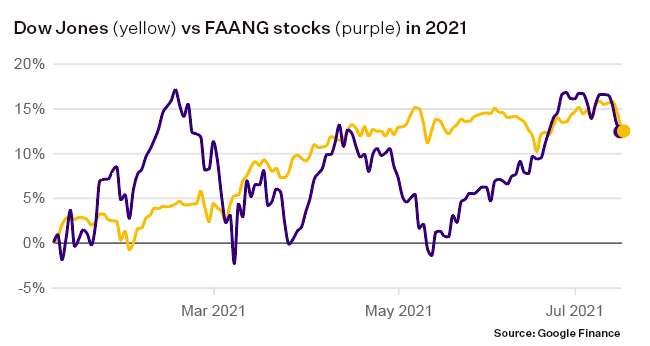
This year the Dow Jones has been keeping pace with the FAANG tech stocks — and even outperforming them. Pendal’s Ashley Pittard explains why global equities investors are looking further afield.
- Investors are looking to broaden their horizons beyond FAANG stocks.
- Inflation and wages are the critical variables.
- The world is normalising and that provides opportunities.
ASHLEY Pittard thinks the 2020s are a bit like the late 1960s and early 1970s. At least in equity market terms.
“Back then there were nice returns in equities. Inflation was increasing but it wasn’t out of control,” says Pendal’s head of global equities. “A limited number of stocks dominated the market.”
As equities appreciated in the late 1960s, and economies grew, there was a broadening out of the market, and investors looked further afield.
“The equivalent in recent years was the FAANG stocks. Everyone wanted them. But why they’ve underperformed over the last year is that growth has expanded into other areas. Commodities, for example,” Pittard says, likening the expansion to the movement beyond the “nifty 50” stocks of the late 1960s.
“What you are seeing now is that people want to own the growth stocks and rent cyclical stocks … but as the world normalises, people will be forced to own the cyclical companies.”
The big change over the past month was triggered by the US Federal Reserve.
“The Fed made it pretty clear that rates will go up and the market read that the risk of overheating had dramatically changed,” Pittard says.
It all evolves around the long-term dynamics of the market, Pittard says. Will inflation be higher over the next three to five years, than the last three to five years?
“I think it will. Interest rates are significantly lower than they have been over the past decade. Wage growth is now recovering and compounding at three to five per cent per annum,” he says. “In fact, you are seeing some fast-food companies paying up to $1,500 sign on bonuses for staff.”
“And if you look at house prices in the US, they’re at 30-year highs. House price growth is at 14.5 per cent.”
“It appears that things are getting in place for inflation to be over the Fed’s two per cent target number, and it won’t be transitory,” Pittard says.
Pittard’s fund on average only turns over 20 per cent each year. The fund managers spend time for looking for undervalued assets and waiting for them to appreciate.
“We like to buy the waterfront property when its trading at a discount and then we’ve got the patience to let things play out.”
– Ashley Pittard, Pendal’s head of global equities
Pittard gives the example of his fund increasing positions in Boeing following a series of accidents involving the 737 Max, and Airbus during the COVID crisis when airlines were on their knees.
“Today, the airlines have gotten rid of many of their old 747s, and the older pilots got axed. Now the US domestic capacity is back at 80 per cent, and recently United Airways said it wanted to buy 250 planes.”
The anecdote highlights that there are opportunities available if you are patient and can find assets that are under-valued because of the abnormal world in which we’ve been living.
“Our core tenant … is that the world is beginning to normalise. Around the world, people are starting to go out. There are fewer lockdowns and as a result people are spending more money on travel and eating out. Wage growth is getting back to normal. And that means there’s opportunities.”
About Ashley Pittard and Pendal Concentrated Global Share Fund
Ashley Pittard leads Pendal’s Global Equities investment boutique. He is responsible for setting the strategy, processes and risk management for the boutique and its funds including Pendal Concentrated Global Share (COGS) Fund.
Ashley has more than 24 years of finance experience, including roles in petroleum economics, global energy investment analysis and 20 years as a global equities fund manager.
Pendal COGS Fund is an actively managed, concentrated portfolio of global shares diversified across a broad range of global sharemarkets.
Find out more about Pendal Concentrated Global Share Fund
Pendal is an independent, global investment management business focused on delivering superior investment returns for our clients through active management.
Contact a Pendal key account manager here.
- Run in markets has made many equity markets, styles and sectors expensive.
- Niche opportunities are available but beware some emerging markets.
- COVID Delta-variant and moreover future variants the big unknown.
ECONOMIC data out of Australia and many parts of the globe have been very positive for most of the past year, albeit from a low base. Equity markets have responded positively, and markets have run sharply higher.
Wall Street is up close to 40 per cent over the past year. European markets have also improved though not to the same extent. London’s FTSE is up more than 8 per cent. Germany’s DAX and the broad based STOXX Europe 600 are both around 20 per cent higher.
It’s the same story in Asian markets, with Japan’s Nikkei up 30 per cent, and markets in Hong Kong and Shanghai 20 per cent higher than a year ago. The local S&P/ASX-200 is 25 per cent higher.
“The strong growth, particularly in the employment market, has been quite remarkable,” says Michael Blayney (pictured above), head of the Multi-Assets team at Pendal. “But what you are seeing now in equity markets is that most of that good news is priced in. In fact, some are starting to look considerably expensive.”
When allocating capital, Blayney is now looking for more niche opportunities. While there’s been broad-based increases over the past year, there’s less opportunity in doing that going forward.
“We’ve had a handful of assets like Mexican equities, listed property and dividend futures in Europe. We have quite a bit of exposure to small caps as well. They are much more bespoke investments,” Blayney says. “Where our mandate allows, we’ve shifted active risk taking from outright equity exposure – and are now focused on trades linked to the reopening rotation into value opportunities.

“We’ve got this combination of good economics and good momentum. But valuations are getting a bit toppy. At this point in the cycle, we are looking at more bespoke trades and relative value opportunities.”
At this time of the cycle, emerging markets are often nominated as opportunities for asset allocation. But Blayney points out that not all opportunities in emerging markets are the same.
“If you look at China, it’s actually a bit expensive. It’s one of the few markets in the world where we’ve seen downward earnings revisions and that’s a bit unique at the moment. The Chinese economy is weakening to the extent that we may soon see an easing of policy. As a result, we are a little bit more cautious on China.
“Also, there’s structural issues to think about. China has an ageing population. People talk about demographics as benefits of emerging markets, but they aren’t always positive, especially if you look at China and Korea. For example, demographics in China have deteriorated to such an extent that the regime had to abandon its “one child policy” several years ago, which has now been replaced with a “three child policy”.
“Then there’s Taiwan. They have a lot of exposure to semi-conductors, and that’s relevant from a valuation perspective and also a geopolitical perspective. There is a very limited capacity to produce very high-end semi-conductors and Taiwan, in particular, is sitting on this very important strategic asset,” Blayney says.
“Those sorts of geopolitical risks make you think about whether there could be a major conflict between the United States and China over Taiwan,” Blayney says. “It’s that type of tail risk that current ‘priced for perfection’ valuations in many parts of financial markets globally are ignoring”
Covid case numbers are less important than you think

If you’re investing money in Australia today, the big issue on everyone’s mind is the impact of the delta variant of COVID-19 breaching quarantine and what it means for the local economy and financial markets.
Looking at overseas experiences is a good way of gaining some insight into what to expect.
“We are starting to look at some of the hospitalisation data out of the United Kingdom,” says Michael Blayney, head of the Multi-Assets Investments team at Pendal. “Looking at the rate of hospitalisations and people on ventilators will eventually be more relevant than the number of infections.
“We will need to get to the point where we can treat COVID like the flu. Naturally we will be somewhat more vigilant than we are with the flu, but vaccination is likely to be effective against preventing the most severe cases and that has massive implications for mobility and people’s ability to go out and spend which flows through optimism in financial markets,” Blayney says.
The UK and Israel, which both have high vaccination rates and are experiencing surges in the delta variant of COVID-19, are good case studies, Blayney says.
“If we start to see hospitalisation rates going up, and an escalation in more serious cases, then that will have a very negative impact on risk sentiment, though so far, so good. Conversely getting to herd immunity can provide a significant tailwind to many parts of the market that have lagged due to COVID.”
About Michael Blayney and Pendal’s Multi-Asset capabilities
Michael Blayney leads Pendal’s multi-asset team. Michael has more than 20 years of investment management and consulting experience. He was previously Head of Investment Strategy at First State Super and head of Diversified Strategies at Perpetual.
Pendal’s diversified funds provide investors with a variety of traditional and alternative asset classes and strategies.
The team — which also includes Stuart Eliot and Allan Polley — manages our multi-asset portfolios with a focus on strategic asset allocation, active management and tactical asset allocation.
* The Pendal Defensive Equity Income Fund closed to applications and reinvestments effective 7 June 2018 and will terminate effective 17 July 2018, with the assets liquidated and the net proceeds returned to investors. More information.
Significant Features: The Pendal Defensive Equity Income Fund aims to provide a consistent monthly income to investors.
Fund Objective: The Fund aims to provide a consistent monthly income plus franking credits; a total return (including franking credits and after fees, costs and taxes) that exceeds the benchmark over rolling 3-year periods; and reduced exposure to the S&P/ASX 200 Index.
- European bourses have long been seen as less attractive equity markets
- Led by banks, many stocks in the region now look undervalued.
- Growth in Europe expected to continue way above trend until beyond 2023.
IT’S BEEN a while since Europe excited global equity investors. For most of the past few decades, there’s always been something a little more exciting – the US, emerging economies, private markets.
But as the world emerges from the COVID pandemic, there’s a whiff of excitement about European equities. And that provides opportunity.
“In my world – continental Europe – earnings forecasts still look very much too low,” says Paul Wild, senior fund manager at JOHCM Global & International Equities. With second quarter earnings season only a fortnight away, Wild expects continued surprises vis-à-vis a year earlier.
“While it’s clear that peak earnings momentum has past, it is still going to remain positive. We could see earnings growth approaching 50 per cent for 2021. Also with European GDP in 2022 likely higher than this year, the earnings outlook stays strong”
Banks and financial companies, like most major markets, are a large part of European equities. But they are behaving atypically at the moment, and that could provide an opportunity.
“The story of European financials is not really yield curve driven at the moment. It’s more about the effects of coming out of the crisis, and that’s about normalising provisions,” Wild says.
Banks increased provisions for bad debts at the beginning of the pandemic, but as the macro environment turned out to be better than forecast, provisioning requirements have fallen. The banks are over-capitalised, Wild says, and that means big dividend payouts later in the year.

2021 Money Management of the Year Awards
Pendal Australian Shares Portfolio
Winner – SMA Australian Equities
Pendal Property Investment Fund
Winner – Australian Property Securities
The other factor for European (and global) banks is inflation.
“The commentary from the Fed a few weeks ago is far and away the key event of recent times,” Wild says. “The market was very much positioned … for the Fed to let things run hot. But the Fed’s dot plot effectively called for two rate hikes in 2023 – they were much more hawkish than what the market was positioned for. The yield curve flattened.”
The question is: has the market interpreted the Fed correctly?
“It’s very difficult for anyone to make a real call on inflation with absolute convictions at the moment given the transitory effects, given past mistakes it seems unlikely the Fed will be too pre-emptive” Wild says.
“Overall global valuations are pretty high at the moment, but Europe looks quite reasonable versus the MSCI World. Whilst bonds are still priced for the moon,” he says.
“If you buy a Government bond, in many cases you are committing yourself to a negative real return. So, then you look at equities and the cash dividend potential, particularly in Europe. It looks like growth in the region can stay sustainably strong until the back of 2023,” Wild says.
“For so long Europe has just been lacking in any positive theme, and that’s now changed as it emerges stronger from the pandemic.”
About Paul Wild and Pendal global equities strategies
Paul Wild is senior fund manager with J O Hambro Capital Management, a London-based active investment manager which is part of Pendal Group.
Pendal offers a range of global equities strategies to Australian investors including:
- Pendal Concentrated Global Share Fund
- Regnan Global Equity Impact Solutions Fund
- Pendal Global Emerging Markets Opportunities Fund