
James Syme (pictured) is a London-based senior fund manager with Pendal subsidiary J O Hambro.
There are two broad drivers of the emerging market equity asset class: global growth and US dollar liquidity. This update serves to point out that neither of these drivers is showing any sign of being supportive, but also that a robust investment process and differentiated portfolio can still find opportunities in the asset class.
Global growth is sick and failing to respond to treatment because no treatment has been applied. In the developed world, the US has seen the weakest ISM manufacturing survey in 10 years as well as weakness in the crucial services data, while eurozone 2019 real GDP growth forecasts have been steadily revised down to the current level of just 1.1%.
In the emerging world, recent Chinese data has been particularly soft, with fixed asset investment (+5.5% year-on-year), retail sales (+7.5% year-on-year), industrial production (+4.4% year-on-year) and exports (-1.0% year-on- year) all coming in both low and below expectations.
Exports and the dollar
The exports of the most cyclically-exposed emerging economies tell a similar story, with Korean exports -11.7% and Taiwanese exports -4.6% in the year to September. Meanwhile, the inherent strengths of the US economy relative to the rest of the world, combined with the asymmetric impact of the trade war, have kept investors more optimistic about US assets and/or more pessimistic about the need to have sufficient US dollar-denominated assets. This has happened despite the enormous increase in the US fiscal deficit (federal government gross issuance will be around US$11.3 trillion in FY2019, up from around US$10 trillion in FY2018, with the majority of that issuance at maturities of six months or less), which represents a huge drain on global dollar liquidity.
The net effect of this has been a resumption of the uptrend in the US dollar relative to other global currencies that began in 2011. The slide in growth and tight liquidity have been transmitted into emerging economies, with negative GDP growth revisions in almost all of the 26 emerging market economies during 2019. Even previous areas of strength, such as India, Pakistan and Thailand, have been caught up in the slowdown, with the 2019 GDP growth estimate revised down 0.8% in India, 1.2% in Pakistan and 0.8% in Thailand. Global conditions remain tough.
Country focus yields opportunity
Our investment process is designed to seek opportunity, principally at the country level, and we have found various areas of opportunity through our process this year. One would be areas where GDP growth estimates have held firm, including Eastern Europe, where aggregate GDP revisions are about flat year-to-date. We have held some exposure in the Czech Republic, which has been a slight laggard, and considerably more in Russia, which has substantially outperformed.
Another source of opportunity is in the pricing (both equity and currency) of these macro conditions. Even where growth is weakening, panicking investors can drive valuations to levels that overstate the challenging fundamentals, and we aim, through a disciplined monthly review, to identify these opportunities.
One such opportunity has been Turkey. With 2019 GDP growth revisions of -1.5%, Turkey has been the second-weakest of all emerging economies year-to-date (Brazil, at -1.6%, is in last place). However, in May the pricing of that slowdown became wildly excessive and the Turkish stocks we bought at the end of that month have very substantially outperformed (and, importantly, have actually made money for investors). Interestingly, Turkey’s 2019 GDP growth estimate has in fact been revised up since the end of May, suggesting that the worst of the selling pressure (and the greatest opportunity for us) was right before the turn. Most, perhaps all, investing is a trade-off between fundamentals and valuation, and we look to use both to identify top-down, country-level opportunities in EM equity, no matter how good or bad the global environment is at that moment.
With another cut from the RBA in October and expectations for further easing, in this update we examine the outlook for one of the central bank’s key targets; inflation. Our cash manager, Steve Campbell assesses the direction for the other – the labour market, which received greater emphasis in the latest statement from Governor Lowe. Meanwhile, the path of domestic credit continues to be directed by the global macro backdrop and as such we explain why we maintain flexible positioning.
Finally, humans’ impact on the environment has garnered even greater attention over the past several months and its importance for our clients continues to grow. We explain the evolving area of impact investing and illustrate the positive contributions it makes to the environment and broader society.
Australian Quarterly Update

Updated asset allocation ranges and neutral positions
Following a review of the asset allocation ranges and neutral positions of Pendal’s diversified funds (Funds) and Pooled Superannuation Trusts (PSTs):
• the asset allocation ranges will be changed effective 6 November 2019 and
• the asset allocation neutral positions will be changed effective 6 November 2019.
Details of these changes can be found here. The Funds’ Product Disclosure Statements (PDS) have been updated and are available here.
The changes are expected to deliver an improved investment outcome for investors through better expected risk-adjusted returns. The changes reflect our latest asset class assumptions for return, risk and inter-asset class correlations and position the funds to take advantage of future market conditions.
Changes to the Fund’s management costs
Pendal Sustainable Conservative Fund (APIR: RFA0811AU, ARSN: 090 651 924)
Reduction in management costs from 25 September 2019
From 25 September 2019, the issuer fee for this Fund will reduce from 0.80% pa to 0.70% pa.
The banking sector may no longer be the defensive investor’s place of refuge for relatively stable and reliable returns. But the Financials sector houses a range of opportunities beyond banks and insurers that may provide a different risk-return experience.
Pendal’s Ashley Pittard shares his thoughts on investing in the lesser observed constituents of the financial world – stock exchange operators.
Find out more about the Pendal Concentrated Global Share Fund.
Financial stocks made up 26%^ of the global share market index before the Global Financial Crisis.
That’s now down to around 15%* today thanks to a shake in the sector and ‘de-yielding’ of the global monetary system.
The sector heavyweights of the banking fraternity have experienced a general de-rating with many investors turning away from the sector.
US banks — which form a large part of the global banking segment — have materially underperformed the market since the GFC.
They are now back to levels last seen in 2009 and 2016 as you can see in the following chart which tracks the relative performance of US banks against the broader US equity market.
US Banks now at pre-GFC levels
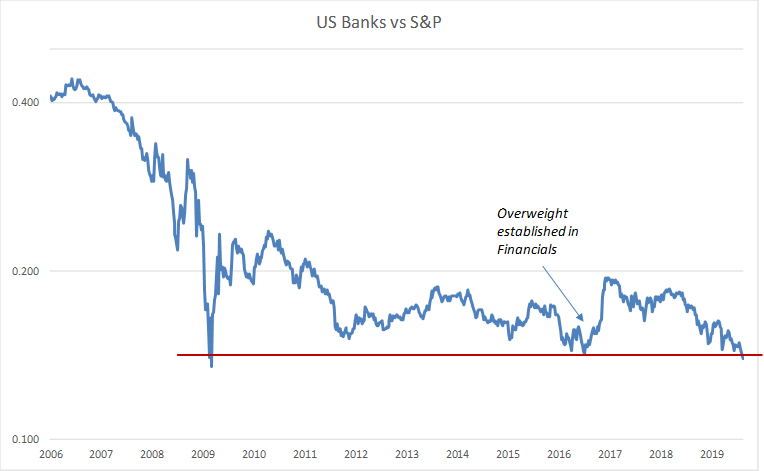
Source: Bloomberg, Pendal using representative exchange traded products
In mid-2016 at the inception on the Pendal Concentrated Global Share Fund we formed a view on a range of major influencing factors including Brexit, interest rates and inflation.
This led us to take a deeper review of the sector to identify areas of interest.
We already knew that many of the sector’s participants were well established with considerable economic moats and scale. This research culminated in establishing material positions across the financials sector.
Within the banks we favoured the regional players over the globally focused competitors which typically have significant investment banking exposures.
This led to positions being established in Wells Fargo, Lloyds Banking Group, Caixa Bank and KBC Group.
The banks we hold are of higher quality as they have generated higher returns than their peers through scale-driven cost efficiencies.
This has enabled them to build the capital required by regulators and be in a position to return the remaining free cash flow in the form of dividends and buybacks to shareholders during a tough environment.
Considering the regional nature of these businesses we expect this cohort will continue to exhibit a degree of resilience should the broader banking sector experience further de-rating.
However, if the broader environment does instead improve, we expect these companies to outperform the market much like they did following the dislocations in 2009 and 2016.
Stock exchanges – the forgotten financials
The other often overlooked segment of Financials are stock exchanges.
Stock exchanges generate revenue based on trading volumes, with an inter-related link to market volatility.
As market uncertainty develops, the derivative products issued by exchanges tend to generate higher revenues as a function of increasing spreads on pricing as well as through higher trade volumes.
Market volatility remains depressed and near historically low levels.
This negatively impacts revenue for companies like CME Group — operator of the Chicago Board of Exchange which holds a 90% market share in global futures trading and clearing services.
We launched the Fund with half of the financials exposure held in stock exchange operators.
This has made a strong contribution to the Fund’s returns over the period. Collectively, our investments in stock exchange operators have generated an average annual return of 23% (in Australian dollar terms).
In December 2018 we took profits on one of these businesses — Intercontinental Exchange — after the stock reached our valuation threshold of a 5% buyout yield.
Staying true to form
Stock exchanges remain a centrepiece of the Fund’s financials exposure and we expect these stocks to continue to re-rate as market volatility increases.
Our process is designed to identify fundamentally sound companies which have been flat or underperformed for a number of years.
Of course, the present environment is far from certain for banks in the short term amid the macro policy tensions but, from a long term perspective their valuations remain compelling to us.
At these levels history has shown it can be beneficial to look through the immediate market concerns and noise and invest in high quality companies wherein their intrinsic value is not being reflected in their current stock price.
^ Source: Bloomberg. Financials weight as represented within the MSCI World Index as at 31 December 2016.
* Source: Bloomberg. Financials weight as represented within the MSCI World Index as at 31 August 2019.
Ratchet: a device consisting of a bar or wheel with a set of angled teeth in which a pawl, cog, or tooth engages, allowing motion in one direction only; a situation or process that is perceived to be changing in a series of irreversible steps
At first, I mulled if ‘Treppenwitz’ is an apt word to describe President Trump’s comebacks to the tariff pronouncements by China. I have experienced this phenomenon before. When someone says something to me which overwhelms me, leaves me speechless, and I cannot come up with a snappy comeback on the spot. Yet once I have walked away from the situation, the perfect response suddenly pops into my head. Literally translated, Treppenwitz, a German word, means staircase joke, because the witty retort hits you in the stairwell on your way out. By then it is usually too late.
However, I quickly realised my folly. That is probably the opposite of how President Trump reacts. He is more off the cuff, speak your mind and ratchet. Since mid-2018, one of the risks markets have to contend with is whether this trade war will persist for a long time. If ever there was a doubt on that outcome, it was possibly snuffed out in August 2019. I think it is fair to say that decision-makers in China and companies on both sides of the tariff divide have decided that a resolution, if any, will at best be temporary in nature.
Then what about the other ratchets around the world? Prime Minister Johnson has engaged on a path that seems to indicate a very high probability of a no-deal Brexit. In Argentina, despite a US$57b bail-out by the IMF, we have capital controls, while Ms Legarde, the ex-IMF chief, will head the ECB. These different, seemingly unconnected events manifest themselves in the markets in one measure – the strong US dollar.

Source: Bloomberg
When risk aversion increases, the usual beneficiaries of the flight to safety trade reflect this angst. I have no clue whether we are in a phase of an even stronger or possibly weaker US dollar. History provides a reasonable guide to outcomes in markets in either case. However, in an era of nationalism, policy activism and intervention, it would take a brave soul to predict the future.
Luckily, I remember that fortune favours the brave. As the tiff with China has intensified, you might have noticed that we have ratcheted up our holdings in China, particularly the ‘A’ share market. At the end of last month, our holdings in ‘A’ shares represented approximately 10% of the portfolio. Our rationale is threefold:
1. Invest in quality businesses with high or rising margins/return metrics (with low volatility of those metrics) and a growing top line. In a world of low growth, it is a global phenomenon that higher growth companies are being rewarded more by the markets. However, these companies must have the ability to withstand disruption (whether online or policy) or benefit from it.
2. From 1978 until around 2015, China enjoyed almost uninterrupted high economic growth. In that environment, it is not easy to pinpoint businesses that have genuine resilience to economic cycles. Yet from 2015/16, we have witnessed a marked slowdown in growth, volatility in the renminbi and sharp policy zigzags in China. What is normal in any other emerging market companies in China are now facing with gusto. This provides a more fertile environment for companies that can manage better than the average ones. (Additionally, in the past, some of the best firms listed in either Hong Kong or the US, obviating the need to access the ‘A’ share universe).
3. With index providers increasing weightings for Chinese ‘A’ shares, there will be a trend over the long term towards the ‘institutionalisation’ of equity markets. Trading is currently dominated by retail investors, tends to be short term in nature and mostly, I hear (no pun intended), based on rumours and news flow. Over time, as larger pools of institutional capital pour in, it is reasonable to expect this to change. There is a caveat to this, of course. If most of the capital flows from index funds and ETFs perhaps that stream of capital might not focus on the quality names we have an interest in.
Time will tell whether this line of thinking is brave or foolhardy. Increasingly, there are signs that lower interest rates and looser monetary policy engineered by central banks are less potent than before. Some term it the ‘Japanisation’ of a world marked by disinflationary tendencies and beset with debt. Countries held hostage to external funding, like Argentina, pay a price in the US dollar value of assets. Those who have an ability to finance themselves with domestic debt pay a price in lower and faltering growth. If this indeed turns out to be the case, China might indeed be more like Japan. The probability that high growth domestic business make good long-term investments might be high. As insurance, we do hold some in the portfolio. Yet, as stated earlier, our attempt is to find and invest in more of the quality names in ‘A’ shares in China.
Fund Manager commentary for the month ended 31 August 2019 covering market reviews, Pendal fund performance and our outlook for the period ahead.
Access the monthly commentary here.
We assess and score every country in the emerging markets index on a 5-point framework: growth, liquidity and monetary environment, currency, politics and governance, and valuation. We are investing based on where trends are going, not where they have been. In this latest piece James Syme assesses the currency situation particular to China and the flow-ons from the US-China trade war.

In August, the Trump administration formally designated China a “currency manipulator” (following a tweet to this effect from the presidential Twitter account). The term has formal meaning in US law, with the US Treasury required to produce an annual report identifying countries engaging in currency manipulation. China does not meet the technical criteria laid out in 2015 legislation (current account surplus, bilateral trade surplus and evidence of one-sided intervention), and, although legislation from 1988 does give more flexibility, the timing of this designation, away from the formal annual review, suggests a political rather than technical motivation.
China’s current account surplus is forecast by the IMF to be only 0.4% of GDP, which is effectively at balance. China does run a bilateral trade surplus with the United States (currently averaging US$ 27b/month), but there really is no evidence of ‘one-sided intervention’. Chinese foreign exchange reserves have been steady at around US$3.1 trillion for several years now, the currency moves broadly in line with the reference rate from a basket of currencies and, crucially, if the currency has deviated from the basket reference rate in recent months, it is to the stronger side.
Followers of our process will be aware of our view that a focus on currency valuation is a core part of the work when investing in emerging markets, as well as our preference for real effective exchange rate (REER)-based methods to do this. We are big fans of the IMF’s External Sector Report, in which every July, the IMF guides towards its views on the fundamental valuations of 26 leading currencies, focusing on how much a country’s REER would need to move to drive stability in that country’s current account balance. The 2019 External Sector Report concluded that “China’s external position was assessed to be in line with fundamentals and desirable policies, as its current account surplus narrowed further”. It also noted that “the identified policy gaps are small on net (-0.3%), reflecting largely mutually offsetting forces: loose fiscal policy and excessive credit growth on the one hand and inadequate health spending on the other hand.”
What is most interesting in the report is the consistent focus on policy-driven external imbalances in other economies: “In many countries with higher-than-warranted current account balances (Germany, Korea, Netherlands, Thailand), a tighter-than-desirable fiscal stance contributed to those external imbalances”. There is plenty of imbalance that the US Treasury could be focusing on given 2019 current account surpluses in those four countries are forecast by the IMF to be 7.0%, 4.6%, 9.3% and 7.1% of GDP, respectively. For the record, in the last three years the foreign exchange reserves of Thailand have increased by 23%, very much suggesting one-sided intervention there.
In a sense, China is merely the lightning rod for American perceptions that the US dollar is overvalued. The IMF’s report concludes that the dollar was 8% overvalued at the end of 2018, and the desire of US policymakers to have a more competitive exchange rate is clear. Unfortunately, the desire of other countries to accumulate US dollar assets is very rational. As Mark Carney, Governor of the Bank of England, noted in a speech in August, the US represents 10% of world trade and 15% of global GDP but 50% of global trade invoices, while two-thirds of EM external debt and global foreign exchange reserves are in US dollars.
We remain, then, in a position where structural economic imbalances are driving global geopolitical tensions, and the potential exists both for an escalation of US-Chinese conflict as well as an extension of these stresses to other countries, both developed and emerging. Someday, this war’s going to end. That would be just fine for emerging market investors. Until then caution is warranted.
About the Pendal Global Emerging Markets Opportunities Fund
Be a part of the world’s fastest growing economies
With just over 12 months to go before the Americans return to the polling booths, Pendal Head of Bond, Income & Defensive Strategies Vimal Gor published his thoughts in the AFR on why the US economy is on a near-certain path to recession, and why President Trump’s new world order on trade is a success in the making.
View the AFR article