
What economic conditions would make the RBA happy? Pendal’s head of government bond strategies TIM HEXT has some answers
I SPOKE last week about central banks needing tighter conditions to help limit inflation in our Income and Fixed Interest Weekly note.
I mentioned the term a “hawkish hike” which prompted a number of readers to ask: “aren’t all hikes by definition hawkish?”
The answer is that they are… but the accompanying statement is a chance to influence expectations of future hikes.
This is especially so in countries where longer term fixed rate home loans are predominant – no point hiking and seeing them go nowhere. We expect the Fed to do this in their March hike, possibly pushing up the terminal level of rates as well. This will not be bond friendly.
In the US Goldman Sachs produces a Financial Conditions Index (FCI) to try and capture this wider view.
The FCI is largely made up of 10-year nominal Treasury yields and Corporate Bond spreads (as measured by non-financial BBB bonds 15+ years). They also include equities, the TWI and the Fed Funds rate — though these are much smaller.
The important point is that moving Fed Funds — while other indicators stay put — does not tighten financial conditions.

Find out about
Pendal’s Income and Fixed Interest funds
They need to see a measured sell-off in term rates. Wider credit spreads help. Lower equities also help, provided they don’t go into a tailspin.
Any Fed ‘put’ for markets (where they jump in to protect them) is a very long way from here.
What would make the RBA happy
In the Australian context, the RBA would be extremely happy if by the end of 2022 inflation is at 3.25%, unemployment sub 4%, wages 3.5%, equities 10% lower, 10-year bonds 2.75% and cash rates 1%.
It is not the RBA’s job to make sure superannuation balances have positive performance in any given year. Or to protect house prices.
Given the massive rises in 2021 a negative year for assets is not a major setback. A year where labour outperforms capital is long overdue.
Of course, the Ukraine disaster will have an impact. But prospects of higher inflation will mean the Fed will need to get on with its hiking path, even if near-term risk markets are unsettled.
About Tim Hext and Pendal’s Income & Fixed Interest boutique
Tim Hext is a Pendal portfolio manager and head of government bond strategies in our Income and Fixed Interest team.
Tim has extensive experience in banking, financial markets and funding including senior positions with NSW Treasury Corporation (TCorp), Westpac Treasury, Commonwealth Bank of Australia, Deutsche Bank, Bain & Co and Swiss Bank Corporation.
Pendal’s Income and Fixed Interest boutique is one of the most experienced and well-regarded fixed income teams in Australia.
Find out more about Pendal’s fixed interest strategies here
About Pendal
Pendal is a global investment management business focused on delivering superior investment returns for our clients through active management.
In 2023, Pendal became part of Perpetual Limited (ASX:PPT), bringing together two of Australia’s most respected active asset management brands to create a global leader in multi-boutique asset management with autonomous, world-class investment capabilities and a growing leadership position in ESG.
Here are the main factors driving the ASX this week according to our head of equities Crispin Murray. Reported by portfolio specialist Chris Adams.
Find out about Crispin’s Pendal Focus Australian Share Fund
Find out about Crispin’s sustainable Pendal Horizon Fund
MARKET reaction to Russia’s invasion of Ukraine was more subdued than many would have expected, though there has been underlying volatility.
The S&P500 actually ended up last week, gaining 0.8%. This is possibly because the market had already priced in a high probability of conflict – alongside the underlying issue of higher rates.
Sentiment was cautious as a result. The view that sanctions would not cover key commodities and NATO forces would not engage on the ground tempered perceived near-term impact on the broader global economy.
A spike in gold, oil, wheat and other commodities unwound in the space of a few hours. This was a catalyst for recovery in parts of the market that initially fell the most.
The domestic market was hit harder than the US with the S&P/ASX 300 off 2.4%. This seems mainly due to anticipation of a more negative reaction in offshore equities.
This sentiment-driven fall overwhelmed a reasonably positive final week of reporting season, which underpinned the consistent message that the domestic economy looks set to recover well while cost pressures are building in certain areas.
Recent market caution could mean the late-week bounce continues, likely led by growth stocks.
But we remain wary this will persist given liquidity withdrawal has not yet started. Economic strength will probably also continue to underpin inflationary pressures, which could be exacerbated by the geopolitical risks triggered by Russia last week.
This makes the policy response even more challenging.

Pendal Focus Australian Share Fund
Now rated at the highest level by Lonsec, Morningstar and Zenith
This will be combined with a reappraisal of energy policy in the West. Significant sums will need to be invested to accelerate the energy transition and build resilience in the supply of energy and other critical commodities.
This reinforces this long-term theme of far higher levels of investment which underpin commodity demand.
Economics and policy
Some are questioning whether central banks will delay rate hikes in response to the Ukraine crisis.
This is unlikely in our view — the level of inflation is just too high to delay action. The only small shift is that the probability of the Fed hiking rates 50bp in March has fallen.
Economic momentum appears to be building, particularly in the US. We have seen incomes remain strong, unemployment claims hit 52-year lows, Covid cases decline and strong capital goods shipments and house prices accelerate.
US personal income growth has now cycled through all the additional hand-outs people were receiving.
While it fell marginally below the growth in outlays for the first time since Covid struck, the savings rate remains in normal territory. This indicates households have been able to maintain spending without dipping into the excess savings built up over the past two years.

Sustainable and
Responsible Investments
Fund Manager of the Year

The Citi Economic Surprise Index is on the rise again. This measures the difference between reported economic data and consensus expectations (it rises when the data is better than consensus).
Unlike the 2018 rate raising cycle when the Fed raised four times while data was starting to disappoint, this is not the case currently.
This will be a signal to watch as rates rise.
Markets
The combination of high volatility and a growing use of short-dated options by retail and institutional investors has exacerbated recent market moves.
This year we have seen rising volatility force investors to sell down risk. This can have a self-reinforcing effect due to the technical nature of options.
The sharp bounce at the end of last week shows this trend can operate in reverse — which may be supportive in the near term, particularly if volatility starts to subside.
Current volatility levels signal daily moves of 1.5% in US equities, so it is plausible this subsides. However in our view this would be a technical bounce and we are still working through a correction as liquidity becomes a headwind.
That said, we note that sentiment indicators remain at the more pessimistic end. US domestic equity fund inflows have still not reversed — though this will be something to watch as liquidity is withdrawn.
In terms of other assets oil is very hard to call in the near term.
There is still a potential for a deal between the US and Iran, which is probably worth $10-15 off the price in the near term. There is also the threat of releasing strategic reserves. But the medium-term fundamentals are supportive given low inventory, improving demand and potential supply disruption.
Soft commodities are the other key sensitive area to watch given the political consequences of high food prices. Wheat traded almost identically to oil.
Aussie stocks
Domestic market moves were dominated by the Ukraine news, which muted reactions to positive results such as NEC and exaggerated negative reactions.
Banks underperformed after a good run on initial concerns that the rise in rates may be slowed given geopolitical uncertainty. That narrative has quickly unwound.
The 32% bounce back in Block(SQ2) (formerly Afterpay) on Friday highlighted the potential for a positioning unwind in this market.
The underlying themes for reporting season have been constructive with regard to the domestic economy. Rising costs are an issue, the ability to price for it is key.
About Crispin Murray and Pendal Focus Australian Share Fund
Crispin Murray is Pendal’s Head of Equities. He has more than 27 years of investment experience and leads one of the largest equities teams in Australia. Crispin’s Pendal Focus Australian Share Fund has beaten the benchmark in 12 years of its 16-year history (after fees), across a range of market conditions.
Pendal is an independent, global investment management business focused on delivering superior investment returns for our clients through active management.
A weekly comment from Pendal’s head of government bond strategies, Tim Hext
WHEN it comes to bonds, some things are easy to read.
Strong data normally means inflation pressure which means yields sell off. And vice versa.
But events such as this week’s Ukraine crisis are less clear.
Do you jump on risk off and buy bonds? Or do you fret that already high inflation pressures are going to worsen, forcing central banks to tighten more?
This is a glimpse into the complicated world of stagflation.
Even career central bankers such as RBA governor Phil Lowe have only distant memories of stagflation.
Like most, he has largely operated for 30 years in a world of solid growth but low inflation.
Policy could be cautiously eased, unemployment falls and asset prices boom. Life is great for central bankers.
Hit the reverse button though and choices become very hard.
Now is such a time.
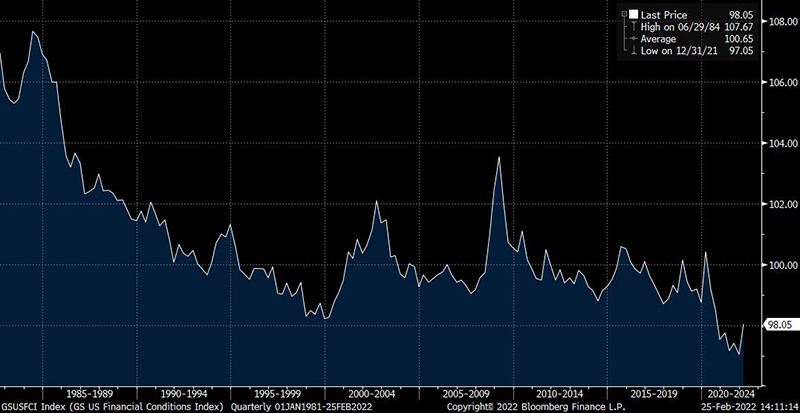
The US Fed needs to get financial conditions tighter in the US — they remain near all-time lows despite very high inflation, as you can see in the Goldman Sachs Financial Conditions Index below:
The Ukraine events may hit sentiment in Europe and even globally, but sanctions will push commodity prices even higher.
There is a left tail risk it worsens. But logic (and hope) suggest Putin’s aim is to install a Russia-friendly (or at worst neutral) buffer between him and NATO, rather than to expand further.
We think the US Fed may tip its hat to events by only going 25bp in March. But it will be a hawkish hike — that is, they need long-end yields to move higher to tighten conditions and rein in inflation.
This is especially so in an economy where mortgages are tied more to long-term, not short-term rates.
We saw such a thing from the RBNZ this week, which went out of its way to increase forward expectations despite only hiking 25bp not 50bp.
Find out about
Pendal’s Income and Fixed Interest funds
This week’s events have not fundamentally changed our view that equities drift lower and bond yields higher over 2022.
After all that’s how you get tighter financial conditions.
What central banks want they can engineer — at least short term.
The 2021 halcyon days for asset markets are fading fast.
About Tim Hext and Pendal’s Income & Fixed Interest boutique
Tim Hext is a Pendal portfolio manager and head of government bond strategies in our Income and Fixed Interest team.
Tim has extensive experience in banking, financial markets and funding including senior positions with NSW Treasury Corporation (TCorp), Westpac Treasury, Commonwealth Bank of Australia, Deutsche Bank, Bain & Co and Swiss Bank Corporation.
Pendal’s Income and Fixed Interest boutique is one of the most experienced and well-regarded fixed income teams in Australia.
Find out more about Pendal’s fixed interest strategies here
About Pendal
Pendal is a global investment management business focused on delivering superior investment returns for our clients through active management.
In 2023, Pendal became part of Perpetual Limited (ASX:PPT), bringing together two of Australia’s most respected active asset management brands to create a global leader in multi-boutique asset management with autonomous, world-class investment capabilities and a growing leadership position in ESG.
Investors are voting against the election of male directors in companies that lag on gender diversity, according to new research from Regnan. ALISON GEORGE explains what it means for investors
- Reduced support for male directors in low-diversity companies
- Diverse boards benefit from broader skills sets
- Find out more about responsible investing leader Regnan [regnan.com]
INVESTORS are voting against the election of men to boards that lag gender diversity targets, according to new research from responsible investment pioneer Regnan.
It’s another indication Australians are placing more importance on Environmental, Social and Governance factors when making investment decisions.
Regnan’s findings reflect a toughening of gender diversity recommendations from proxy advice firms. That’s come in response to escalating concern among institutional investors that some ASX-listed companies are dragging their feet on finding female directors.
Regnan’s head of research, Alison George, says a study of voting patterns at annual meetings in the second half of 2021 shows a decline in support for male directors on low-diversity boards.
“Investors are showing they are willing to take a stronger line with companies that are yet to achieve gender diversity at board level ,” says George.
Less support for male-dominated boards
Regnan examined two groups of companies in the ASX 300 — those with low gender diversity at board level and a smaller group with no female directors at all.
For the low-diversity boards, male directors were supported by 93% of votes on average compared to 98.8% for women.
“Support for re-election of directors in Australian companies is typically very high — a vote that dips below 95 per cent stands out,” says George.
“While this is a small sample set it’s quite a strong difference. Gender diversity concerns are driving the outcome.”
Held to account
Investors were using their votes to hold those responsible for slow progress to account, said George.
Male directors seeking election for the first time faired far better (at 96.2 per cent support) than those seeking re-election (92.2 per cent across all low-diversity boards).
In companies with no female directors at all, support for re-election of male directors fell to 86.3%.
Sustainable and
Responsible Investments
Fund Manager of the Year
Signs of improvement
The companies are getting better at finding new female directors, says George.
There has been concern in recent years that a small pool of women were being appointed to an excessive number of boards.
“It’s clear that the pool of talent being accessed is growing. We are starting to see some interesting candidates who have come from non-typical backgrounds.”
Australia has seen success in recent years lifting the number of female directors, partly through the activities of the 30% Club which advocates for 30 per cent female representation on boards.
“There is good evidence that this 30 per cent target matters,” says George.
“Once you have 30 per cent, the dynamics of the boardroom change to be more inclusive of diverse views, which is when we really start to see the positive impact of new ideas and perspective on business value.”
In 2020 super fund HESTA launched its 40:40 Vision project which targets 40 per cent women in ASX200 board and executive roles by 2030. (Regnan’s parent company Pendal Group is a founding partner of the campaign.)

Find out about
Regnan Global Equity Impact Solutions Fund
Diversity means better boards
“The skills needed on boards has been an area of focus for corporate governance in recent years,” says George.
“There’s been a rethinking of how many lawyers, bankers and accountants we actually need on boards, versus skill sets in technology, marketing and customer experience for example.”
One way to improve board-level skill sets is through greater diversity.
“Companies that think harder about the types of skills and background required will find they gravitate naturally to improved director diversity.
“A company board should reflect the strategy of the business and the challenges in the operating environment, as well as seeking balance and breadth of skill sets and experience.”
About Alison George
Alison George is Regnan’s head of research. She has deep experience in ESG, responsible investment and active ownership. Alison oversees Regnan’s research frameworks, processes and outputs, ensuring it remains at the forefront of industry practice and meets evolving clients needs.
About Regnan
Regnan is a responsible investment leader with a long and proud history of providing insight and advice to investors with an interest in long-term, broad-based or values-aligned performance.
Building on that expertise, in 2019 Regnan expanded into responsible investment funds management, backed by the considerable resources of Perpetual Group.
The Regnan Global Equity Impact Solutions Fund invests in mission-driven companies we believe are well placed to solve the world’s biggest problems.
The Regnan Credit Impact Trust (available in Australia only) invests in cash, fixed and floating rate securities where the proceeds create positive environmental and social change. Both funds are distributed by Perpetual Group in Australia.
Find out about Regnan Global Equity Impact Solutions Fund
Find out about Regnan Credit Impact Trust
For more information on these and other responsible investing strategies, contact Head of Regnan and Responsible Investment Distribution Jeremy Dean at jeremy.dean@regnan.com.
Here are the main factors driving the ASX this week according to our head of equities Crispin Murray. Reported by portfolio specialist Chris Adams.
Find out about Crispin’s Pendal Focus Australian Share Fund
Find out about Crispin’s sustainable Pendal Horizon Fund
SEVERAL themes are emerging from Australia’s reporting season:
- The Australian economy is in good shape with a strong outlook
- Companies that have been challenged for some time by Covid disruptions are responding well and positively surprising the market
- Labour availability and inventory management have been a challenge for some companies
- US-based businesses are seeking to put through material price rises
Globally, the valuation de-rating of growth companies and concern over the Ukraine weighed on equity markets last week. The S&P 500 fell 1.5% and the NASDAQ was down 1.7%.
A generally good menu of corporate results helped support the local market, which ended up 0.2%.
Year to date, the S&P/ASX 300 is -2.9% versus -8.6% for the S&P 500 and -13.3% for the NASDAQ.
This week’s action underpins our view that Australian equities are generally more defensive in the current environment.
Macro-economic news
Inflation
There was little newsflow last week. Our view remains that financial conditions — including asset markets — need to tighten further for any real chance of inflation cooling.
Headline inflation data may moderate in coming months due to the base effect. But US economic momentum looks to be strengthening.
Pendal Focus Australian Share Fund
Now rated at the highest level by Lonsec, Morningstar and Zenith
For example, company survey data from researcher Evercore ISI indicates the US economy continues to pick up following the most recent Covid wave.
This is supported by Bank of America credit card data and air travel sales. Housing is staying resilient despite mortgage rates moving higher. This may reflect pent-up demand and supply constraints.
Meanwhile monetary policy remains loose. This is not consistent with the need to bring inflation down, which is becoming a political imperative given the mid-term elections in November.
Fed Chair Powell is still yet to be officially confirmed for another term. The process has been delayed by wrangling in the Senate over the appointment of Sarah Bloom Raskin to a key regulatory role at the Fed.
If this situation drags on it raises an outlying risk that Powell may not be confirmed if he is failing to quell inflation. This is arguably putting more than the usual political pressure on the Fed.
Ukraine
There are two very different perspectives on the Russia-Ukraine stand-off.
The first is that Putin is almost certain to invade in the next couple of weeks and is trying to engineer a pretence to do so via claims of an unwarranted act from Ukraine.
The other is that the US is overstating the risk to put pressure on Putin and reframe Biden’s image.
The outcome remains to be seen.
Sustainable and
Responsible Investments
Fund Manager of the Year
History suggests any sell-off in risk assets in response to military action will be relatively short lived.
If a solution is found, it could see the oil price back down to about $80 very quickly — particularly if the market starts to price in the possibility of a new deal with Iran.
This would give Biden some relief on the inflation issue, with high fuel prices becoming an acute political problem.
Australia
The domestic economic looks primed for a period of strength thanks to a combination of:
- Pent-up demand supported by excess savings
- Border re-opening as cases numbers fall
- Labour market and wage strength
- Renewal of immigration
- Policy — rates remain low and we are likely to see a stimulatory pre-election budget
Employment-to-population ratios continue to climb. There is little evidence of the “great resignation” seen in the US.
The job market also looks strong, based on Seek’s job ads data, which continues to climb to 10-year highs.
Immigration is also recovering quite quickly, helped by a near-term boost from returning students.
This all bodes well for aggregate corporate earnings, which can help protect the domestic equity market from the valuation de-rating seen elsewhere.
Markets
The rotation away from growth continues.
Speculative tech names declined again after a recent small bounce. Meanwhile mining stocks continue to climb.
It was interesting to note some positive noise on gold last week. The gold price is up 5.8% for the month and has broken out a recent technical range, helped by geopolitical concerns.
This needs to be watched. Gold miners have been material underperformers for almost two years and when they do run, they tend to do so sharply.
There is a lot of debate on the link between real rates and gold. There has been a strong negative correlation in recent years (as real rates rise, gold underperforms). This has helped entrench bearish sentiment recently.
There is an argument that relationship held in the Quantitative Easing era where gold was a hedge against deflation.
Now there is a view we may see correlations between gold and real rates return to the pre-GFC era, when gold was held as a hedge against inflation.
Flows in gold ETFs are only now just beginning to turn positive, so sentiment is not over extended. Iron ore fell 11.8% as Beijing clamped down on speculative activity by traders. But underlying demand and economy strength appear to be constructive, supporting a price in the low US$100 range.
About Crispin Murray and Pendal Focus Australian Share Fund
Crispin Murray is Pendal’s Head of Equities. He has more than 27 years of investment experience and leads one of the largest equities teams in Australia. Crispin’s Pendal Focus Australian Share Fund has beaten the benchmark in 12 years of its 16-year history (after fees), across a range of market conditions.
Pendal is an independent, global investment management business focused on delivering superior investment returns for our clients through active management.
Wages are the next battleground for policy. Pendal’s TIM HEXT explains how it will play out and what it means for investors
THE upcoming federal election will determine if it’s a good year for the Australian Labor Party, which for some reason adopted the US spelling more than a century ago.
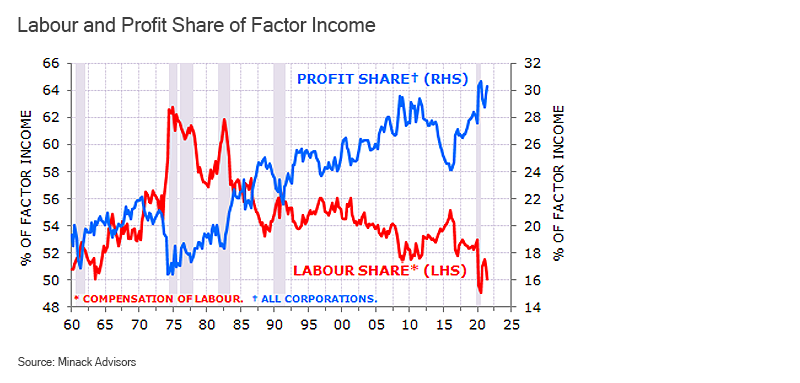
No matter the election result, it will finally be a good year for labour at least.
This year has not started well for asset owners, though a late 2021 surge means the one-year picture is better.
Here are the returns in AUD:
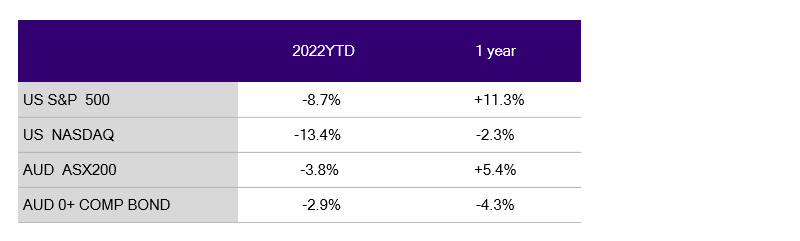
Of course these are nominal returns. If we look at it in real returns (including inflation) the picture is 3.5% worse. Spending power is going backwards.
This week we are seeing further evidence of the next battleground for policy — wages.
Wages will be under pressure on two fronts.
Firstly, workers who are feeling cost-of-living pressures are more likely to push for higher increases.
Secondly, there is a window in Australia we have not seen for a very long time where limited migration means worker shortages. Unions are not going to miss their chance.
Teachers and nurses have already begun their bargaining dance and transport workers have now joined them.
Expect a lot more of this as the NSW government (and others) 2.5% wage policy comes under attack. First introduced by Mike Baird a decade ago they got away with it given private sector wages were 2.5% or even lower.
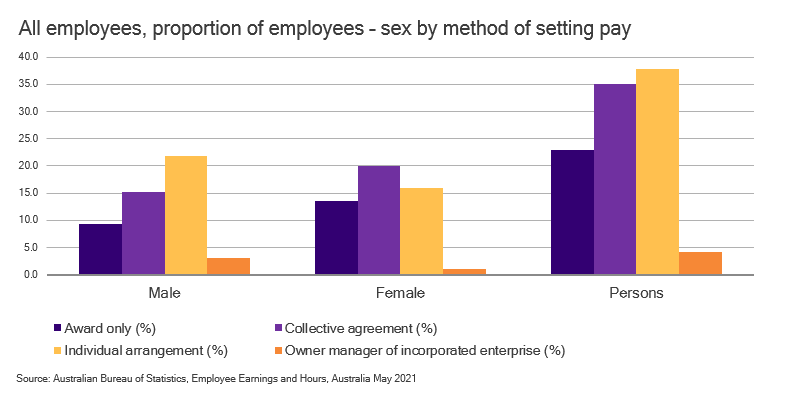
The next year or even two will not be that kind. Collective agreements and awards underpin the majority of wages.
Watching with keen interest will be the RBA.
Wages are the ultimate lagging indicator but the clock is now ticking.
We think the market will be right about rate rises this year, likely beginning in August — though five hikes is probably one too far.
It is important to keep some perspective though. If by December we have a strong economy, wages at 3.5%, unemployment at 3.5% and inflation at 3% then it should be smiles all round.
Capital has had a much better decade — even during Covid — than labour. So a reversal for several years should be applauded.
Ultimately a strong economy, spurred on by pent-up savings and re-openings, should mean risk markets take rate hikes in their stride.
Mistakes happen late cycle and that will be a number of years away.
Investors should take advantage of higher bond yields in the next few years to start building up some defensive positions.
At 2.5% (zero real yields plus 2.5% inflation) I will stop calling bonds expensive.
History suggests, though, it is too early to call them cheap.
Find out about
Pendal’s Income and Fixed Interest funds
About Tim Hext and Pendal’s Income & Fixed Interest boutique
Tim Hext is a Pendal portfolio manager and head of government bond strategies in our Income and Fixed Interest team.
Tim has extensive experience in banking, financial markets and funding including senior positions with NSW Treasury Corporation (TCorp), Westpac Treasury, Commonwealth Bank of Australia, Deutsche Bank, Bain & Co and Swiss Bank Corporation.
Pendal’s Income and Fixed Interest boutique is one of the most experienced and well-regarded fixed income teams in Australia.
Find out more about Pendal’s fixed interest strategies here
About Pendal
Pendal is a global investment management business focused on delivering superior investment returns for our clients through active management.
In 2023, Pendal became part of Perpetual Limited (ASX:PPT), bringing together two of Australia’s most respected active asset management brands to create a global leader in multi-boutique asset management with autonomous, world-class investment capabilities and a growing leadership position in ESG.
The US Federal Reserve is expected to start raising rates next month. Pendal’s TIM HEXT explains how the rate hike cycle is likely to play out in Australia
The March 16 US Federal Reserve meeting is now a month away.
A tightening is a given. Market pricing suggests 50bp to get things started and then 25bp every meeting this year (there are another six).
If correct this would mean it will take less than a year to get back to almost 2.5%. It took three years in the last hiking cycle (Dec15-Dec18).
Obviously 7.5% inflation focuses a central banker’s mind and stopping to see if hikes are working along the way is not on the cards.
The US Fed has often done this as Greenspan showed in the 2004 to 2006 relentless hiking cycle.
This is partly because the US largely has a long-dated fixed rate mortgage market, so cash rates have less importance.
Overall, financial conditions are more influenced by long-term interest rates which may or may not go up with rate hikes.
In the 2004 to 2006 cycle cash rates went from 1% to 5% but 10-year bonds from only 4% to 5%.
What about us?
Australia is very different.
Rate hikes are passed on almost instantly. Traditionally, floating rates make up 80% of the market, though recently that fell to 50%.
However most of the wall of fixed rates from last year will roll off in 2023, offering only limited respite.
Find out about
Pendal’s Income and Fixed Interest funds
Therefore the RBA is more likely to move more cautiously.
Like my local bus service, rate moves tend to come in twos.
This year that should be August and September and then November and December. This at least gives a little time to see the impact on housing and confidence.
The next CPI, due in late April, will again be strong but with an election and post-election uncertainty (hung parliament anyone?) the RBA will likely wait till after the Q2 CPI in July.
Strangely enough that CPI could offer some inflation respite. Goods prices will be tapering by then and a childcare subsidy will knock 0.3% off headline CPI.
What comes next
Attention now turns to the terminal rate — in other words how high do cash rates need to go to slow the economy enough to bring inflation back to target and GDP growth back to capacity.
Nirvana for the RBA would be inflation at 2.5%, GDP growth at 3% and wages growth at 3.5%.
I wrote about this in our last quarterly report, but it’s fair to say a zero real rate and 2.5% inflation rate leads to 2.5% as a reasonable estimate.
A lot would need to go right before we get there but this decade feels different to the last, mainly due to fiscal policy being unleashed.
Finally, asset owners should start thinking about where they get back into fixed interest markets.
Bonds are a defensive instrument but the last few years it has been hard to avoid the awkward fact that they were expensive on any long-term measures.
Back above 2.5% though this changes and we expect some rebalancing back into bonds for long-term asset owners, especially those managing retirement incomes.
About Tim Hext and Pendal’s Income & Fixed Interest boutique
Tim Hext is a Pendal portfolio manager and head of government bond strategies in our Income and Fixed Interest team.
Tim has extensive experience in banking, financial markets and funding including senior positions with NSW Treasury Corporation (TCorp), Westpac Treasury, Commonwealth Bank of Australia, Deutsche Bank, Bain & Co and Swiss Bank Corporation.
Pendal’s Income and Fixed Interest boutique is one of the most experienced and well-regarded fixed income teams in Australia.
Find out more about Pendal’s fixed interest strategies here
About Pendal
Pendal is a global investment management business focused on delivering superior investment returns for our clients through active management.
In 2023, Pendal became part of Perpetual Limited (ASX:PPT), bringing together two of Australia’s most respected active asset management brands to create a global leader in multi-boutique asset management with autonomous, world-class investment capabilities and a growing leadership position in ESG.
Here are the main factors driving the ASX this week according to our head of equities Crispin Murray. Reported by portfolio specialist Chris Adams.
Find out about Crispin’s Pendal Focus Australian Share Fund
Find out about Crispin’s sustainable Pendal Horizon Fund
THE challenge for central banks — particularly in the US — is that the economy is growing well above trend, with little slack in labour markets.
They need to engineer a tightening of financial conditions to resolve this and at least slow the economy back to trend growth rates.
This is yet to be achieved, which means they need markets to adjust further.
This is why we remain wary of equity markets in the near term. We are not expecting a major bear market, but believe we remain in a correction phase.
We also remain mindful that Australian equities should fare better than the US, reflecting its sector mix and less need to tighten. The S&P/ASX 300 is down 3.2% year-to-date versus -7.2% for the S&P 500 and -11.8% for the NASDAQ.
US inflation data came in higher than expected last week. In combination with further evidence of wage pressure, this saw an increase in the number of expected US rate hikes this year.
Concerns over the Russia-Ukraine crisis also drove oil prices higher, adding to future inflationary pressure as well as geopolitical risk.
Pendal Focus Australian Share Fund
Now rated at the highest level by Lonsec, Morningstar and Zenith
The S&P 500 fell 1.8% and the NASDAQ lost 2.2% last week. Australia fared better with the S&P/ASX 300 up 1.3%.
This was partly a catch-up on the overseas rally in the previous week, but also reflected reasonable results in the local financial sector.
Economics and policy
US inflation data came in worse than expected last week. Headline CPI was at 7.5% and the underlying core measure at 6% annual growth.
Current consensus is a peak of 7.9% headline and 6.4% core inflation in February. The latter would be the highest reading since 1984. It is then expected to ease as a result of base effects and easing supply chain pressure.
Prices of goods have been rising at 11% annualised, which has been the key driver of inflation. For example, of the 6% growth in core CPI, a disproportionately large 2.7% is coming from used cars and new vehicles.
The unwinding of components such as these are underpinning expectations of a deceleration in inflation after February.
However we are also seeing services inflation start to rise, reaching its highest levels since 2007. The pathway here will be something to watch.
There is also a broadening of inflationary factors. The median three-month CPI component is running at an annualised rate of 5.9% — its highest level since data was first recorded in 1983.
Key components such as rents (17% of the core PCE index) are yet to rise since measured rent is below signals of what spot rents are doing. For example, the Zillow measure of rents is up close to 14% versus the 4% in the PCE calculation.
This is all adding to concern that inflation may prove harder to contain.
Concerns over the threat of a wage-price spiral was reinforced by the Atlanta wage tracker, which moved over 5% annualised growth, the highest level in 20 years.
Sustainable and
Responsible Investments
Fund Manager of the Year
The issue here is one of the pathway and changing expectations. The market is still implying that annualised inflation drops below 3% by the end of 2022. There are reasons to be wary of this expectation:
- The US economy is growing well above trend (nominal GDP >10%)
- Commodity prices are still rising
- The housing market remains strong
- Labour market are very tight
- Real wages are declining, requiring labour to seek increases to catch up
- Money supply growth is still well over 10%
- Real rates still negative
- Companies are clearly stating a need to push prices higher to compensate for higher costs.
The key point is the size of the disconnection between policy conditions and the economic environment.
We can see this in the Goldman Sachs Financial Conditions Index which captures contributing factors beyond just rates. This remains at a 39-year low.
This stance is grounded in the view that inflation will fall as supply chains improve; high levels of debt mean the economy will be sensitive to small adjustments in rates; and the belief that real rates can stay negative.
This means central banks need to do more to drive bond yields, the US dollar and credit spreads higher and/or equities lower – since these are all contributors to total financial conditions. This means either tightening faster than expected or going higher than expected – or seeing signs that the economy is rolling over quicker than expected.
None of these scenarios are benign for any asset class, though within equities there is scope for variance in outcomes.
With real rates still needing to move higher, this remains a difficult environment for growth stocks. So shorter duration, cash generating names will be more defensive which we have seen in the Australian market this week.
Part of the reason equities can be a bit more defensive is that equity risk premiums have stayed at reasonable levels through this cycle.
A more positive data point was that Chinese loan growth was larger than expected. This reflected more issuance of local government bonds which are likely to underwrite greater infrastructure spend in China over the next few months.
The Chinese economy remains fragile, particularly the small-to-medium enterprise (SME) sector. However this should lead further easing of policy — with two key policy meetings towards the end of March — which can help underpin the resource sector.
Markets
Resources and financials helped the market last week. They are leading to an emerging theme of large cap outperformance.
About Crispin Murray and Pendal Focus Australian Share Fund
Crispin Murray is Pendal’s Head of Equities. He has more than 27 years of investment experience and leads one of the largest equities teams in Australia. Crispin’s Pendal Focus Australian Share Fund has beaten the benchmark in 12 years of its 16-year history (after fees), across a range of market conditions.
Pendal is an independent, global investment management business focused on delivering superior investment returns for our clients through active management.
Australia’s national border will finally re-open on February 21. TIM HEXT explains how the economy will respond
THIS week brought news of the re-opening of our borders on February 21 – to fully vaccinated visitors anyway.
Fingers crossed Covid does not bring new surprises.
It will take time for business-as-usual to resume. We will be watching numbers closely to see if it’s a trickle or flood — or more likely something in between.
The surge in inflation over the past year has been led more by supply side than demand side — so this should potentially bring some relief in labour markets over time.
Globally, goods supply bottle-necks should also ease, though not as quickly as some would hope.
So where does this leave inflation? Well, it’s complicated.
Goods markets inflation is likely already peaking about now. An increase in labour supply should reduce wage pressures over the medium term, but 2022 should still see a sellers (employee) market.
On the other side housing inflation (particularly rents) will likely pick up again with population growth.
Find out about
Pendal’s Income and Fixed Interest funds
In most locations the flat-lining of the population has masked an under-supply of housing. This could again become an issue by 2023.
Inflation will ebb and flow in 2022 before settling down in the medium term not too far from the RBA target.
Longer term we stand by the view that inflation will be structurally around 1% higher this decade than last – nearer 2.5% than 1.5%.
Unfortunately market pricing is already there so the opportunity that markets gave us in 2021 is largely gone.
Our attention has now turned to the path of real yields as the big story in 2022.
(My colleague Amy Xie Patrick has just recorded a short podcast on this).
A combination of surging business investment, reduced monetary stimulus and sustainability initiatives should see real rates get back to zero over the year.
This will put upward pressure on yields, though for now they have probably moved enough.
The RBA will take comfort from the border re-opening.
I suggest unions and employees in general take advantage of the current squeeze to lock in some decent wage hikes now, for the years ahead.
About Tim Hext and Pendal’s Income & Fixed Interest boutique
Tim Hext is a Pendal portfolio manager and head of government bond strategies in our Income and Fixed Interest team.
Tim has extensive experience in banking, financial markets and funding including senior positions with NSW Treasury Corporation (TCorp), Westpac Treasury, Commonwealth Bank of Australia, Deutsche Bank, Bain & Co and Swiss Bank Corporation.
Pendal’s Income and Fixed Interest boutique is one of the most experienced and well-regarded fixed income teams in Australia.
Find out more about Pendal’s fixed interest strategies here
About Pendal
Pendal is a global investment management business focused on delivering superior investment returns for our clients through active management.
In 2023, Pendal became part of Perpetual Limited (ASX:PPT), bringing together two of Australia’s most respected active asset management brands to create a global leader in multi-boutique asset management with autonomous, world-class investment capabilities and a growing leadership position in ESG.
Here are the main factors driving the ASX this week according to our head of equities Crispin Murray. Reported by portfolio specialist Chris Adams.
Find out about Crispin’s Pendal Focus Australian Share Fund
Find out about Crispin’s sustainable Pendal Horizon Fund
EQUITY markets bounced last week after overselling — but underlying news flow indicates further tightening, which remains a headwind for markets:
- Both the European Central Bank and the Bank of England signalled a more hawkish policy direction
- US employment and average earnings growth were far stronger than expected
- Oil prices continue to rise as “OPEC Plus” nations signalled they were sticking to their plan despite high oil prices
- US bond yields hit new cycle highs; the 10-year government bond yield reached 1.92%
The S&P/ASX 300 gained 2% and the S&P 500 1.6% last week.
So far this year the latter is now down 5.5% and the NASDAQ has lost 9.8%. The S&P/ASX is down 4.5%, reinforcing our view that the Australian market should be more defensive in this environment.
The first three weeks of January saw hedge funds de-leveraging and the market cutting growth positions. This phase has played out for now. The market is likely to be more focused on earnings in the near term.
The bull case from here relies on slowing growth and easing supply chain pressure resolving the inflationary pressures without requiring a significant economic slowdown.
The bear case is that rates are still low, inflationary pressures are rising (oil, wages, rents, company pricing power) and the market begins to raise its view on where terminal rates are.
Last week’s news flow shifts probability to the latter. We think the market’s expectations are still playing out. Hence we remain cautious in the near term.
One CEO we spoke to last week said companies could not rely on the hope that inflationary was transitory.
They needed to act as though inflation was here to stay — which meant price increases.
Pendal Focus Australian Share Fund
Now rated at the highest level by Lonsec, Morningstar and Zenith
If most companies are thinking this way it means more inflationary pressure is in the pipeline.
The market also seems to be more discerning now the initial de-risking has played out.
We saw this in the divergence between Facebook and Amazon last week. Features such as pricing power, control over costs, earnings predictability, strong cash flow, low gearing and the ability to do capital management are likely to be rewarded in this environment.
This reinforces our view that in 2022 beta could be lower than previous years and alpha will be a major differentiator.
Policy and economics
The key notion underpinning central bank thinking is the realisation that the combination of emergency policy measures, substantial fiscal expansion and supply chain disruption has triggered a significant rise in inflation — and they need to stop stimulating as quickly as possible.
This means normalising rates in a shorter timeframe than previously thought. The next step would be an increase in the terminal rates they are targeting, though we are not seeing this yet.
European Central Bank
President Christine Lagarde followed the Fed’s suit as the ECB made a sharp hawkish turn in tone. The bank removed references to rate increases this year being “highly unlikely” and emphasised the strength of the economy.
This is in response to year-on-year Eurozone inflation rising to 5.3% and a shift upwards in longer-term inflationary expectations 2%.
The fact that interest rates sit at -0.5% highlights the disconnection between policy and the underlying economy.
The consensus expects an announcement in March that Quantitative Easing ends from June. This suggests EUR200 billion less QE in 2022 versus 2021 and rate hikes to follow in September and December.
This triggered a sell-off in European bonds. German Bund yields increased from 0% to 0.2% and the Euro rose against other currencies.
Sustainable and
Responsible Investments
Fund Manager of the Year
Bank of England
The BoE has been the most hawkish of the major central banks, raising rates 25bp with four out of nine members calling for a 50bp hike. It also announced quantitative tightening.
This highlights a policy of front-ending tightening and reflects the wage pressure that is already evident (it’s forecast to hit 5% for 2022).
The BoE is effectively prepared to break the economy’s strong growth to reduce the hit to real incomes form inflation and power price increases.
This is something to be mindful of for UK-exposed companies on the ASX this year. The GBP also sold off versus the EUR.
US employment
US payrolls came in at +467,000 new jobs versus +125,000 expected. This strong number was reinforced by material positive revisions to recent months and resilient average earnings data.
All this highlights that the Omicron wave has had limited impact on the economy and makes the Fed’s job of slowing inflationary pressures harder.
There was also a significant re-allocation of jobs in 2021. This reflects a shift in seasonal adjustments which meant the labour market was growing far more consistently through the year than previously thought.
Compared to previous recessions, the unemployment rate has returned to original levels far more quickly after the post-Covid shock. But the impact on the participation rate is far worse.
While the initial decline in participation was greatest in the 16-24 year age cohort, it is now evenly spread across all age cohorts.
It is impossible to isolate the drivers. But key contributors are considered to be rising wealth, a desire to change careers leading to re-training and education, health considerations and lifestyle choices. Whatever the reasons, it is creating a substantial labour bottleneck, driving wages higher.
Data released in the US last week shows civilian worker wages are up 4% from last year.
Another survey showed all private-sector wage growth of 5%, while leisure and hospitality wages were up 8.9% year-on-year. Wage growth is critical to watch. It is the factor that can turn supply chain inflation into more structural inflation
The bottom line is that pressures driving inflation are not yet showing any signs of abating.
Covid outlook
New case number and hospitalisations continue to fall. The BA.2 variant appears to be 30% more transmissible, but no more severe.
The US has seen case numbers halve and hospitalisations fall 25%. Fatalities have fallen 80%, mostly due to immunity that has built up in the community from vaccines and prior infections. The death rate among those who have had vaccine boosters is 99% lower than the unvaccinated.
The ability for health systems to largely weather the Omicron wave is likely to reduce the use of restrictions in future waves. We should now see a re-opening boost heading into the northern hemisphere spring.
Markets
Brent crude rose 1.2% last week and was up after the “OPEC plus” meeting.
It is now at its highest point since 2014. The Australian dollar oil price is almost back to its 2008 peak.
Oil inventories are below pre-Covid levels.
It is hard to see what might change this, given continued demand recovery, OPEC sticking to careful supply increases, some concern they are limited in their ability to respond and the ESG overlay combined with a steep backwardation limiting new supply. All this adds to the inflationary pressure still in the economy.
The credit markets serve as indicators of stress in the economy. Spreads have widened but are nowhere near the stress we saw in the 2020 sell-off. This reflects good economic growth, cheap and available funding, and lower corporate gearing.
The market also watches the yield curve, which continues to flatten. Higher yields generally mean lower P/E ratings for equities and underperformance of growth stocks. This is a very different environment to what we have seen for the last few years.
In this vein, it was interesting to note the divergence in stock performance in the US last week.
The FAANGM stocks are longer performing in unison. Stock analysis and stock picking are becoming increasingly important since relentlessly increasing valuation ratings no longer overwhelm earnings trends.
About Crispin Murray and Pendal Focus Australian Share Fund
Crispin Murray is Pendal’s Head of Equities. He has more than 27 years of investment experience and leads one of the largest equities teams in Australia. Crispin’s Pendal Focus Australian Share Fund has beaten the benchmark in 12 years of its 16-year history (after fees), across a range of market conditions.
Pendal is an independent, global investment management business focused on delivering superior investment returns for our clients through active management.