
Our responsible investing specialists have published a two-part guide explaining the impact of climate change on business and investing. Download your PDF copies below.
IT’S NOT easy for business managers and investors to understand the implications of climate change. The latest IPCC report which made headlines in August 2021 runs to a daunting 3900 pages.
Pendal Group’s responsible investing specialists have prepared a two-part climate change guide for financial advisers and investment professionals.
In late 2020 we published part one, Climate Change and Business: Key Concepts, which explains how major climate-related issues create risks for businesses.
Now we have published part two, Climate Change and Investing: Key concepts, which covers the implications for investing.
We invite you to download PDF copies below.
About Pendal Group
Pendal is an independent, global investment management business focused on delivering superior investment returns for our clients through active management.
We believe sustainability considerations ultimately drive higher and more stable investment returns over the long term.
Pendal Group has a proud heritage in responsible investing, extending back decades. Our specialist responsible investing business Regnan includes highly experienced ESG research and engagement experts and offers a growing range of investment strategies.
Find out about some of our responsible investing strategies:
What’s impacting Aussie stocks this week, according to Pendal’s head of equities Crispin Murray (pictured above). Reported by portfolio specialist Chris Adams.
THE waning probability of an agreement on the next tranche of US fiscal support — coupled with suspension of AstraZeneca’s (AZ) vaccine trial — prompted a market wobble last week.
The S&P/ASX 300 fell -1.0% — however it held technical support levels. The S&P 500 was off -2.5%.
New developments on key issues:
- Australian Covid cases: Numbers continue to improve, but nothing to change the level of restrictions
- US cases: Trends distorted by Labor Day holiday. We continue to watch for the impact of school return and onset of colder weather.
- Vaccines & therapeutics: AZ vaccine issues highlighted risks in timing and success. But expert consensus remains confident in an approval by year’s end.
- Australian economy: Data suggests we are underperforming other developed markets in H2. The budget will be important. Significant stimulus is likely but there is a potential issue with timing.
- US economy: There was limited new data with real-time measures due to the holiday. Fiscal stimulus impasse continues.
Covid cases
New daily cases in NSW are trending down to mid-single digits after an uptick around the Sydney CBD cluster.
Victoria continues to trend down under the impact of lockdown. It is nearing a range of 30-to-50 cases a day, which would trigger step two of the restriction roll-back.
It remains unclear how the third step of a more material re-opening will be triggered any time soon under the current approach. This requires a moving average of fewer than five new cases a day — a level NSW has been unable to achieve despite a successful track-and-trace approach.
Given the material economic impact from the current situation, the framework may require review.
The US remains broadly in a holding pattern. The Labor Day holiday caused some volatility in testing and case numbers. Hospitalisations and mortality rates continue to grind lower.
Vaccine outlook
AZ suspended its vaccine trial after a patient developed transverse myelitis (spinal cord inflammation).
Safety watchdogs gave a greenlight for the trial to restart — but progress may be slower. This highlights risk in assuming that a vaccine will be ready by year’s end.
There are four potential scenarios around the AZ incident:
- The patient’s illness is unrelated to the vaccine
- Risk is linked to the vaccine, but it’s not common enough to halt the trial. If the vaccine works it would require a warning label, similar to other current flu vaccines.
- There is an issue with the vaccine delivery mechanism, which uses an adenovirus sourced from chimps to trigger a response that fights Covid. There is evidence that similar adenoviruses can trigger a rare condition in a small number of patients which in some instances can present as transverse myelitis. If this is the case it will be specific to the AZ vaccine.
- There may be an issue with the “spike” protein used to penetrate cells in the patient. If this is the case, it will be an issues for all vaccines.
Scenario three is considered most likely at present. This may be an issue for Australia because of our government’s commitment to the AZ vaccine.
Regardless, scrutiny of possible side effects may serve to slow down trials. This is a reminder not to assume a vaccine will come by year’s end.
US economic outlook
Real-time US activity data remains in a holding pattern and needs to be watched as the holiday period comes to an end.
The US fiscal agreement remains at impasse. The funding of state and municipal governments is proving to be a significant barrier.
Many Republicans are reluctant to fund what they see as recalcitrant state authorities. The political element becomes increasingly important as this drags on. As the election nears, Democrats may be less willing to agree to a package, fearing it will give Trump a pre-election boost.
The president’s “Lost Wages Assistance” unemployment insurance (UI) program is gaining some traction as it passes through state legislatures.
Some 40 states are going through the process. This is much smaller than previous UI packages but it has scope for “catch-up” payments.
This is leading to a bump in disbursements, helping close some of the gap on previous total payments.
Commercial real estate in the US should be watched as a potential negative factor. An oversupply of malls and reduced demand for office space could exacerbate rental delinquencies.
The big global banks have substantial provisions against this but some smaller regional banks may be at risk. This may impact broader credit provision and the multiplier effect of stimulus.
While not an issue at this point it’s another risk that bears watching.
Australian economic outlook:
Australia has the highest level of restrictions versus economies such as the UK, US, Canada, NZ, Germany and China due to our border closures and Victorian measures.
This has an important potential impact on economic recovery. Australian GDP fell -7% in 1H CY20 compared to about 10% for other countries.
The rest of the world is now experiencing a good rebound off a lower base — while there is risk Australia may disappoint with flat growth in 2H.
This is not a given outcome. A rethink of restrictions may alleviate this risk — particularly if combined with fiscal stimulus in the October federal budget.
However there is a challenge in the timing. Policy makers seem reluctant to replicate some of the blunter measures used earlier such as broad cash payments. But more refined measures may take longer to have an effect.
This is compounded by concerns over the impact of a “fiscal cliff” as JobSeeker, JobKeeper and superannuation access are rolled back.
This cliff is a complicated issue. The impact is difficult to quantify given the interplay of further stimulus, cash payments and the savings rate.
Key questions are:
- Savings have surged as payments have increased and consumption has fallen. How much does a fall in savings rate offset the reduction in household cash flow?
- How much additional stimulus occurs to boost household income?
- How much additional superannuation will be pulled out before the deadline?
- Will there be extensions to the interest deferrals on loans?
There is some near-term risk around domestic recovery and, by extension, the stocks leveraged to it.
But we are mindful several levers can be pulled which might see sentiment switch quickly and stock prices surge.
Retaining some exposure as part of a balanced portfolio is important.
Market outlook
Markets were generally quiet last week with thin volumes due to holidays in the US and Europe.
Tesla’s non-inclusion in the S&P index continued to weigh on growth stocks, although they ultimately found some degree of support.
There was a 6-7% drop in oil prices last week which bears watching. There has been some rumbling over OPEC supply as well as disappointment at the AZ vaccine trial.
Anything more prolonged may indicate deeper concerns about underlying demand.
There was minimal dispersion at a sector level in the Australian market outside of the oil-related fall in Energy (-5.3%) stocks. Origin (ORG, -10.3%) was the worst performer in the ASX100, followed by Beach (BPT, -8.4%) and Oil Search (OSH, -8.4%).
Rio Tinto
Rio Tinto (RIO, +4.5%) was — somewhat ironically — the best performer in the ASX 100 last week.
It is clearly disappointing that governance issues deteriorated to a point which culminated with three senior executive departures.
It is preferable that mistakes of this severity don’t happen in the first place. But when they do, it is critical companies are quick to acknowledge the error and act decisively to address it.
In this instance RIO’s initial response was not robust and lacked accountability.
Without accountability, issues can fester and snowball as the recent Royal Commission demonstrated.
The executive departures raise uncertainty over medium-term strategy.
One factor in RIO’s favour is that, operationally, their existing operations are well established and supported by cyclical tailwinds. This buys time to restructure management and repair cultural issues that led to this juncture.
This is in contrast to the banking sector, which has had to deal with the fallout of the Royal Commission in a much tougher operating environment.
Crispin Murray is Pendal’s Head of Equities. He has more than 27 years of investment experience and a strong track record leading Australian and European equities funds. He manages a number of our flagship funds along with one of the largest equities teams in Australia.
Pendal is an independent, global investment management business focused on delivering superior investment returns for our clients through active management.
Find out more about our investment capabilities: https://www.pendalgroup.com/about/investment-capabilities
Contact a Pendal key account manager: https://www.pendalgroup.com/about/our-people/sales-team/
Opportunity in China is not always where you might think. Global Emerging Markets Opportunities portfolio managers James Syme and Paul Wimborne (pictured above) explain their approach
THIS month we highlight one of the main expected drivers of our portfolio and explain the case for those investments.
We focus on these holdings because a high-level look at the portfolio’s relative weightings might not bring out the degree of our conviction.
At a country-level, our portfolio is broadly neutral China — a country that represented 42.6% of the MSCI Emerging Markets Index at the end of August.
There are different groups of stocks within that Chinese index weight — including Hong Kong-listed securities (23.4%), mainland China-listed securities (5.1%) and US-listed securities (14.1%).
The US group is mainly technology and new consumer companies that have generally participated in the broad rally in US equity markets.

Although it is Hong Kong-listed, Chinese alcohol producer Meituan Dianping (1.8% of the MSCI EM Index) can also be thought of as one of the Chinese consumer stocks that have re-rated this year.
In total, this group constitutes 15.9% of the MSCI Emerging Markets Index.
Where we focus
The Global Emerging Markets Opportunities portfolio has a zero weight in these names.
Instead, it has a substantial allocation to companies that are beneficiaries of a policy-led recovery in domestic economic activity in China.
Recent economic data points to a fairly strong Chinese economy (certainly compared with other major economies).
The data also shows the recovery is driven (as in previous recoveries in 2009-10, 2013 and 2015-16 — by centrally-mandated liquidity and credit provision; and the feed-through of that into construction, real estate and financial sectors.
Although there is some positive effect on Chinese consumers, we do not see signs of a strong recovery.
We do not share the consensus enthusiasm for expensive Chinese consumer stocks.
The heartbeats of Chinese policy are credit growth and money supply growth.
Having been restrained back to single-digit growth rates for the last few years, the period since March has seen a marked pick-up in both.
In the year to July we’ve seen M2 growth of 10.7% (year-on-year) and growth in claims on the financial sector of 12.4%.
While still below the 2016 peaks of 14% and 22.2% for example, there has clearly been a step-change in policy in China.
This has driven a pick-up in the Chinese economy.
Composite PMI measures for August are around the 55 level, industrial profits in the year to July are up 19.6% year-on-year and property and infrastructure investments are showing clear recoveries.
GDP growth in 2Q20 was 3.2% year-on-year. This was a substantial positive surprise relative to expectations.
Signs of strength
Other signs of strength can be seen at a micro level — for example a sharp move higher in Chinese copper imports since June.
Then there are the positive year-to-date returns from mainland Chinese equities and strong growth in southbound mainland-to-Hong Kong equity investment flows.
By comparison, retail sales in the year to July were down 1.1% year-on-year.
Notably, the last three retail sales data points have all come in below expectations, reflecting ongoing caution among Chinese consumers.

This slower recovery can also be seen in China’s external balances.
China’s trade balance averaged CNY 254bn per month in 2019. The surplus has averaged more than CNY 400bn per month in the last three months.
This is supportive of China’s currency and financial system, but also reflects relative weakness in domestic consumption.
What we hold and why
So, with our lack of enthusiasm for the domestic consumer, what do we hold in our Chinese sub-portfolio instead?
We have substantial exposure to the real estate sector including developers and also service providers and companies with investment portfolios.
In the second quarter we added a cement company and the operator of the Hong Kong Stock Exchange.
One of our few pure consumer names is a retailer of gold and gold products, which are in effect savings vehicles.
We continue to look for opportunities in this part of the economy: construction, cement, real estate, infrastructure, and financials and asset reflation plays.
This is where we find policy support, positive macro-economic momentum, positive fundamental momentum and attractive valuations.
Although the relative country weight does not show it, this is one of our strongest conviction ideas.
James Syme and Paul Wimborne are senior fund managers and co-managers of Pendal’s Global Emerging Markets Opportunities fund.
Pendal is an independent, global investment management business focused on delivering superior investment returns for our clients through active management.
Find out more about our investment capabilities: https://www.pendalgroup.com/about/investment-capabilities
Contact a Pendal key account manager: https://www.pendalgroup.com/about/our-people/sales-team/
Changes to the Pendal Ethical Share Fund (APIR: RFA0025AU, ARSN 096 328 219)
The Fund’s investment strategy, including how we take labour standards and environmental, social and ethical considerations into account when selecting, retaining or realising investments of the Fund, will be changing from 12 October 2020.
Investment strategy
From 12 October 2020, the Fund will be a high conviction, values-oriented, concentrated portfolio of typically 15-35 stocks that invests in businesses that in our view, in aggregate, provide a net benefit to Australia’s future economy and society.
Pendal will adopt a principles-based approach in identifying the Fund’s investments which aims to:
• Avoid companies whose industries, business models and products or services are not sustainable or cause significant harm, having regard to what we believe most investors would want to avoid in a values-based investment portfolio.
• Invest in companies that demonstrate, or offer or enable more sustainable practices, business models or products and services.
• Invest in companies that advance or participate in the transition of the Australian economy to one that is more sustainable.
• Engage with management of companies in which we invest to manage risk, effect change and realise potential value over the long term.
From 12 October 2020, the following exclusionary criteria will apply to the Fund.
|
In managing the Fund, we avoid investing in companies which: |
|
|
Fossil Fuels |
· directly undertake fossil fuel exploration or extraction (specifically, coal, oil and gas); or · earn more than 10% of their revenue from fossil fuel-based power generation, or from fossil fuel refinement or distribution (coal, oil and gas); or · earn more than 10% of their revenue from the provision of supplies or services which relate specifically to the fossil fuel exploration or production industries (coal, oil and gas) |
|
Uranium |
· directly undertake uranium mining for weapons or power generation; or · earn more than 10% of their revenue from nuclear energy-based power generation |
|
Logging |
· earn more than 10% of their revenue from unsustainable forestry or forest products, including non-Forest Stewardship Council certified forest products or non-Roundtable on Sustainable Palm Oil certified palm oil production |
|
Gambling |
· directly manufacture, own or operate gambling facilities, gaming services or other forms of wagering; or · earn more than 10% of their revenue from the indirect provision of gambling (for example, through telecommunications platforms) |
|
Pornography |
· produce pornography; or · earn more than 10% of their revenue from the distribution or retailing of pornography |
|
Weapons |
· produce or distribute controversial weapons (such as cluster munitions, landmines, biological and chemical weapons), or supply goods or services specifically relating to controversial weapons; or · produce or distribute non-controversial weapons or military equipment; or · produce or distribute civilian firearms, or supply goods or services specifically related to firearms, or to firearm manufacturers |
|
Alcohol |
· produce alcoholic beverages; or · earn more than 10% of their revenue from the distribution or retailing of alcoholic beverages |
|
Tobacco |
· produce tobacco (including e-cigarettes and inhalers); or · earn more than 10% of their revenue from the distribution of tobacco (including e-cigarettes and inhalers) or supply of goods or services specifically related to the tobacco industry (for example, packaging or promotion) |
|
Animal Testing |
· directly undertake animal testing for cosmetic products |
|
Predatory Lending Practices |
· directly provide products or services with lending practices that are unfair or deceptive to ordinary borrowers, including small amount short term loans at higher than commercial rates of interest (for example, payday loans, pawn loans or the use of aggressive sales tactics) |
|
Breaches/ misconduct |
· we consider to have been found to have significant breaches of social or environmental norms or regulations, or are subject to serious and substantiated allegations of unethical conduct, which we consider have not been remedied or adequately addressed. |
Why are we making the changes?
We believe it is in the best interests of investors for the new and tighter exclusionary criteria to be implemented for the Fund. These screens are expected to better meet investors’ expectations regarding the holdings of an ethical fund, which have evolved considerably since the Fund was launched in 2001.
Most notably, investors in ethical funds have increasingly sought to avoid allocating capital to companies whose activities significantly contribute to climate change. For this reason, we will be introducing fossil fuel-related screens in the Fund.
The investment team will be applying a framework that places a greater focus on stocks and industries that meet our investment criteria, responsible investment priorities and philosophy, resulting in a high conviction, values-oriented, concentrated portfolio that is expected to deliver better risk-adjusted returns for investors in the Fund.
Transition into the new investment strategy
The changes will require a number of stocks in the Fund to be sold from 12 October 2020, as these stocks do not meet the new exclusionary criteria. These stocks are relatively liquid and we expect to be able to complete the sell down within one day under normal market conditions.
Management fee
There is no change to the management fee of the Fund which will remain at an issuer fee of 0.95% p.a.
About the Fund’s Portfolio Manager
The Fund will continue to be managed by Crispin Murray, Head of Equities.
Crispin was appointed as Head of Equities in 2003 and is responsible for overseeing Pendal’s Australian Equities business and currently manages A$15 billion of funds under management.
In managing the Fund, he will be supported by the Pendal Australian Equities Team, a team of 19, one of the largest fundamental Australian Equities Team in the market.
Here’s what’s impacting Aussie stocks at the moment, according to Pendal’s head of equities Crispin Murray (pictured above). Reported by portfolio specialist Chris Adams.
Strong US jobs data last week suggests the reduction in fiscal stimulus is not yet biting.
The Victorian lockdown continues to drag on Australia’s national economic pulse. As a result Australia is a negative outlier in global industrial surveys.
There was a sharp sell-off in growth stocks late last week, which dragged on markets as a whole.
Key near-term factors
- US cases: New case numbers are plateauing; it’s important to watch for a pick up as students return to school
- Australian cases: Trends continue — numbers falling in Victoria, steady in NSW.
- Vaccine/therapeutics: No new material news.
- US economy/policy: Stronger data – no signs of lower unemployment insurance payments stalling rebound. Policy impasse remains.
- Australia economy/policy: Rising expectations for tax cuts in upcoming budget
Australian outlook
Victoria’s seven-day moving average of new cases continues to trend lower, dipping back below 100. Having crept back up a few weeks ago, NSW remains steady at around 10 new cases a day.
Victoria’s decision to pursue an effective elimination strategy is material. It means stricter restrictions for longer, with a greater impact on activity, the economy and budget deficits.
The number of people dining out demonstrates the impact of Victoria’s lock-down on the national economy. In NSW restaurant-going has returned to pre-Covid levels, while Queenslanders are eating out more than they were in January.
However at a national level dining out remains 20-30% below pre-Covid levels, due to the drag from Victoria. This remains a headwind for the domestic equity market and specific companies.
US outlook
The rapid spread of Covid-19 among students returning to university has seen new daily cases in the US plateau at around 40,000 – after falling from a mid-July high of about 60,000. Hospitalisations continue to fall. But this may change given the lagging effect with new cases. Mortality rates continue to fall.
The main news out of the US was last week’s strong jobs data. The payroll data was reasonable – probably a little better than expected. But the household survey of employment was very strong, suggesting unemployment fell 2% over the month to about 8% – half its pandemic high-point. The hours-worked survey confirmed the same trend.
Margins of error are likely to be larger than normal. But the change is beyond anything that could be explained by such margins – and paints a picture of a strong V-shaped economic recovery.
The easier gains are likely to have been made and it may get harder to maintain momentum from here. But this helps explain why markets have been as strong as they have. The rebound has simply been much better than many feared. It also confirms falling government payments are not crimping the rebound.
Global GDP growth forecasts have progressively improved as analysts become less pessimistic. There’s been a sharp pick-up in expected growth rates for Q3 2020 since mid August.
This is supported by underlying activity in key sectors such as autos, where US production is now running above pre-Covid levels. The rebound in China and Japan is also strong. This has been driven by income support and pent-up demand helped by an aversion to public transport. Other sectors are languishing, however this demonstrates the speed with which key parts of the global economy are rebounding.
Most industrial surveys in key economies around the world are in expanding territory and improving. Australia is an outlier in this regard. The drag from Victoria has prompted deteriorating industrial surveys and a more neutral outlook for the economy. The effective elimination strategy is likely to see this drag continue for a while longer.
Crispin Murray is Pendal’s Head of Equities. He has more than 27 years of investment experience and a strong track record leading Australian and European equities funds. He manages a number of our flagship funds along with one of the largest equities teams in Australia.
Pendal is an independent, global investment management business focused on delivering superior investment returns for our clients through active management.
Find out more about our investment capabilities:
https://www.pendalgroup.com/about/investment-capabilities
Contact a Pendal key account manager:
https://www.pendalgroup.com/about/our-people/sales-team/
There are some interesting differences among major Latin American countries that are important for emerging markets investors right now. Here senior portfolios managers James Syme and Paul Wimborne take a closer look, explaining which countries they favour and why.
WE believe growth metrics and policies designed to support growth are the key data points to track for markets — with stimulative monetary policies and attractive valuations present almost everywhere in the emerging world.
But we note some interesting differences in inflation dynamics among major Latin American countries.
Brazilian consumer price inflation, which ended 2019 at a 4.3% year-on-year increase, fell to a 20-year low of 1.9% in May 2020, recovering slightly to 2.1% in June.
Mexican consumer price inflation, which ended 2019 at 2.8%, rose to 3.3% by June.
Clearly there are some very different dynamics at play here. Why, and what does it mean for investors?
Firstly, both countries have had difficult coronavirus crises.
Brazil was third and Mexico sixth in total new cases for the two weeks to August 3, according to European Centre for Disease Prevention and Control figures. (USA and India were one and two. South Africa and Colombia were four and five).
Both countries have experienced very significant disruption to economic activity.
In Brazil, industrial production and retail sales to May were -21.9% and -7.2% respectively. In Mexico those figures were -30.7% and -23.7%.
Historically for both countries, the imported component of inflation has been volatile, driven at times by exchange rate volatility. The Brazilian real fell 28.1% against the US dollar in the first seven months of 2020. The Mexican peso fell 16.4%.
A closer look
With a deeper slowdown in Mexico (which should have eased demand pressure on prices), and a smaller fall in the currency, why has Mexican inflation proved so sticky?
A deeper look into the Mexican data shows a very stable core CPI rate (year-to-date the range has been 3.6%-3.7%, with declines in housing, non-food merchandise and services offset by significant price pressure in food merchandise).
The food, beverages and tobacco price index rose 6.6% in the year to June, which the central bank attributes to a reallocation of household spending and to disruptions in the supply of certain goods.
Spikes in food prices (up and down) are common in emerging markets. But they are typically short-lived as supply and demand adjust quite quickly.
The expectation of the Mexican central bank — and of many observers — is that policy interest rates could be cut in the second half of 2020.
The deputy governor of the central bank said recently: “In my personal opinion the cycle hasn’t ended [and] we’ll look to take our monetary stance to an expansive level in accordance with the current economic situation”.
The central bank has cut rates from 7.25% at the start of the year to 5% at the last meeting. Under consensus expectations the rate will fall to 4.2% by the end of the year.
By comparison, Brazilian interest rate cuts may have been front-loaded this year, with a decline from 4.5% to 2.25% so far. Any additional rate cuts would be “small”, the central bank’s monetary policy committee said in the minutes of its last meeting.
Reflecting Brazil’s extremely weak fiscal position, the minutes described current monetary policy as “close to the level from which further interest rate reductions could be accompanied by asset price instability”.
There are a number of reasons why we (cautiously) prefer Mexico to Brazil at this time, including Brazil’s difficult coronavirus statistics and extended fiscal deficit.
The outlook for monetary policy in the second half is another reason.
James Syme and Paul Wimborne are senior fund managers and co-managers of Pendal’s Global Emerging Markets Opportunities fund.
Pendal is an independent, global investment management business focused on delivering superior investment returns for our clients through active management.
Find out more about our investment capabilities:
https://www.pendalgroup.com/about/investment-capabilities
Contact a Pendal key account manager:
https://www.pendalgroup.com/about/our-people/sales-team/
Here’s what’s impacting Aussie stocks at the moment, according to Pendal’s head of equities Crispin Murray (pictured above). Reported by portfolio specialist Chris Adams.
The S&P/ASX 300 gained 1.3% last week, driven largely by resources (+4.9%) while uncertainty over the impact of the Victorian lockdown weighed on the banks (-1.3%). The key near-term factors were on balance neutral to slightly positive, which helped support the broader market: Key short term issues
- US Covid trends: Continue to improve, with falling hospitalisations.
- US earnings season: Continues to surprise on the upside, albeit off a very low base of expectations.
- Vaccine & other therapeutics: Novavax trial reports positive, raising possibility of an alternative vaccine platform.
- US policy: A continued stalemate on fiscal package. Progress is expected this week; if not the market will start to worry.
- NSW and Victoria’s Covid trends: Victoria is showing early signs of stabilisation while NSW holds the line. Broadly in-line with expectations.
- Australian Policy: Federal government will make payments to support self-isolating Victorians unable to earn an income. Emphasises approach of policy plugging economic gaps.
- Australian earnings season: Mixed results, but too early for discernible trends. ResMed (RMD, -11.4%) was negative; REA Group (REA, +4.6%) was positive; Insurance Australia Group (IAG, -1.2%) was in-line.
Covid-19 update There was no material change in trends in Australia last week. While it’s too early to make a call, it’s reasonable to assume the Victorian lockdown will work based on previous experience. NSW case numbers need to be watched. However we note that swift identification of clusters and contact tracing means the numbers are better than many had feared. Signs that NSW continues to hold the line — and that the Victorian lockdown is yielding results — should be well received. Any signs of an acceleration in NSW would hurt sentiment. US trends are generally positive. Test numbers are falling — but not as much as case numbers, so the ratio of positive results is falling. There is some evidence that base levels of immunity are helping in the worst-hit states. More importantly hospitalisations are falling. This is helped by a younger age skew, better adherence to safety protocols and possibly the weather. Even in the hotspot states hospitals have been coping and pressure is now being relieved. This has fed through to a much better outcome in terms of mortality. Deaths reached half the rate of the April peak and are now falling. This is likely due to age skew and protocols. But it’s also due to a wider geographic spread of cases, allowing the healthcare system to cope better — with more experience and better treatments. At this point we are likely to see a Sweden-like model in the US, where cases remain persistently high. If the community believes a third major surge can be avoided under this model — and acute cases are better managed — activity will start ramping up again, supporting markets. This is a very different situation to Australia. Here we are prepared to accept more short-term economic damage in exchange for effective elimination. The key risk in the US is children returning to school at the end of August. This will be a key swing factor moving into September. The US reporting season has so far yielded the largest ever quarterly decline in earnings and the largest upside surprise to expectations. US earnings are down 35%. This is far better than consensus expectations, which have obviously re-based too low. This has helped the market offset the negative effects of the Covid second wave and stalled fiscal negotiations. Economic update The US remains in a holding pattern. Mobility data and outlook surveys are all trending sideways. Employment data was better than expected, but still a material step down from improvements in June. Elsewhere around the world ISM survey data suggests good momentum on improving growth from June, albeit off a low base. Vaccine update The development of a viable vaccine remains the most important medium-term issue for the economy and markets. The result of the Novavax trial was encouraging, but not a silver bullet. Its platform is based on introducing a protein rather than the current approach of using a genetic message to prompt the immune system to produce the required protein. This is important because it offers an alternative route for vaccine development and increases the overall chances of success. The method of vaccination also has a better history of success. Consensus expectations among experts about the likelihood of developing a vaccine for delivery in material amounts next year have increased markedly in recent weeks. Gold Gold has run hard in recent weeks and become the hot topic in financial commentary. Traditional measures of sentiment suggest it may have over-heated near term. The RSI, for example, has reached its highest point in over a decade. This suggests near-term consolidation may be likely, particularly if we see more positive news on the vaccine front. Nevertheless, we continue to see this as a buying opportunity. In our view gold plays an important role in the portfolio, protecting against two key issues (outlined below) and risks facing investors:
1. The decline in real rates
As we’ve noted before, the Fed has clearly signalled it will allow inflation to rise through the target range rather than pre-emptively tightening. They are taking the view that avoiding structural economic deterioration and potential social consequences is paramount. So we are likely to see the use of their balance sheet and other tools to hold nominal yields, even as inflation expectations rise. This should support economic growth. But there is also an imperative to hold rates down given the explosion in debt — much of it short duration — with which the US treasury has been funding itself. Even a small increase in rates could see a massive increase in interest expenses, which the US budget would struggle to accommodate. The outcome is likely to be long-term suppression of real rates, which in turn is driving a lower USD, lower credit spreads, lower equity risk premiums — and a higher gold price. It also has a significant effect on performance within the market, as referenced last week. It is more nuanced than a simple rotation to value. Value does not necessarily outperform, given this could be a headwind for financials. But it will help certain industrials. Growth stocks are okay in this environment, but they lose the tail wind they have had for 10 years. Outside of equities, low real rates are beneficial for other real assets. This has constructive implications for housing. Mortgage affordability in the US is rising and history suggests low real rates are good for house prices. It is worth putting some perspective around moves in the USD, given its relationship to this issue and to gold. It, too, looks oversold in the near term. Some are pointing to the fact that it is back to a reasonable historical range when measured by the DXY (US Dollar Index). However the latter is dominated by value versus the Euro (58% of the measure). On a trade-weighted basis (TWI) the USD remains very strong compared to history. It has room to fall further once the near-term move has consolidated.
2. US-China relations
The second driver of a gold position is the deterioration in US China relations, which is unlikely to look any better ahead of the election. While the tension remains largely rhetorical at this point, there have been material moves that elevated risks and risk premiums in the market. The US has acted against Chinese companies such as Tik Tok and WeChat. It has also sanctioned politicians, increased carrier group activity in the South China Sea and sent the US health secretary on a visit to Taiwan. China has responded via moves in Hong Kong, increased activity in the disputed regions of the South China Sea and dragging its feet on a phase one trade deal. With the US and China using this friction for domestic purposes, this situation is unlikely to disappear in the near term. Heightened tension is prompting investors to allocate more to gold for portfolio insurance. Crispin Murray is Pendal’s Head of Equities. He has more than 27 years of investment experience and a strong track record leading Australian and European equities funds. He manages a number of our flagship funds along with one of the largest equities teams in Australia. Pendal is an independent, global investment management business focused on delivering superior investment returns for our clients through active management. Find out more about our investment capabilities: https://www.pendalgroup.com/about/investment-capabilities Contact a Pendal key account manager: https://www.pendalgroup.com/about/our-people/sales-team/
What’s the outlook for bond yields right now? Pendal’s Head of Bond, Income and Defensive Strategies Vimal Gor explains in a new video interview with online business channel Ausbiz.com.au.
Watch the video above or read the transcript below.
TRANSCRIPT
AUSBIZ interviewer: Vimal Gor is joining us from Pendal Group. I would like to get your reflections on Jerome Powell’s media conference on the reiteration of monetary policy stance in the US. What was your big takeaway?
VIMAL GOR: He was pretty much as dovish as he could have been. There’s this big debate around when they’re going to move to an average inflation targeting framework.
They pretty much said last night that they’re already doing that and even though they haven’t officially announced it yet. They are already running the policy which effectively means the monetary policy is going to be easier than it would have been under the old regime.
The Fed has a target of 2% and average inflation has been running over the last few years at about 1.5%, therefore they need to make up that shortfall inflation.
They will have to run an easier policy which is kind of what everyone was expecting, but the way that he reiterated that was really interesting.
It means they’re probably going to have to announce this in the September meeting, so it just means easier monetary policy pretty much forever in the US.
INTERVIEWER: I noticed one of the questions in the press conference that Jerome Powell was asked was whether the Fed would consider buying equities directly. And he said a flat out ‘no’. We have seen in the past that markets can go and bully the Fed into making particular moves, do you say that the Fed will never, ever buy equities?
VIMAL GOR: I fully expect the Fed to buy equities. They say they never going to do things and they do them. They’re talking about buying CMBS and they’re already buying ETFs and high yields.
If you’re buying a fallen angel high yield bond which has a massively high correlation to equities, why won’t you just buy equities as well? Bank of Japan has been buying equities for many years.
In fact, they are the largest shareholder of most of the companies and Niko. This is the next level when the economies don’t bounce back because the way the markets and the Feds are expecting, they have to add more stimulus in and they’ll just continue to throw package after package.

Interviewer: The first time we spoke, early in this pandemic, you were absolutely unequivocal that we would see rates going to zero and potentially negative. Do you still have that conviction?
VIMAL GOR: Yes, very much so. The CPI numbers we saw last week highlight that. We talked about the difference between nominal yields and real yields, and that’s behind this whole conundrum right now.
The market focuses on nominal yields and about nominal yields going below zero, but it’s all about real yield. If nominal yields don’t move then we will have deflation like what we have in Australia, the real yields are increasing and that slows the economy.
That is the last thing the RBI needs. If you bring it back to the Fed, and what the Fed has done is lock itself into this situation. It certainly wasn’t predetermined, but they’ve found themselves in a situation where they’re controlling nominal yields, the same way the RBA. RBNZ and ECB held nominal yields.
Now what they’ve found themselves in is a situation where they can get inflation expectations moving in the US. Would it bring real yields down, which continues to boost the economy?
Unfortunately, in Australia our inflation rates are low and inflation expectations are low. If nominal yields don’t move and inflation expectations come down, we’re seeing real yields rise at some point that I would still expect bond yields in the US and Australia to go negative across the whole curve.
AUSBIZ: Do you think all this is going to work? We’re in a pandemic, we’ve got mass unemployment, and things are looking pretty grim. Is it going to have the desired effect?
VIMAL GOR: Absolutely not. The desired effect is to slow the pace of the slow-down. We have a massive multigenerational hit to economies. It’s a solvency issue, many companies will need to go bankrupt and go under.
And what has happened by the monetary and fiscal policy we’ve seen from authorities across the world is from a large degree of liquidity at a solvency issue.
It doesn’t mean that the companies won’t go under, but what you’re doing is you’re drawing out the amount of time over which they go under. Therefore the drawdown in economic growth isn’t as deep or as quick.
And so effectively you’re hoping that you can grow out of this over time. If you took it over one or two quarters the effects would be unbelievably bad. They’re just trying to buy time for the economies and hope the economies heal somewhat.
But there’s no question that when you take the growth that drawdown in a short period or a long period, it’s still going to be monumentally large.
Interviewer: We saw the 10-year real yield in the United States at record lows last week, the big dollar suffering wounds and gold has hit record. What happens next?
VIMAL GOR: It goes higher and we can talk about gold. I think last time we also talked about crypto, and I’ll talk about that very briefly in the same context. The fed has bypassed the US banking system, and it’s pumping money directly into Main Street now.
If you’re a corporate in the US you can go directly to the Fed to get a loan. And when, in all likelihood, they’re going to forgive that loan anyway. So it’s just free money. And that’s why money supply growth in the US is running at 30%, 40%, the largest by magnitudes that this has run since the sixties.
At some point, there has to be inflationary and the market is reacting to that, not right now, but in the medium term. Plus a loss of confidence in the fear currency system, because every government in the world is just ignoring debt levels now.
And so those two things coupled together have met the gold’s going up. The other reason for gold is that normally other assets yield positive and gold is a negative-yielding asset.
But you buy a rock and then you dig a rock up, you sell it somewhat. And I put it back in the ground, but it costs you to hold in the ground because there’s a holding cost for like storage and security, etc.
So gold is a negative-yielding asset. Now, virtually every asset in the world is a negative-yielding asset. Therefore gold on a relative basis looks better. And then you can take that argument on Bitcoin.
If Bitcoin is considered a store of value and a store value is purely a social construct. Then it is better than gold as it’s transferable as you don’t need to go and physically pick up a big heavy bar and just give it to someone else.
It has an advantage over gold. Plus it’s a call option on the digitalization of the world, which is very clear where we’re going with all the central banks in the world, looking at their own coins. At some point, if you believe in the social construct like Bitcoin has a store of value.
Well, then you would expect Bitcoin to start really going in here as well. Gold and Bitcoin are going up for similar reasons in loss of confidence in the financial system, but they’re also going up for different reasons, pieces of a call option on arguably a new financial future, and the digitalisation of the world.
Vimal Gor – Head of Bond, Income and Defensive Strategies
Pendal is an independent, global investment management business focused on delivering superior investment returns for our clients through active management.
Find out more about our investment capabilities:
https://www.pendalgroup.com/about/investment-capabilities
Contact a Pendal key account manager:
EACH year responsible investment adviser Regnan engages with a range of ASX-listed companies seeking better management of Environmental, Social and Governance (ESG) issues.
Here Regnan’s Head of Engagement Alison Ewings (pictured) outlines our progress
REGNAN’s corporate engagement work encourages market disclosures that support better decision-making, improved responses to climate-related risks, greater oversight of conduct and progress in corporate governance issues.
In 2020 the work could not be more relevant after a horror Australian bushfire season, closely followed by the COVID-19 pandemic and global debate on inequality highlighted by the Black Lives Matter movement.
Regnan — a wholly owned subsidary of Pendal — has just released its annual Engagement Impact Report covering the outcomes of its meetings with 41 companies over the past year.
The report shines a light on the importance of three key issues: capacity, resilience and interdependency.
“ESG engagement has often sought assurances regarding capacity and resilience — invisible assets that can receive scant attention when things are going well,” the report says.
“This year has provided an opportunity to test and underscore the importance of these, from straightforward aspects such as director over-commitment, to more complex questions of maintaining an appropriate balance between efficiency and resilience.
“But the pandemic has also revealed the extent of interdependencies within our system, many of which lie beyond the boundaries of the portfolios in which we invest.”
Positive progress
The good news is, Australian companes are listening and acting.
More than 95% of Regnan’s active engagements have demonstrated progress, including 79% in the past 12 months.
As well as reporting on the impact of its ESG engagement with companies, Regnan also explores the implications of current world events for active asset owners.
Engagement on complex social issues has increased relative to previous years, the report notes.
Political lobbying, supply chain and issues of cultural heritage and stakeholder relations all feature more prominently, attracting media and community attention.
On the topic of modern slavery legislation Regnan encourages a “beyond compliance” approach focused on making a meaningful difference.
CLICK HERE TO READ THE FULL REPORT
Regnan is a global leader in long-term value, systemic risk analysis and responsible investment advice.
Last year Regnan appointed a London-based impact investment team to launch a Global Equity Impact strategy in late 2020.
Regnan recently co-authored a paper with the Principles for Responsible Investment, Active Ownership 2.0, which includes tips for owners seeking to be more active.
Regnan is wholly owned by Pendal Group.
Liquidity everywhere – the chase for yield: portfolio manager Steve Campbell (pictured) of Pendal’s Bond, Income, and Defensive Strategies team will discuss this in the article below.
The Reserve Bank’s Statement on Monetary Policy in May contained its forecasts for the Australian economy out to June 2022.
The statement highlights significant headwinds ahead for the Australian economy, even allowing for the fact that some forecasts may be too pessimistic.
In its most recent economic forecasts, the RBA revised down economic growth for the year to June 2020 by almost 10% to -8%. For the year to December economic growth is forecast to be -6%, a downward revision of 8.7%.
This would normally result in an aggressive cut to the cash rate. But with a starting point of just 1.50% from mid-2019 – and the RBA’s aversion to negative interest rate policy – we have seen the cash rate cut by just 125 basis points.
If the magnitude rather than the level matters, it’s paltry when all else is considered. Contrast this with the GFC experience and the RBA’s forecast revisions around that time.
For the year to June 2009, economic growth was revised down from growth of 2.25% in August 2008 to -1.25% in May 2009. A 3.5% fall in forecast economic growth saw the cash rate cut from 7.25% to 3% versus a 10% fall in forecast growth that has seen the cash rate cut from 1.50% to 0.25%.
The RBA is not alone in the limited ammunition available via conventional monetary policy.
The following graph shows the total changes to cash rates during the GFC and the most recent moves due to COVID-19.
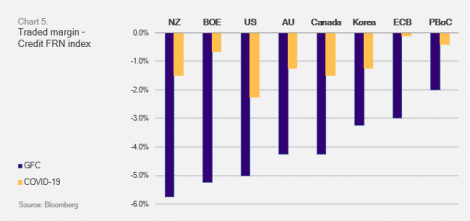
What does this mean going forward? The RBA has moved into more unconventional areas with the use of yield curve control and the term funding facility. With the damage wrought on the economy, further stimulus is warranted – be it fiscal or monetary.
Modern Monetary Theory is something that will garner more and more discussion in this period. The output that has been lost as a result of COVID-19 will take a long period to recover.
For cash investors returns are going to remain extremely low. If other central banks implement negative interest rates it cannot be ruled out here either. Although the RBA certainly won’t be leading the charge into the next wave of negative rate club members.
Steve Campbell – portfolio manager with Pendal’s Bond, Income and Defensive Strategies team.
Pendal is an independent, global investment management business focused on delivering superior investment returns for our clients through active management.
Find out more about our investment capabilities:
https://www.pendalgroup.com/about/investment-capabilities
Contact a Pendal key account manager: