

The changing landscape of the Indian economy
In Asia, we have witnessed several months of outflows, first on trade concerns, now on geopolitical rumblings. On one hand, index providers are likely to increase their allocation to China ‘A’ shares, yet sentiment could not be softer. India has finally found itself caught up in the selling bout. Its economy epitomises the macro weakness that are common in almost all Asian economies: a dependence on oil imports and excessive reliance on foreign capital flows.
Some months ago I had mentioned the relentless rise in unsecured lending in India. Overall credit statistics showed a benign picture. Yet, under the surface, some established and several newly created non-bank finance companies (NBFCs) took up the baton of lending from beleaguered government-owned banks. In the end, they repeated the classic mistake of an asset-liability mismatch, compounded by borrowing increasingly larger amounts from wholesale funding sources like money markets and commercial paper.
That has now come home to roost as rising oil prices, a depreciating currency and lower liquidity are exposing those who thought lending was an easy business. In my opinion, growth in India will disappoint. Higher oil prices and higher interest rates will affect demand. The additional driver that will dampen Indian growth will be the retrenchment of lending by these NBFCs. In the two years after demonitisation (remember that demon?) most of the NBFCs stepped on the accelerator to lend copious amounts of credit to the needy and the unsuspecting. Home loans, loans against property (nothing but a charade to provide working capital loans to SMEs by mortgaging their shops and offices), car loans, consumer durable loans, education loans, foreign travel loans and more. On a trip to Bombay about 18 months ago, I was surprised to learn that tailoring shops associated with big branded fabric companies were willing to finance a purchase of a suit for your wedding. That cost 3-4 months’ average monthly salary, yet there were many who did borrow on that scheme.
“In my opinion, growth in India will disappoint”
Samir Mehta, Senior Fund Manager, JOHCM
The paradox of India has always been that there are some very well-managed businesses able to operate in challenging macroeconomic conditions. In our portfolio, I have bought into what I think are some of those very businesses, knowing that we might face trying economic times ahead. As the market sell-off has continued into early October, it has given me an opportunity to add to some of our holdings. The direction of the currency is anyone’s guess, while poor sentiment amongst domestic investors could lead to lower multiples for some names. I would welcome that development. Finally, it seems like valuations are coming down to levels that we can live with over the next 3-5 years. Given the state of markets and the sentiment, it is better to be cautious in adding to our names. I hope to be in a position to expound on some of these businesses in the coming months.

In this Australian Quarterly Update, we analyse the hot-button issue of negative gearing and the potential effects of proposed Labor policies on the domestic housing market. We also look at why some of the broader global concerns appear to be easing for local credit investors, as well as developments in the local cash market. Finally, we examine ESG trends in Australia and distinguish between the range of different classifications in the area.
I hope you find the piece useful and we welcome feedback from readers.
View our Australian Quarterly Update here.
Fund Manager commentary for the month and quarter ended 30 September 2018 covering market reviews, Pendal fund performance and our outlook for the period ahead.
Access the monthly commentary here.
Access the quarterly commentary here.
This time last year we highlighted some of the factors that we believed would drive a resurgence of volatility in markets. The most significant force was the global withdrawal of unprecedented central bank stimulus and draining of liquidity from the financial system. One year on, we have witnessed one of the largest spikes in volatility since the GFC, a 10% peak-to-trough sell-off for the S&P 500, routs in high yield credit and a dramatic downturn within emerging markets. As central bankers continue to march down the path of policy normalisation, alongside the heightened spectre of political disruption, we believe volatility is likely to persist in the near term.
Despite some of the sizeable market swings experienced in 2018 thus far, policymakers have shown little sign of shying away from monetary tightening. The Federal Reserve has already delivered two rate hikes this year and is widely expected to deliver at least one more before year end, while a further two are priced in for 2019. Its peers are following suit with the Bank of England and Bank of Canada having ratcheted up rates further this year and the ECB forecast to do the same in 2019. Compounding this global policy tightening is the reduction of central bank balance sheets. The Fed continues to sell down large blocks of its securities each month, while the ECB will halt its purchases of corporate and government bonds this quarter. Together, the annual change in global central bank balance sheets is now forecast to shrink next year, as illustrated in the chart below.

When we started to identify the risks posed by this thematic, we flagged several areas that we believed would be most vulnerable, namely those that had benefited most from the swell of liquidity in prior years and those that had lured investors with the potential for higher returns in an era of low yields. This included high yield credit, pockets of emerging markets, as well as regions particularly susceptible to political disruption. On the reverse side, we believed as investors unwound their higher risk positions, safe-havens like the US Dollar would benefit.
Of course, timing such a reversal in risk sentiment and change in market regime from a long period of calm seas to one of crashing waves can prove difficult.
When we saw the S&P’s 10% correction and 308% VIX spike in February this year, we knew the volatility regime change we had been expecting was underway. Several subsequent episodes of volatility helped reinforce this view and benefited our positioning. One such episode was the well-publicised Italian political turmoil. This reflected a theme we had identified around heightened political risk, particularly in Italy ahead of its general election. We positioned our portfolios accordingly and they subsequently benefited significantly from the large spike in the country’s yields.
Looking forward, we believe Italy’s experience reflects a growing trend across broader Europe away from the prevailing centrist political views, to the extremes. This is likely to feed further fiscal policy uncertainty in the near term and trigger additional bouts of market volatility. The ECB removing stimulus is also effectively pulling the rug out from overvalued asset prices in the region, leaving European credit particularly exposed.
Despite some of the sizeable market swings experienced in 2018 thus far, policymakers have shown little sign of shying away from monetary tightening.
Vimal Gor, Head of Income & Fixed Interest
Emerging markets (EM) have been another area of significant volatility and political disruption, with specific pockets more at-risk than others. During the years of low yields, many market participants were tempted into developing economies in their search for higher returns. Now as global stimulus is being withdrawn these positions are being unwound, causing rapid capital outflows and dramatic downturns in their currency and bond markets. Turkey has been a prime case study this year with the Turkish Lira having plunged 42% to the end of August. It is just one example among a growing list of suffering EMs that includes South Africa, Brazil and Argentina.
Their experience is just one symptom of the global liquidity drain and has in turn revealed a number of pain points across markets. If we consider that the ’taper tantrum’ headache of 2013 was driven by the mere slowing of asset purchases, then their reversal should be a very long and painful hangover. With less liquidity and the implicit support under overvalued asset prices being removed, we are likely to see much more extreme reactions going forward. This represents both a risk and an opportunity for investors. It is a risk for investors that are reliant on areas like high yield credit and certain emerging market debt. At the same time, it is an opportunity for investors that are positioned to benefit from the underperformance of those asset classes and have a long volatility bias. In turn, we believe an allocation to a defensive and active fixed interest manager remains a critical part of an investor’s portfolio.
We know this much – the trade war by China against the US has been going on for years. To the extent one wants to call this a trade war, we are determined to win it.
Mike Pompeo, US Secretary of State, September 2018
 One defining feature of the Trump administration from an emerging market perspective is the willingness, even enthusiasm, to confront the United States’ geopolitical rivals. The US has significantly expanded sanctions applied to Russian companies and individuals while applying increasingly severe tariffs to Chinese exports. The effects have been felt in both countries, notably through currency weakness that does not seem to reflect the healthy external balances both countries enjoy.
There is a temptation to view the actions of the US administration as both driven by the President and targeted at the popular vote, but we feel it’s important to look at some of the statements by other administration members to see where these policies might be headed, and what that might mean for emerging market investors.
Vice-president Pence recently summed up the administration’s view as “Beijing is employing a whole-of-government approach, using political, economic and military tools, as well as propaganda, to advance its influence and benefit its interests in the United States.” Whilst the military rivalry between the two powers has been visibly building over the last couple of decades, the focus on economic competition is a newer feature, and one with a strong advocate in the Trump government.
The Death by China script
Peter Navarro is an American economist and author who has been a hard-line advocate of a confrontational US trade policy towards China, most notably in his 2011 book Death by China. Having served as an adviser to the Trump campaign, he was appointed to an advisory post in the administration in December 2016, and much China policy since then can be seen to follow his views. Navarro very much sees the trade relationship between the two as akin to a war, accusing China of ‘cheating’ through uncontrolled pollution, poor labour standards, government subsidies, exporting counterfeit and dangerous goods, currency manipulation, and intellectual property theft. He has been a strong advocate of large tariffs on Chinese exports, with steel seen as a priority, and this is the exact policy path that has been followed. If there was any doubt, the Trump administration’s unusual step of creating a military space force is exactly what is called for in chapter eleven of Death by China.
One defining feature of the Trump administration from an emerging market perspective is the willingness, even enthusiasm, to confront the United States’ geopolitical rivals.
James Syme, Senior Portfolio Manager JOHCM
It is in this light, therefore, that we note with concern the recent Bloomberg scoop alleging that Chinese intelligence agencies caused highly specialist computer chips to be covertly placed in computer servers being exported to the US, thereby deeply compromising security at various US companies and government agencies. The potential for this to happen was highlighted in chapter ten of Death by China and this significantly increases the likelihood that the US seeks to disentangle some of its supply chains from China, not to improve the trade balance, but as a fundamental matter of national security.
Implications for emerging markets
This would have profound implications not only for China, but also for some key emerging market industries. It may create market share opportunities for Korean and Taiwanese companies at the expense of Chinese ones, but it is also likely to raise prices to consumers, increase capital expenditure and reduce returns on capital and reduce economies of scale. It is also likely to see continued weakness in the Chinese renminbi in response to diminished export opportunities, and will not be supportive of Chinese equities. Yet the Chinese reaction in September was to turn down further trade talks and to summon the American ambassador to Beijing to protest sanctions imposed on the Chinese military. Despite the economic consequences, there has been no backing down by China. As Lord Kitchener said, “No financial pressure has ever yet stopped a war in progress.”
More reading
Pendal Global Emerging Markets Opportunities Fund
Update – 15 October 2018: The following article was initially published on 21 September, based on prevailing valuations, to outline our thoughts on the inherent risks for FAANG stocks. This cohort have subsequently experienced significant share price declines in October after broader market sentiment particularly towards the US technology sector turned negative. On the surface our article may appear prophetic, however we don’t see the recent correction as a reflection of the key risks highlighted in this article these are yet to be acted on by the market. Regardless of whether the FAANGs decline further or even recover from this point, our fundamental reasons for not investing in Facebook, Apple, Amazon and Netflix remain unchanged. Similarly, our rationale for investing in the owner of Google remains valid and is in line with our long term approach to investing.
Many people love an acronym these days and fund managers are no exception so we’ll start this article with a somewhat cryptic collection of terms. The reference to FAANG stocks has been gaining broader recognition as a result of the meteoric rise in the share prices of its constituents. In 2018 this dynamic has led to a situation where the FAANGs have often determined the direction of the US S&P500 stock index. As with any stock, the higher the share price rises, the greater the risk of a correction, but we believe the inherent risks for some FAANG stocks are much deeper.
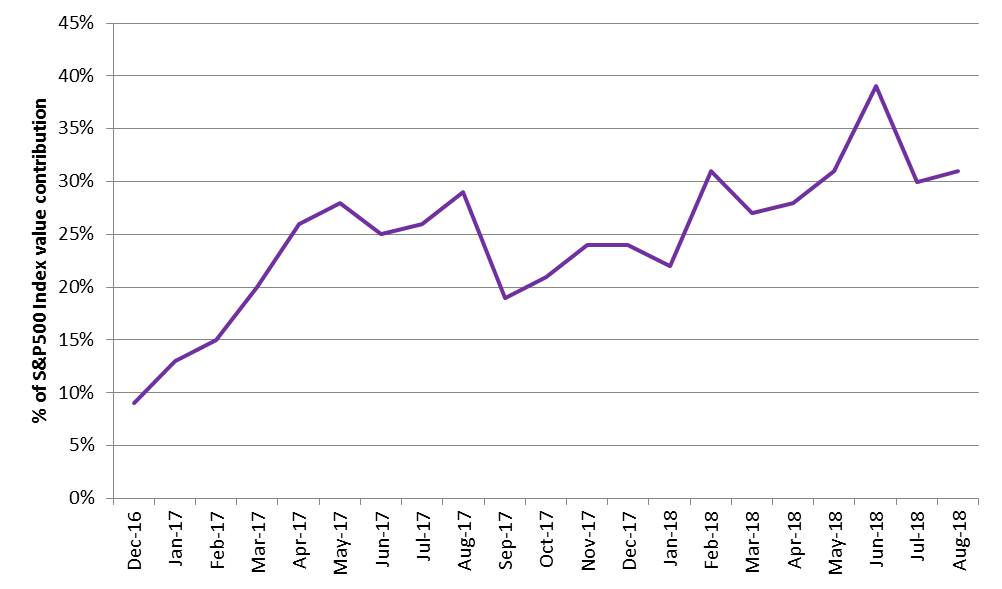
The collective of mega-cap global consumer technology companies known as FAANG stocks — Facebook, Apple, Amazon, Netflix and Alphabet’s Google — have rapidly grown in value over the past two years as a result of success in global penetration of their consumer products and platforms. These five stocks have become increasingly integral to the broader market’s performance and now represent around 15% of the S&P500 by weight. Their growing concentration within the US market has meant they account for 20-30% of the market’s movement in value. Expressed another way, for the first half of 2018, the positive return for the S&P500 was due to the FAANGs as they collectively added more than twice the value that the rest of the market lost. The growth in passive index tracking products also contributes to this self-fulfilling cycle, where price rises lead to index weight increases which then push prices further. Both Apple and Amazon reached milestones of US$ 1 trillion in total market value this year and are now larger than the annual output (GDP) of some countries such as Switzerland, Saudi Arabia and The Netherlands.
12 month rolling percentage of S&P valuation created by the FAANGs
Source: Pendal, Bloomberg
For simplicity we’ll continue to use the FAANG abbreviation to represent this group of five leaders in global technology enablement as we address a pertinent question on the minds of many onlookers: Could the Fear Of Missing Out on the massive share price gains become the more satisfying notion of Lucky To Miss Out? There are a number of valid reasons why at the present time, would-be investors in FAANGs can afford to be more sanguine about avoiding these stocks.
FAANGs reached their peak valuation in June before the market was made aware of earnings disappointments from Netflix and Facebook. Netflix’s share price was down 14% for the month; Facebook’s shares declined 20%, or US$ 120 billion to represent its largest one-day loss in value. This was a strong market reaction to the company’s future earnings prospects and the concerns are legitimate. Facebook’s core product is mature and revenue growth is primarily based on increasing prices for advertising. Netflix is now basing its expectations on user growth rates with little consideration for the incremental cash it will generate from each subscriber.
Similar concerns exist for other stocks in this group. Amazon’s business model is all about growing their share of online retailing with a focus on generating revenues rather than profits. At some point one will have to justify the other. Apple has a somewhat similar approach to capturing the biggest slice of the mobile device market. Its unit sales haven’t grown over the past two years and despite claims of its customers being captive to Apple’s iOS ecosystem, its market share has actually declined. And while Google has grown its share of the competing Android platform, it is heavy exposed to the highly cyclical online advertising market.
While these factors don’t necessarily mean these are bad companies they do increase the downside risk if current strategies fail to deliver. We would argue this is more than a remote possibility, considering the rapidly advancing intersection between technology, competition and fickle consumer preferences which can abruptly impact revenues.
Regulators on the trail
Until recently, FAANGs have been fortunate to grow while being relatively unfettered by government controls. Effective control over these behemoths of the technology world is far from simple to achieve, but the renewed vigour of regulators together with the rise of populism and anti-establishment political forces now present as a sizeable risk to the FAANGs’ business models, pricing structures and market access. Consider Facebook and its unintended leakage of personal information to Cambridge Analytica. This not only drew the ire of its millions of users but also resulted in CEO Mark Zuckerberg being hauled in for a ‘please explain’ grilling by US Congress. At the hearing he argued Facebook is a technology platform rather than a media company, although he conceded Facebook is responsible for what is posted on its platforms. This is an important distinction in the US as media companies face stricter regulations, are legally responsible for the content they publish and can be sued over the content of their platforms.
Zuckerberg sees greater investment in artificial intelligence as part of the solution but he knows there is some way to go on that front. Facebook have committed to hiring 10,000 new cybersecurity and content monitoring employees by the end of 2018. But of even greater concern is the broader impact of content restrictions. Facebook’s engagement metrics are most valuable at the extremes of content, so any material restrictions on content will have direct implications for advertising revenues. The US currently lacks a single comprehensive law regulating the collection and use of personal data, but the tide against the capitalism supports for mega companies like Facebook cannot be ignored. Recall the US Department of Justice case against Microsoft in the late 90s when the regulator sought to break up Microsoft on anti-trust law violations. Microsoft retained its structure on appeal, but it did result in the death of Netscape and subsequent ascension of Google.
Being a global platform also means offshore regulators share an interest. In July the European Union regulatory authority fined Google €4.3b (A$6.9b) for abusing Android’s monopoly to push Google’s apps on its own platform. The ruling determined that Google forced phone makers to preinstall its Chrome browser as a condition for accessing the GooglePlay app store and illegally paid manufacturers to preinstall its search app exclusively. Google are now required to give manufactures and phone providers free choice on the apps they install.
Margrethe Vestager, the European Commissioner for Competition, has been busy over the past few years increasing her efforts to limit the commercial power held by these companies. It makes sense that Europe rather than the US take the lead as it assumes all of the downside from social issues, interference with elections, job destruction, tax avoidance and anti-competitive behaviour but little of the upside from high-paying jobs, donations and value creation. The General Data Protection Regulation (GDPR) which came into effect in May is the most stringent legislation to date and aims to provide more control to citizens over their personal data. While it is still early to assess the real impact from GDPR, the cynic in me thought the timing of Facebook’s downgrade on their second-quarter earnings was interesting.
A little more than luck at stake
We acknowledge these are great companies, leading in their field with a global footprint. But everything has a price and as stewards of our clients’ capital we are reticent to invest on the basis of market leadership alone. Our process involves buying leading companies which have fallen out of favour with the market, often for reasons external to their underlying operations. They must be leaders in their industry but must also be attractive in terms of free cash flow, dividend yield, and trade on a buyout ratio of at least 8%. Our analysis needs to identify a clear catalyst for higher earnings. On these factors, Google (Alphabet Inc) is the only FAANG that qualifies for investment.
Google operates a robust business model with a 90% share of online search, 70% share of the mobile operating system (Android) and 45% of the online advertising market. YouTube is a clear leader in video and becoming a meaningful grow driver for the group. The regulatory risk for Google is considerably lower than for other FAANG stocks.
The only conceivable regulatory action that would have a meaningful impact on Google would be for its search algorithms to essentially become a utility where by the market is granted access under a regulated fee and licensing regime. We don’t view the likelihood of this happening any time in the foreseeable future as very high. The great advantage of Google’s search product is that it ages in reverse its algorithms become more powerful the more they are used. It also operates in a duopoly as online advertisers are effectively limited to two platform choices. Facebook and Google together account for about 80% of the global (ex-China) online advertising market.
The stock trades on a 16x earnings valuation multiple (excluding cash and losses from its non-core business) which is reasonable even after considering the risks. This collection of businesses is expected to generate earnings growth in the mid-teens for the current fiscal year.
By comparison, Amazon trades on a valuation that is very hard to justify. If we separate Amazon’s two core business Amazon Web Services and Marketplaces and value them separately, in order to justify Amazon’s current valuation our analysis concludes that the Marketplace business would need to achieve a 15% earnings margin. That margin would be three times larger than the best food retailers have ever managed to sustain in one of the most competitive and price sensitive industries in the world.
As for the other FAANGs we don’t see their current valuations as justified on the measures we focus on. We also believe the risks to their future earnings from regulatory imposts are yet to be appreciated by the market. Cyclical and product specific factors also arise when considering the maturity of some business lines. Market momentum factors may act to support their share prices in the short term, but at prevailing valuations I prefer to remain a humble user of iOS, transact via EFT, stream VOD and PM my contacts without sharing the nascent, yet real risks as a shareholder.
Regnan has released its annual report on ESG Engagement and Advocacy activity throughout FY18. Increased scrutiny of corporate conduct, mostly due to the Royal Commission, saw a higher number of engagements on this longstanding theme. Climate risk remains an ongoing engagement theme with ASX200 companies, in particular, to pursue enhanced climate-related disclosures, management of energy transition risks, and acknowledgment of the physical impacts of a changing climate.
Download Regnan’s Annual Report report here:
About Regnan
Regnan – Governance Research & Engagement Pty Ltd was established in 2007 to evaluate the relationship between environmental, social and corporate governance (ESG) factors and investment value. Regnan has evolved to become a global leader in long term value, systemic risk analysis and sustainable investment advisory.
Regnan provides ESG integration, advisory and stewardship services on behalf of institutional investors including asset owners, fund managers, wealth managers, retail and investment banks to drive improved ESG performance in S&P/ASX200 listed companies. Regnan meets with directors and senior company leaders, in a constructive manner, to influence change on issues with the potential to impact value over the long term.
Regnan is also a regular contributor to the public debate on long term value and sustainability, and is an active commentator in the media and at corporate and financial industry events. Regnan also provides submissions to government and other policy makers to improve both sustainable investment and the identification of systemic risks.
Regnan’s research insights are applied to Pendal’s Sustainable, Ethical and mainstream funds where relevant, as well as enabling us to work with other institutional investors in meeting their sustainability objectives.
DISCLAIMER
This document has been prepared by Regnan Governance Research and Engagement Pty Limited (ABN 93 125 320 041), (“Regnan”) and is republished with Regnan’s permission. It is for general informational purposes only and should not be relied upon in making a decision to invest or a decision in relation to an existing investment. It has been prepared without taking into account any recipient’s personal objectives, financial situation or needs. Because of this, recipients should, before acting on this information, consider its appropriateness having regard to their individual objectives, financial situation and needs. This information is not to be regarded as a securities recommendation.
The information relates only to Regnan’s assessment, based on its research and the information available to it, of the performance of a company in relation to environmental, social and governance issues and should not be regarded as a recommendation or statement of opinion by Regnan on:
i. any other aspect of the company’s performance;
ii. the prospects of the company; or
iii. the company’s suitability or attractiveness from an investment perspective.
The views expressed in this document are exclusively those of Regnan and the information contained within is current as of the date of publication. Pendal Group is the owner of Regnan and commissioned the company to provide research and engagement services for use as inputs into the decision making processes for Pendal’s investment activities. The views of Regnan expressed in this article may differ from those held by Pendal Group.
Edge – the projecting ledge or brink, as of a cliff; the part farthest from the middle; line where something begins or ends; the verge or brink, as of a condition
During times of risk aversion prompted by tighter liquidity conditions, as geopolitical risks re-emerge and long-term trade agreements unravel, it is rational to get a sense of revulsion when stock market volatility increases with downside bias, in conjunction with a large sell-off in emerging market currencies.
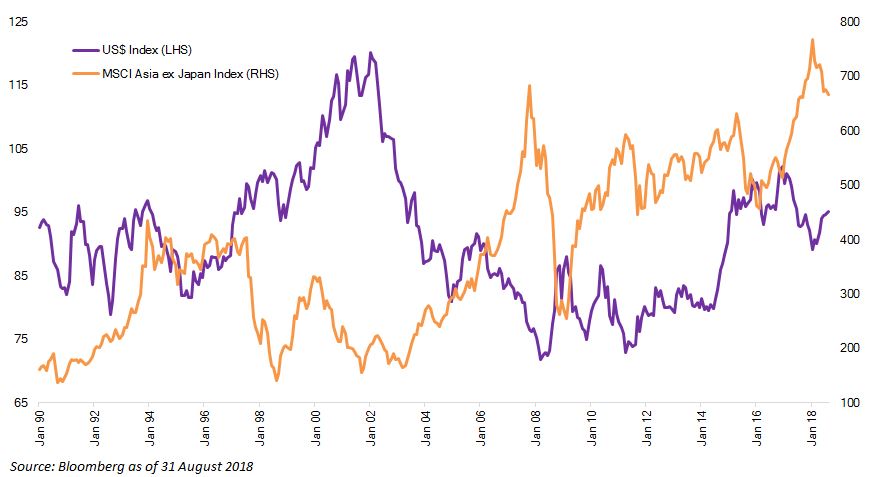
The US dollar trade-weighted index is a near perfect proxy for liquidity conditions in emerging markets, which in turn impacts all underlying asset prices including equities.
The mighty US dollar carries all before it
 There is now near unanimity that emerging markets are in a tough spot, after years of loose monetary policy that led to higher debt levels in several of those countries. When those debts are US dollar-denominated, it exposes the weakness and tension between capital flows, rising domestic inflation and slowing growth. The trade off, in a simplistic way of thinking about the conundrum, is that growth has to slow and savings have to be rebuilt (a current account surplus). That should be either by raising domestic interest rates or by letting the currency weaken. In some countries, like Argentina or Turkey, the measures have been drastic. In Asia, none of the countries is in that dire a state but the taint of emerging markets and increase in debt levels is the common thread.
“The challenge, as I see it, is not just over resilience of the businesses we own but also on the ravages that liquidity induced sell-offs and currency depreciation will bring to markets.” Samir Mehta
The big concern for all of us, not just in Asia, surely remains how China manages this transition of tighter liquidity and slower growth. We came close to a similar looking edge in 2015/16. At that time, too, we appeared to be on the cusp of a hard landing. I distinctly recollect the scare when an unexpected change in the way China managed its currency led to fears of a meltdown, which further exacerbated capital outflows from China. By February/March 2017, with the US dollar appreciating, equity markets sold off aggressively, and we all thought this was the moment when China paid the price for its extreme indebtedness. A pause by the US Federal Reserve in its path of raising interest rates gave us the breathing space to come back from the edge. In that moment, it looked and felt like we were standing by a dark and bleak chasm, but, in hindsight, this turned out to be just another edge.
I have no clue whether the edge that we peer at today is a real precipice. As I’ve mentioned over the past couple of months, I have certainly reduced the portfolio’s cyclicality and added names that we perceive to be very resilient businesses. The challenge, as I see it, is not just over resilience of the businesses we own but also on the ravages that liquidity induced sell-offs and currency depreciation will bring to markets. Caution prevails.
Politicians think of their own survival and that means taking action that the population likes. Nobody talks about the need for pension reform anymore, and that’s worrying.
Robson Andrade, head of the Brazilian National Industry Confederation, quoted in Bloomberg article, 29 August 2018
Regular followers of our process will know that we consider a country’s current account balance to be a key indicator to watch. That doesn’t mean that it’s the only place where deficits matter, though. There are times when the fiscal balance is the more important metric. That has been the case in the ongoing crisis in Argentina (where we have had a zero weight), but also forms the backdrop for October’s presidential election in Brazil.
Argentina is in an economic crisis. To the end of August, the MSCI Argentina price index was down 54.5% in US dollar terms, as the currency sold off despite policy interest rates being hiked to 60%. At the heart of Argentina’s problems is a huge fiscal deficit (forecast to reach 5.0% of GDP this year). The monetary system’s financing of that deficit has driven credit growth at an annualised rate of over 30%, which was great for assets until foreign investors lost confidence, at which point it wasn’t. Argentina now has to brutally tighten both monetary and fiscal policy at the same time.
This is unfortunate timing for Brazil, as it grapples with its own economic pressures, very much including the fiscal deficit. Like Argentina, Brazil has a large sovereign debt outstanding (75% of GDP, compared to Argentina’s 65% pre-crisis and an estimated 85% now), which comes with very substantial interest payments. That makes it imperative that the primary fiscal balance (i.e. before interest payments) is positive, but that is neither the case in Brazil (primary deficit 1.4% of GDP) nor Argentina (primary deficit 2.5% of GDP).
And yet from this chaos, in the next seven weeks, must come the man or woman who will rescue the Brazilian national finances from future crisis.
Brazil’s two significant additional weaknesses are intertwined. The first is its utterly unsustainable pension system. The various generous pension systems, implemented during the transition to democracy, use a pay-as-you-go model in which the current workforce is taxed to pay pension payments. This system faces collapse with an ageing population; the combined annual shortfall of the pension schemes is close to 4.5% of GDP and set to rise.
In Brazil, only a constitutional amendment can modify pension laws, because the right to retirement benefits is engraved in the 1988 Constitution. Reform is incredibly politically difficult, needing the support of three-fifths of Congress to amend the constitution, and has proved impossible for both previous governments and the current Temer administration.
 The second weakness is the chaotic state of Brazilian politics: there is a presidential election in October; the incumbent seized power through a controversial impeachment of his predecessor and has a popularity rating of 5%. At the time of writing, the two most popular candidates are campaigning from a prison cell (Lula, currently banned from standing) and a hospital bed (Bolsonaro, who has just survived an assassination attempt). All the candidates have negative net preference from the voters. And yet from this chaos, in the next seven weeks, must come the man or woman who will rescue the Brazilian national finances from future crisis. It is completely unclear as to who this will be or how this will happen, but it has to happen to avert disaster.
From a market viewpoint, the election of a president who can manage reforms could ignite a powerful rally in Brazilian assets. Year-to-date, the MSCI Brazil price index has fallen 20.8% in US dollar terms, to a 12-month forward price/earnings ratio of just 10.2x. The potential for large moves up or down certainly exists. We remain cautious in the face of all this, but equally are alert for the opportunity to participate in a powerful upward move should the political environment improve.
“We haven’t seen a trade war hit emerging markets. If it does I think it will be quite specific in terms of where it hits.”
James Syme, Senior Portfolio Manager, Pendal Global Emerging Markets Opportunities Fund
Investor caution towards emerging markets has increased this year as a strengthening USD creates real challenges for a number of EM countries. This caution has accelerated more recently with trade war rumblings and Turkey’s economic flashpoint.
In this quarterly update, Senior Portfolio Manager James Syme:
– explains, using Russia, Brazil and Turkey as live examples, why active top down country selection is so important in EM
– sets out the team’s rationale for key country-level overweight and underweight positions
– discusses the role the USD and oil prices will play in driving EM performance dispersion.
Further reading:
Be a part of the world’s fastest growing economies