
Here are the main factors driving the ASX this week according to portfolio manager Jim Taylor. Reported by portfolio specialist Chris Adams
RECENT trends persisted last week, although news flow was relatively quiet.
US and Australian 10-year government bond yields rose 15bps for the week, prompting further rotation from long-duration growth plays.
Commodity prices continued their climb. Brent crude oil rose 3.9% and copper 2.1%. There was some relief for iron ore, which gained 9.7% after recent plunges.
Gas and electricity prices continue to surge in the US, the EU and Asia. They are at record levels in the UK and EU, while volumes in storage are materially below historical averages. Moscow stepped in late last week, saying it was prepared to take steps to calm energy markets.
US payrolls data on Friday asked more questions than it answered in terms of the pace of tapering and rate rises.
The S&P/ASX 300 gained 1.86% and the S&P 500 0.83%.
Covid outlook
New case numbers continue to improve in US and most places around the world.
Singapore is an outlier, walking back some re-opening measures after a material resurgence in cases.
Severity of infection is proving far lower in vaccinated people. About 98% of recent Covid cases experienced either no symptoms — or only mild effects — in the 28 days before becoming positive.
Pfizer has asked the FDA to approve the vaccine for 5-to-11-year-olds. The FDA took about 30 days to approve the Pfizer vaccine for 12-to-15-year-olds.
Israel last week became the first country to effectively make vaccine boosters mandatory.

Pendal Focus Australian Share Fund
Now rated at the highest level by Lonsec, Morningstar and Zenith
Six months after a second vaccine dose, Israelis now require a third dose to retain a fully immunised “green pass” allowing entry into restaurants, gyms and other venues.
Over the past two months Israel has provided boosters to 39% of its population, significantly ahead of all other countries.
The case count there has been pushed down by 54% over the past two weeks. Health outcomes appear materially better than for those with just two doses.
Economics: US outlook
Friday’s US employment had been eagerly awaited for some read-through to Fed policy. But there was not enough clarity to read one way or the other.
There were expectations that September non-farm payrolls would see a material rebound given a reduction in unemployment benefits, the return to school after summer break and continued vaccinations.
But the headline came in weaker than expected with 194,000 jobs added versus consensus expectations of 500,000.
That said, the previous two months were revised up by 169,000 jobs. There was also a distortion from government jobs, which have been volatile and fell by 123,000.
Private payrolls were up 317,000 month-on-month. Hiring in tech-related service sectors remained strong. Leisure and hospitality was less buoyant (up 74,000) reflecting difficulties in recruitment.
The question is whether this meets the definition of “decent” economic momentum Powell flagged in September to keep tapering on track.
A key point of debate remains around the extent to which displaced workers are retiring or re-training rather than returning to old jobs.
Earlier explanations for lack of labour — such as the effect of benefits or the summer break — seem to be falling by the wayside.
The jobless rate fell to 4.76%, down from 5.2%. The modest pace of hiring will be enough to push the US towards full employment, since the labour force participation rate for prime-aged workers fell.
Average hourly earnings rose 0.62% month-on-month, ahead of a 0.4% expectation. The means the question of the Fed needing to tighten sooner rather than later remains live, although a mix shift of more growth in lower-paid hospitality jobs may see wage growth ease going forward.
Economics: Australia and New Zealand
The RBA left policy settings unchanged, as expected, including the cash rate target, the 2024 yield target and the pace of Quantitative Easing purchases.
The RBA maintained its positive medium-term view while noting ongoing disruptions from lockdowns in Sydney and Melbourne.

Pendal Focus Australian Share Fund
A high-conviction equity fund with 16 years of strong performance in a range of market conditions
The RBNZ lifted its official cash rate by 25bp to 0.5%, also in line with expectations. It maintained a moderate, hawkish bias, noting that “further removal of monetary policy stimulus is expected over time”.
APRA announced an increase in the minimum serviceability buffer of 0.5% (from 2.5% to 3%) The market had generally expected APRA would wait until early 2022. Clearly regulators appear more concerned about risks in the housing market than anticipated.
The message is that while banks are “well capitalised and lending standards have generally remained sound”, action is being taken to offset the “heightened risks for the financial system from lending at very high levels of indebtedness”.
Basically regulators are worried about households taking on too much debt relative to incomes at a time of record low rates. The increase in serviceability buffers will be effective from the end October.
Elsewhere, business surveys and consumer sentiment survey results have fallen as a result of lockdowns, but importantly they remain high compared to pre-Covid levels.
Markets
Bond yields rose materially last week. Commodity prices also rose which, in combination, underpinned a continued rotation away from growth.
A rebound in iron ore provided some much-needed respite for the major miners.
Energy (+4.49%) and Financials (+3.27%) did best, while Health Care (-0.26%) and Technology (+0.25%) lagged.
Worley (WOR, +9.8%), AGL (+7.9%), Woodside (WPL, +6.7%), Origin (ORG, +6.5%), Santos (STO, +6.0%) and Oil Search (OSH, +5.37%) all had a strong week as energy prices continued to climb. The oil price benefited from news that the US are unlikely to tap strategic fuel reserves.
Higher bond yields supported the financials, particularly QBE (QBE, +8.1%), IAG (IAG, +6.8%) and Challenger (CGF, +5.4%).
Insurers had good news with a federal court ruling that was largely in their favour in the second test case for Business Interruption (BI) related claims from Covid.
The outcome was seen as more commercial-friendly then consumer-friendly, which differs from many judgements globally. An appeal is set down for November 21 with further clarity expected on December 21.
About Jim Taylor and Pendal Focus Australian Share Fund
Drawing on more than 25 years of experience investing in top-performing Australian companies and a background in accounting, Jim manages our Long/ Short Fund and co-manages our Imputation Fund. He is a Chartered Accountant with membership of the Australian Institute of Chartered Accountants.
Pendal Focus Australian Share Fund has beaten its benchmark in 12 years of its 16-year history (after fees), across a range of market conditions. Find out more about Pendal Focus Australian Share Fund here
Pendal is an independent, global investment management business focused on delivering superior investment returns for our clients through active management.
Jeremy leads the Responsible Investment Distribution strategy across Institutional, Wholesale and For-Purpose clients.
He works closely with the Investment boutiques and Regnan Advisory to deliver client solution that seek meet both investment outcomes and sustainable goals.
Prior to joining the company, Jeremy held senior product and distribution roles at the Westpac-owned BT Financial Group (Listed Equity Products), Westpac Institutional Bank (Equity Derivatives and Debt Markets) and Citi (Global Markets and Banking).
Jeremy holds a Bachelor of Business (Charles Sturt) and a Masters of Applied Finance (Macquarie University). Jeremy is a CIMA® professional.
As Australia embarks on take two of the post-covid re-opening sequence, focus is turning to reducing risk in our overheated housing market. ANNA HONG explains
IN A MOVE that surprised no one, Australia’s financial system regulator APRA took steps to cool the housing market on Wednesday.
The decision to tackle house prices with macro-prudential instead of monetary tools reflects the reality that we are still in a tentative economic situation despite rocketing house prices.
This week Australia edged towards take two of the post-covid, re-opening sequence.
NSW firmed up its re-opening date of October 11. Victoria pushed forward with a roadmap out of lockdown despite rising case numbers.
We are opening up just in time to face global supply chain issues that are already creating havoc — and may worsen with potential delivery strikes.
Against this backdrop of uncertainty, RBA governor Phil Lowe reiterated the central bank’s dovish stance earlier in the week.
His main objective was to reduce unemployment and boost wages and prices.
That leaves APRA with the heavy lifting on cooling the housing market.
Property obsession
Australia’s obsession with property certainly isn’t new.
We spend an average of 2.5 hours a week researching property — even when we’re not in the market, according to HSBC data from 2019:
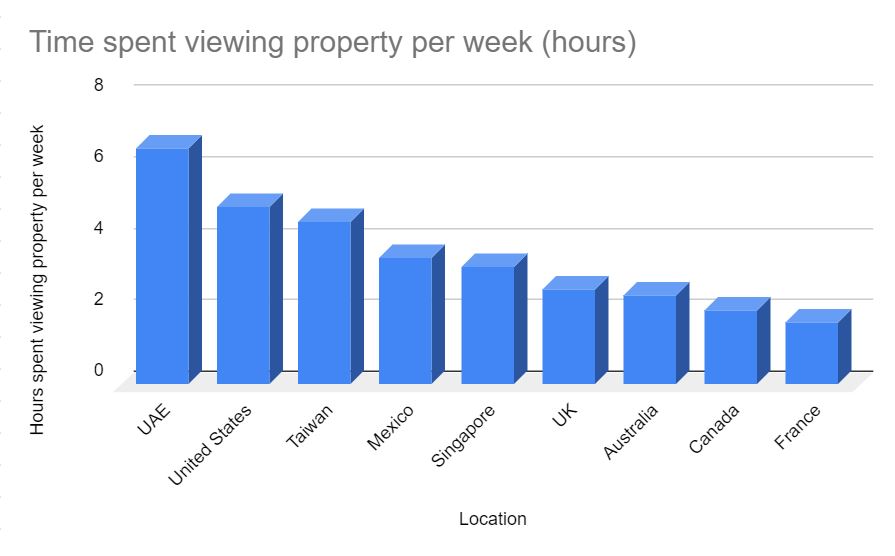
That’s twice the time spent at the gym (1.08 hours) and three times as much as we talk to our parents (0.88 hours).
Under such benign housing credit conditions — low rates, greater certainty on repayments with the fixing of rates thanks to the Term Funding Facility, lockdowns coupled with income from JobKeeper — it’s not surprising that we’re ploughing money into property.
On Wednesday APRA sent a letter to the banks, instructing them to increase the minimum interest rate buffer applied to new home loan applications.
The serviceability buffer will increase from 2.5 per cent to 3 per cent.
“While the banking system is well capitalised and lending standards overall have held up, increases in the share of heavily indebted borrowers, and leverage in the household sector more broadly, mean that medium-term risks to financial stability are building,” said APRA chairman Wayne Byres.
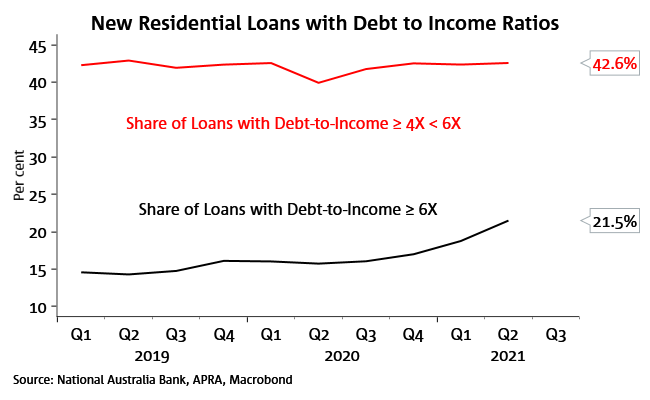
APRA wants to reduce maximum borrowing capacity, since a fifth of new loans now have more than a 6:1 ratio of debt-to-income, as this NAB chart shows:
The implications
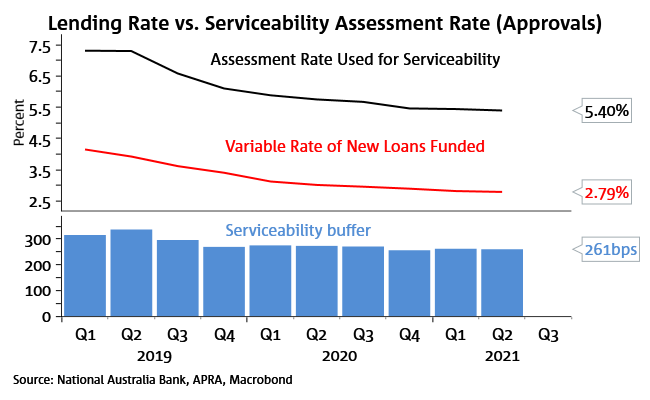
This increase in serviceability buffer reduces the borrowing capacity of borrowers by 5 to 6 per cent, again shown in this NAB chart:
Only time will tell if the latest measures put a dent in the housing market.
History has shown these may be mere bumps in the road instead of a large-scale correction.
But it’s just the first shot across the bow from APRA.
About Anna Hong and Pendal’s Income and Fixed Interest team
Anna Hong is an assistant portfolio manager with Pendal’s Income and Fixed Interest team.
Pendal’s Income and Fixed Interest boutique is one of the most experienced and well-regarded fixed income teams in Australia. In 2020 the team won the Australian Fixed Interest category in the Zenith awards.
With the goal of building the most defensive line of funds in Australia, the team oversees A$22 billion invested across income, composite, pure alpha, global and Australian government strategies.
Find out more about Pendal’s fixed interest strategies here
About Pendal Group
Pendal is an independent, global investment management business focused on delivering superior investment returns for our clients through active management.