
What does this week’s big inflation number mean for rates? Here’s a snapshot from Pendal’s head of cash strategies STEVE CAMPBELL
WEDNESDAY’S 7.3 per cent headline inflation number was the highest annual increase since 1990.
The key numbers were:
- Q3 headline: +1.8% (v 1.6% market forecast), taking the annual rate to 7.3% (v 7% market forecast)
- Q3 trimmed mean: +1.8% (v 1.5% market forecast), taking the annual rate to 6.1% (v 5.5% market forecast)
- Q3 weighted median: +1.4% (v 1.5% market forecast), taking the annual rate to 5% (v 4.8% market forecast)
The most significant contributors to the rise in the quarter were new dwellings (+3.7%), gas (+10.9%) and furniture (+6.6%).
New dwelling costs rose due to higher labour costs (due to labour shortages) and material shortages.
The rate of price growth did ease relative to prior quarters though (+5.6% and 5.7%), reflecting softening new demand and easing supply constraints
Electricity prices rose 3.2% for the quarter. This was offset by subsidies from the WA, Qld and ACT governments. Excluding these, electricity would have risen 15.6% in the quarter.
New dwellings (+20.7%) was also the biggest contributor to the 7.3% annual headline inflation number, followed by and automotive fuel (+18%).
However automotive fuel was down 4.3%, reflecting a fall in the crude oil price.

Find out about
Pendal’s
cash funds
What does it mean for investors?
The Reserve Bank was always going another 25 basis points at its meeting on Melbourne Cup day next week.
This inflation data — while higher than expected — does not warrant a bigger move.
One thing the RBA has in its favour over other central banks is its higher meeting frequency.
With the exception of January the RBA meets monthly, as opposed to the six-week cycle of most other central banks.
However today’s data does is make it more likely the RBA will follow up with another 25-point hike in December.
Merry Christmas from the RBA!
What would delay a December hike?
External forces increasing the likelihood of faster deterioration in global economic growth would make them reluctant to tap the brakes further.
The RBA is more than aware of the balance of risks from aggressive central bank policy tightening this year.
About Steve Campbell and Pendal’s Income and Fixed Interest team
Steve Campbell is Pendal’s head of cash strategies. With a background in cash and dealing, Steve brings more than 20 years of financial markets experience to our institutional managed cash portfolio.
Find out more about Pendal’s cash funds:
Short Term Income Securities Fund
Pendal Stable Cash Plus Fund
Pendal Managed Cash Fund
Pendal’s Income and Fixed Interest boutique is one of the most experienced and well-regarded fixed income teams in Australia.
As the Aussie hits multi-year lows against a rising US dollar, is it time to currency-hedge international portfolios? Pendal’s ALAN POLLEY argues the ‘yes’ case
- Strong diversification benefits in foreign currency exposure
- Low Aussie dollar offer hedging opportunity
- Find out about Pendal’s multi asset funds
INVESTORS should consider hedging foreign currency exposure in international share portfolios as the Aussie dollar hits 2½ year lows against a rising US dollar, arguesPendal’s Alan Polley.
The US dollar’s strength has been the big story of 2022 as the Fed battles inflation by lifting interest rates at the fastest pace since the ’80s.
Higher rates are drawing in money from overseas investors, sending the value of the US dollar higher.
The Australian dollar traditionally offers investors natural diversification benefits because it tends to fall when global markets fall, softening any global declines for local investors.
But at current levels it could pay to think about reducing foreign exchange exposure, says Polley, a portfolio manager with Pendal’s multi-asset team.
“At this point in time, with the Aussie dollar very low versus the US dollar, it’s just natural to ask how much FX exposure should we have and if now is a good time to hedge a little bit more.
“The US dollar on our metrics is becoming expensive — and historically the AUD tends to find support around these levels.
Australian dollar to United States dollar
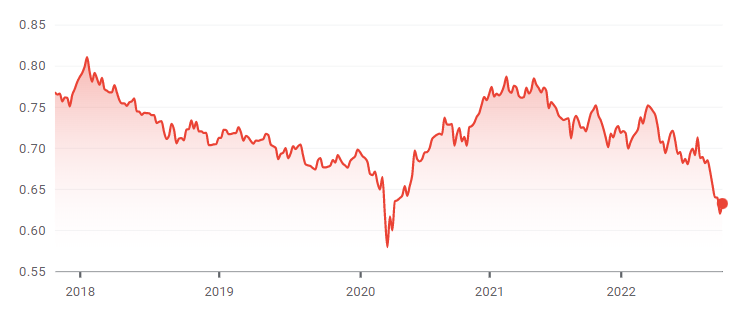
“It has positive momentum – the US is increasing cash rates at a greater rate than we are – but in long-term investing, you should focus a bit more on the valuation metric. Buy things when they are cheap.
“Arguably the Australian dollar versus the US Dollar appears on the cheap side.”
Foreign exchange exposure is an important consideration for Australian investors who are increasingly holding offshore assets in their portfolios.
“There are strong diversification benefits just by having foreign currency exposure,” says Polley.
“The Australian dollar is seen as a ‘risk-on’ currency – that means in a risk-off environment, the Australian dollar tends to fall.
“If your international equities are falling, typically the Australian dollar might fall as well and that provides an offset for international equities. That diversification benefit from FX exposure is quite valuable.
“There’s not that many defensive exposures in the world. Owning developed-world foreign currency provides significant diversification benefits at the whole portfolio level.”
The right exposure
So what’s the right way to think about the optimal level of exposure?

Find out about
Pendal
Multi-Asset
Funds
Polley says investors can best understand the effects of hedging in a portfolio by considering what happens if you take a theoretical fully hedged portfolio and then start introducing currency exposure.
“What tends to happen is the volatility of the whole portfolio comes down because of the diversification benefits from adding foreign currency exposure.
“But as you keep increasing the amount of foreign currency exposure, the diversification benefits become marginally less and the incremental volatility of currency starts to dominate.
“That means the more currency exposure you have, at some point the volatility of the overall portfolio starts to go up.
“So theoretically there’s an optimal – or a volatility minimisation – point.”
Important considerations
There are other considerations to keep in mind, says Polley.
“As the amount of currency exposure gets large, you’re exposed to the risk of a sustained rise in the AUD.
“Also, future correlations may be different to the past and expected diversification benefits may not arise.
“Lastly, we tend to invest overseas for the offshore assets, so the currency exposure is more a by-product than an explicit aim.”
For most Australian investors, a 20 per cent FX hedge ratio on an international equities portfolio will balance these considerations — and should also mitigate overt sensitivity to FX movements, says Polley.
“You’re getting diversification benefits by having some FX exposure, but you’re not having too much of a good thing.”
How can you do that?
“Consider buying a hedged international equity product and have that at about 20% of your international equity portfolio.”

Sustainable and
Responsible Investments
Fund Manager of the Year

About Alan Polley and Pendal’s Multi-Asset capabilities
Alan is a portfolio manager with Pendal’s multi-asset team.
He has extensive investment management and consulting experience. Prior to joining Pendal in 2017, Alan was a senior manager at TCorp with responsibility for developing TCorp’s strategic and dynamic asset allocation processes covering $80 billion in assets.
Alan holds a Masters of Quantitative Finance, Bachelor of Business (Finance) and Bachelor of Science (Applied Physics) from the University of Technology, Sydney and is a CFA Charterholder.
Pendal’s diversified funds provide investors with a variety of traditional and alternative asset classes and strategies.
How are different asset classes faring in these rough economic conditions? Here’s a quick snapshot from our multi-asset chief Michael Blayney
- Opportunities in REITs and infrastructure
- Be ready to shift to bonds if recession looms
- Find out about Pendal’s multi-asset strategies
THE key risk to equities in coming months is how hard profit margins and earnings are hit by slowing economic growth from rising interest rates, and higher inflation, says Michael Blayney, head of Pendal’s multi-asset portfolios.
For bond investors, high inflation continues to be a headwind. But with a slowing economy, investors need to be ready to shift to the security of bonds if a recession looms.
The de-rating of real assets means there’s some opportunities in real-estate investment trusts and infrastructure, Blayney says, while the prospect of recession makes investing in high yield credit markets more difficult.
The silver lining for (new) investors from falling markets during the past six months is the de-rating of assets.
But the rise in fixed income yields makes other assets, which are priced off bonds, less attractive, Blayney adds.
Equities
The valuation backdrop in equity markets has improved, Blayney says.
“We are getting to the position where there’s some opportunities to buy. But we are not at the point of seeing broad based bargains yet.”
Find out about
Pendal Multi-Asset Funds
“US large cap stocks remain expensive, while Australian equities are closer to fair value,” he says.
“The Australian economy and market are not really in bad shape. Our equity market is a value market … and the resources sector is less negatively impacted by inflation.”
“Globally, small and mid-cap equities are fair value, or even cheap, relative to large caps.”
Blayney says lower valuations of small caps partly reflects market sentiment that they’re more likely to underperform in a recession.
But he adds: “For a longer-term investors cheap valuations represent an attractive entry point, to the extent in which a significant amount of ‘bad news’ has already been priced in.”
Similarly for investors with a longer-term horizon, value stocks continue to provide an opportunity in major markets, particularly Europe, Japan, and the small cap end of the US market.
“In addition, a rising interest rate environment should remain supportive of value as a style.
“Value outside of US large caps is the most attractive area to play a value tilt, given the spread in earnings growth for value versus the broader market has been considerably smaller in most other markets than it has been in the large cap end of the US market.”
Bonds
Bonds remain attractive because of their defensive characteristics, but they still have significant headwinds from inflation.

Adviser Sam is invested
in making our world
A better place.
Watch as Sam meets a
mum rebuilding her life
thanks to responsible
investing
“We generally retain some duration exposure for defensiveness within portfolios, but this is at a lower level than usual,” Blayney says.
“Where possible, we have a preference for inflation protection and Australian exposure within portfolios.”
Credit
Investment grade credit offers reasonable returns on a medium-term basis, he says.
“High-yield spreads are now better than they were. However, we believe that the risk of investing in high yield during an economic slowdown outweighs the benefit of higher yields at this point.”
Listed Real Assets
In listed real assets, the increase in interest rates have triggered a de-rating of both global REITs and many listed infrastructure assets.
“Higher bond yields have caused REITs to de-rate significantly, moving A-REITs and global REITs back towards fair value,” Blayney says.
“There are also some attractive opportunities available in listed infrastructure.”
About Pendal’s multi-asset capabilities
Pendal’s diversified funds provide investors with a variety of traditional and alternative asset classes and strategies.
These include Australian and international shares, property securities, fixed interest, cash investments and alternatives.
In March 2024, Perpetual Group brought together the Pendal and Perpetual multi-asset teams under the leadership of Michael O’Dea.
The newly expanded nine-strong team will manage more than $6 billion in AUM and create a platform with the scale and resources to deliver leading multi-asset solutions for clients.
Michael is a highly experienced investor with more than 23 years industry experience, including almost a decade leading the team at Perpetual.
ESG is not just a company-level issue, says Pendal multi-asset portfolio manager ALAN POLLEY
- Asset allocation accounts for about 90% of a portfolio’s return variability
- Important to consider ESG at asset allocation level
- Find out about Pendal’s multi asset funds
ENVIRONMENTAL, social and governance factors should be incorporated into portfolios at an asset allocation level — rather than only at individual stock selection level, says Pendal’s Alan Polley.
ESG has long been a critical factor in investing, aiming to identify and avoid risk and financial loss as well as bring about change.
But it’s often considered only at a company level.
A better investing framework would incorporate ESG factors at an asset allocation level before the security selection process even takes place, says Polley, a portfolio manager in Pendal’s multi-asset team.
“We know asset allocation is the primary driver of investment returns. It explains about 90 per cent of the return variability in a portfolio according to the original Brinson study,” says Polley.
“But ESG integration in asset allocation is not something that is covered in the industry.
That’s for two reasons:
“First, because it’s hard. How do you think about it?
Find out about
Pendal
Multi-Asset
Funds
“And second, in my opinion, asset allocation is not well shaped in the industry overall.
So, where does ESG fit into an investment process that isn’t very well defined?”
Three-part framework
Polley offers a three-part framework for thinking about ESG in asset allocation.
The practice of asset allocation fundamentally involves three decisions, he says:
- Changing allocations between existing asset classes
- Changing the definition of existing asset classes
- Introducing new asset classes
“When you think about asset allocation, you really doing one of those three things — there’s no other decisions.
“Given those three decisions sets, incorporating ESG is quite simple.”
Climate change example
Polley uses the environmental factor of carbon emissions as an example.
“Emissions intensity in Australia is vastly higher than global markets. So, if you think climate change is an important investment consideration, you might tilt away from Australian equities towards international developed markets.
“There is a ESG headwind to the Australian market and the Australian economy in its exposure to fossil fuels.”
Pendal’s multi-asset funds have incorporated this insight by reducing a portfolio’s home bias and tilting instead towards US and European shares.
The framework also holds true for social and governance factors.
“Emerging markets are not great on E, S or G — they are emerging for a reason. But we’re not going to rule out the asset class because it’s an important source of diversification and returns.
Sustainable and
Responsible Investments
Fund Manager of the Year
“So, we changed the definition — for emerging markets, we’ve removed repressive regimes: China, Saudi Arabia, Russia and a few others. From an ESG standpoint, we just don’t think they’re true to label.”
The change means the portfolios can still hold emerging markets assets and lifts the weightings to less risky markets.
New asset classes
The third asset allocation decision — introducing new asset classes — has allowed the portfolios to lift exposure to the energy transition theme.
“The conversion from fossil fuels to renewables is a secular tailwind so we have created a listed renewables infrastructure asset class. We’re investing directly into renewable listed investment companies — the underlying assets are pure infrastructure like batteries, wind farms, solar and hydro.
“It’s great because we tend to focus on investing in primary market stock issuances, so we’re directly funding the development of these renewables assets.
“It’s a great way of getting a big lick of ESG exposure into our portfolios within the asset allocation construct.”
It’s important that sustainable investors step beyond simple security selection, says Polley.
“Security selection is just the first generation of ESG thinking — the 1G.
“Asset allocation is 2G and you can even step up to a third generation and consider ESG in the whole of portfolio construction.
“But most of the industry is still stuck at 1G.”
About Alan Polley and Pendal’s Multi-Asset capabilities
Alan is a portfolio manager with Pendal’s multi-asset team.
He has extensive investment management and consulting experience. Prior to joining Pendal in 2017, Alan was a senior manager at TCorp with responsibility for developing TCorp’s strategic and dynamic asset allocation processes covering $80 billion in assets.
Alan holds a Masters of Quantitative Finance, Bachelor of Business (Finance) and Bachelor of Science (Applied Physics) from the University of Technology, Sydney and is a CFA Charterholder.
Pendal’s diversified funds provide investors with a variety of traditional and alternative asset classes and strategies.
A stockmarket rally has left some calling the start of a new equities bull market. But investors should remain diversified with exposure to bonds and alternatives, says Pendal’s MICHAEL BLAYNEY
- Big rallies come in bear markets
- ‘Stay diversified, be a little bit cautious, but be ready’
- Find out about Pendal’s multi-asset strategies
A STRONG rally in markets since the lows of June has left some calling the start of a new equities bull market.
But Pendal’s Michael Blayney says it will pay to stay conservative for the rest of 2022 — and watch for better buying opportunities as the inflation outlook matures.
Better-than-expected inflation figures and a benign US earnings season have fuelled a rally over the past few weeks on hopes the pace of interest rate rises might be slowing.
But Blayney, who heads Pendal’s multi-asset investment team, says it pays to be wary of bear-market rallies. A balanced, conservative approach is the best way to ride out the coming months, he says.
“You have to have cautious — when you look at history, you see the strongest rallies in bear markets.
“Inflation has moderated a little bit in the US but it’s still at an uncomfortably high level.”
Equities
For all the new-found excitement, global markets remain “somewhere between fair and expensive, depending on where you look”, Blayney says.
“Australian equities are probably one of the better-value markets but it’s not a bargain hunter’s paradise out there in any way, shape or form.
“So, we’re not at the point yet where we would want to go overweight equities in portfolios — and infact we’re still a little bit underweight.”
Find out about
Pendal Multi-Asset Funds
Blayney says the US earnings season has been more benign than many feared.
“We haven’t yet seen huge pressure on earnings and that’s something that investors need to keep an eye out for.
“If you look at past instances of inflation and monetary tightening, you often see pressure on earnings, particularly if that tightening pushes the economy into recession.”
What to watch
Investors looking to wade back into markets should watch for signs inflation is coming under control, allowing the US Fed to stay its hand and avoid pushing the economy into recession.
But on the flip side, there is still the risk of a return to falling markets. That could create a buying opportunity.
“If inflation doesn’t subside and the Fed needs to hike more aggressively, that would be one trigger.
“The other is if we start to see pressure on earnings.”
Adviser Sam is invested
in making our world
A better place.
Watch as Sam meets a
mum rebuilding her life
thanks to responsible
investing
Where to diversify
Blayney says the golden rule is to maintain diversification.
“The first thing is we always maintain some bond exposure. If you look through history, in down markets for equities, bonds will give you a positive return 70 per cent of the time.
“We also leave a certain amount of our global shares unhedged which gives us foreign currency exposure.”
Foreign currency exposure creates a useful automatic stabiliser for Australian investors because in times of trouble the Australian dollar tends to get sold off, lifting the value of foreign assets held by a local investor.
“And something that has really helped support our portfolios this year has been alternatives exposure.
“We invest in a range of assets, including listed renewables and other sustainable infrastructure with inflation linked cash flows, as well as commodity-type assets.
“People love to say the 60:40 portfolio is dead, but the reality is that style of balanced portfolio has stood the test of time.”
“So, the message is stay diversified, be a little bit cautious, but be ready for when those buying opportunities do come along if we see something nasty and everyone starts to panic.”
About Pendal’s multi-asset capabilities
Pendal’s diversified funds provide investors with a variety of traditional and alternative asset classes and strategies.
These include Australian and international shares, property securities, fixed interest, cash investments and alternatives.
In March 2024, Perpetual Group brought together the Pendal and Perpetual multi-asset teams under the leadership of Michael O’Dea.
The newly expanded nine-strong team will manage more than $6 billion in AUM and create a platform with the scale and resources to deliver leading multi-asset solutions for clients.
Michael is a highly experienced investor with more than 23 years industry experience, including almost a decade leading the team at Perpetual.
What does the RBA’s latest monetary policy statement mean for rates and inflation? Here’s a snapshot from Pendal’s head of cash strategies STEVE CAMPBELL
INVESTOR response to the RBA’s monetary policy statement on Friday was pretty much non-existent.
That’s not surprising since the key updated forecasts were included in Tuesday’s rates announcement, when the cash rate was lifted by another 0.5 percentage points.
Not surprisingly Friday’s statement included sizable upward revisions to inflation forecasts, which had already been flagged when the RBA raised the cash rate by 0.5% in June.
The main downward revisions were to economic growth, dwelling investment and household consumption – not surprising given the increase in interest rates and the economy operating at close to capacity.
The unemployment rate troughs at 3.4% later this year, a downward revision of 0.3% for this year before edging higher.
Regardless, the labour market will remain extremely tight for the next couple of years and wage inflation will follow.
The wage price index was revised marginally higher with annual increases of 3%, 3.6% and 3.9% now forecast for 2022, 2023 and 2024.
Some key points from Friday’s monetary statement:
Inflation
- Short-term inflation expectations have increased, but longer-term inflation expectations remain anchored
- Inflation is broad based with about 75% of the basket growing by an annualised rate of 3% or more in the June quarter
- Fair Work Commission and state government increases will see the wage price index pick up
- Building materials inflation is now closer to 20%; dwelling construction is about 10% of the inflation basket
- Passthrough of higher costs continues, though there signs pressure may be easing. (I doubt the passthrough will be quick on the way down)
Find out about
Pendal’s
cash funds
Labour market
- Average employment growth of 51k per month over the past quarter versus an average of 21k jobs in the 12 months prior to the pandemic
- Employment-to-population ratio hit a record high level of 64.4% in June
- There are now almost as many vacant jobs as there are unemployed people
- In response to the tight labour market businesses are offering non-wage incentives; hiring lower-skilled people and offering higher wages
- Numbers for overseas students and working holiday makers remain low, particularly affecting accommodation and food service sectors
Investment
- Non-residential construction investment remains constrained by supply issues, weather events and capacity constraints
- Despite higher prices the mining sector is spending only to maintain existing output rather than investing to expand capacity
Housing
- Existing investment pipeline remains strong, offering near-term support; but approvals and commencements are responding to higher input prices and interest rates
- Sentiment is deteriorating with biggest declines in Sydney and Melbourne
- Advertised rents grew strongly in the first half due to low vacancy rates and household income growth
The RBA’s main forecasts and revisions against the May monetary statement:
| Current Forecasts | Dec-22 | Jun-23 | Dec-23 | Jun-24 | Dec-24 |
|---|---|---|---|---|---|
| Trimmed mean inflation | 6 | 5 | 3.8 | 3.3 | 3 |
| Consumer price index | 7.8 | 6.2 | 4.3 | 3.5 | 3 |
| Wage price index | 3 | 3.4 | 3.6 | 3.8 | 3.9 |
| Unemployment rate (quarterly, %) | 3.4 | 3.4 | 3.5 | 3.7 | 4 |
| Employment | 4.4 | 2.2 | 1.4 | 1.1 | 0.9 |
| Gross domestic product | 3.2 | 2.3 | 1.8 | 1.8 | 1.7 |
| Dwelling investment | 1.7 | 2.5 | -0.1 | -2.6 | -4.8 |
| Business investment | 4.9 | 5.9 | 6.6 | 5.7 | 4.6 |
| Household consumption | 4.9 | 2.8 | 2.4 | 2.3 | 2.2 |
| Major trading partner (export-weighted) GDP | 3.3 | 4.8 | 3.4 | 3.4 | 3.5 |
| Revisions | Dec-22 | Jun-23 | Dec-23 | Jun-24 |
|---|---|---|---|---|
| Trimmed mean inflation | 1.4 | 1.4 | 0.7 | 0.4 |
| Consumer price index | 1.9 | 1.9 | 1.2 | 0.6 |
| Wage price index | 0 | 0.1 | 0.1 | 0.1 |
| Unemployment rate (quarterly, %) | -0.3 | -0.2 | -0.1 | 0.1 |
| Employment | 0.5 | 0.2 | -0.1 | -0.1 |
| Gross domestic product | -1 | -0.8 | -0.2 | -0.2 |
| Dwelling investment | -2.6 | -3.2 | -2.7 | -4 |
| Business investment | -0.1 | -2.4 | -1.4 | 0.2 |
| Household consumption | -0.9 | -1.6 | -0.7 | -0.5 |
| Major trading partner (export-weighted) GDP | -0.7 | 0.5 | 0 | -0.1 |
Where to from here
The RBA’s line last week that it is “not on a pre-set path for normalising policy” has been interpreted as the central bank becoming potentially less aggressive.
Inflation data is released quarterly in Australia so we may see the RBA moving in increments of 25 basis points at its next two meetings prior to the release of third-quarter inflation data in late October.
That gets us to a cash rate of 2.35% before a decision on whether a bigger response is needed on Melbourne Cup Day in response to the inflation print.
The inflation forecast of 7.75% seems too high to us. We see inflation as being closer to low 7s for 2022.
Either way it still well above the upper end of the RBA’s 2-3% target band.
We also take the RBA’s forecasting with a massive grain of salt.
As Governor Lowe himself conceded recently, it’s been embarrassing how wrong they’ve been.
About Steve Campbell and Pendal’s Income and Fixed Interest team
Steve Campbell is Pendal’s head of cash strategies. With a background in cash and dealing, Steve brings more than 20 years of financial markets experience to our institutional managed cash portfolio.
Find out more about Pendal’s cash funds:
Short Term Income Securities Fund
Pendal Stable Cash Plus Fund
Pendal Managed Cash Fund
Pendal’s Income and Fixed Interest boutique is one of the most experienced and well-regarded fixed income teams in Australia.
What’s next after today’s 0.5 percentage point hike? Here’s a quick snapshot from Pendal’s head of cash strategies STEVE CAMPBELL
THE Reserve Bank raised the cash rate by a further 50 basis points today, taking the cash rate to 1.85%.
Further policy tightening will occur in the months ahead, the RBA says.
Size and timing will be determined by the data and the bank’s assessment of the outlook for inflation and the labour market.
We’ll get an updated set of economic forecasts on Friday in the RBA’s next Statement on Monetary Policy.
Today’s release included a preview of those forecasts including:
- Inflation is forecast to hit 7.75% in 2022; just over 4% in 2023 and around 3% in 2024
- GDP is forecast at 3.25% in 2022 and 1.75% in 2023-24
- The unemployment rate is expected to fall further from 3.5% in the months ahead before rising to end 2024 at a still low 4%
The RBA sees household spending as the major source of uncertainty. But it notes people are finding jobs and longer hours.
Labour scarcity is not something that will be resolved anytime soon.
A large amount of fixed rate mortgages are due to reset over the next 12 months — which means some households will face a significant increase in mortgage repayments.
Find out about
Pendal’s
cash funds
Higher food and commodity prices are also weighing on consumption.
Where to from here?
A line in today’s statement — that the RBA is “not on a pre-set path for normalising policy” — has been interpreted as the central bank being potentially less aggressive.
Inflation data is released quarterly in Australia so we may see the RBA moving in increments of 25 basis points at its next two meetings — prior to the release of third quarter data in late October.
That gets the RBA to a cash rate of 2.35% before deciding whether a bigger response is needed on Melbourne Cup day in response to the inflation print.
The inflation forecast of 7.75% seems too high to us. We see it as closer to low 7s rather than high 7s for 2022.
Either way it’s still well above the upper end of their 2-3% target band.
We also take the RBA’s forecasting with a massive grain of salt. As Governor Philip Lowe himself conceded recently, it’s been embarrassing how wrong they’ve been.
About Steve Campbell and Pendal’s Income and Fixed Interest team
Steve Campbell is Pendal’s head of cash strategies. With a background in cash and dealing, Steve brings more than 20 years of financial markets experience to our institutional managed cash portfolio.
Find out more about Pendal’s cash funds:
Short Term Income Securities Fund
Pendal Stable Cash Plus Fund
Pendal Managed Cash Fund
Pendal’s Income and Fixed Interest boutique is one of the most experienced and well-regarded fixed income teams in Australia.
Investors are facing the challenge of investing in a high-inflation environment. Pendal’s head of multi-asset MICHAEL BLAYNEY explains what to keep in mind
- Investors face slowing growth and high inflation
- Diversification and active investment are critical
- Equities, bonds, alternatives and currency all play a role
INVESTORS haven’t faced the challenge of investing in a low growth, high-inflation environment for many decades. But that’s the scenario right now.
For financial planners, equities mostly sit at the heart of a portfolio and provide long term growth. Now investors must diversify to protect portfolios, says Michael Blayney, who heads up Pendal’s multi-asset team.
Investors can think about the market in four quadrants, says Blayney:
“First, there’s good growth and high inflation. That’s not necessarily a bad thing for equities. They generally do well, whereas it’s a bad environment for bonds.
“If you have a low growth, low inflation, equities might be lagging a bit, but bonds are doing well.
“Then there’s the good growth, low inflation environment which we have enjoyed since the global financial crisis. We’ve had solid, albeit unspectacular, growth and really low interest rates and that’s been close to a Goldilocks situation for both equities and bonds.
The most challenging time to be an investor is in a low or slowing growth, higher inflation environment – the likely current scenario.
Find out about
Pendal Multi-Asset Funds
“We haven’t seen that for a long time. That’s what happened with the dreaded stagflation of the 1970s,” Blayney says.
“That environment is challenging for bonds – they tend to get whacked early when you have the initial high inflation. Once the market adjusts and you get higher yields, they can start being a good investment.”
“Right now, Aussie bonds are about fair in terms of pricing-in higher inflation. Overall, with global bonds, the yields aren’t quite high enough. They haven’t quite priced in the inflationary environment enough.
“But it is an environment where you want to be active because if yields spike, then bonds might be attractive,” he explains.
Inflation-linked bonds are a potential option in the current environment. In their standard index form, they tend to have long interest rate duration and so can still suffer in a rising rate environment.
Blayney says a critical factor for the asset class is not where inflation has been, but where the market thinks it’s going.
“If you see the market start to expect inflation to be higher for longer, than you would expect inflation-linked bonds to outperform nominal bonds of the same maturity – though absolute returns may still be negative if the impact of rising yields is larger than the impact of the increase in longer-term inflation expectations, which has been the case so far in 2022.”
So far, the market hasn’t priced in inflation as a long-term problem, with pricing inferring an inflation rate over five years of 2.6 per cent.
Investing in equities in a low growth, high inflation environment is tricky, Blayney says.
Adviser Sam is invested
in making our world
A better place.
Watch as Sam meets a
mum rebuilding her life
thanks to responsible
investing
“A higher bond yield means a higher discount rate applies to equities, so they get marked down. And you will also likely see earnings start to come off, though that hasn’t come through in aggregates of broker estimates yet.
“In periods of rising inflation commodity sectors tend to do better. Further, in periods of both rising inflation and falling growth, sectors with sticky demand and pricing power like healthcare and consumer staples have historically been good places to invest.”
Diversify and stay nimble
The current environment highlights the benefits of diversification and being nimble, says Blayney.
It’s time to look beyond bonds and equities, he says.
“There are assets like commodity futures which have followed the pattern of the early 1970s, though have come off a bit more recently. Real assets can be attractive in the listed infrastructure space, where you can get inflation-linked cash flows.”
He warns that trying to pick exchange rate movements is not straight forward.
“The Australian dollar is a commodity currency, so all things being equal, you’d expect with commodity prices high, the Aussie dollar would be strong.
“But it’s also a ‘risk-on’ currency. If markets struggle a bit, you tend to see those currencies fall. And then there’s the interest rate factor and the US Federal Reserve has been more aggressive than the Reserve Bank of Australia. There’s opposing forces on the currency and it’s difficult to get a clear direction for the Aussie dollar.
“Financial planners should think about the things that provide portfolio diversification away from just equities. And that’s bonds, currency and alternatives.
“Unless you have a wonderful crystal ball, you need to own all of them.”
About Pendal’s multi-asset capabilities
Pendal’s diversified funds provide investors with a variety of traditional and alternative asset classes and strategies.
These include Australian and international shares, property securities, fixed interest, cash investments and alternatives.
In March 2024, Perpetual Group brought together the Pendal and Perpetual multi-asset teams under the leadership of Michael O’Dea.
The newly expanded nine-strong team will manage more than $6 billion in AUM and create a platform with the scale and resources to deliver leading multi-asset solutions for clients.
Michael is a highly experienced investor with more than 23 years industry experience, including almost a decade leading the team at Perpetual.
Investing in a globally diversified portfolio with a mix of equities, bonds, alternatives, property and cash has proven a sound strategy for long-term wealth creation says Pendal’s head of multi-asset MICHAEL BLAYNEY
- Time to consider rebalancing portfolios
- Globally diversified portfolio remains a sound strategy
- Find out about Pendal multi-asset funds
CONTRARY to some claims, the balanced portfolio isn’t dead.
Periods of volatility and changing correlations are a normal part of the market cycle, and that is what’s happening now, says Michael Blayney, head of Pendal’s multi-asset investments team.
“While there are clearly a lot of headwinds to equities at present, Australia is fortunate that the local market is more reasonably valued than many offshore markets. Also, the resources weighting of the ASX helps provide a partial hedge against inflation,” Blayney says.
Blayney’s fund remains modestly underweight equities. But he says Australia, in a relative sense, is one of the more attractive markets globally.
Rising yields have hurt fixed income investments, but on a forward-looking basis Australian 10-year bonds now yield more than 4 per cent for the first time since 2014.
“This higher-running yield provides an attractive level of income relative to cash, and a cushion against the impact of any further increases in yields,” Blayney says.
“While we retain an underweight allocation to bonds in portfolios generally, we do see Australia as relatively attractive compared to other major bond markets.”
Find out about
Pendal Multi-Asset Funds
Opportunities
Times of market volatility tend to throw up opportunities.
“While we’re not at the point, yet, of seeing ‘bargains’ like March 2020 or late 2008, the market falls have led to lower valuations across a range of asset classes,” Blayney says.
Now is a good time to rebalance, whereby assets are trimmed after strong price increases and topped up after falls, he says.
“It is one of the simplest and best ways to incrementally improve long-term outcomes.
“In the present environment, this would naturally lead investors to trim cash and alternatives and top up cheaper equity and bond holdings.”
Blayney says equity markets tend to fall about one year in three — meaning they rise the other two.
“Investing in a globally diversified portfolio — with a mix of equities, bonds, alternatives, property and cash — has proven a sound strategy for long-term wealth creation over many decades, through wars, pandemics and a host of economic crises.
“Conversely, panicking after large market falls and selling has, generally, been a wealth-destroying activity for investors.
“You see classic examples of that behaviour at work in 2008 and early 2020.
“While we’ve been somewhat underweight equities and bonds in portfolios this year, these are relatively modest positions in the context of our long-term strategic asset allocations.
“We continue to believe investors should ‘stay the course’ in respect of their long-term strategies.”
Adviser Sam is invested
in making our world
A better place.
Watch as Sam meets a
mum rebuilding her life
thanks to responsible
investing
About Pendal’s multi-asset capabilities
Pendal’s diversified funds provide investors with a variety of traditional and alternative asset classes and strategies.
These include Australian and international shares, property securities, fixed interest, cash investments and alternatives.
In March 2024, Perpetual Group brought together the Pendal and Perpetual multi-asset teams under the leadership of Michael O’Dea.
The newly expanded nine-strong team will manage more than $6 billion in AUM and create a platform with the scale and resources to deliver leading multi-asset solutions for clients.
Michael is a highly experienced investor with more than 23 years industry experience, including almost a decade leading the team at Perpetual.
What does the Reserve Bank’s 0.5% rate rise mean for investors? Here’s a quick overview from Pendal’s head of cash strategies STEVE CAMPBELL
THE Reserve Bank surprised the market today with a lift of 50 basis points, taking the cash rate to 0.85%.
The RBA now joins the 50-point hike club along with the Federal Reserve, Bank of Canada and Reserve Bank of New Zealand.
It’s the RBA’s biggest rate increase since February 2000 and only the fifth time we’ve seen a move of 50bps or more since the introduction of the cash rate target.
What prompted the big move?
The cash rate has been held too low for too long and the RBA is behind the curve. They are moving more quickly to get closer to neutral.
There wasn’t any particular economic data release you could point to — wage price index data was weaker (although they prefer their own business liaison results) and the unemployment rate at 3.9% was pretty much in line with the previous month.
Economic growth was solid but no smoking gun.
Inflation is now higher than expected due largely to the conflict in Ukraine and Covid-related supply disruptions.
Find out about
Pendal’s
cash funds
Tightness in the domestic labour market and the effect from the floods on food prices are also putting upward pressure on inflation.
Where to now?
“The size and timing of future interest rate increases will be guided by the incoming data and the Board’s assessment of the outlook for inflation and the labour market,” the RBA said in today’s statement.
“The Board is committed to doing what is necessary to ensure that inflation in Australia returns to target over time.”
I view 50 basis points next month as more probable than 25.
Households are now dealing with rising electricity prices, rising petrol prices and higher repayments for the roughly one-third with a mortgage.
It is going to sting — particularly for households that took out a mortgage over the past year and have not built up large buffers in mortgage offset accounts.
The RBA acknowledges this risk. But it also recognises average household balance sheets are in strong positions — many with solid buffers in mortgage offset accounts.
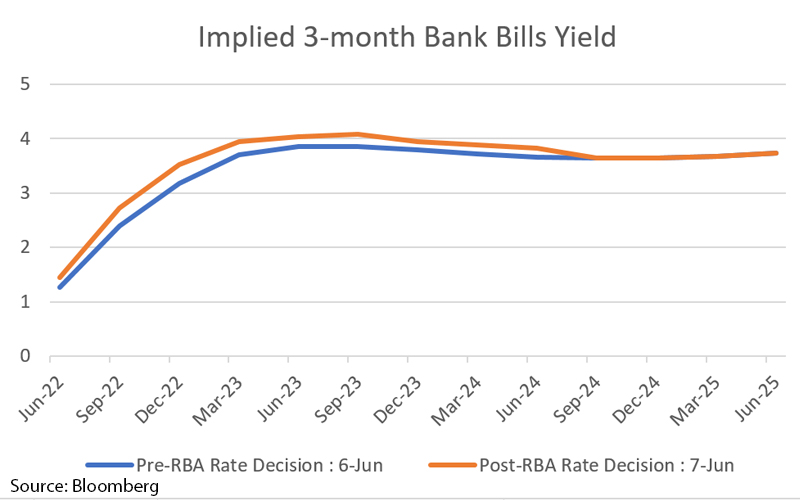
And the market is moving. This graph below shows the implied three-month rate from the bank bill futures (lack of change further out the curve is due more to lack of liquidity and nothing trading).
This graph below shows change in pricing today:
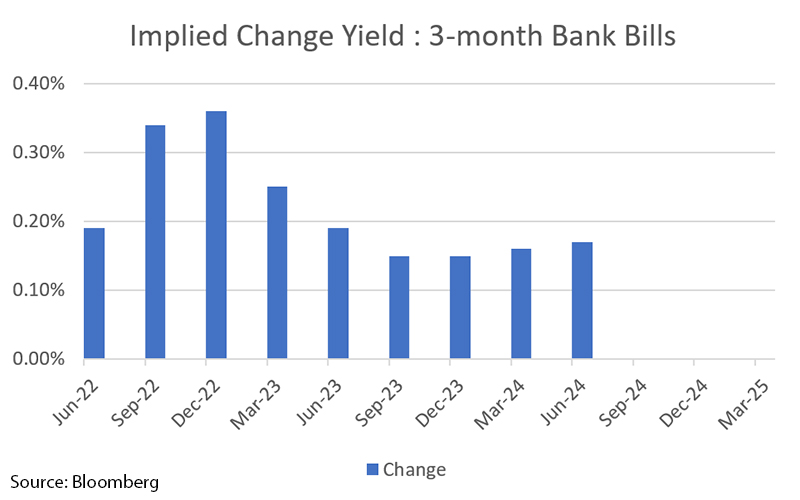
A cash rate closer to 3% by the end of the year? Market pricing is aggressive. But at the moment I wouldn’t rule anything out.
What does it mean for investors?
The questions for asset owners is: while markets are looking for another 3% of rate hikes in the next 12 months, is the economy ready for it?
The RBA tried to imply the economy would be resilient. But the tide is now going out.
The first 1.5% of hikes will see belt-tightening, but probably no more.
However the next 1.5% could see actual stress, especially in housing. This is an experiment the RBA hasn’t undertaken for more than a decade — and risks of a policy error are rising.
About Steve Campbell and Pendal’s Income and Fixed Interest team
Steve Campbell is Pendal’s head of cash strategies. With a background in cash and dealing, Steve brings more than 20 years of financial markets experience to our institutional managed cash portfolio.
Find out more about Pendal’s cash funds:
Short Term Income Securities Fund
Pendal Stable Cash Plus Fund
Pendal Managed Cash Fund
Pendal’s Income and Fixed Interest boutique is one of the most experienced and well-regarded fixed income teams in Australia.