
It’s become increasingly important for equities investors to understand how companies in their portfolios are protected from data breaches, says Pendal’s SUE SCOTT
- Increased focus on cyber security
- Investors need comfort from cyber policies
- Find out about Pendal Concentrated Global Share Fund
AFTER the recent Optus and Medibank data breaches, stockmarket investors may be wondering what to look for when assessing how vulnerable a company is to a hack attack.
Big, listed companies can make attractive targets for hackers.
“The larger the company, the more data it has and the more critical it is to society,” asks Sue Scott, a senior analyst in Pendal’s global equities team.
“These companies are more likely to be targeted for a cyber-attack,” Scott says. “Given our investment philosophy, it’s a particular risk for several of our portfolio companies.
“Understanding the risk, and what is being done by management to mitigate the associated with a cyber-attack on that business is critical.”
Scott use the example of Spanish financial services giant CAIXA, which Pendal has assessed for cyber-security risks.
Find out about Pendal Concentrated Global Share Fund
CAIXA has the largest IT platform in Spain and processes some 30,000 transactions per second.
“They receive 74 attacks every hour and the number of attacks has increased 2.6 times in 2022 compared to 2021,” Scott says.
Yet CAIXA hasn’t experienced a successful critical attack, says Scott.
What to look out for
Before investing, Pendal scrutinised the policy framework CAIXA has in place to understand preparedness for cyber-attacks and mitigation efforts.
“Importantly we saw that there are very clear roles and responsibilities defined within CAIXA.
“It has a cyber policy that’s corporate wide and mandatory for everyone to comply with.
“They have a specialised Cyber Security Committee which includes executive management representation; an audit team which presents to the board regularly; and three board members with specific technical expertise.
“Board members receive training and it’s reflected in the KPIs of management.”
An important addition at CAIXA is the Cyber Risk and Compliance role, separate from the Chief Technology Officer role.
“CAIXA felt when tackling cyber security, it’s important to have someone with a technical focus, and someone focused on governance.
“It also undertakes independent assessments of their cyber security capabilities twice a year, as well as complying with all European regulation regarding cyber safety,” Scott says.
Danger from within
Risks can also come from staff — whether intentional (such as a dissatisfied employee) or unintentional.
CAIXA monitors unusual behaviour among staff and their use of data.
“If there’s any abnormalities exposed then they investigate further,” Scott says.
“For non-intentional risks CAIXA has comprehensive training programs for staff and customers.”
One challenge is the ability to attract the relevant talent into a cyber security division.
“Everyone wants technical talent now to negate cyber risk. The fact that CAIXA has scale and is heavily resourced has helped attract people and keep the attrition rate very low,” Scott says.
“It gives us a lot of comfort talking to them, helping us understand what good looks like in terms of a cybersecurity policy and implementation of that policy.
“While good policy and technical expertise aren’t enough to prevent all attacks, they do mitigate the risk of an attack where critical business functions are affected, and reputational damage is inflicted.”
About Sue Scott
Sue joined Pendal in 2016 as a senior investment analyst for the global equities team. She is responsible for global sector coverage of the technology, consumer discretionary and materials sectors.
Sue has more than 24 years of experience in the finance industry. Before Pendal she advised global and Australian investors in Morgan Stanley’s Institutional Equity Division.
Pendal Concentrated Global Share fund is an actively managed, concentrated portfolio of global shares diversified across a broad range of global sharemarkets.
Find out more about Pendal Concentrated Global Share Fund
Pendal is a global investment management business focused on delivering superior investment returns for our clients through active management.
Contact a Pendal key account manager here.
Pendal is an independent, global investment management business focused on delivering superior investment returns for our clients through active management.
- Find out about Regnan Global Equity Impact Solutions Fund
REGNAN portfolio manager Tim Crockford spends most of his time searching for companies with an innovative edge in solving the world’s biggest problems.
Right now the opportunities lie with smaller companies, he argues
IT would take nerves of steel to write-off US large-cap equities.
Trading at just below 20x price/earnings, the S&P 500 can be seen as either over-valued or under-valued, depending where you think the world is going.
Given the rally in Big Tech through the first quarter, quite a few investors would seem convinced that there’s life — and value — left in long-duration, large-cap growth.
But this feels like a belief that the future will replay the past.
Are there alternatives?
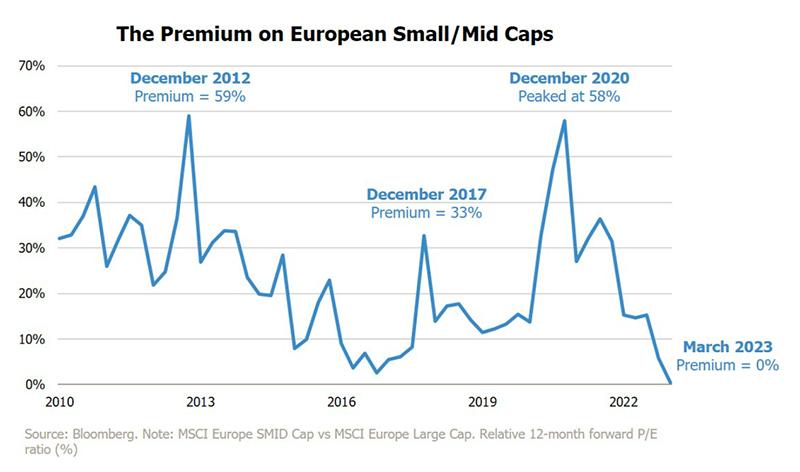
The chart shows the premium on European small and mid-cap relative to their large cap peers.
It is now approaching zero — the lowest it has been since the aftermath of the Global Financial Crisis.
We wouldn’t like to call the market.
But what we can do is identify opportunities in the European small and mid-cap area that we feel deserve serious consideration.
Here are two.
Alfen is a manufacturer of smart grid solutions that accelerate the energy transition.
It’s the only company in Europe combining smart grids, energy storage systems and electric vehicle (EV) charging systems into a single integrated approach.
A key growth market for the business is its range of smart-connected EV chargers, enabling the broader adoption of electric vehicles.
The prospective growth of EV hardly needs to be emphasised.
Ford Europe, as one example, expects to switch completely to electric vehicles in just two years.

Find out about
Regnan Global Equity Impact Solutions Fund
Stevanato Group has been operating for 70 years, most of that time manufacturing basic glassware.
Its current — and future — strength lies in “containment” technology.
This involves machinery that greatly accelerates the production of sterile medical equipment, particularly pre-filled syringes and vials used in high-growth biologic therapeutics.
About Tim Crockford
Tim Crockford leads Regnan’s Equity Impact Solutions team and is senior fund manager of Regnan Global Equity Impact Solutions Fund. Tim previously managed the Hermes Impact Opportunities Equity Fund after co-founding the Hermes impact team in 2016.
About Regnan
Regnan is a responsible investment leader with a long and proud history of providing insight and advice to investors with an interest in long-term, broad-based or values-aligned performance.
Building on that expertise, in 2019 Regnan expanded into responsible investment funds management, backed by the considerable resources of Perpetual Group.
The Regnan Global Equity Impact Solutions Fund invests in mission-driven companies we believe are well placed to solve the world’s biggest problems.
The Regnan Credit Impact Trust (available in Australia only) invests in cash, fixed and floating rate securities where the proceeds create positive environmental and social change. Both funds are distributed by Perpetual Group in Australia.
Find out about Regnan Global Equity Impact Solutions Fund
Find out about Regnan Credit Impact Trust
For more information on these and other responsible investing strategies, contact Head of Regnan and Responsible Investment Distribution Jeremy Dean at jeremy.dean@regnan.com.
It’s back to the future for investors with 2023 looking like a “normal financial crisis”, says Chris Lees, co-manager of Pendal Global Select Fund
- Opportunities in technology and consumer staples
- Exporters in UK, Europe and Japan are favoured
- Find out about Pendal Global Select Fund.
IT’S back to the future for investors with 2023 looking like a “normal financial crisis”, says Chris Lees, co-manager of Pendal’s Global Select Fund.
“The classic 60/40 asset allocation model is working again,” says Lees in a recent quarterly webinar.
Scroll down to watch the full presentation.
Inflation remains the big unknown — specifically whether we’re facing a 1970s-style scenario when rates rose and then were cut too early, triggering a second round of price rises.
Or a 1980s-type scenario where rates stayed higher for longer and inflation was killed off.
Or should investors expect an injection of liquidity – the so-called ‘Greenspan put’ – if markets fall sharply?
Lees and fellow co-manager Nudgem Richyal have not bought any western banks for the fund in about 15 years. “The banks are not as cheap, and not as safe, as many investors and depositors think.”
“We don’t find them particularly attractive at 0.5 to 1.5 times book [value],” Lees said.
“We do however own as couple of emerging market banks which are very profitable, with 300-to-500 basis points of net interest margin spreads. They are growth stocks in emerging markets.”
“We still think the short-term risk to interest rates is still probably on the upside, and the short-term risk to earnings is probably on the downside,” Lees says.
“The investment environment is clearly changing from last year’s inflation and interest rate shock to this year’s banking shock,” he says.
This means sectors such as financials and energy have deteriorated, from an investor’s viewpoint. Technology and consumer staples have improved, he says
Pendal Global
Select Fund
Something very
different in
global equities
“At the regional level, we’ve seen the UK, Europe and Japan improve at the margin, and specifically the exporters in those markets,” Lees says.
“And that’s the type of stock that we’ll be looking to add to the portfolio next – some world class champions in the UK, Europe and Japanese technology or consumer staples sectors.”
About Chris Lees and Nudgem Richyal
Chris Lees co-manages Pendal Global Select Fund with Nudgem Richyal. The pair have been working together in global equities investing for more than 20 years.
Chris has more than 32 years of investment industry experience. He joined Pendal Group’s UK-based asset manager J O Hambro Capital Management (JOHCM) in 2008 after spending 19 years at Baring Asset Management, ultimately as head of its global sector team.
About Pendal Global Select Fund
Pendal Global Select Fund is a global equities portfolio with a distinctive, yet proven approach.
Fund managers Chris Lees and Nudgem Richyal have worked closely together for more than 20 years.
They manage a portfolio of 30-60 stocks using quantitative analysis and fundamental research based on decades of experience.
The team draws on the expertise of 40-plus investment professionals at JOHCM and Regnan.
Pendal equities chief Crispin Murray and bonds boss Tim Hext discuss the big issues facing investors right now
THERE are a mind-boggling number of issues investors need to stay on top of in 2023.
The potential for recession, government intervention, China outlook, wages growth, consumer confidence, inflation and rates to name a few.
And there are differing views on each of these issues across the investing spectrum.
To cut through the noise and find some answers, our latest podcast brings together two of Pendal’s top investment managers: our head of equities Crispin Murray and head of government bond strategies Tim Hext.
You can also listen to this podcast on Apple or Spotify
Here’s an excerpt:
Are we heading for a recession in the US and Australia?
Tim Hext: I think we’re clearly heading for a slowdown. No one is disputing that.
Does the slowdown take us through zero growth, in other words into negative territory? It may for one quarter. It may even for two quarters, which is technically a recession, but I doubt it.
The important point is when most people think of recession they’re thinking about jobs and they’re thinking about major job losses.
I think in Australia we are going to have a rising unemployment rate. It’s probably going to go from 3.5% up towards 4.5%.
But I’m a little bit more optimistic that it will be in a context of an increasing workforce rather than necessarily large-scale job losses.
For Australia I would say chances are against a recession, although we may go close.
I’m a little bit the other way around in the US, where I think the chances are it does happen, but not with high probability.
Crispin Murray: I share a similar view to Tim on this one.
In Australia we haven’t dipped down into those excess savings as much as they have in the US.
We’ve got population growth. The stats came out for Q3 and we’re at 1.6% population growth, probably heading towards 2%. Just by bringing in more people, you help prop your economy up.
It doesn’t stop the fact that it’s a slowdown — and the big debate is about the consumer.
What you’ve got is this big headwind from the mortgage cliff as people refinance their fixed-rate mortgages into much higher variable rate runs in the next six months.
That acts as a pretty major headwind for the household income budget and that’s where we’ll see the weaknesses in the consumer.
The investing part of the economy, particularly with the public sector and with resources still going well, that probably just gets us over the line. As Tim said, it will be close, but probably not a recession.
In the US there’s two schools of thoughts.
We’ve probably got as wide a spread in terms of potential outcomes as we’ve seen for many years.
One school of thought is a soft landing where you get a pickup in participation that allows unemployment to rise without major job losses and therefore we avoid recession.
Then other people are saying: “Look at these high rates, falling money supply, less liquidity. All of those things are creating tension and strains in the financial system and you don’t know how they manifest.”
Listen to the full podcast above

Find out about
Pendal’s Income and Fixed Interest funds
Find out about
Pendal Focus
Australian Share Fund
Crispin Murray,
Head of Equities
About Tim Hext and Pendal’s Income & Fixed Interest boutique
Tim Hext is a Pendal portfolio manager and head of government bond strategies in our Income and Fixed Interest team.
Tim has extensive experience in banking, financial markets and funding including senior positions with NSW Treasury Corporation (TCorp), Westpac Treasury, Commonwealth Bank of Australia, Deutsche Bank, Bain & Co and Swiss Bank Corporation.
Pendal’s Income and Fixed Interest boutique is one of the most experienced and well-regarded fixed income teams in Australia.
Find out more about Pendal’s fixed interest strategies here
About Pendal
Pendal is a global investment management business focused on delivering superior investment returns for our clients through active management.
In 2023, Pendal became part of Perpetual Limited (ASX:PPT), bringing together two of Australia’s most respected active asset management brands to create a global leader in multi-boutique asset management with autonomous, world-class investment capabilities and a growing leadership position in ESG.
There is anger among Credit Suisse bondholders who’ve been wiped out as part of the bank’s rescue plan. But there are also important lessons for Australian fixed income investors. Pendal’s AMY XIE PATRICK explains
- Fast podcast: Prepare for likely recession with long-duration bonds
- Find out about Pendal fixed interest funds
SOME $A25 billion worth of Credit Suisse “additional tier one” (or AT1) bonds have been written down to zero value as part of a rescue deal that favoured equity shareholders.
That’s caused anger among bondholders who have lost their money – and fears of wider fallout among investors around the world.
Are broader fears justified? What can Australian fixed income investors learn from the crisis?
Murky at the bottom
AT1 bonds – also known in Europe as CoCos (contingent convertible bonds) and in Australia as bank hybrids – were created in response to previous financial crises, including the European debt crisis in 2011.
They are a type of bond that can be converted into shares if a certain event happens – and are often used by banks to meet their capital requirements.
The bonds can be converted into either common equity or written down to help absorb losses.
All 13 of In Credit Suisse’s outstanding CoCos – worth a combined face value of US$17.3 billion ($A 25.7 billion) – are of the write-down variety.
It isn’t unreasonable that these bonds are now worth zero. This part of the capital stack was designed to provide a buffer when the going gets tough.

But bondholders are outraged because equity holders will get paid more than CoCo holders on the bottom rung of the bond ladder.
That hasn’t always been the case.
In 2017, Spanish lender Banco Popular SA suffered a loss of some 1.35 billion euros
Regulators forced the bank to write off its CoCos – as well as its equity.
The Swiss regulator’s decision to write down a far larger amount of Credit Suisse CoCos — while retaining some (albeit small) value in its stock — sends a signal that things are murkier than we thought further down the capital structure.
Revaluation risks
The European CoCo market has a face value of $US275 billion. The instruments are perpetual in nature and have no maturity date.
Instead, they have call dates when issuing banks may choose to buy them back.
A “call” is financial jargon for having the option to buy a security at a pre-set price.
In the case of CoCos, it’s the issuing banks that have this option, not the bond holders.
The issuing banks should only want to buy back these CoCos at the call dates if they can do so below the prevailing market price or issue new CoCos at a cheaper level.
A “gentlemen’s agreement” between banks and investors means call dates are usually honoured (typically five to 10 years from the issue date) — and the securities are valued as if those call dates are hard maturity dates.
As recently as October 2022 we have seen in Australia’s bank T2 market that those call dates shouldn’t be viewed as maturity dates.
The Australian regulator was keen to remind issuers and investors alike that the economics needs to make sense for banks to call existing T2 paper.
While APRA has allowed T2 and AT1 bonds to be called since then, the immediate aftermath in Q4 2022 was a revaluation of existing low-coupon, subordinated bank paper to new and longer assumed maturity dates.
The time value of money dictates that when you get your principal back later than you originally thought, the value of that investment in today’s terms has to fall.
Australian T2 bank bonds had a volatile fourth quarter last year.
European bank debt traders are faced with a revaluation exercise this week as they try to factor in an increased write-down risk across the asset class, while also reassessing the value of the “gentlemen’s agreement” on call dates.
Since these CoCo bonds can also skip or defer coupon payments, their utility in providing steady income streams will also come into question.
What it means for Australian portfolios
Australian bank hybrids are designed to do the same job as European CoCos.
They are close to the bottom of the capital stack (next to equities) and are there to absorb losses for banks when they get in trouble.
The terms and conditions on our hybrids are a little different than CoCos. Most of our hybrids are convertible into common shares.
The big difference is the investor base that holds Australian hybrids.
AT1 bonds issued by European and US banks have large minimal parcel sizes for investors.
This is the regulators’ way of acknowledging the highly risky nature of these securities.
Only large wholesale or institutional investors are able to invest in hybrids offshore.
If mums and dads want exposure, they’ll likely have to invest in a fund or ETF that targets investing in hybrids.

Find out about
Pendal’s Income and Fixed Interest funds
This, at least, would get them some diversification benefit versus putting all their eggs in one basket.
In Australia, retail investors are the primary audience for hybrids.
Minimum investments for CoCos are small, to allow mums and dads to directly access this asset class.
The CoCo protestors in the Credit Suisse case are banks, hedge funds and big private wealth clients all chasing yield over the last decade.
The ones left holding the bag if any of our Aussie banks get into trouble would be retirees thinking they had bought “safe” bonds.
A wake-up call for Australians
Fortunately, the Australian financial system and banks are in rude health, thanks to the relatively risk-averse nature of our banking and regulatory institutions.
Our regulator and central bank have a huge library of “dos and don’ts” to draw upon from offshore crisis experiences.
That was one of the reasons the RBA was able to pull out the stops of quantitative easing and the term funding facility so quickly in the initial throes of the COVID pandemic.
Nevertheless, the wiping-out of Credit Suisse AT1 bondholders will be a wake-up call for parallel assets in Australia.
In coming days, the market will be rightly asking whether the risks have been adequately priced in to domestic subordinated bank bonds.
Is the market making the right assumptions about call dates and maturity dates?
Do hybrids pay enough extra coupon for the risk that those coupons might be switched off?
Are there ways to construct portfolios that offer better sleep at night?
At the very least, the premium investors will demand of the next hybrid bond to be issued in Australia ought to be higher.
Hybrid bonds are not fixed income
At Pendal, we’ve long maintained that hybrid bonds are not fixed income.
Fixed income investors demand stable and reliable income streams, with the benefit of diversification.
Diversification counts the most when the system is under stress.
Hybrids may look like fixed income when markets are calm. They look like equities (or worse!) when volatility picks up.
The worst part? By the time this becomes obvious, hybrid investors may not be able to find an exit.
More than ever, we believe it is time to take fixed income back into portfolios and scrutinise its true-to-label behaviour.
Pendal’s income strategies have never relied on hybrids for additional income, even when yields were glued to the floor.
That means today, our strategies don’t have to worry about the potential revaluation hole that awaits the asset class.
Instead, these strategies have been employing a highly active approach to managing interest rate risks around a safe and liquid core investment grade portfolio. That’s exactly what’s been needed as bond volatility reaches decade-highs.
About Amy Xie Patrick and Pendal’s Income and Fixed Interest team
Amy is Pendal’s Head of Income Strategies. She has extensive expertise and experience in emerging markets, global high yield and investment grade credit and holds an honours degree in economics from Cambridge University.
Pendal’s Income and Fixed Interest boutique is one of the most experienced and well-regarded fixed income teams in Australia. The team oversees some $20 billion invested across income, composite, pure alpha, global and Australian government strategies.
Find out more about Pendal’s fixed interest strategies here
About Pendal Group
Pendal is a global investment management business focused on delivering superior investment returns for our clients through active management.
There is anger among Credit Suisse bondholders who’ve been wiped out as part of the bank’s rescue plan. But there are also important lessons for Australian fixed income investors. Pendal’s AMY XIE PATRICK explains
- Fast podcast: Prepare for likely recession with long-duration bonds
- Find out about Pendal fixed interest funds
SOME $A25 billion worth of Credit Suisse “additional tier one” (or AT1) bonds have been written down to zero value as part of a rescue deal that favoured equity shareholders.
That’s understandably caused anger among bondholders who have lost their money – and fears of wider fallout among investors around the world.
Are broader fears justified? What can Australian fixed income investors learn from the crisis?
Murky at the bottom
AT1 bonds – also known in Europe as CoCos (contingent convertible bonds) and in Australia as bank hybrids – were created in response to previous financial crises, including the European debt crisis in 2011.
They are a type of bond that can be converted into shares if a certain event happens – and are often used by banks to meet their capital requirements.
The bonds can be converted into either common equity or written down to help absorb losses.
All 13 of In Credit Suisse’s outstanding CoCos – worth a combined face value of US$17.3 billion ($A 25.7 billion) – are of the write-down variety.
It isn’t unreasonable that these bonds are now worth zero. This part of the capital stack was designed to provide a buffer when the going gets tough.
But bondholders are outraged because equity holders will get paid more than CoCo holders on the bottom rung of the bond ladder.
That hasn’t always been the case.
In 2017, Spanish lender Banco Popular SA suffered a loss of some 1.35 billion euros
Regulators forced the bank to write off its CoCos – as well as its equity.
The Swiss regulator’s decision to write down a far larger amount of Credit Suisse CoCos — while retaining some (albeit small) value in its stock — sends a signal that things are murkier than we thought further down the capital structure.
Revaluation risks
The European CoCo market has a face value of $US275 billion. The instruments are perpetual in nature and have no maturity date.
Instead, they have call dates when issuing banks may choose to buy them back.
A “call” is financial jargon for having the option to buy a security at a pre-set price.
In the case of CoCos, it’s the issuing banks that have this option, not the bond holders.
The issuing banks should only want to buy back these CoCos at the call dates if they can do so below the prevailing market price or issue new CoCos at a cheaper level.
A “gentlemen’s agreement” between banks and investors holds that call dates will be honoured (usually between five and 10 years from the issue date) — and the securities are valued as if those call dates are hard maturity dates.
As recently as October 2022 we have seen in Australia’s bank T2 market that those call dates shouldn’t be viewed as maturity dates.
The Australian regulator was keen to remind issuers and investors alike that the economics needs to make sense for banks to call existing T2 paper.
While APRA has allowed T2 and AT1 bonds to be called since then, the immediate aftermath in Q4 2022 was a revaluation of existing low-coupon, subordinated bank paper to new and longer assumed maturity dates.
The time value of money dictates that when you get your principal back later than you originally thought, the value of that investment in today’s terms has to fall.
Australian T2 bank bonds had a volatile fourth quarter last year.
European bank debt traders are faced with a revaluation exercise this week as they try to factor in an increased write-down risk across the asset class, while also reassessing the value of the “gentlemen’s agreement” on call dates.
Since these CoCo bonds can also skip or defer coupon payments, their utility in providing steady income streams will also come into question.
What it means for Australian portfolios
Australian bank hybrids are designed to do the same job as European CoCos.
They are close to the bottom of the capital stack (next to equities) and are there to absorb losses for banks when they get in trouble.
The terms and conditions on our hybrids are a little different than CoCos. Most of our hybrids are convertible into common shares.
The big difference is the investor base that holds Australian hybrids.
AT1 bonds issued by European and US banks have large minimal parcel sizes for investors.
This is the regulators’ way of acknowledging the highly risky nature of these securities.
Only large wholesale or institutional investors are able to invest in hybrids offshore.
If mums and dads want exposure, they’ll likely have to invest in a fund or ETF that targets investing in hybrids.
Find out about
Pendal’s Income and Fixed Interest funds
This, at least, would get them some diversification benefit versus putting all their eggs in one basket.
In Australia, retail investors are the primary audience for hybrids.
Minimum investments for CoCos are small, to allow mums and dads to directly access this asset class.
The CoCo protestors in the Credit Suisse case are banks, hedge funds and big private wealth clients all chasing yield over the last decade.
The ones left holding the bag if any of our Aussie banks get into trouble would be retirees thinking they had bought “safe” bonds.
A wake-up call for Australians
The Australian financial system and banks are in rude health, thanks to the relatively risk-averse nature of our banking and regulatory institutions.
Our regulator and central bank have a huge library of “dos and don’ts” to draw upon from offshore crisis experiences.
That was one of the reasons the RBA was able to pull out the stops of quantitative easing and the term funding facility so quickly in the initial throes of the COVID pandemic.
Nevertheless, the wiping-out of Credit Suisse AT1 bondholders will be a wake-up call for parallel assets in Australia.
In coming days, the market will be rightly asking whether the risks have been adequately priced in to domestic subordinated bank bonds.
Is the market making the right assumptions about call dates and maturity dates?
Do hybrids pay enough extra coupon for the risk that those coupons might be switched off?
Are there ways to construct portfolios that offer better sleep at night?
At the very least, the premium investors will demand of the next hybrid bond to be issued in Australia ought to be higher.
Hybrid bonds are not fixed income
At Pendal, we’ve long maintained that hybrid bonds are not fixed income.
Fixed income investors demand stable and reliable income streams, with the benefit of diversification.
Diversification counts the most when the system is under stress.
Hybrids may look like fixed income when markets are calm. They look like equities (or worse!) when volatility picks up.
The worst part? By the time this becomes obvious, hybrid investors may not be able to find an exit.
More than ever, we believe it is time to take fixed income back into portfolios and scrutinise its true-to-label behaviour.
Pendal’s income strategies have never relied on hybrids for additional income, even when yields were glued to the floor.
That means today, our strategies don’t have to worry about the potential revaluation hole that awaits the asset class.
Instead, these strategies have been employing a highly active approach to managing interest rate risks around a safe and liquid core investment grade portfolio. That’s exactly what’s been needed as bond volatility reaches decade-highs.
About Amy Xie Patrick and Pendal’s Income and Fixed Interest team
Amy is Pendal’s Head of Income Strategies. She has extensive expertise and experience in emerging markets, global high yield and investment grade credit and holds an honours degree in economics from Cambridge University.
Pendal’s Income and Fixed Interest boutique is one of the most experienced and well-regarded fixed income teams in Australia. The team oversees some $20 billion invested across income, composite, pure alpha, global and Australian government strategies.
Find out more about Pendal’s fixed interest strategies here
About Pendal Group
Pendal is a global investment management business focused on delivering superior investment returns for our clients through active management.
Should Australians be alarmed about Labor’s plans for Super? Pendal’s RICHARD BRANDWEINER believes not
AN essay by Jim Chalmers backing a “values-based approach” to capitalism last month triggered a flurry of positive and negative reviews.
This week a political battle over the role of Super escalated after Labor’s decision to cap concessions for people with more than $3 million.
Should Australians be worried about their Super?
What does the federal treasurer’s essay infer about his view on superannuation – and how the $150 billion or so annual new flows into the APRA-regulated, multi-trillion-dollar system should be managed?
Is there room for government intervention?
The Chalmers essay can be seen as a government’s reflection of the well-acknowledged excesses of neo-liberalism, says Pendal’s Richard Brandweiner.
Chalmers believes in the free market, Brandweiner says. But he also knows that unchecked neoliberalism creates market failures and distortions, such as worsening inequality.

“Markets ultimately exist to improve well-being and to enable organisations, corporations and governments access to capital to grow, and for others to be able to share their capital to save,” says Brandweiner, who also chairs Impact Investing Australia.
Left completely unchecked, markets can generate negative outcomes. But the treasurer doesn’t want to attack markets, Brandweiner believes.
“Chalmers is arguing to help create the infrastructure that will actually help the market play a role in solving some of the very real social and environmental problems we face.
Collaborate and co-invest
“He is asking: is there a scenario where not-for-profits, market participants and governments can collaborate and co-invest on market based parameters in order to help solve these problems.
“He is pointing to the Clean Energy Finance Corporations as an example where government did not direct capital, but there was a collaboration,” Brandweiner says, adding the public-private partnerships are examples of successful co-investments to support infrastructure needs.
“In PPPs, the government is playing a role directing the investment, but private capital is bidding for that and making a market-based decision on where it wants to allocate capital,” Brandweiner says.
“At the end of the day, the thing that matters in the long term is improved well-being for all.
“Markets are a very powerful tool to ensure an efficient allocation of resources, but they can create failures.
Find out about
Regnan Global Equity Impact Solutions Fund
“So how should we think about squaring this circle?
“How can governments, non-government organisations and markets leverage what they bring to the table most effectively to achieve the mission of improving well-being across the board?” Brandweiner asks.
He doesn’t believe Treasurer Chalmers is intending to direct superannuation funds where to invest.
Nor does he believe there is any desire or expectation for returns to be compromised.
“But he does want to create infrastructure that will support return-driven investment into areas which could lead to better environmental and social outcomes.”
“The way the capital in our super system is deployed will impact the world we retire into, and there’s no way around that.”
Given that, Chalmers policies could be critical for all our futures.
About Richard Brandweiner
Pendal’s Richard Brandweiner has more than 20 years of experience in investment management. He is the chair of Impact Investing Australia.
Pendal offers a range of sustainable and impact investing strategies, including:
Regnan Global Equity Impact Solutions Fund, which invests in mission-driven companies we believe are well placed to solve the world’s biggest problems.
Pendal Sustainable Australian Fixed Interest Fund, a defensive Australian bond fund that delivers market-leading performance with positive environmental and social outcomes.
Regnan Credit Impact Trust, which invests in cash, fixed and floating rate securities where the proceeds create positive environmental and social change.
For more information on these and other responsible investing strategies, contact our head of responsible investment distribution, Jeremy Dean at jeremy.dean@pendalgroup.com.
- US tech stocks remain overvalued
- Opportunities in European markets
- Find out about Regnan Global Equity Impact Solutions Fund
REGNAN portfolio manager Tim Crockford spends most of his time searching for smaller companies with an innovative edge in solving the world’s biggest problems.
So where should investors be looking for innovation right now?
Probably not among Wall Street’s big tech stocks, which Tim still sees as relatively over-valued.
“I still think they are at levels that aren’t reflecting the post-Covid norm,” says Tim, who leads Regnan’s four-person Global Equities Impact Solutions team.
“There was a big move downwards in the second half of last year and then tech stocks rallied in January,” he says.
“While you’ve had a sell-off across many parts of the equity market, you still have valuation levels in some parts of the markets that are just too hot.
“That’s particularly the case in sectors that have been very crowded for the past ten or 12 years since the global financial crisis.”
Find out about
Regnan Global Equity Impact Solutions Fund
“I still see fundamentals, particularly in these large tech names, where profitability margins are more reflective of what happened during the extraordinary years of the global pandemic.
“I expect those margins to gradually normalise over the course of this year and next. And that still needs to be reflected in valuations.”
Look instead to Europe
In contrast, European markets offer better value, he says.
“European equities are almost the mirror image of US equities. You had a lot of bearishness priced in last year because of the conflict in Eastern Europe. But the market went too far, particularly in terms of profitability.
“What we are seeing coming through in the first earnings season is that more companies are surprising positively. And this isn’t just in sales, but particularly on the margin line,” Crockford says.
“Last year during some months, anything outside US equities was considered almost un-investable.
“That’s no longer the case.”
About Tim Crockford
Tim Crockford leads Regnan’s Equity Impact Solutions team and is senior fund manager of Regnan Global Equity Impact Solutions Fund. Tim previously managed the Hermes Impact Opportunities Equity Fund after co-founding the Hermes impact team in 2016.
About Regnan
Regnan is a responsible investment leader with a long and proud history of providing insight and advice to investors with an interest in long-term, broad-based or values-aligned performance.
Building on that expertise, in 2019 Regnan expanded into responsible investment funds management, backed by the considerable resources of Perpetual Group.
The Regnan Global Equity Impact Solutions Fund invests in mission-driven companies we believe are well placed to solve the world’s biggest problems.
The Regnan Credit Impact Trust (available in Australia only) invests in cash, fixed and floating rate securities where the proceeds create positive environmental and social change. Both funds are distributed by Perpetual Group in Australia.
Find out about Regnan Global Equity Impact Solutions Fund
Find out about Regnan Credit Impact Trust
For more information on these and other responsible investing strategies, contact Head of Regnan and Responsible Investment Distribution Jeremy Dean at jeremy.dean@regnan.com.
Go smaller for better upside says Regnan’s head of impact investing, TIM CROCKFORD
- Era of easy beta-fuelled returns is over
- Opportunity with over-sold small and mid caps
- Find out about Regnan Global Equity Impact Solutions Fund
WE can debate whether the era of easy money is over.
But there is less doubt that the era of large-cap, beta-driven, passive investing is over, says Regnan’s head of impact investing, Tim Crockford.
Investors should now consider small-and-medium companies where valuations are more appealing than large caps, says Tim Crockford, who manages Regnan Global Equity Impact Solutions Fund.
The last two years suggest that markets may remain volatile for some time to come and sector rotation away from “yesterday’s leaders” merits a more nuanced, active approach, he says.
The 2024 price-earnings ratio for MSCI World SMID Cap Index – which tracks performance of small and medium companies in developed markets – is estimated at 14.2x, says Crockford.
That compares to an estimation of 15.7x for the MSCI World Large Cap index – despite expected year-over-year earnings growth rates of 11% and 7.6% respectively.
“Over the long-term, small caps have been a powerful driver of returns because they typically grow their earnings much faster than large caps,” Crockford says.
“Over the last decade portfolios have been under-exposed to these companies, so now there’s an opportunity to re-balance.”
Find out about
Regnan Global Equity Impact Solutions Fund
The “impact investing” space
Crockford’s four-person impact investing team looks for innovation and impact in the small and mid-cap space.
“They’re the companies that can help solve real-world problems with innovative solutions. They’re likely to be winners in decades to come as demand grows for solutions to big problems like the SDGs.”
SDGs refers to 17 “Sustainable Development Goals” identified by the United Nations as requiring urgent global action.
“We look for small and mid-sized companies that sit at the intersection of impact, innovation and investability.
“It’s important to think in decades not in quarters, and build high conviction positions in a small group of companies that have the potential to make an impact on pressing environmental and social challenges through innovative solutions.”
The return of active management provides an opportunity for investors to rethink their exposure to these kind of companies as general stock market returns slow, relative to those earned in the last decade, Crockford adds.
“Capital markets are starting to discriminate again, because capital has become concentrated in a narrow area within the broader market,” he says. “Sixty-one per cent of active managers outperformed the S&P500 in 2022.”
“Small-and-medium companies are trading at very appealing valuations versus large caps and represent a significant underweight in portfolios.
“While last year was tough for investors, growth stocks were sold off more than other areas of the market.
“Some of the selling was indiscriminate and irrational.
“While valuations have come down, for the right companies, fundamentals remain intact.
”Long-term growth expectations for some companies exposed to these transformational themes are too conservative.”
About Tim Crockford
Tim Crockford leads Regnan’s Equity Impact Solutions team and is senior fund manager of Regnan Global Equity Impact Solutions Fund. Tim previously managed the Hermes Impact Opportunities Equity Fund after co-founding the Hermes impact team in 2016.
About Regnan
Regnan is a responsible investment leader with a long and proud history of providing insight and advice to investors with an interest in long-term, broad-based or values-aligned performance.
Building on that expertise, in 2019 Regnan expanded into responsible investment funds management, backed by the considerable resources of Perpetual Group.
The Regnan Global Equity Impact Solutions Fund invests in mission-driven companies we believe are well placed to solve the world’s biggest problems.
The Regnan Credit Impact Trust (available in Australia only) invests in cash, fixed and floating rate securities where the proceeds create positive environmental and social change. Both funds are distributed by Perpetual Group in Australia.
Find out about Regnan Global Equity Impact Solutions Fund
Find out about Regnan Credit Impact Trust
For more information on these and other responsible investing strategies, contact Head of Regnan and Responsible Investment Distribution Jeremy Dean at jeremy.dean@regnan.com.
Most equity markets are in a drawn-out, bottoming process and patience will be required as we wait for the dips, says Pendal’s CHRIS LEES
- Investors are looking beyond a potential recession
- Quality growth stocks favoured
- Find out about Pendal Global Select Fund
MOST equity markets are in a drawn-out, bottoming process – but patience is still required in the wake of last month’s rally and potential recession risks.
That’s the message from Chris Lees, co-manager of Pendal Global Select Fund.
“China’s re-opening and signs that disinflation is prompting a slower pace of interest rate rises buoyed markets in January.
“So far this year, these two positives have offset negative earnings revisions as equity markets try to look through the much-anticipated recession,” Lees says.
The bottoming process will take time, he says.
Investors will take on more risk on some occasions, and then reduce risk, as they manage their portfolios for the period beyond any short-term downturn.
Lees says there are improving relative fundamentals and share prices, and attractive valuations in several segments of the global equity market.
- Quality growth stocks, many of which are already down up to 50 per cent
- UK and European global champions, plus Japanese exporters
- Emerging markets domestic consumption stocks
- Stocks exposed to China’s reopening and recovering economy
Pendal Global
Select Fund
Something very
different in
global equities
“But given the recent rally and 2023 recession risks we will wait to buy the dips throughout the year,” he says.
The bear and bull scenarios
Lees and co-manager Nudgem Richyal’s current scenario analysis is 50 per cent bullish and 50 per cent bearish on equity markets.
“Short-term reasons to be bearish include a recession potentially becoming a financial crisis or a larger event such as a contagion,” Lees says.
“Medium-term reasons to be bullish include the Fed regaining credibility with inflation and interest rates stabilising this year.”
Beneath the 50 per cent bullish, 50 per cent bearish forecast are three scenarios. The first, which Lees and Richyal assign a 40 per cent probability to, is a rally led by quality growth stocks.
“It is probably nearer the end of the bear market for economically resilient, quality growth stocks that are already down 30 to 50 per cent after their 2022 interest rate shock,” Lees says.
The second scenario, which the fund managers assign a 10 per cent probability to, is a rally led by cyclical value stocks.
“In the case of these stocks, it is probably nearer the beginning of the bear market given their recessionary earnings risk. The question is whether investors will look through this?” Lees says.
The final scenario, which Lees and Richyal assign a 50 per cent probability to, is that equity markets keep falling. In that case defensive stocks are more attractive options.
“Healthcare is our biggest position relative to benchmark given the sectors positive fundamentals, valuation and trend,” Lees says.
About Chris Lees and Nudgem Richyal
Chris Lees co-manages Pendal Global Select Fund with Nudgem Richyal. The pair have been working together in global equities investing for more than 20 years.
Chris has more than 32 years of investment industry experience. He joined Pendal Group’s UK-based asset manager J O Hambro Capital Management (JOHCM) in 2008 after spending 19 years at Baring Asset Management, ultimately as head of its global sector team.
About Pendal Global Select Fund
Pendal Global Select Fund is a global equities portfolio with a distinctive, yet proven approach. Fund managers Chris Lees and Nudgem Richyal have worked closely together for more than 20 years.
They manage a portfolio of 30-60 stocks using quantitative analysis and fundamental research based on decades of experience.
The team draws on the experience of 40-plus investment professionals at JOHCM and Regnan.