
Here’s our weekly Bond, Income and Defensive Strategies wrap from Pendal portfolio manager Tim Hext (pictured).
THE RESERVE BANK last week started the slow unwind of extraordinary monetary policy.
In recognition of the overall stronger economy, Yield Curve Control will not extend beyond the current April 2024 bond.
When the current $100 billion of Quantitative Easing (QE) ends in September, the pace will fall from $5 billion a week to $4 billion a week. It will be reviewed again in November.
Together with the closing of new borrowing from the Term Funding Facility (in total $187 billion lent) this represents the first steps back toward conventional monetary policy.
In our view the timeline looks something like this:
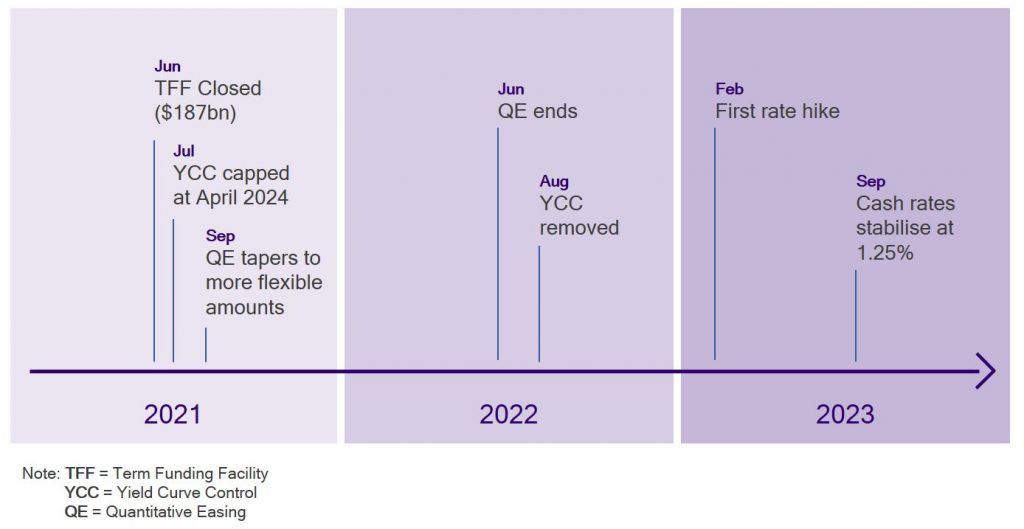
QE will likely taper further once the US Fed starts its own taper later this year.
The end of QE is probably brought forward by recent AUD weakness, relieving RBA concerns that higher rates here would push the AUD above 80c.
Of course there are a number of clear criteria laid out by the RBA to actually hike cash rates.
Inflation must be sustainably within the 2-3% band. For that to happen they believe wages need to be at least 3%, which in turn requires full employment.
The view is full employment is nearer 4% than 5%. We wrote extensively about employment and wages in our last newsletter. (Contact a Pendal key account manager for a PDF copy).
Given our views on inflation and wages we expect rates to lift-off in the first half of 2023. We expect them to stop around 1.25% to 1.5% before staying there for some time.

Of course this is a view into the future. In a week dominated by lockdowns and US bond rallies, bond markets here saw lower yields.
There is a lot more to play out in US employment markets in the months ahead.
Unlike Australia where jobs are now higher than before Covid, the US still has 8.5 million jobs “missing”.
The bulls blame higher welfare payments discouraging people from returning to low-paying jobs. The bears suggest COVID has shown the way for businesses to permanently operate with fewer staff.
The truth is likely a bit of both.
How this plays out in the months ahead will set the tone for bonds markets and eventually equity markets.
We will dive deeper into this topic in the weeks ahead.
About Tim Hext
Tim Hext is a portfolio manager with Pendal’s Bond, Income and Defensive Strategies (BIDS) team.
Led by Vimal Gor, Pendal’s BIDS boutique is one of the most experienced and well-regarded fixed income teams in Australia. In 2020 the team won the Australian Fixed Interest category in the Zenith awards.
The team oversees $22 billion invested across income, composite, pure alpha, global and Australian government strategies with the goal of building Australia’s most defensive line of funds.
Find out more about Pendal’s fixed interest strategies here
Pendal is an independent, global investment management business focused on delivering superior investment returns for our clients through active management.
The next five years will see inflation significantly higher than the past decade. We should be alert to this but not alarmed says Pendal portfolio manager Tim Hext in our weekly Bond, Income and Defensive Strategies note.
Find out more about Pendal’s fixed interest strategies
THE two big highlights of the week were the federal budget and US inflation numbers — and they are more closely linked than it might seem.
Federal Budget
The RBA and Treasury now forecast GDP and employment at full capacity for next year.
That means no slack left in the economy. Normally this would signal a tightening of monetary and fiscal policy. But times have changed.
Invoking the continuing transition from the crisis, the RBA and government are both firmly foot-to-the-floor.
For the government a looming federal election translates to “why not keep handing money out?” After all no one seems too troubled.
Even the usual crowd of economists who warn of impending doom from too much debt have gone quiet. The only ones who can hold their heads high are proponents of Modern Monetary Theory. They understand better just how government debt works.
The RBA seems to have gotten itself in a corner. Like the rest of us they expected the health crisis to be far worse. Unlike us they made commitments (or guidance in some cases) out to 2024 based on that expectation.
The RBA is more oil tanker than speedboat when it comes to turning around. For now they remain committed to Quantitative Easing, Yield Curve Control and no rate hikes.
This is now based solely on benign inflation and wage forecasts — not growth and employment, which are strong.
Future RBA statements will be watched closely for watering down of rhetoric.
US inflation
That leads us to this week’s US CPI numbers. CPI was 0.8% for April and 4.2% year-on-year.
Extraordinary numbers.
Economists and no doubt the Federal Reserve will be quick to reassure us this is transitory.
Supply bottlenecks in the auto industry have prompted a spike in used car and rental car prices. Hotel rooms, airfares, sporting events — most things have spiked as the economy reopens.
These spikes won’t repeat but other spikes are coming. Rents are creeping up and wages are already rising. Commodity prices are taking off.
If there is excess capacity in labour markets perhaps the Fed can get away with the idea of ignoring these transitory factors and we can return to business-as-usual low inflation.
I suspect though with ongoing massive fiscal and monetary stimulus the inflation genie is out of the bottle.
Low inflation expectations may become, if not unhinged, at least challenged in the years ahead. Wages could well follow. Inflation in Australia will also follow.
Eventually technology and demographics will keep a lid on inflation becoming a massive problem.
But the next five years will see inflation significantly higher than the last 10 — something we should all be alert but not alarmed at.
Tim Hext is a portfolio manager with Pendal’s Bond, Income and Defensive Strategies (BIDS) team.
Led by Vimal Gor, Pendal’s BIDS boutique is one of the most experienced and well-regarded fixed income teams in Australia. In 2020 the team won the Australian Fixed Interest category in the Zenith awards.
The team oversees $22 billion invested across income, composite, pure alpha, global and Australian government strategies with the goal of building Australia’s most defensive line of funds.
Find out more about Pendal’s fixed interest strategies here
Pendal is an independent, global investment management business focused on delivering superior investment returns for our clients through active management.
Contact a Pendal key account manager here
PENDAL GROUP (ASX: PDL) today announced it has entered into an agreement to acquire 100% of Thompson, Siegel & Walmsley (TSW), a US-based, value-oriented investment manager, for US$320million (A$413 million).
Established in 1969 and headquartered in Richmond, Virginia, TSW operates primarily in long-only equity (US and international) with US$23.6 billion (A$30.5 billion) of funds under management (FUM).
The acquisition price represents 7.6x 1H21 EBITDA (annualised, excluding synergies) and is expected to be double-digit EPS accretive in the first full year after completion.
Pendal Group Chairman Mr James Evans said: “This is a strategic and compelling opportunity to acquire a highly successful complementary business, which will create immediate value and facilitate our growth opportunities in the US market.
“The acquisition will deliver scale and diversification benefits for Pendal across investment capability, asset classes, geographies and distribution channels.
“The Board believes this acquisition will accelerate shareholder returns and strengthen the diversity of earnings.”
Transaction highlights:
- The acquisition is expected to be double-digit EPS accretive in the first full year after completion.
- Pendal’s consolidated FUM will increase 30% to $A132 billion after the acquisition. Its US client FUM will increase 112% to US$44.7 billion (A$57.8 billion).
- TSW has robust business momentum driven by recent large client wins and strong investment performance. Four out of the six funds (where TSW is the sole sub-advisor) hold a 4/5-star Morningstar rating and rank in the top quartile over the last three-year period.
- The acquisition will double Pendal’s addressable market in the US.
- TSW CEO Mr John Reifsnider will be appointed CEO of Pendal’s combined US business.
- The US$320 million purchase consideration will be funded with a combination of equity, debt and existing capital. Equity will be raised through a fully underwritten placement and — to enable retail shareholder participation — a shareholder purchase plan.
Pendal Group CEO Mr Nick Good said: “TSW is a natural strategic and cultural fit with Pendal and expands our successful diversified business model in the largest equity market in the world.
“TSW is highly complementary to Pendal’s US business, with almost no overlap of investment strategies and clients.
“This will deliver the opportunity to generate new FUM through the expansion of our addressable market in the US and our ability to distribute both TSW and JOHCM products through an expanded global distribution network.
“Both businesses have solid flow momentum and high-performing investment strategies. With this growth profile I believe we will be well placed to take advantage of more opportunities inherent in the positive US economic outlook and increasingly strong investor sentiment globally.”
Highly regarded
TSW is a highly regarded value-oriented investment manager. It has a solid base of institutional and sub-advisory relationships and a track record of strong investment performance. Some 86% of TSW FUM outperformed benchmarks over the past year, highlighting the discernable rotation to value strategies over the past six months.
TSW’s investment capability spans international value, US equity and fixed income.
TSW has an experienced, stable team of 74 employees and a long-tenured and talented investment team of 20, with deep bench-strength across all strategies.
Its recent large client wins are testament to the quality of the team and the momentum of the business. The TSW team are fully supportive of the acquisition and are aligned with Pendal’s values, investment independence philosophy, and its growth aspirations.
Alignment of culture and business models
“Cultural fit is all-important in fund management acquisitions,” said Mr Good. “Both parties have put significant effort into considering compatibility, investment, client approach and alignment and mutual commitment to growth.”
TSW’s CEO Mr John Reifsnider will be appointed CEO of Pendal’s combined US business, taking over the role from Mr Good. Mr Reifsnider will also join Pendal’s global executive committee.
“John is an outstanding leader and the right person to head the combined US business,” said Mr Good. “I have every confidence he will continue to drive the positive momentum that is evident in both companies and seize the new growth opportunities we see ahead of us.”
Mr Reifsnider said: “This is a unique opportunity for TSW to join a strategically compatible and highly regarded global investment management company that is a natural fit and has strong alignment to our investment approach and culture.
“All of us at TSW are thrilled to be joining Pendal Group. We see excellent potential for growth and an exciting future.
“I am delighted to take on the role of CEO of the combined businesses. Pendal has been very successful in the US with an extraordinary 10 consecutive years of positive flows and an enviable reputation in the market.
“Investment autonomy is fundamental to both our businesses and to our success. That match has been a very important consideration for the TSW team.”
Mr Good said: “Pendal’s acquisition of JOHCM was a success. We are approaching this acquisition of TSW with the same intent and focus and are confident that we will be able to implement a seamless transition.”
Equity raising
To fund the acquisition Pendal is undertaking a fully underwritten placement to raise A$190 million through the issue of 27.9 million new fully paid shares, representing about 8.6% of current issued capital.
Details of the offer can be found on Pendal’s shareholder webpage here.
The shareholder purchase plan (SPP) will open on May 17, 2021 and close on June 7, 2021.
The SPP is subject to the terms set out in the SPP offer booklet, which is expected to be lodged with the ASX and sent to eligible retail shareholders following the opening of the SPP offer on May 17, 2021.
Pendal expects to complete the transaction in the September quarter, 2021.
Further details are set out in the investor presentation provided to the ASX [PDF download] on Monday, May 10, 2021.
The investor presentation contains important information including key risks and foreign selling restrictions with respect to the Offer.
This presentation can also be accessed on the Pendal website at https://investors.pendalgroup.com/Investor-Centre.
Webcast details
Pendal will present in relation to its 1H21 half year financial results and the acquisition of TSW today, Monday May 10 at 10.30am AEST. The webcast of the results announcement will be available live at https://webcast.openbriefing.com/7243.
If you wish to view the presentation live via the webcast we recommend logging in 10-to-15 minutes prior to start time.
About Thompson, Siegel and Walmsley
TSW is a US-based value-oriented investment management company, operating primarily in the long-only equity (international and US) and fixed income asset classes with US$23.6 billion of FUM at March 31, 2021.
Established in 1969 and headquartered in Richmond, Virginia, TSW is 75.1% owned by the NYSE listed BrightSphere Investment Group (BSIG), but operates as an independent, autonomous, indirect subsidiary. The remaining 24.9% of shares in TSW are held by TSW current and former management.
TSW has a well-known record in attracting and retaining investment talent, with an average tenure of 12 years among the investment team members.
About John Reifsnider
John has been CEO of TSW since January 2021 and has been with the firm for more than 15 years. He was appointed Co-President of TSW in September 2018 overseeing the day-to-day management of the firm and serving as member of the Board of Managers.
Prior to that, he was the Head of Distribution. He remains highly engaged in TSW’s distribution activities. Before joining TSW in 2005, he was Managing Director at Atlantic Capital Management, responsible for business development and client service.
John started his career in the investment industry in 1990.
John earned his BBA from the University of Toledo, is currently registered with FINRA, and is registered as an Investment Adviser Representative. He is an active volunteer for non-profit youth sports organisations.
About Pendal
Pendal Group is an independent global investment manager focused on delivering superior investment returns for clients through active management. Pendal manages A$101.7 billion in FUM (at March 31, 2021) through J O Hambro UK, Europe & Asia; JOHCM USA; Pendal Australia and Regnan.
Pendal operates a multi-boutique style business across a global marketplace through a meritocratic investment-led culture. Its experienced, long-tenured fund managers have the autonomy to offer a broad range of investment strategies with high conviction based on an investment philosophy that fosters success from a diversity of insights and investment approaches.
Listed on the ASX since 2007 (ASX: PDL), the company has offices in Sydney, Melbourne, London, Prague, Singapore, New York, Boston and Berwyn.
Sustainable investing leader Regnan has analysed the environmental impacts of hydrogen production in a new research report aimed at investors.
Regnan’s H2 beyond CO2 report reviews popular hydrogen production technologies and identifies factors that may lead to competitive advantages and potential constraints.
The report — produced by Regnan’s Abby Frank, Alison George, Maxime Le Floch and Oshadee Siyaguna — can be downloaded here.
-
- Hydrogen production shows strong potential for investors but there are issues to be managed
- Investors can identify key factors that will influence winners and losers
- Listen to an interview with the report’s authors on Decarb Connect podcast
- Find out more about Regnan or contact Jeremy Dean at jeremy.dean@regnan.com
THERE’S a lot of excitement among investors, scientists and politicians about the scope for hydrogen to be a major energy source of the future, based on its potential contribution to decarbonisation goals.
But there is still a long way to go before hydrogen can be considered a practical alternative to traditional energy sources such as gas.
The conundrum for the world economy between now and 2050 is to reach net-zero emissions while providing enough energy to meet demand from an expanding global population.
This energy transition is at the heart of the United Nations’ Sustainable Development Goals (SDGs), the global agenda launched in 2015 to tackle the world’s toughest environmental and social challenges.
In theory, hydrogen could be used as a fuel for transport and power, as heat for industrial processes and buildings, and as a feedstock for chemicals like fertilisers and industrial products like metals.
In practice, hydrogen’s appeal is difficult to judge.
Hydrogen production needs to be assessed across all sustainability dimensions. Investors and companies are wary of locking into a technology only to find problems later on.

This happened with earlier generations of biofuels and liquified natural gas, all of which were initially promoted as impact solutions.
“It’s a relative game between low-carbon technologies,” says Maxime Le Floch, an analyst with sustainable investing leader Regnan.
Mr Le Floch is a contributor to H2 beyond CO2, a new Regnan research report that examines the environmental impact of hydrogen production for investors.
He is part of a London-based team that manages the Regnan Global Equity Impact Solutions Fund, which aims to generate market-beating, long-term returns by investing in solutions to the world’s environmental and societal problems.
Hydrogen’s potential
“Hydrogen is competing against other technologies for decarbonisation in different parts of the economy,” Le Floch says.
“New hydrogen fuel vehicles have been touted, though with the pace of progress of electric vehicles, hydrogen becomes less likely there. But in other applications like heavy industrial and steel-making, hydrogen might be very interesting.
“We need to keep in mind that these are very long investment cycles, so decisions made today have an impact in 10, 20 or 30 years time. There is a whole carbon cost curve that shows where different solutions stack.”
Growing support for investment in hydrogen technology needs a dose of scepticism — not because the enthusiasm is wrong. It’s just too early to say it’s correct.
“The nature of the investment process within the Regnan Global Equity Impact Solutions team is very comprehensive,” says Regnan’s head of research Alison George, a co-author of the report.
“It’s not just looking at SDGs, but all of the environmental and social impacts. Hydrogen might look attractive, but what are all the implications?”

Key economic, environmental and social issues associated with H2 production. Source: Regnan
George says when researching hydrogen, the economics are discussed constantly, and decarbonisation is talked about some of the time. “But there were gaps in the environmental case.”
“We needed some of these questions answered to determine if it was suitable for the fund. It was really a process of trying to fill some pretty surprising gaps,” she says.
The result was H2 beyond CO2, a report that looks beyond carbon emissions analysis alone.
The report can be downloaded here.
“The entire approach of the fund is to find solutions to the grand problems of sustainability and that approach informs investment decisions. There’s a preference for solutions with the greatest contribution to make, and the clearest pathway to making a difference,” George says.
Key hydrogen production technologies
The report concludes that climate change benefits can be achieved through both green hydrogen and blue hydrogen, but with some important caveats.
For green hydrogen, which is made with electricity, the energy source drives the climate outcomes and the majority of other environmental impacts.
An answer, potentially, is to couple electrolysers with intermittent renewables like wind and solar to help manage output peaks and avoid generator curtailment.
That would support growth in renewables and improve the economics of hydrogen production as well as maximising the contribution to climate goals.
“Few of us have been asking the right questions… this report gives essential answers on the sustainability of climatetech” – Alex Cameron, Decarb Connect podcast
Blue hydrogen has the potential to be a sustainable and economic option for hydrogen production — particularly in regions with local natural gas resources, existing pipelines and transport infrastructure.
But it relies on successful carbon capture and reliable carbon storage. They must be maintained for longer periods to be climate effective.
The Regnan report shows there is much more work to be done in the field of hydrogen.
“Some solutions look great on paper but when you scrutinise the environmental impacts things start to get more nuanced,” Le Floch says. “There’s a great need for more research.”
Case study: hydrogen production with offshore wind
Almost 200 years ago, physicist Hans Christian Orsted discovered electromagnetism, and changed the course of history.
Orsted laid the foundation for the modern generation of electricity, and his name is now synonymous with energy in the Scandinavian countries. Orsted, the company, is the biggest offshore wind developer in the world.
Orsted is one of the few global companies able to generate huge amounts of energy through its offshore wind projects across Europe and in Taiwan. It is a critical piece of the renewable energy puzzle, and not just in terms of wind.
“If you want to decarbonise hydrogen production then you need large sources of energy,” says Regnan’s Maxime Le Floch.
“You can take electricity from the grid but that does not always work. So this is why developing hydrogen production with offshore wind makes sense and projects are being announced.
“Offshore wind projects are on a big scale – and scale is a challenge for other sources of renewable energy like onshore wind and solar,” Le Floch says.
“We are talking about gigawatt scale projects in the North Sea, for instance.”
It demonstrates the necessary links between different energy sources, if renewable power is to reach its potential. It also highlights that companies that could benefit from greater use of hydrogen don’t necessary sit in that sector.
“Orsted is getting involved in exploratory projects around hydrogen and much of the work is to demonstrate that the technology can work,” Le Floch says.
About the authors
Alison George is Regnan’s head of research. She has deep experience in ESG, responsible investment and active ownership. Alison oversees Regnan’s research frameworks, processes and outputs, ensuring it remains at the forefront of industry practice and meets evolving clients needs.
Oshadee Siyaguna is a senior ESG analyst with Regnan, responsible for research and engagement and the generation of analysis and insights on ESG themes and issues. Oshadee joined Regnan as an ESG analyst in 2015. Prior to that he was Assistant Vice President at PolitEcon Research.
Abby Frank is an ESG analyst with Regnan, responsible for research and engagement and the generation of analysis and insights on ESG themes and issues. Abby joined Regnan in 2018.
Maxime Le Floch is an investment analyst with Regnan’s Global Equity Impact Solutions team. He has a decade of experience in sustainable investment. Maxime previously worked as an investment analyst at Hermes where he helped manage Hermes Impact Opportunities Equity Fund and led the integration of ESG and stewardship across investment strategies.
About Regnan
Regnan is a responsible investment leader with a long and proud history of providing insight and advice to investors with an interest in long-term, broad-based or values-aligned performance.
Building on that expertise, in 2019 Regnan expanded into responsible investment funds management, backed by the considerable resources of Pendal Group.
Regnan Global Equity Impact Solutions Fund invests in mission-driven companies we believe are well placed to solve the world’s biggest problems, while the Regnan Credit Impact Trust (available in Australia only) invests in cash, fixed and floating rate securities where the proceeds create positive environmental and social change.
Both funds are distributed by Pendal in Australia.
Find out about Regnan Global Equity Impact Solutions Fund
Find out about Regnan Credit Impact Trust
For more information on these and other responsible investing strategies, contact Head of Regnan and Responsible Investment Distribution Jeremy Dean at jeremy.dean@regnan.com.
One year after the market low, here’s how head of equities Crispin Murray (pictured) drove outperformance for Pendal Focus Australian Share Fund during the pandemic. Chris Adams reports.
THIS week marks one year since the market’s low point during the pandemic.
Since the pre-Covid peak on February 21, 2020, Pendal Focus Australian Share Fund has returned 2.9% after fees (to Mar 19, 2021).
The benchmark ASX 300 lost 2.2% over the same time according to Morningstar.
A key factor in the fund’s 5.11% outperformance against the benchmark has been its ability to perform through each phase of the market last year. This is driven by our approach to portfolio construction.
Pendal Focus Australian Share Fund does not rely on a certain set of macro variables to be in place to perform. This has enabled the fund to deliver outperformance while other more thematic approaches have not performed as well.
A market of rapid rotations
The world has run out of clichés to describe the past 12 months.
We had the impact of lockdown policies, supply chain disruption, fiscal stimulus, monetary policy, China-Australia trade tension, the shift of consumers to online, increased focus on ESG and US Presidential elections.
It’s fair to say we have never seen such a material change to so many structural factors in such a short space of time.
Swift changes in key macro factors prompted often-sudden rotations in market leadership.
Defensives did well in the initial market slump. Though the nature of the crisis meant some sectors previously considered defensive – such as A-REITS – were anything but.
The policy response of slashed interest rates helped growth companies renew their pre-Covid surge.
In November, news of successful vaccines drove a swift rotation to cyclicals and value.
Meanwhile entire industries and business models were structurally disrupted in a matter of weeks. Other companies encountered a once-in-a-generation opportunity.
As a result it’s been an incredibly challenging period for investors.
It has also been a period in which the Pendal Focus Fund showed its mettle.
How our portfolio construction drove outperformance
Relying on one “style” of investing can lead to prolonged periods of underperfomance — as value investors have seen for many years.
Trying to “time” swings in style involves anticipating changes in macro variables and investor sentiment — something that’s incredibly hard to get consistently right.
We address this issue by building portfolios based on company insight. We want a portfolio that can perform regardless of the environment, driven by stock selection.

Our aim is a portfolio that is not hostage to one style or a theme playing out in a certain way. In environments of heightened uncertainty, we want to avoid heroic calls on binary outcomes.
Under our approach we created different segments in the portfolio that worked together, allowing it to perform in different scenarios. Key segments last year included defensives, growth stocks, policy beneficiaries, quality franchises and recovery plays.
The key is to find companies with attractive fundamental features that can help limit the downside if the macro factors are not supportive, while delivering the potential for large upside gains in the right environment.
This requires an understanding of companies and industries drawn from access to management that comes with our 18-strong, highly experienced Australian equity team.
2020 provides a strong case study of why we do it this way:
- We were able to move quickly to identify and avoid companies facing existential threats.
- We were able to take opportunities in companies where we anticipated a better outcome than share prices implied – such as Nine Entertainment and Qantas.
- Pendal Focus Australian Share Fund’s outperformance in periods of negative sentiment was driven by defensive holdings such as Metcash (MTS) and by the portfolio insurance provided by gold miners such as Evolution (EVN).
- Falling bond yields helped our growth exposure via Xero (XRO) – which has then held up well due to company-specific fundamentals as other growth stocks sold off.
- Recent outperformance has been driven by recovery-linked exposures such as Qantas (QAN), Santos (STO) and Westpac (WBC).
- Throughout the period there has been a strong tailwind from policy beneficiaries such as Fortescue Mining (FMG) and JB Hi-Fi (JBH).
- We have also done well as the market recognised the value offered in long-term winners such as Aristocrat (ALL), James Hardie (JHX) and Nine Entertainment (NEC).
The outcome is a portfolio that has outperformed through each phase of the market in 2020.
Outlook
The world is now in a better place than many expected a year ago.
The economic rebound has been strong, helped by a surge in monetary and fiscal policy support. Vaccines are arriving. The world is getting better at living with the virus and mitigating its economic damage.
Nevertheless, risks remain.
The risk of premature policy-tightening cannot be ruled out. Vaccinations are working, but efficacy against new strains must be monitored. Geopolitical risk – particularly around the relationship between China and Australia – is higher than usual.
There has been a rotation from growth to value and cyclicals, but the reality is far more complex than broad style labels.
Within value there are plenty of companies that are structurally challenged and are cheap for very good reason.

Growth stocks may have lost the tailwind of falling real rates, but plenty of growth companies remain attractive long-term investments. It’s interesting to note the market seems to be starting to differentiate between profitable growth companies with cash flow and more speculative, long-duration stocks.
Given heightened macro risk, we believe a strategy that is not reliant on a certain macro outcome offers the best chance for consistent performance.
If value, recovery-related stocks continue to outperform, that part of our portfolio will benefit.
If inflation starts to creep up we have exposures with pricing power that will do well.
If we see a hit to sentiment – either from tighter policy or a deterioration in Covid – then the defensives should step up.
We continue to have exposure to carefully selected growth stocks, where we see fundamental valuation support on the basis of earnings visibility and realistic expansion opportunities.
The upshot is that we believe our balanced approach remains as valid now as it did a year ago. It has served our investors well in the sell-off and has worked in the rebound.
No-one knows what will come next. But we believe our portfolio construction, underpinned by our company knowledge, should give investors confidence that their portfolio is well positioned regardless of the next phase of the Covid saga.
Here’s an overview of Pendal Focus Australian Share Fund performance at February 28, 2021:

Source: Pendal. *Benchmark: S&P/ASX300. Past performance is not a reliable indicator of future performance
About Crispin Murray and Pendal Focus Australian Share Fund
Crispin Murray is Pendal’s Head of Equities. He has more than 27 years of investment experience and leads one of the largest equities teams in Australia.
Crispin’s Pendal Focus Australian Share Fund has beaten the benchmark in 12 years of its 16-year history (after fees), across a range of market conditions , as this graph shows:
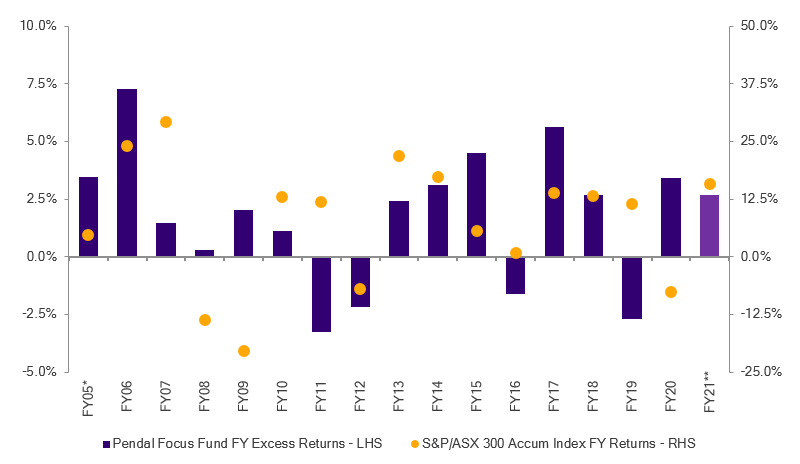
Source: Pendal. Performance is after fees and before taxes. *From 01 Apr 05; **as at 28 Feb 21. Past performance is not a reliable indicator of future performance.
Pendal is an independent, global investment management business focused on delivering superior investment returns for our clients through active management.
Find out more about Pendal Focus Australian Share Fund here.
Pendal has today launched our first Responsible Investment and Stewardship Annual Report for Australia. Here Pendal Australia’s chief executive Richard Brandweiner (pictured) explains what it means
I AM pleased to introduce our inaugural Responsible Investment and Stewardship Annual Report for 2020.
This is a new initiative to summarise the responsible investment practices — including environmental, social and governance (ESG) integration and stewardship activities — we undertake on behalf of our clients.
As an active investment manager, we are truly stewards of our clients’ capital. We believe we have a role and responsibility to deliver sustainable returns for them, as well as influence sustainability practices more broadly.
We do this as part of our fiduciary duty to clients, but also in recognition of our position as one of the largest allocators of capital in the Australian ecosystem.

This means we need to influence positive change by taking a constructive and forward-looking approach to supporting companies improve their ESG credentials.
Long-term value creation
As society evolves and consumers and regulators increasingly look towards organisations to be mindful of their social licence to operate, we believe attention to ESG factors leads to better informed investment decisions and can improve the quality and consistency of long-term value creation.
We are proud to work with many clients who have additional ethical and sustainability-related objectives, in addition to generating returns. For these reasons, we integrate financially material ESG factors across all Pendal funds, as well as offer dedicated investment solutions to meet our clients’ additional priorities.
At Pendal we have a multi-boutique structure, with four distinct investment teams: Australian Equities, Global Equities, Multi-Asset Strategies and Bond, Income & Defensive Strategies.
Each boutique integrates ESG and undertakes stewardship in a way that makes sense for their respective strategies and asset classes.
In other words, we don’t have a single way of investing responsibly at Pendal, although our dedicated Responsible Investments team does bring a common thread across the firm by supporting all boutiques and helping to define quality.
Regnan: Sustainable and impact investing
As many of you will be aware, in early 2019 we assumed full ownership of Regnan, bringing the team in-house to be Pendal Group’s specialist sustainable and impact investing business unit.
Regnan’s experienced team of experts have been a great addition, supporting our engagement and research activities and the continued development of our investment products.
Excitingly, 2020 saw Regnan’s capabilities expand to investment management.
Pendal Group secured a specialist global impact investment team to join the Regnan ecosystem and we launched two products under the Regnan brand.
We look forward to the expansion of the Regnan business, further enabling the purposeful allocation of capital.
Learning and growth
While 2020 in many ways went down as a year most would rather forget, for Pendal it was also a year of learning and growth.
It was a year of paradoxes: a reminder that not every situation is an “either/or”, and not every decision can be bound by the immediate environment or issues at hand.
The year saw, for example, corporate management held to account for more than just the maximisation of short-term shareholder profit in ways we have not seen before.
As we turn our attention to the future and “building back better”, we expect the topics of climate change and inequality will gain importance in the year ahead — and beyond.
The COVID-19 pandemic laid bare many underlying inequalities in societies around the world. Women, elderly and vulnerable communities were disproportionately represented in the hardest hit sectors of the economy.
Encouragingly we are seeing investor action already and we share in this report some of the ways we are working with our clients and investee companies to address this rising inequality.
Tranformation through collective action
The pandemic has also shown us that collective action can drive transformative policies and deliver break-through technologies that seemed unthinkable before the crisis.
Through our engagements and advocacy efforts we will seek to ensure the advances witnessed in 2020 continue.
How else can we ensure that our health, political and economic systems can be resilient in the face of a pandemic, or other form of crisis in the future?
We are thrilled with some of the things we achieved in responsible investment and stewardship in 2020.
These efforts are detailed in this report which I hope you enjoy reading.
We look forward to reporting annually on the ways in which we continue to enhance our approach, responding not only to the ever-changing investment environment but to the evolving needs of our clients.
— Richard Brandweiner
Pendal Chief Executive Officer, Australia
Pendal is an independent, global investment management business focused on delivering superior investment returns for our clients through active management.
Download Pendal’s Responsible Investment and Stewardship Annual Report 2020 (PDF)
Contact a Pendal key account manager here.
As part of its approach, Pendal Horizon Fund invests in companies that enable and lead in the transition to a more sustainable and future-ready Australian economy, while avoiding those that cause significant harm.
An example is business software innovator Xero, a leader in the trend to digitalisation which is changing the way we work.
Pendal equities analyst Elise McKay explains in a short video above.
ASX-listed technology stocks — particularly so the so-called WAAAX stocks Wisetech (WTC), Afterpay (APT), Altium (ALU), Appen (APX) and Xero (XRO) — have been favourites among many investors in recent years.
A key part of this has been the benefit of low-bond yields, which have lifted valuations for growth companies — including many tech names — worldwide.
This tailwind has receded in recent months as yields have begun to rise. Meanwhile vaccines have provided a pathway to re-opening, boosting sentiment around more cyclical stocks. As a result market leadership has shifted from growth stocks to cyclical and value.
In our view this does not mean a shift to a stance of “sell growth, buy value”.
There are plenty of value stocks that are structurally impaired. At the same time, we think there are compelling opportunities in tech stocks. Stock selection is as critical as ever.
In the tech sector we think the market will start to discern between companies with less tangible prospects that are not delivering cashflow — and those that are profitable with good earnings visibility.
We see accounting software provider Xero as one of the latter. It is our top pick in the ASX tech sector.
In this video above Pendal Research Analyst Elise McKay shares insights into XERO, the ASX tech sector and the five-factor framework by which we assess companies.
XERO is included in Pendal Horizon Fund (formerly Pendal Ethical Share Fund) and Pendal Focus Fund.
“We use this framework to find those companies like Xero that are generating strong, sustainable returns on the capital that they’re investing today in unlocking a large global addressable market and creating significant value in the future,” says McKay.
In Xero’s case:
- The industry structure and competitive landscape is favourable and there is a large global addressable market
- Xero is well placed in the cycle as secular trends drive the adoption of cloud accounting products
- It’s investing heavily in innovating the next generation of products.
- The culture of the company is strong, and it’s able to internally create the products it needs.
- And finally, the capital return and unit economics of the business are attractive.
“One of the great things about Xero is that it has accelerated digitalisation of the economy, particularly for small businesses.”
Digitalisation refers to the use of digital technologies “to change a business model and provide new revenue and value-producing opportunities” according to research house Garnter. (It’s distinct from digitisation, which simply means converting things such as bank accounts or books from analog to digital.)
“This platform opportunity allows Xero to be the plumbing into so many more solutions being offered to this community.”
Digital tools are rapidly becoming essential for small business in Australia, according to McKay, who says businesses adopting digital are on average able to save 10 hours a week and generate 27 per cent more revenue.
She believes the fast-growing cloud accounting provider is at the start of a multi-year journey to unlock an enormous global market and become a platform for transforming small business.
XERO is included in Pendal Horizon Fund (formerly Pendal Ethical Share Fund) and Pendal Focus Fund.
About Elise McKay
Elise is an investment analyst with Pendal’s Australian equities team. Elise previously worked as an investment analyst for US fund manager Cartica where she covered a variety of emerging market companies. She has also worked in investment banking and corporate finance at JP Morgan and Ernst & Young.
About Pendal Horizon Fund and Pendal Focus Australian Share Fund
Pendal Horizon Fund (formerly Pendal Ethical Share Fund) is a concentrated, high-conviction portfolio aligned with the transition to a more sustainable, future-ready economy.
Pendal Focus Australian Share Fund is an actively managed, concentrated portfolio of 15 to 30 of our best investment ideas across the Australian share market.
Both funds are led by one of Australia’s most experienced portfolio managers, Crispin Murray. Crispin is backed by one of the largest, most experienced Australian equity teams.
Pendal is an independent, global investment management business focused on delivering superior investment returns for our clients through active management.
Find out more about Pendal Focus Australian Share Fund here.
Contact a Pendal key account manager here.
Major shifts in policy-making — driven by the Covid crisis and a desire to correct GFC-era mistakes — can drive equities higher despite pockets of excess, says Pendal’s head of equities Crispin Murray (pictured).
Here are some insights from reporting season, drawn from Crispin’s bi-annual Beyond The Numbers presentation.
Watch the presentation here (registration required).
Key points
- Equities to benefit from major shifts in policy goals
- A number of factors are driving rotation from growth to value
- Performance is not simply “buy value, sell growth”
- Find out about Pendal Focus Australian Share Fund
INVESTORS may see pockets of excess in markets at the moment — but that’s not necessarily a sign that we’ve reached a top in equities, says Pendal’s Head of Australian Equities Crispin Murray.
These are symptoms of a policy agenda designed to avoid the mistakes of the Global Financial Crisis era.
That era resulted in fiscal austerity, pre-emptive monetary tightening and a focus on economic goals to the exclusion of other factors.
Today policy makers are thinking more about reducing inequality, building economic resilience and a greater role for clean energy.
This means bigger fiscal spending and very accommodative monetary policy.
Coupled with the impact of pent-up demand amid a re-opening economy and the return of fund inflows, this should combine to drive the stock market higher, Murray believes.
But he cautions investors to watch for additional complexity in markets.
For example Covid has accelerated structural trends such as the transformation of work via digitalisation and the impact of Environmental, Social and Governance factors when scrutinising companies.
Growing concern about inflation can also trigger bond market sell-offs which can have varying impacts across equity market sectors.
“We think equity markets will be resilient in the face of rising bond yields,” he says. “[But] they do have a big effect on what’s going to actually perform in the market.”
Higher inflation expectations and bond yields are seeing market leadership shift away from growth to cyclicals with pricing power. This suits the Australian markets, he says.
But future outperformance is not a simple matter of buying value stocks and avoiding growth stocks.
“There are still going to be companies in the value sector that are structurally disadvantaged.
“And you’re going to find companies in the growth sector that still have incredibly strong franchises. So, you need to be nuanced about your stock selection.”
The environment is ripe for an active, style-neutral approach focused on company specifics.

Four components of a well-constructed equities portfolio
Murray says a well-constructed portfolio should have four components:
- First, defensive stocks are needed to protect against risk and the chance of policymakers changing their minds.
- Second, a portfolio should have exposure to stocks that are leveraged to the potential inflationary pressures coming through.
- Third, investors should hold companies that used the crisis to improve their position and are ready to benefit from the release of pent-up demand.
- And finally, investors should consider the companies hit hardest by the pandemic who will see a material shift in fortune once the vaccines roll out.
“When we think about our portfolio, we think about the different roles stocks play. Like a football team, you need the defence, you need the midfield, and you need the attack.”
About Crispin Murray and Pendal Focus Australian Share Fund
Crispin Murray is Pendal’s Head of Equities. He has more than 27 years of investment experience and leads one of the largest equities teams in Australia.
Crispin’s Pendal Focus Australian Share Fund has beaten the benchmark in 12 years of its 16-year history (after fees), across a range of market conditions, as this graph shows:
Source: Pendal. Performance is after fees and before taxes. *From 01 Apr 05; **as at 28 Feb 21.
Past performance is not a reliable indicator of future performance.
Pendal is an independent, global investment management business focused on delivering superior investment returns for our clients through active management.
Find out more about Pendal Focus Australian Share Fund here.
Pendal Group Limited (ASX: PDL or Pendal) today announced the appointment of Mr Bertrand Lecourt and Mr Saurabh Sharma to establish a global equities sustainable water and waste investment strategy within the Regnan business.
Based in London, Mr Lecourt will join Regnan as Senior Fund Manager and Mr Sharma as Fund Manager.
It is expected the investment specialists will commence in April 2021, with the investment strategy to be launched in the UK and Europe in the second half of calendar 2021.
The team joins from Fidelity International where they manage the Luxembourg-domiciled US$2.4 billion Fidelity Funds Sustainable Water & Waste Fund.
The investment strategy will invest in companies involved in the design, manufacture or sale of products and services used in the water and waste management sectors.
Emilio Gonzalez, Group Chief Executive Officer of Pendal Group, said: “The appointment of Bertrand Lecourt and Saurabh Sharma demonstrates our ability to attract superior talent and progresses Regnan’s plans to become a global leader in providing environmental, social, and governance (ESG) investment strategies and solutions to clients.
“Regnan’s focus is on delivering innovative and specialist sustainable and impact investment solutions, drawing on over 20 years of experience at the frontier of responsible investment.
“The team’s appointment is the second investment team hire since Regnan expanded into investment management and follows the appointment of the Regnan Equity Impact Solutions team in December 2019, led by Tim Crockford, who joined from Federated Hermes.
“Clients are increasingly seeking out investment strategies that address environmental concerns in a sustainable way.
“The development of new technologies and proper water and waste management will be critical to manage the increasing demand for clean water and waste management as populations grow and become more urbanised.
“This will drive investment opportunities that Bertrand Lecourt and Saurabh Sharma will be able to capture through the unique combination of a diversified water and waste global equities portfolio with strong ESG credentials.”
Team biographies
Bertrand Lecourt, Senior Fund Manager
Bertrand Lecourt joined Fidelity International as a Portfolio Manager in 2018, where he launched and managed the Fidelity Funds Sustainable Water & Waste Fund.
Previously he was a Portfolio Manager at Polar Capital and the founder and CIO of Aquilys Investment Management. Prior to moving to the buy-side, Bertrand was Head of Equity Research, France at Deutsche Bank and a utilities analyst at Dresdner Kleinwort Benson and Goldman Sachs.
He holds an MSc in International Finance from HEC School of Management, France; an MSc in Money, Banking and Finance from Birmingham University, UK; and a DEA in Monetary Economics from Orleans University, France.
Saurabh Sharma, Fund Manager
Saurabh Sharma joined Fidelity in 2014 as a Product Specialist before becoming an Assistant Portfolio Manager in February 2020.
Previously, he held equity research analyst roles at Moody’s Analytics and GlobalData.
Saurabh has an MBA in Finance from IBS Hyderabad School in India and is a CAIA and ICFAI Charterholder.
Who is Regnan?
Regnan is a responsible investment business within Pendal Group with a vision to grow its funds under management and become a global leader in providing environmental, social, and governance (ESG) investment strategies and solutions to clients.
Regnan exists to drive positive impact and investment for a sustainable future and works towards this by developing and promoting more principled, rigorous and outcome-oriented approaches in responsible investment. It has a long and proud heritage in engagement and advice on ESG issues.
Regnan has produced pioneering research that has changed the way investors think about their wider responsibilities to society including advising influential organisations, such as the Principles for Responsible Investment (PRI).
Regnan can trace its roots back to a collaboration with Monash University, Melbourne in 1996, with an investigation into overlooked ESG-sources of risk and value for long-term shareholders in Australian publicly listed companies.
Regnan has since taken its ESG expertise globally. Its diverse experience in advocacy, regulation, academia and advising investment managers has enabled Regnan to offer ESG-related advisory, engagement and research services.
Visit Regnan.com
Find out about Regnan Global Equity Impact Solutions Fund
Find out about Regnan Credit Impact Trust
For more information on these and other responsible investing strategies, please contact Head of Regnan and Responsible Investment Distribution Jeremy Dean at jeremy.dean@regnan.com.
A global shift towards sustainable agriculture and food production is opening attractive opportunities for investors as new technologies and business models start to gain traction.
RESEARCHERS at Regnan, a global leader in sustainable investing, have named four areas of investment that will drive the transformation of food production while minimising waste and developing new sustainable and affordable food products.
The findings are featured in a new Regnan report, Catalysing Sustainable Agriculture and Food Production, by Regnan senior adviser Doug Holmes and Regnan fund manager Mohsin Ahmad.
Reforming agriculture is essential to meeting the challenge of climate change because agriculture and food production accounts for nearly a quarter of the world’s greenhouse gas emissions. Without change, emissions are forecast to grow more than 30 per cent by 2050.
“Industrial farming was the right solution for increasing global production of food back in the 50s and 60s,” says Holmes, who has worked in the sustainability sector for nearly three decades.

Source: WRI analysis based on FAO (2017a); UNDESA (2017); and Alexandratos and Bruinsma (2012).
“But there’s so much evidence out there around the negative impacts from industrial farming as practised now that it’s quite clear we need to change course.”
Climate change aside, large-scale food production is doing astonishing damage to the environment.
Run-off from fertilisers, pesticides and herbicides is polluting waterways and marine habitats, soil is being degraded by reliance on chemicals and irrigation is depleting aquifers.
A third of the planet’s soil has already been degraded. Without significant change, 90 per cent of soil on earth will be degraded by 2050.
But despite the toll, crop land and pasture land will increase by 600 million hectares over the next three decades, destroying forests and natural ecosystems.
The challenge is how to feed a global population that will hit 10 billion by 2050 — requiring 50 per cent more food than we produce today — without inflicting further damage on struggling ecosystems.
In the new report, Regnan’s team identifies four areas of investment that are crucial to the key stress points in global food production, ideal to catalyse change and – perhaps most importantly – largely unsung by the global investment industry.
1. Soil health
The first is regenerative and organic farming aimed at improving soil health.
Organic matter – essentially dead and decomposing plant and animal debris alongside billions of living creatures like bacteria, fungi, insects and worms – plays a vital role in soil health.
A 1 per cent increase in soil organic matter helps soil hold 20,000 more gallons of water per acre. Organic matter is also a powerful store for carbon dioxide that helps mitigate climate change.
The investment opportunity lies in the carbon credits that can be generated by better soil management.
“There are business models being developed monitoring and measuring and tracking soil carbon using various technologies and then creating markets for soil carbon that can be brought into the public space,” says Holmes.
2. Controlled farming
The second opportunity is controlled farming which can be conducted in cities as indoor or vertical farms, or larger-scale state-of-the-art greenhouse farming close to urban areas.
“Within developed economies, this is a real growth area,” says Holmes.
“There are some quite large controlled-farming start-ups and businesses in places like the United States and in Europe developing models that are very focused on feeding a rapidly growing urban population. They typically employ AI and advanced technologies.”
Controlled farming is essential to support the rapid growth of cities and the increasing urbanisation of the world.
The growing risk of extreme weather is another driver, as controlled farming can be better protected, lowering the risk of crop loss.
3. Waste management
Third on the ledger is the growing industry aimed at reducing the enormous waste in food supply chains.
Close to a third of all food produced is lost to waste.
This not only means that fewer meals are available for those in need, but it also lifts the land area and resources required to make up lost food, putting additional stress on the food system and lifting greenhouse emissions.
“By reducing food waste, there’s more food available that eventually reaches the dinner plate, so that means less load on systems upstream.
“Less land is cleared for agriculture and there is less load from the agricultural processes themselves and all the inputs that go into producing food.
“You’re reducing greenhouse impact and the also providing more food at the other end of the cycle.”
Food is lost across the food supply chain, from growing to storage, processing and distribution right through to the food thrown out by retailers and households.

Source: FAO 2011, Regnan 2020
ReFED, a non-profit aiming to end food waste, says a 20 per cent reduction in US food waste over the next decade would be equivalent to removing about 4 million cars from the road.
“It’s a key area for attention,” says Holmes, who says some of the more promising innovations are platforms connecting farmers with pre-determined buyers for food that might otherwise go to waste.
“For example, in developed countries, farmers who have produced crops that might be less presentable from a marketing perspective have pre-determined buyers to take that product and turn it into other value-added food products like juices or similar products.
“The systems are developed to pre-identify buyers for food that may be less visually appealing or perceived to be of lesser quality.”
The Regnan team singles out Tomra, which has its origins as a reverse vending machine company that collects bottles and cans for recycling. Tomra has now expanded into providing sorting technology for the food industry, inspecting produce and helping divert low-quality food to alternative uses.
You can read more about Tomra here.
Regnan funds also hold shares in NYSE-listed Ecolab, which makes antimicrobial water additive products that reduce foodborne pathogens and help control spoilage of processed fruit and vegetables.
4. Plant-based meat
Finally, Holmes points to the growth of a new plant-based meat industry as an example of a move to sustainable food products that replace resource intensive agriculture.
“Livestock production is enormously greenhouse intensive. The opportunities afforded by the plant-based products is a very big one from a sustainability perspective, and particularly as those products are get better and better.
“It seems to be to me there’s a there’s a very big business opportunity there.”
Download Regnan’s Catalysing Sustainable Agriculture and Food Production report here.
Who is Regnan?
Regnan is a responsible investment leader with a long and proud history of providing insight and advice to investors with an interest in long-term, broad-based or values-aligned performance.
Building on that expertise, in 2019 Regnan expanded into responsible investment funds management, backed by the considerable resources of Pendal Group.
The Regnan Global Equity Impact Solutions Fund invests in mission-driven companies we believe are well placed to solve the world’s biggest problems.
The Regnan Credit Impact Trust (available in Australia only) invests in cash, fixed and floating rate securities where the proceeds create positive environmental and social change.
Both funds are distributed by Pendal in Australia.
Visit Regnan.com
Find out about Regnan Global Equity Impact Solutions Fund
Find out about Regnan Credit Impact Trust
For more information on these and other responsible investing strategies, contact Head of Regnan and Responsible Investment Distribution Jeremy Dean at jeremy.dean@regnan.com.