
“It’s not easy bein’ green,” sang Kermit the Frog. But sustainable portfolio construction does get easier when investors take a global view, says Pendal’s Michael Blayney.
- Being green is best achieved thinking globally
- A multi-asset approach helps realise goals
- Find out more about Pendal’s Multi-Asset funds
“It’s not easy bein’ green,” sang Kermit The Frog. But when it comes to sustainable investing, taking a broad view of opportunities across Australia, Europe, North America and Asia can provide rewards well beyond the financial.
“In sustainable investing, you need to think about the global opportunity set,” says Michael Blayney, head of the Multi-Assets Investments team at Pendal.
“It gives you the ability to exclude some stocks, without overly impacting your portfolio, and there’s a good chance you’ll end up with a superior long-term return.”
Creating a sustainable equities portfolio using global stocks also allows investors to pick and choose the type of portfolio they want.
It might be based on companies that are making an impact on society. It might be based on a portfolio that excludes certain companies – tobacco companies or manufacturers of weapons, for example. Or it might be anything in between.
“There are many benefits that come from tilting a portfolio to place a greater emphasis on sustainability, from reduction of tail risks to better positioning the portfolio to benefit from the transition to a low carbon economy,” Blayney says, adding that sustainable investing is best done using a multi-asset approach, not just equities.
Find out about
Pendal Multi-Asset Funds
Part of the challenge sticking to single equity markets while investing sustainably is the lack of choice. If fossil fuel producers are excluded that may bias a portfolio towards other sectors.
In some markets, like Australian equities, fundamental active management is best positioned to mange portfolio biases. In international equities, the major portfolio construction implication is a lower energy exposure.
Some sectors necessarily lose out when screening is introduced, notably energy and utility companies. But in most other sectors, there are plenty of choices from clusters of stocks with similar characteristics, Blayney explains.
He uses fossil fuels as an example.
“Traditionally, the main benefit of fossil fuel exposure for investors was to provide some hedging against an unexpected increase in inflation.
“But there are a range of assets available to a multi-asset manager which are correlated with fossil fuels and inflation but provide a more sustainable exposure. These assets can be used to retain the desirable aspects of fossil fuel exposure, without the undesirable tail risk and negative externalities,” he explains, highlighting the benefits of a multi-asset approach.
“When you go global, there are a lot of flavours to choose and you can tilt your portfolio to positive solutions,” Blayney says.
“Going global can also overcome benchmarking challenges in local markets.
“Should investors continue to compare their performance to standard market capitalisation benchmarks or non-sustainable peers once they’ve made the decision to move sustainable,” he asks. “A benchmark should represent the available opportunity set and if this is modified by investors’ preference, the benchmark should reflect that.”
That needs a global marketplace.
About Michael Blayney and Pendal’s Multi-Asset capabilities
Michael Blayney leads Pendal’s multi-asset team. Michael has more than 20 years of investment management and consulting experience. He was previously Head of Investment Strategy at First State Super and head of Diversified Strategies at Perpetual.
Pendal’s diversified funds provide investors with a variety of traditional and alternative asset classes and strategies.
The team — which also includes Stuart Eliot and Allan Polley — manages our multi-asset portfolios with a focus on strategic asset allocation, active management and tactical asset allocation.
Higher levels of regulation in Beijing could make big Chinese companies more attractive by raising barriers to entry in key industries. Pendal’s Samir Mehta explains
- Balancing risk, investors should consider ‘what could go right’
- China big tech may benefit from regulation
- Find out more about Pendal Asian Share Fund
A SELL-OFF in Chinese stocks in recent weeks left some (but not all) investors wondering if the risk of further regulatory intervention outweighed the opportunities of investing in the dynamic Chinese economy.
But Pendal’s Samir Mehta, who manages Pendal’s Asian Share Fund, cautions against walking away from China, saying focusing only on managing risk means investors can miss opportunities.
Beijing’s actions have sent shudders through global investment markets, as policies aimed at improving quality of life and relieving cost of living pressures send shares reeling and leave investors wondering what else might go wrong.
“It’s easy to ask yourself what can go wrong in an investment,” says Mehta. “But equally sometimes it is just as important to ask yourself what could go right?”
Counter-intuitively, higher levels of regulation from Beijing could lift the attractiveness of the big Chinese companies as investment opportunities by raising higher barriers to entry into key industries.
Mehta draws parallels with Europe’s 2018 introduction of tight data privacy regulations — the General Data Protection Regulation (GDPR) — which triggered a sell-off in shares of affected companies like Facebook and Google.
“In reality, what has happened is incumbents have been the most benefited from this,” says Mehta.

Find out about
Pendal Asian Share Fund
“Who has the money? Who has the army of lawyers? Do you think a small startup will be able to compete in an environment where the GDPR requirements are so onerous?
“The same thing is going to happen in China as this crackdown comes in.
“Who is going to be funding competitors to Tencent, Alibaba, Meituan or any of these companies?”
Mehta points out that commentators are criticising China’s intervention in the education industry in particular without considering that the kind of intervention Beijing is proposing would not be out of place in the playbook of western governments.
Beijing wants to reduce the cost of education to quell the community’s concerns about cost of living pressures by stopping companies profiting from tutoring based on the national curriculum
Similarly, there is a widespread clamour in the US to reduce the $1.5 trillion-plus in outstanding student debt, with some pushing to make America’s education system free.
“President Biden even went to the extent of saying that he was willing to write off $10,000 of debt per student,” says Mehta.
“It’s easy to ask yourself what can go wrong in an investment. But equally sometimes it is just as important to ask yourself what could go right?”
Samir Mehta, Portfolio Manager, Pendal Asian Share Fund
Mehta is also impressed by the high levels of competition between the big Chinese companies, which he says has the effect of creating stronger businesses.
Mehta says investors should pay attention to three key metrics to decide when the Chinese stock sell off has gone too far and if it might be time to buy.
“Equity risk premiums, liquidity and profitability — those are the three metrics that I’m looking at,” says Mehta
“Equity risk premiums reflect the negativity that starts to come in as people want a higher and higher discount rate because the risks have gone up.
“Liquidity matters because every Tom, Dick and Harry wants to sell out of China at the moment.
“On profitability, the government measures are going to impose costs on these businesses so the big question is could these be passed on to consumers because there are going to be fewer competitors that might give you a cheaper deal?
“Then finally, what will go right is that at some point in time people will realise that the incumbents are now in a significantly better position.”
About Samir Mehta and Pendal Asian Share Fund
Samir manages Penda’s Asian Share Fund, an actively managed portfolio of Asian shares excluding Japan and Australia. Samir is a senior fund manager at UK-based J O Hambro, which is part of Pendal Group.
Pendal Asian Share Fund aims to provide a return (before fees, costs and taxes) that exceeds the MSCI AC Asia ex Japan (Standard) Index (Net Dividends) in AUD over the medium-to-long term.
Find out about Pendal Asian Share Fund
About Pendal Group
Pendal is an independent, global investment management business focused on delivering superior investment returns for our clients through active management.
Here’s what’s driving Australian equities this week according to Pendal’s Jim Taylor. Reported by portfolio specialist Chris Adams.
KEY INDICIES consolidated gains last week in the face of surging Delta cases around the world. The S&P/ASX 300 was flat, while the S&P 500 shed 0.4%.
Commodities were generally stronger with the notable exception of iron ore. Materials (+2.8%) were the leading sector on the ASX.
The market is watching the spread of Delta, but so far remaining relatively sanguine. Ironically the rapid growth in Delta cases is creating a scenario where current policy settings may remain in place longer than expected.
US reporting season has been strong and is providing near-term support to markets, as is the flurry in Merger and Acquisition activity in major developed markets.
The outlook for China remains unclear. The government previously looked to moderate growth in specific sectors, but the overall slowing of growth may have reached a bottom. Implications of a change in government policy toward the biggest tech names is yet to be fully understood.
Covid and vaccines
New daily cases continue to plummet in the UK, while rising in France and the US.
US regions with low vaccination rates are reporting the greatest rise in new cases. Critically, the link between vaccination and lower rates of hospitalisation appears to be holding.

The curve just refuses to bend in NSW. Recent mobility data suggests we have only now got back to mobility levels last seen in April 2020.
There are signals that the NSW government has pivoted from a policy of elimination to suppression. The National Cabinet has adopted a new framework which makes lockdowns a first resort — and vaccination targets of 70-80% to move away from the lockdown strategy.
India has experienced a 90% drop in daily confirmed cases over the past two months. A recent serum study indicated 67% of the population had Covid antibodies either from the vaccine or through infection. The number of tests has remained pretty constant at around 1.6 million for the past two months as daily case numbers have fallen.
Israel has started a program of a third vaccination for people over 60. Some troubling data on the duration of the effectiveness of the vaccines continues to emerge, though questions remain about its accuracy given it’s not a controlled test. The current positivity rate in Israel is about 2.4%
Economics
The small amount of macro data out last week didn’t raise many headlines.
The core personal consumption expenditure (PCE) deflator — a measure of inflation — was 3.5% year-on-year versus an expectation of 3.7%. The month-on-month reading was 0.4% versus 0.6% expected. This is still well above the Fed’s flexible 2% target, though its rate of change may be starting to slow.
US headline private sector wages are growing at 3.5% year-on-year — the strongest rate for many years. Labour supply issues from the past few months are likely still affecting the data. Better indications of the extent to which the wage data will remain high should be forthcoming in the fourth quarter data (late January 2022).
At roughly the halfway mark of the US and European earnings season, a record number of companies are beating consensus sales and EPS estimates.
In the US, 88 per cent of S&P500 companies that have reported beat EPS estimates. EPS growth for these companies is running at +83% year-on-year — 18% ahead of consensus expectations. Revenue growth in the US is coming in at +23% year-on-year — 5% ahead of consensus expectations.
Find out about
Pendal Focus
Australian Share Fund
Crispin Murray,
Head of Equities
The average positive surprise and the proportion beating expectations has been pretty broad-based across sectors, though the more cyclically exposed parts are leading the charge.
This strength in earnings is important because it further eases the market’s valuation multiple and provides support even as concerns about the Delta variant mount.
Markets
Australian equities have so far held up despite the Sydney lockdown and lack of clarity regarding re-opening.
The expectation of fiscal assistance to counter the economic impact is likely a key part of this.
Last week resources (+2.5%) outperformed on signals of a more pro-growth tack from China and the prospect of huge dividends. We are still expecting to see positive adjustments to consensus expectations, which are lagging on recent commodity price increases.
M&A continues to feature. Santos (STO, -2.1%) and Oil Search (OSH, -4.5%) appear to have agreed to terms for a merger. There was a bump up in the bid for Spark Infrastructure (SKI, +5.9%), which will now allow due diligence to take place. This week we saw a bid by Square for Afterpay (APT, -9.4% last week) valuing it at a 30% premium to recent trading.
Crown (CWN, -14.1%) was the worst performer in the ASX 100 last week. This followed comments from the Victorian Royal Commission that it could take years for Crown to meet the conditions for its licence. The upcoming West Australian Royal Commission extended the reporting time frame to Q2 2022.
A2 Milk (A2M, -13.6%) fell on concerns that Beijing’s efforts to alleviate the cost of raising children — exemplified by turning the huge tuition business into not-for-profit with the stroke of a pen — may flow through to regulated pricing for infant formula.
AGL (AGL, -9.5%) and Origin (ORG, -9.3%) saw earnings downgrades for 2022 in their energy markets business due to higher coal costs.
Some of the growth names had a soft week following recent strength. In addition to APT’s fall, Seek (SEK) was down 4.4%, Fisher & Paykel Healthcare (FPH) fell 3.1% and Ansell (ANN) lost 4.6%.
Solid quarterly production updates helped resources lead the pack. Lynas (LYC, +14.2%) was the best in the ASX 100. Oz Minerals (OZL, +9.3%), IGO (IGO, +5.3%), BHP (BHP, +4.3%) and Alumina (AWC, +3.1%) also fared well.
Rio Tinto (RIO, +5.0%) was disappointing on the production front. Nevertheless, a slightly higher-than-expected dividend and a high payout ratio is emphasising the cash flow story.
BlueScope Steel (BSL, +6.7%) upgraded earnings expectations for 2H FY21 on strength across the board in volumes and spreads.
Here’s our weekly Bond, Income and Defensive Strategies wrap from Pendal portfolio manager Tim Hext.
THE June Quarter CPI numbers were strong but largely as expected. Headline CPI was 0.8% for the quarter buy underlying was a more tepid 0.5%.
The number plays well into the Reserve Bank narrative that inflation is transitory — and helps it maintain a medium-term forecast of 2% annual inflation. Markets have spent the last month taking out rate hikes. If the RBA is right about inflation then rates are here for a long time to come.
But we are not in normal times and the task for statisticians is made difficult by numerous measurement issues.
How do you currently measure international flights or hotel accommodation? How do you measure rents when all kinds of deferrals are taking place?
The main impact comes from government subsidies. CPI is what consumers pay, not what a business charges. Of course normally they are the same thing but a myriad of subsidies means governments are footing part of the bill.

Find out about
Pendal’s Income and Fixed Interest funds
For example Homebuilder might mean a builder is charging $500,000 for a new home but the consumer is only paying $475,000. In fact new dwelling costs in the CPI (8.5% of the index) have been negative this year despite actual prices going up almost 4%.
State governments have also been busy subsidising utility bills, restaurant meals, movie tickets and a host of other items.
On our subsidy-adjusted estimate, underlying CPI is now more like 0.7% or around the annual RBA 2.5% target.
Eventually these of course come off but it will be more of an early 2022 story. We remain of the view higher inflation is coming, but it will be services rather than goods leading the way.
Nothing to see from the Fed
Chairman Powell managed to turn the latest Federal Open Market Committee meeting into a non-event, retaining a watching brief on how they may respond to stronger data down the track.
There is nothing to see here for now.
A combination of China wobbles and rising Covid cases kept bond markets generally bid on the week.
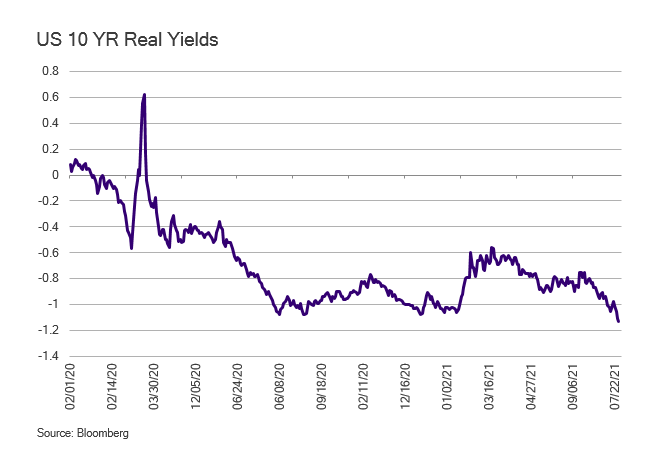
Real rates are now at record lows, driven by the weight of money but also growth pessimism. This feeds back into positive news for equities (what isn’t these days) despite being potentially concerning news for the economy.
Asset owners can relax because central banks have your back, and their “put” seems to be a trailing level on the way up.
The chart below shows how the market sees inflation as transitory in the US, with real yields falling to record lows last seen in 2020.
About Tim Hext and Pendal’s Income and Fixed Interest boutique
Tim Hext is a portfolio manager with Pendal’s Income and Fixed Interest team.
Pendal’s Income and Fixed Interest boutique is one of the most experienced and well-regarded fixed income teams in Australia. In 2020 the team won the Australian Fixed Interest category in the Zenith awards.
With the goal of building the most defensive line of funds in Australia, the team oversees A$22 billion invested across income, composite, pure alpha, global and Australian government strategies.
Find out more about Pendal’s Income and Fixed Interest strategies here
About Pendal Group
Pendal is an independent, global investment management business focused on delivering superior investment returns for our clients through active management.
A monthly insight from James Syme and Paul Wimborne (pictured), managers of Pendal’s Global Emerging Markets Opportunities Fund
- Five important global macro indicators to monitor when assessing risk and opportunity in the higher-risk, more capital-flow sensitive emerging markets.
- Conditions that have led to capital inflows, stronger currencies and good returns to equity investors are still in place.
- Find out about Pendal Global Emerging Markets Opportunities Fund
IF YOU wanted to paint a negative view of the emerging market asset classes (equities, bonds and currencies), there would be several pieces of evidence in macro conditions to point to.
Traditionally, the northern hemisphere summer is seasonally difficult for risk assets.
Covid-19 case numbers are again moving in the wrong direction in some countries.
And the surprisingly hawkish June commentary from the Federal Reserve has seen a rapid shift in a number of financial market indicators that are not supportive of risk assets.
St. Louis Fed president Jim Bullard made these comments in June:
“FOMC was surprised on the upside over the last few months… recent data is very good news… by the time you get to the end of 2022, you’d already have two years of two-and-a-half to 3% inflation. To me, that would meet our new framework where we said we’re going to allow inflation to run above target for some time, and from there we could bring inflation down to 2% over the subsequent horizon.“
This saw a sharp upward move in shorter-term US bond yields as the markets priced in tapering and a US rate hike in 2023.
A June Financial Times opinion piece by former India Reserve Bank governor Duvvuri Subbarao was an important indicator of the current environment for emerging markets (particularly the higher risk ones).
In the article, Emerging markets are right to worry about capital flows, Subbarao discusses the impact of foreign capital flows on India and the central bank’s resulting policy dilemma:
“With extraordinarily loose money supply and low returns in the rich world, emerging markets inevitably become a destination of choice for investors looking for high yields…
“The RBI has been in the market almost continuously, buying dollars to prevent an unwarranted appreciation of the rupee. But buying dollars results in extra rupee liquidity which could go beyond the central bank’s comfort level.
“The RBI could of course mop up the extra liquidity by selling bonds. But such a move would cause interest rates to spike, resulting in the economy being swamped with “carry trade” dollars looking to make money on the yield differentials.”
Subbarao’s main concern is that, when inflows become outflows, India (and other, similar, emerging markets) will see a liquidity crunch and a hardlanding in the economy and financial markets.
We agree with his diagnosis of the mechanism, but not (yet) his concern.
Generally, the conditions in emerging markets that typically mark the top of the capital-flow cycle have not yet occurred: sustained increases in credit and money supply, high capacity utilisation, buoyant financial markets and in particular, weak current account balances.

Five indicators to monitor risk and opportunity
We think there are perhaps five important global macro indicators to monitor when assessing risk and opportunity in the higher-risk, more capital-flow sensitive emerging markets:
1. Capital flows into the bond markets of emerging economies
One event in the mind of many investors is the ‘Taper Tantrum’ in the second quarter of 2013.
When the Fed announced that it would, at some point in the future, reduce the volume of purchases of assets, it triggered a sharp rise in US yields and significant weakness in the currency and bond markets of many emerging countries as capital flowed out and back into US dollar assets.
The fear is that the Fed’s indication of future policy tightening will have a similar outcome.
We are much less concerned.
In particular, positioning in EM fixed income markets is more benign, in our opinion. The years leading up to the Taper Tantrum had seen significant capital flows into the riskier emerging markets, and had driven down bond yields relative to US yields. (This gap is the heart of the carry trade that attracts and keeps those flows into Emerging Markets).
We estimate that for the six main riskier emerging markets (Brazil, Mexico, South Africa, Turkey, India, Indonesia), net foreign capital flows into government bonds in the year before the Taper Tantrum were over US$100 billion.
Right now that number is less than a third of that.
Similarly, the average ten-year local currency bond spread over US ten-year bonds was, we estimate, 1.5% below its long-term average. Now it is 1% above the long-term average.
We would concede that US-denominated bonds look expensive relative to history, but these are now a small part of the funding mix for mainstream emerging market
2. Currencies in the riskier markets look reasonably valued
We have written at length this year about large moves in terms of trade and current account balances in some of these markets (particularly Brazil, Mexico, India and South Africa) and how we see those underpinning currency valuations.
We think a lot of weak hands were flushed out of riskier emerging markets in the middle of 2020. We do not see the same positioning in equity or bond markets that we had back then (or, indeed in 2007-08, the previous period of excessive optimism towards the asset class).
3. Commodity prices are a significant driver of inflationary concerns in the US
It remains our view that Chinese credit growth is contractionary at the margin — and the Chinese economy is slowing.
Chinese demand remains a major driver of global commodity prices. We have seen heat go out of some of the most dramatic commodity markets. For example the Chicago lumber future contract finished June below US$800 per lot after peaking in May at US$1686.
4. The Fed’s own long-term forecast for the peak US policy rate remains at only 2.5% (and, notably, is unchanged since before the pandemic).
If the peak of the hiking cycle is only 225bp above current levels, it is likely to have far less impact than, say, the 375bp that was expected in 2013.
5. Forecasts for both GDP growth and equity market earnings are still being revised up in our preferred emerging markets.
This is not a universal phenomenon. But these improving expectations are a powerful support for markets — not only equities, but also currencies and bonds — as better conditions attract capital inflows.
Countries to avoid
Following on from that last point, we believe investors should always be selective when investing in emerging markets.
There are two types of countries we think lack the economic fundamentals to be attractive at this time.
The first are the South-East Asian economies. In this region growth recoveries have been weak and the next move in policy rates is likely down, not up.
Malaysia’s commodity sectors have been more supportive of growth there (although we remain zero weight). But we see a lack of a compelling growth stories particularly in Indonesia, Thailand and the Philippines.
The second country we choose to avoid on economic grounds is Turkey.
Turkey has had a very significant credit boom in the last few years due to unorthodox fiscal and monetary policy.
With the current account deficit elevated, inflationary pressures mounting and a weakening currency, the pressure on the central bank to hike rates is a defensive one to prevent capital flight, rather than a reflection of strong growth.
Bob Farrell, the legendary head of research at Merrill Lynch, is famous for his “10 Market Rules to Remember”. His fourth rule says in part that “rapidly rising or falling markets usually go further than you think”.
In our time in emerging markets we’ve found this is very much the case for the emerging market capital flow cycle.
In good times currencies appreciate far more — and interest rates and bond yields fall much further — than predictions.
Between 2003 and 2008 Brazilian policy interest rates fell from 14.25% to 11.25%. At the same time the Real strengthened from BRL 3.60 to the dollar to BRL 1.60.
We believe the conditions that have led to capital inflows, stronger currencies and good returns to equity investors are still in place.
We do not agree that a repeat of 2013 is likely to happen soon.
We think there is plenty of scope for a positive capital flow/growth cycle to continue in emerging markets.
Markets usually go further than you think.
About Pendal Global Emerging Markets Opportunities Fund
James Syme and Paul Wimborne are senior portfolio managers and co-managers of Pendal’s Global Emerging Markets Opportunities Fund.
The fund aims to add value through a combination of country allocation and individual stock selection.
The country allocation process is based on analysis of a country’s economic growth, monetary policy, market liquidity, currency, governance/politics and equity market valuation.
The stock selection process focuses on buying quality growth stocks at attractive valuations.
Find out more about Pendal Global Emerging Markets Opportunities Fund here.
Pendal is an independent, global investment management business focused on delivering superior investment returns for our clients through active management.