
AI spending starts to pay off for some hyperscalers | VIDEO: Opportunities in bonds | Where to hunt as AI leadership broadens
After a strong year for emerging markets, investors looking for continued gains should look to a weakening US dollar and pockets of resilience in China. PAUL WIMBORNE explains
Emerging markets – key insights:
- Weaker US dollar to drive next gains
- Opportunities emerging in China
- Learn more about Pendal Global Emerging Markets Opportunities Fund
Emerging markets are entering a new phase. China’s manufacturing strength and a weaker US dollar should underpin emerging market stocks over the next few years, but investors should look beyond the AI semiconductor cycle for the next leg of growth, says Paul Wimborne, a senior fund manager for Pendal Global Emerging Markets Opportunities Fund.
The MSCI Emerging Markets Index surged more than a third over the year to June 2026, driven mainly by gains in Korean memory-chip makers and Taiwan Semiconductor as global AI capital investment soared.
Wimborne says the recent strength in Korea and Taiwan has been closely tied to the AI cycle, but the next phase of emerging market returns may come from a wider set of opportunities as capacity expands and China accelerates efforts to build a competing semiconductor supply chain.
Instead, emerging markets investors might be better placed broadening their focus to Chinese manufacturing and US dollar-exposed cyclicals like Brazil, Mexico and South Africa.
The AI semiconductor cycle driving emerging markets
“We’re in super cycle with emerging markets, but that will change at some point,” says Wimborne.
“First, if AI capital expenditure budgets start to be reduced. Secondly, all of the big memory companies are starting to increase capital expenditure significantly. We would imagine nearly every company will double capacity in the next three to five years.
“And then, increasingly, Chinese companies – directed by the government – are spending huge amounts of money in building their own semiconductor industry, which isn’t just their own chips, but it’s all the equipment that goes into making the chip factories as well.”
Wimborne says memory chips are “essentially commodity type products”.
“And we certainly think that the memory stocks had reached a point where investors needed to think carefully about the risk and reward, which is why we started to broaden our focus within emerging markets.”

Emerging markets present a Chinese opportunity
Chinese shares look well priced for emerging markets, partly due to the persistently weak domestic economy, says Wimborne.
“One of the key risks, but also why the opportunity is there, is economic growth,” says Wimborne.
“Domestic demand and consumer confidence are very low and have been since COVID.
“But it does mean that China is very cheap. There are some great companies in China that are doing incredibly well, particularly on the manufacturing side. We’ve been increasing our exposure there.”
The Chinese government is also encouraging household savings away from bank deposits and bonds towards the share market.
“So, we’ve bought a position in a brokerage house where the results of that sector have been doing very well for the last few quarters, increasingly more accounts being opened,” says Wimborne.
“We own an insurance company that will benefit if equity returns pick up and then we have a position in Hong Kong Stock Exchange as well.
“There are pockets within China where we think growth is strong for emerging markets, where the companies can thrive.”
Emerging markets see a US dollar tailwind
A weaker US dollar should also benefit cyclical markets such as Brazil, Mexico and South Africa, where the strong dollar has constrained economic and earnings growth for much of the past decade, says Wimborne.
“The time you make the most money in emerging markets is in weak dollar environments,” says Wimborne.
“Emerging markets in strong dollar environments tend to underperform, and we’ve seen that for most of the last 13, 14 years until 18 months ago.
“We think from a cyclical point of view, countries like Brazil, Mexico, South Africa – that borrow money from the rest of the world – are big beneficiaries if you do get a weaker dollar.
“What you’ve had for those countries over the last 10 to 15 years is the strong dollar providing a big headwind to their economic and earnings growth.
“We think that headwind has now turned into a tailwind.”
Wimborne says investors can underestimate the cyclical potential in emerging markets when the US dollar weakens.
He says not only does local currency appreciation add to returns, but multiples expand as investors become more willing to pay to get access.
Local borrowers also benefit from easier to repay US-dollar debt, while stronger currencies also reduce the cost of imports, helping dampen inflation and keeping interest rates lower.
“We think all of those factors will help drive returns to be better in those countries than they have been over the last 10 years,” he says.

Find out about
Pendal Global Emerging Markets Opportunities Fund
Frequently asked questions
Why do emerging markets perform well when the US dollar weakens?
A weaker US dollar is the biggest tailwind for emerging markets. Local currencies rise, share prices lift, and US-dollar debt gets cheaper to repay. It also lowers import costs, which helps keep inflation and interest rates down
Why is China considered an opportunity in emerging markets right now?
China’s economy is weak but many companies — especially in manufacturing — are doing well. The government support for the share market is also helping brokers, insurers and exchanges grow.
What is the outlook for emerging markets in 2026 and beyond?
Emerging markets over the next few years will be supported by China’s manufacturing strength and a weaker US dollar. There is caution around expensive AI chip stocks in Korea and Taiwan however.
About Pendal Global Emerging Markets Opportunities Fund
James Syme, Paul Wimborne, Ada Chan and Roshni Bolton are co-managers of Pendal’s Global Emerging Markets Opportunities Fund.
The fund aims to add value through a combination of country allocation and individual stock selection.
The country allocation process is based on analysis of a country’s economic growth, monetary policy, market liquidity, currency, governance/politics and equity market valuation.
The stock selection process focuses on buying quality growth stocks at attractive valuations.
Find out more about Pendal Global Emerging Markets Opportunities Fund here
Pendal is a global investment management business focused on delivering superior investment returns for our clients through active management.
Here are the main factors driving the ASX this week, according to Pendal’s head of equities CRISPIN MURRAY. Reported by portfolio specialist Chris Adams
THE selloff in semiconductors/AI sectors seemingly reached a nadir on investor liquidation, with a strong bounce late last week.
We also saw Kevin Warsh’s second meeting as Fed Chair confuse the market and erode Fed credibility, leading to a steeper yield curve and 30-year Treasury yields reaching 20+ year highs.
The Iranian situation continues to oscillate from aggressive rhetoric to conciliatory signals with the growing perception that the oil price drives strategy.
Elsewhere two hyperscalers (Microsoft and Amazon) reported last week, with the results largely well received. Capex continues to be revised higher, but there is more evidence of payback with accelerating cloud revenues at both companies.
The S&P 500 rose 1.1%, while the S&P/ASX 300 gained 2.3%.
Australia performed well as relatively benign inflation data raised optimism that rates may not need to be raised again, reflected in a 20-basis-point fall in domestic two-year yields.
The ASX also benefitted from weakness in the semiconductor/AI trade as shorts in Australia – used to fund some of the rotation to Asian AI-stocks – were unwound.
The refining/fuel retail stocks (Viva Energy and Ampol) upgraded earnings, resource results were generally constructive, and tech and healthcare were the best performers on rotation in positions.
Overall July returns were okay; the S&P/ASX 300 gained 2.3% and the S&P 500 was flat (-0.1%) despite the dramatic sell-off in semis.
Semi/momentum unwind
The rotation away from momentum/AI/semi stocks seemed to reach a final phase last week.
At the depths, SK Hynix had fallen 55% from its June peak, Coreweave -48%, Micron -39%, the iShares Semiconductor ETF (SOXX) -29%.
While hard to pinpoint the catalysts for the plunge, it reflected a combination of:
- The semi theme was hugely overbought; the SOXX was up 124% from late March to the June peak
- Concerns over the funding of AI investment; Alphabet raising US$85 billion of capital on 2nd June, the SpaceX IPO on 11th June, and Amazon issuing US$25 billion in bonds in early July all drew liquidity from the market. Ongoing capital calls saw credit spreads widen in AI-related companies, reinforcing funding concerns.
- Noise around cheaper Chinese open-sourced models; raised questions around revenue models and therefore the ability for AI capex to generate adequate returns.
- The IPO of Chinese semi company CXMT; this rose 520% from the IPO price and is a US$500 billion company. While currently its products are at the low end of the DRAM market – and therefore not a competitor to Samsung and Hynix – it highlights there may be a risk of new supply to affect memory pricing at some point in the future.
- Leverage driving margin calls and forced liquidation; the Korean market was the largest source of this. At its peak it is estimated there was U$26 billion of margin loans and U$18 billion of securities-backed loans (US$45 billion all up). Goldman Sachs estimates that as at 13th July 1.2 million Korean retail accounts faced margin calls with ~350,000 liquidated. Also, we had the high-profile liquidation of the Situational Awareness hedge fund, which was estimated to have sold $16 billion of stock to Citadel.
The semi sector was heavily oversold on technical measures at the lows last week, so the combination of the news that Situational Awareness had been forced to liquidate led to a strong rally in the sector, which was reinforced by largely positive results from the hyperscalers.
US Federal Reserve
The Fed held rates at 3.75%, with three of the 12 voters dissenting in favour of a hike.
The market had gone into the meeting with odds of a hike at 35% and initially the reaction to the hold was benign.
However, the press conference shifted sentiment to this being a dovish, rather than hawkish, hold.
This in turn saw a selloff in the long end of the yield curve, with 30-year yields breaking out to cycle highs at 5.25% (the highest level in 20 years), while 10-year yields also rose to their highest level since January 2025 at 4.75% (but below cycle highs of 4.98%).
The spread between the two and 10-year yield quickly reversed the move in June, suggesting that Warsh may have erased the credibility built at the prior meeting.
of shifting the funding mix or improving the deficit. This likely explains the latest White House pivot with regard to Iran.
The Fed Chair talks tough on inflation, with comments such as:
- “Let me reiterate: There is no soft inflation target, there is no soft implicit target — not on this Committee’s watch. There is only a target, and it is 2 per cent.”
- “We have begun a new chapter, and we understand that the five-plus years of inflation above target cannot be cured in nine weeks — or by a single month of modest price decreases.”
- “This Fed will not waver. Our credibility rests on performing our duties and delivering on our responsibilities.”
The issue is that while this sounds good, it is inconsistent with his actions:
- His 2% inflation target is based off an undefined ‘broader set of inflation data,’ not the traditional measure of the core personal consumption expenditures (PCE) deflator.
- He notes inflation is boosted by tariffs and the effects of the Iran conflict, which are fading, and that AI related inflation is overstated.
- He believes tighter total financial conditions could do the tightening for the Fed, rather than rates.
- He notes a more credible Fed would lead to lower inflation
So there is ambiguity about how the target is measured, the framework they are using to evaluate inflation, and how they assess progress to the target. Nor is there any data to demonstrate why they have confidence inflation is falling back to the target – and this is in the context of the inflation target not being met for five years.
The dissenters reinforced the point that they do not see how inflation returns to the objective, noting the issue is both supply and demand driven.
One source of contention is that Warsh does not believe in forward guidance – he does not think the Fed should ‘spoon feed’ the market and the latter needs to adjust to this.
“Market participants are learning to play the ball, not the referee — and market prices will continue to respond in the direction and magnitude they see fit. This is, in my view, a change for the better — and we are just getting started,” he said.
The issue many have with this approach is that perceptions of US rates cannot be left to “swing in the breeze”; there is a large fiscal deficit which needs funding, there is substantial leverage collateralised against US bonds and any perception that the Fed is no longer trying to shape the outcome could see market confidence lost.
Given Warsh’s belief in the signal provided by markets, he will need to reassess the message as 10- and 30-yields are breaking higher – and the US cannot afford that.
The main critique of Warsh, as articulated by Bill Dudley (former head of the New York Fed) is that the Fed needs to explain its reaction function to the market.
If this is not known, the market may misprice how new data affects policy, making the transmission mechanism less efficient.
Markets price off what they expect the Fed to do – not what it should do – so less transparency can lead to confusion and a higher risk premium. The move in the 30-year yield suggests this is happening.
This leads to the debate about real interest rates in the US, with the 30-year real rate increasing now to 3.1%, which is the highest since 2002. For most of the post-GFC era it was around 1%.
The 10-year real yield is 2.5% – back to the 2022 high and, prior to that, levels not seen since the GFC.
The rise in real yields is being driven by:
- The high US debt and fiscal deficit and concerns over funding and sustainability. This has led to a higher term premium which explains the gap between 10 and 30-year yields.
- Supply shocks and the breakdown of the global optimised supply chain.
- Demand for capital from investment in AI, defence and energy.
- Erosion of central bank credibility following poor policy decisions in recent years, pressure from the Trump administration and the uncertainty over Warsh’s agenda
- Some are concerned that the need for the Bank of Japan intervention to support the Yen (as occurred last week) could lead to them liquidating US bond holdings. The perceived threat itself may lead to the market positioning for this.
This combination means the market needs a greater premium to fund US debt and perceives the real rate required to contain inflation to be higher.
This view does not factor in a productivity boost from the use of AI which Warsh, alongside others in the administration, seemingly expect.
But the market is concerned that the Fed bakes this in before it actually occurs and hence leave monetary policy too loose.
Overall, the rate environment is a building risk to markets.
The last time we saw this, Treasury Secretary Scott Bessent was able to assuage concerns through shifting the funding profile and walking back tariffs.
The current challenge feels harder, as it relates to a market seeking to test the Fed’s credentials, the tension between short and long rates, and whether Warsh is genuinely independent or a vessel for Trump’s agenda.
There is also little more that can be done in terms
US economic data
Recent data suggests that growth remains solid and inflation is not getting worse.
US Q2 real GDP rose 1.5%. This was softer than expected due to net exports, government spend and inventories – which means underlying domestic demand remains firm at +3.2%.
Tech-related investment remains strong. There was also a positive sign that non-tech investment reversed its recent downtrend, with its 7% rise the strongest rate in three years.
The GDP deflator rose sharply (+6.3% annualised) which drove overall nominal annualised GDP to 7.9%. This is clearly too high and even a material slowing in this number would still leave pressure on the Fed to raise rates.
GDP growth is expected to slow in the second half of 2026 as the benefit of tax rebates fades.
Monthly core PCE was also slightly lower than expected at +0.13%, helped by the tariff effects rolling off.
At another time this may have bought the Fed some time and reduced bond yields – however with a strong economy and renewed pressure on fuel prices, the prospect of inflation falling back to target is questionable and compounded by all the concerns over Fed credibility.
Oil and the Iran war
Prospects of a US compromise and a new ceasefire have risen, reflecting the pressure on the US from rising oil prices and bond yields.
Flows through the Strait of Hormuz have slowed to 3.1 million barrels per day (bpd) while the Bab al-Mandab Strait flows from the Red Sea have halved to 1.5 million bpd, with 1 million bpd being re-routed through the Suez Canal.
The market believes that a continued draw-down of Chinese and, to a lesser extent, US inventories can buy another few months – but the balances are getting tighter.
We are also seeing refining margins continue to rise on the combined effects of curtailed product supply from the Gulf, constraints at some refineries in Asia, and the loss of Russian capacity leading to a tight market.

Find out about
Pendal Focus Australian Share Fund
Crispin Murray, Head of Equities
Hyperscaler earnings
We have now had three hyperscalers (Alphabet, Microsoft and Amazon) report earnings and the message was positive in that they are seeing an acceleration in cloud service revenues, suggesting they are seeing a pay back on their AI spend.
Overall, their combined cloud revenues grew 48% year/year in Q2, up from 39% the previous quarter.
- Alphabet (+9% last week having been down on result) grew its cloud business 82% year/year versus 64% expected. The company’s backlog (signed but undelivered computing contracts) rose US$50 billion sequentially to US$514 billion, with half converting to revenue in the next two years. New customer acquisition velocity has doubled year/year. Advertising conversions are up ~15%, leading to an 11% drop in cost per lead. The one area of concern was some margin pressure, which reflected the company having to pay up for third-party compute. Alphabet is saying this is a temporary issue, but still the right strategy when you look at the overall long-term customer relationship.
- Microsoft (+19%) saw Azure revenues accelerating to 43% year/year growth (versus 40% expected) and guiding to 45% in Q3. Copilot paid seats rose from 20 million to 30 million since April. Github Copilot reached 50 million users with revenue +60% quarter/quarter since the move to user-based pricing.
- Amazon’s (+17%) AWS revenue rose 37% year/year versus 31% expected. The company talked to data centre economics and a useful life of 30+ years, enabling five-six generations of servers inside the same building. There is a two-year lag from build to cashflow, given the rate of build out this is why we are not yet seeing free cash flow, but Amazon believes it has the same margin profile as its cloud business. The CEO spoke to AWS having the possibility to be a trillion-dollar revenue business, double previous expectations.
The consensus forecast for total hyperscaler capex in CY26 has risen 4.7% since the start of Q2 earnings season to $793 billion (+93% year/year). The expectation for CY27 capex has risen 13% over the same period.
The prospect for a compute shortage remains in place for probably 12 to 24 months.
This spending continues to see a surge in capex as a proportion of cash flow. Consensus expects this to peak at 110% in 2027, from which point revenue begins to catch up with the spend.
Australian inflation and central bank comments
Domestic bond yields fell as the June consumer price index (CPI) came in below expectations, with the core at 3.8% year/year (versus 4.0% expected) and the trimmed mean at 3.6%, around 0.1% below expectations.
This does not mean the inflation problem is resolved but does buy the RBA some time to see how the interplay of growth and inflation plays out.
Governor Michele Bullock said last week that the RBA was keeping their options open, noting both the importance of getting back to target inflation – but also that, in their opinion, policy was moderately tight and the economy likely slowing. She pointed out that this may help reduce the rate of inflation and they need to see whether that is sufficient.
The fallout from the Federal Budget on the housing market also adds to the uncertainty; while policy is not driven by house prices it does affect activity and provides another reason for the RBA to pause.
The rise in fuel prices is another complicating factor. Anecdotes indicate that the removal of the fuel excise rebate, combined with higher oil price, has led to a slowdown in discretionary spending in July and this will be compounded by the second part of the rebate being removed last weekend.
While that affects growth, Governor Bullock did say that they are concerned persistent supply shocks could impact inflation expectations.
Markets
It was interesting to note that even in a month where there was a large drawdown in semis and other AI investment-related stocks, the US market ended flat due to the rotation to other sectors.
This highlights the captive nature of liquidity in the market, which leads to greater stock and sector specific volatility.
The other feature mid-reporting season is the continued strength in earnings which is helping underpin the US market.
EPS growth for this quarter is set to be +26% on an underlying basis (excluding the “other income” paper profits made by the hyperscalers from investments in private start-ups).
There have been broad-based positive revisions for 2027 EPS, which is also supportive for markets.
The risk remains a weakening economy – of which there is little sign – or the rise in bond yields forcing the Fed’s hand on rates to restore confidence, which could lead to a de-rate in equities.
Australia
The Australian market was +2.3% last week, led by a strong bounce in previously underperforming sectors such as Technology (+7.0%), Health Care (+5.5%), Consumer Discretionary (+4.5%), and Communication Services (+4.2%).
A lot of the move reflected a positional rotation within Asia Pacifc, as the fall in Korean semis forced de-grossing in hedge funds, leading to them covering their funding short in Australia.
The more benign inflation data also supported the market.
The S&P/ASX 300 ended July up 2.1%, led by banks (+7.6%) where the earnings outlook remains supportive with credit growth strong and an unwind of the initial reaction to the budget, as fears of a major housing downturn dissipated.
Elsewhere Energy (+12.1%) reflected the 23% rise in the oil price. Miners were down 0.9% as slowing Chinese growth weighed on iron ore (-2%) and lithium prices (-5%), albeit copper and aluminium prices rose 3% and 2%.
There was significant divergence in resources with lithium stocks hit hard, while S32 rose 17% on the announced sale of the aluminium business and a better quarterly report.
Tech (-4.8%) was the worst performing sector, the rotation away from semis hit the data centre companies despite continued compute demand, while the software names did not benefit from this rotation.
Small caps underperformed (S&P/ASX Small Ordinaires -3.2%) the S&P/ASX 20 (+3.7%) which partly reflected the rotation to banks and away from resources but also suggests some angst about the domestic economic outlook.
Going into reporting season we have seen a very mild shift to negative revisions, but not meaningful.
The areas we are watching this reporting season include:
Progress of turnaround stocks; we are looking for demonstrations of improved operating performance.
How well companies have managed expectations in FY26 and FY27; there are no excuses – other than a material change in operating environment – for management teams failing to ensure expectations have been sufficiently adjusted, given the consequences experienced in recent seasons. If this plays out, we may see less downside volatility.
Domestic economy and forward-looking assessment of the consumer; we will be looking for a gauge on whether the budget has manifested in the spending outlook, particularly from July when the fuel excise returned. In addition, while the banks are likely to have had good earnings performance, the test will be how cautiously they talk to the outlook, specifically on housing and asset quality.
Updates on AI threatened stocks; companies have had six months to adapt and develop a strategic response.
Offshore stocks performance; where the impacts of fuel inflation may be countered by a good US economy.
About Crispin Murray and the Pendal Focus Australian Share Fund
Crispin Murray is Pendal’s Head of Equities. He has more than 27 years of investment experience and leads one of the largest equities teams in Australia. Crispin’s flagship Pendal Focus Australian Share Fund is a high-conviction equity fund with a two-decade track record across a range of market conditions.
Pendal is a global investment management business focused on delivering superior investment returns for our clients through active management.
Here are the main factors driving the ASX this week, according to Pendal portfolio manager JULIA FORREST. Reported by portfolio specialist Chris Adams
MIDDLE East tensions continue to weigh on markets.
Attacks on Saudi tankers in the Red Sea and hostile US-Iran rhetoric drove Brent crude up almost 10% last week and over 30% for the month, above US$100/bbl.
This played into inflation concerns, which pushed the US 10-year bond yield up 13 basis points (bps) to 4.68%, the highest point since January 2025, as markets priced in further monetary policy tightening.
Still, with US Congressional midterm elections under 100 days out, policymakers have growing incentive to ease tensions and limit the damage to inflation, sentiment and markets.
Strong earnings cushioned the risk-off mood, leaving the market just 2.7% off its all-time high, while the VIX (an index of equity market volatility) held steady at 19.1.
Trade tensions stayed in focus as the Trump administration imposed tariffs of up to 12.5% on 60 partners (including Australia).
US equities fell as higher oil prices, rising yields and AI-spending jitters hit sentiment — the S&P 500 dropped 0.6%, the Nasdaq fell 2.1%, with tech leading losses.
Alphabet slid despite strong earnings after lifting 2026 capex guidance by $15 billion to US$205 billion, while Tesla sold off on weak profitability and negative free cash flow.
Semiconductors stayed volatile. Intel’s upbeat outlook and AMD’s AI chip news offered some support, but the Philadelphia Semiconductor Index briefly entered a bear market as datacentre cost overruns, delays and cheaper open-weight models stoked fears of an AI capex overspend.
Investors are questioning the payback horizon on hyperscaler spending, while bond markets flag capital-competition risk, as heavy AI-related debt issuance meets an already large US deficit, raising the risk of crowding-out and higher yields.
In Australia, a sharp employment surprise drove an increase in bond yields.
June employment rose 76,000 versus expectations of 15,000, prompting markets to reprice the RBA outlook, with the odds of a hike by November 2026 now around 47%, up roughly 20 points over the month. This week’s CPI print will be pivotal.
Australian equities moved sideways, with the S&P/ASX 300 down 0.3%. Energy (+5.9%) outperformed on the oil surge, Materials (+1.8%) was supported by stronger copper and gold, while higher yields hit rate-sensitive sectors such as Technology (-6.5%) and Real Estate (-1.8%).
Energy led commodity markets, with Brent crude rallying 9.9% for the week on Middle East supply risks.
Copper gained 1.6% and is now up 12.3% year-to-date, supported by tightening Chinese inventories and supply constraints.
Gold rose 1.4%, while iron ore eased 0.4% to around US$98/t amid ongoing softness in Chinese steel demand.
AI: A return on capex versus a capital markets story
Persistent volatility in the tech sector is being driven by the interplay of a number of factors:
- Capex rising. Alphabet fell ~7% last week despite beating on every headline number with group revenue +24% and Google Cloud revenue +82% year/year.
Investors looked past the beat and focused on the raise: FY26 capex guidance lifted US$15 billion at the midpoint to US$195–205 billion, driving the company’s first negative free cash flow quarter since its 2004 IPO (-$5.9 billion).
Adding to the optics gap, Alphabet also disclosed a US$94.1 billion SpaceX stake and booked a ~US$98 billion unrealised fair-value gain on it. In aggregate, hyperscaler free cash flows are expected to turn negative in 2027.
- The funding shift. Hyperscaler capex has gone from largely self-funded to increasing reliance on debt and capital markets.
Morgan Stanley estimates ~US$1.8 trillion in off-balance-sheet AI commitments across the industry (leases, purchase obligations, financing).
Aggregate bond issuance for the five major hyperscalers (Oracle, Microsoft, Meta, Amazon, Alphabet) has almost doubled in 2026 versus 2025 and closing on 10x the amount issued in 2024.
- Crowding in the same market. Hyperscalers aren’t the only ones competing for capital. The US alone is running a US$1.9 trillion deficit in FY26.
AI capex and record government issuance are now hitting the same bond market at the same time and the debate has shifted from can they fund it, to does the scale of combined demand start to move the cost of capital itself.
Thus far tech-related capex seems to have just crowded out other private capex, which has been a negative drag on US GDP growth since Q3 2024.
- Rate sensitivity. Hyperscalers and the frontier labs OpenAI and Anthropic (both private companies opaque on unit economics) have been largely rate-insensitive to date.
That won’t hold indefinitely: higher yields lift the return hurdle on every future dollar of capex, and end-demand is not rate-insensitive even if the builders are.
So far we haven’t seen the credit spreads widen materially (excluding Oracle), however the bid-to-cover ratios (a measure of investor demand) for hyperscaler bonds have been falling.
- Returns are getting harder to defend too. Competition is heating up, and frontier models look increasingly alike.
Cheaper Chinese models, more efficient inference and model distillation all raise the risks that AI gets commoditised before the industry earns back its capital.
Much of the ecosystem has been running on a subsidy model — and that’s the part under the most pressure now.
Productivity gains from AI adoption are real but hard to quantify and so far, are accruing disproportionately to larger companies, not smaller ones.
- What’s held the equity market together: passive flows. Equity markets have largely looked through all the above.
BlackRock’s Q2 2026 numbers show why: institutional investors pulled US$41 billion out of low-fee index equities, but that was swamped by US$178 billion of ETF inflows, much of it systematic, auto-pilot retail/401(k) flow, helping push BlackRock’s assets under management (AUM) to a record $15.3 trillion. That flow is arguably the marginal buyer keeping AI-exposed mega-caps supported.
Macro and policy US
The Redbook retail index same-store sales growth slowed to 8.2% year/year last week, down from 11.5% in early July, though spending remains resilient.
US consumers continue to absorb higher energy costs without pulling back spending, which means companies pass through cost pressures and protect margins.
That resilience is being funded by savings, not income: the savings rate has fallen from 4.5% in January to 3.0% in May.
If energy prices stay elevated, this drawdown — and the earnings support it provides — looks less durable.
Elsewhere, US weekly jobless claims fell to 187,000 in the week ended 18th July, which is the lowest print since September 1969, though likely flattered by seasonal auto-plant shutdown distortions.
The trend looks real regardless: the four-week average dropped to 207,500, and continuing claims fell back under 1.8 million to 1.796 million.
With the labour market this resilient, the US Federal Reserve can stay focused on the inflation side of its dual mandate.

Find out about
Pendal Property
Securities Fund
Macro and policy Australia
Australia’s June labour force report was much stronger than expected, with employment rising by 76,000 jobs versus market forecasts of around 15,000.
The increase was the strongest monthly gain in more than a year, highlighting the resilience of the labour market despite slower economic growth and higher interest rates.
It was also surprising given job ads/vacancies had been softer in the last few months.
However, the strength in employment was matched by a surge in labour force participation, as more Australians entered or remained in the workforce.
As a result, the unemployment rate was unchanged at 4.4%, while underemployment rose to 6.5% — its highest level since mid-2024.
While employment remains strong, broader labour market conditions are easing.
Participation rose to a near-record 67.0%, likely reflecting more Australians seeking work or extra hours to help manage cost-of-living pressures.
The practical result is that the data is unlikely to materially alter the RBA’s near-term policy stance. While the strong employment number reduces the urgency for rate cuts, the rise in participation and underemployment offsets some of the apparent strength.
Fixed income markets are now pricing a 47% chance of a further hike by CY26 (+20bp on the month).
Having declared victory over inflation too early in 2025, the RBA is likely to be very cautious about cutting rates prematurely in 2027.
One factor in this could be that residential rental growth appears to be accelerating, with average national house rents +3.1% over the last month and apartments showing a similar increase, exacerbated by falling numbers of Australian rental listings.
Markets
US earnings season
US earnings season has been very strong, with 27% of S&P 500 companies reporting and 86% beating earnings expectations. As a result, both short and long-term consensus earnings growth rates have surged.
The spread between the S&P 500 trailing price to earnings (P/E) and the much lower forward P/E is about as wide as we’ve seen outside of 2000, reflecting investor conviction that earnings are set to inflect sharply higher over the coming year.
While the market is being supported by stronger earnings growth it is also scrutinising capital spending, with Alphabet and Tesla both selling off as investors questioned the returns on AI investment and the sustainability of cash generation.
Tesla fell 17.8% despite record deliveries, as investors reacted to growing margin pressure and negative free cash flow as the company plans to refocus on artificial intelligence and robots.
American Airlines (-13%) also struggled, with the group cutting earnings guidance for the second time in three months on the back of higher jet fuel prices, with the company stating it was only able to offset about 50% of the $2.2 billion in extra fuel costs through higher airfares.
US bonds
US bonds were up 13bp over the week to 4.68% lifted by oil prices, crop prices at a three-year high and stronger US employment data.
This is a level that starts to make US Treasury Secretary Scott Bessent (and equity markets) twitchy, however given the S&P 500 has been supported by strong earnings growth there has been no panic yet. Thirty-year bond yields also shifted higher to ~5.20%.
Australian equities
The S&P/ASX 300 was down 0.3%, although it softened as the week progressed.
The energy sector was strongest as Woodside, Santos and Beach Energy all caught a bid.
Materials held up too, supported by stronger copper and gold (BHP, Rio, Northern Star, Evolution the main beneficiaries).
However, higher oil prices and stronger employment data pushed the Aussie 10-year yield briefly above 5% alongside a similar move in US Treasuries.
The IT sector (-6.5%), Communication Services (-4.0%) and AREITs (-1.7%) bore the brunt as higher yields hit the growth stocks/bond proxies hardest.
Australian REITs
There has been a large divergence between the performance of US REITs (~+19%) and Australian REITs (~-9%) year-to-date.
Reasons for the gap include:
- US REITs have a large exposure to data centres and industrial/logistics — the sectors benefitting from AI infrastructure buildout. While Goodman Group (GMG) has a large data centre pipeline, performance has been held back by a lack of leasing deals.
- While both sectors have been exposed to rising bond yields, Australian REITs have been hit by a tightening cash rate. US REITs have access to long-term fixed-rate debt, which constitutes ~90% of the sector’s debt.
- In Australia, money has piled into the miners, gold and energy and left listed property trusts in the dust. It’s a rotation that just doesn’t have a real US equivalent this year.
Looking at the similarities, both AREITs and US REITs have the same underperforming subsectors – residential and office REITs.
There is still a great deal of uncertainty around how the residential cycle plays out. Within our listed property portfolios, we have a preference for affordable residential providers and land-lease companies, rather than the traditional residential developers.
In the office market, there are some early signs of recovery, with net absorption of office space shifting back into positive territory after being overwhelmingly negative since 2020.
We are seeing signs of a similar recovery in Australia, particularly in the core of the Sydney CBD.
Even if we were to see large headcount reductions, this may not lead to an increase in office vacancy rates as company workforces have grown much faster than occupied space.
A hypothetical 20% fall in white collar employment would just see ratios of employee/workspace fall back to long-term averages.
About Julia Forrest and Pendal Property Securities Fund
Julia Forrest is a portfolio manager with Pendal’s Australian Equities team. Julia has managed Pendal’s property trust portfolios for more than a decade and has 25 years of experience in equities research and advisory, initial public offerings and capital raisings.
Pendal Property Securities Fund invests mainly in Australian listed property securities including listed property trusts, developers and infrastructure investments.
About Pendal Group
Pendal is an Australian investment management business focused on delivering superior investment returns for our clients through active management.
The latest jobs data has lifted market expectations for an RBA hike, but rising underutilisation suggests the labour market is gradually softening. Pendal’s head of government bond strategies TIM HEXT explains
- Jobs growth beats forecasts, unemployment rises
- Underutilisation signals gradual labour market softening
- Find out about Pendal Government Bond Fund
- Browse Pendal’s fixed interest funds
WHILE recent times have seen a major improvement in the timeliness and accuracy of data from the Australian Bureau of Statistics (ABS), the Labour survey remains stuck in time gone by.
Collection of data from the 25,000 households involves either on-line forms, telephone interviews or even face to face.
The survey contains 70 questions revealing a fair bit of personal information. You stay in the survey for eight months before rotating out.
Now I would not want to be the one collecting this data, as if I get a call, email or even a knock on the door from someone claiming to be from the ABS, my most likely course of action would be to avoid the scam.
But apparently, they have over a 90% success rate, which may also be due to a potential fine if you don’t cooperate.
Collection issues aside the survey is quite volatile, so I prefer to look at trend measures when assessing the state of employment.
On this basis trend unemployment is at 4.4% and trend job growth is at 0.2%, or 32,300 a month. This suggests labour supply is also increasing, both with immigration and participation (back up to 67%).
The RBA expected unemployment to be at 4.2% by the end of June. They also expected employment growth to be at only 1.3%, but it has come through at 1.6%.
So, more jobs than predicted but also higher unemployment. The Reserve Bank would view that as a draw, meaning no impact on inflation from either excess demand or supply.
Underutilisation
However, perhaps of mild concern to the Reserve Bank would be the increase in labour underutilisation.
This measure looks at not only unemployment but adds in part-time workers seeking more hours, known as underemployment. It is trying to get a more accurate and earlier read on spare capacity.
The recent shift to part-time job creation over full time means rising spare capacity.
Underutilisation now stands at 10.9%, meaning around 1.7 million people either don’t have a job or want more hours.
This is historically still quite low but is hardly a sign of overall tight conditions. Importantly, it continues to deteriorate.
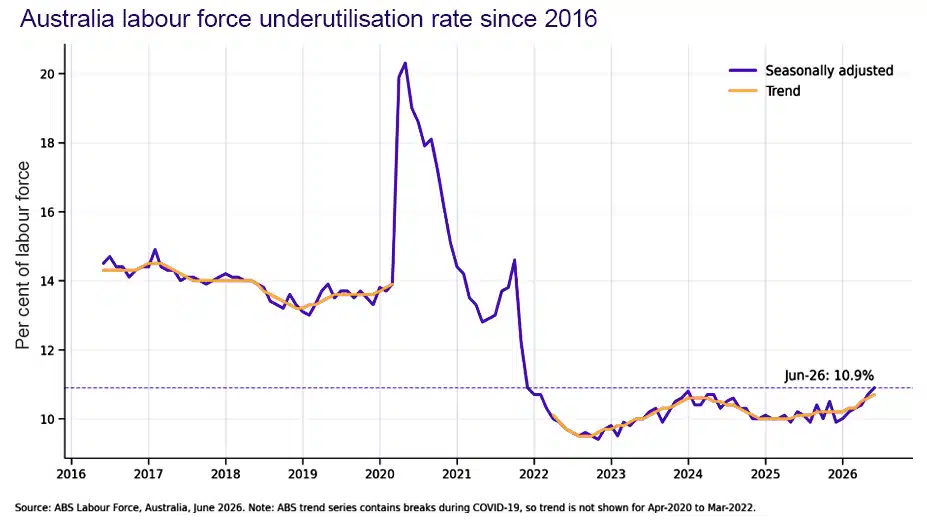
Market Impact
Bond markets have been selling off this month largely on Middle East tensions. The most recent headline employment growth saw yields shift slightly higher and the odds of an August hike shift from 25% to 30%.
The key distinction here is between nominal and real yields. The nominal 10-year yield is the visible market yield, currently around 5%, but the real yield is the return investors receive after inflation expectations.
That is what matters for purchasing power. If inflation expectations remain reasonably anchored, a 5% nominal yield represents a meaningful positive real yield.
This is why bonds are starting to look better value, even if the short-term mark to market remains uncomfortable.
I am slightly surprised by this as the labour market seems to be steady to slightly deteriorating.
However, when overnight headlines easily move markets, few participants are wanting to take on the volatility.
For more patient investors, 10-year yields around 5% do offer value. If inflation expectations remain contained, that implies a positive real yield, which is the more important measure of long-term bond value.
A slowly deteriorating labour market and rising underutilisation should also limit the need for further tightening. With term premium higher than normal, investors are now being paid more both for inflation adjusted return and for taking duration risk.
Find out about
Pendal Government Bond Fund
Tim Hext, Head of Government Bond Strategies
If you’d like to hear more about how Pendal’s Income & Fixed Interest team is positioning for this environment, please contact us through our accounts team
About Tim Hext and Pendal’s Income & Fixed Interest boutique
Tim Hext is a Pendal portfolio manager and head of government bond strategies in our Income and Fixed Interest team.
Tim has extensive experience in banking, financial markets and funding including senior positions with NSW Treasury Corporation (TCorp), Westpac Treasury, Commonwealth Bank of Australia, Deutsche Bank, Bain & Co and Swiss Bank Corporation.
Pendal’s Income and Fixed Interest boutique is one of the most experienced and well-regarded fixed income teams in Australia.
Find out more about Pendal’s fixed interest strategies here
About Pendal
Pendal is a global investment management business focused on delivering superior investment returns for our clients through active management.
In 2023, Pendal became part of Perpetual Limited (ASX:PPT), bringing together two of Australia’s most respected active asset management brands to create a global leader in multi-boutique asset management with autonomous, world-class investment capabilities and a growing leadership position in ESG.
Here are the main factors driving the ASX this week according to Pendal portfolio manager JIM TAYLOR. Reported by portfolio specialist Chris Adams
THE Middle East conflict and rhetoric from Fed governors remain the market’s key talking points.
Meanwhile an unwind in the momentum factor continues with the PHLX Semiconductor index (SOX) and the Roundhill Memory ETF (DRAM) down 20% and 35% respectively from their highs.
The S&P 500 shed 1.6% last week, while the NASDAQ was down 2.9%. The S&P/ASX 300 held up better but weakened by 0.2%. Brent crude rose 15.9% over the week, with further deterioration in the Middle East situation over the weekend.
It feels like there is a faction on the Federal Open Market Committee (FOMC) looking to apply a bit of pressure to Fed Chair Kevin Warsh and force a rate hike in the next quarter, if a string of data indicates a reemerging inflationary pulse.
The benign consumer price index (CPI) and producer price index (PPI) prints out during the week have taken a bit of heat off Warsh and pushed out rate rise expectations from July.
His inaugural testimony to Congress went down well with the markets as he navigated the fine line showing commitment to tackling inflation while being dovish on the need for rate rises.
The Fed will take heart from consumer inflation expectations receding slightly in the latest University of Michigan sentiment survey.
Beyond the inflation data – which saw June headline CPI falling and core slowing month/month and a below-consensus reading for PPI – the US saw a continuation of decent retail sales, solid employment figures and a further uptrend in manufacturing.
Housing activity remains the key weak spot in the US economy. If we hadn’t seen a resumption of the Middle East conflict, we would most likely have been talking about June as peak inflation.
Around 10% of US companies have reported Q2 earnings. So far, the results have been well above estimates with good outcomes from key financials illustrating just how well the US economy is travelling.
Equity markets expressed renewed scepticism around the AI capex spend, best highlighted by chipmaker TSMC beating consensus and raising guidance result at its Q2 result – and the share pricing continuing to fall. It is now down nearly 20% from the June peak.
The launch of the Kimi K3 large language model by Chinese company Moonshot has caused flashbacks to last year’s DeepSeek moment, with the developer claiming the gap to the Open Ai/Anthropic models is closing, creating more angst around the actual returns from AI spend.
SpaceX slid below its IPO issue price and IBM saw it largest single day fall since 1968 after its preannounced Q2 earnings results revealed a shift in enterprise spending away from its software and mainframe segments towards AI hardware (servers, storage and chips).
This is feeding into huge volatility in the equity market momentum factor. Its three-week released volatility has surged to almost 4x that of the S&P 500 – double its previous high point of 2x in 2020.
The Goldman Sachs flagship high-beta momentum basket, GSPRHIMO, roughly tripled in the period from ChatGPT’s launch in November 2022 to its peak in late June 2026 – and has now given back almost one third of this in the last three weeks.
Elsewhere, the correlation between Brent crude oil and gold has reached its strongest inverse relationship in over 30 years.
US macro and policy
The Federal Reserve
The Fed was very busy ahead of this week’s blackout before the next meeting in late July.
Governor Christopher Waller is “determined to avoid repeating” the Fed’s mistake in 2021 when it was too late in responding to higher prices, noting ahead of last week’s inflation data that the Board would need to consider tighter policy in the event that it was “another hot reading”.
It came in on the cooler side. However, Waller said that he would need “several months of lower readings to feel that inflation is mobbing in the right direction”. In that case, he would “continue to hold the policy rate at its current target range”.
New York Fed President John Williams laid out six reasons why he felt that current interest rates are well set to push inflation back to target and he doesn’t see the need for a hike at the next meeting.
These included: tariff impacts rolling off, declines in housing-related inflation, lower oil prices, eventual easing of supply/demand imbalances in AI-related inputs, lack of inflation pressure in labour, and well-anchored expectations.
Dallas Fed President Lorie Logan was more hawkish. “The June CPI data do suggest the possibility of a more hopeful scenario where inflation returns all the way to target … still, that path is tenuous,” she said. “I currently believe modestly higher interest rates would better balance the outlook and risks.”
Kevin Warsh made his first testimony to Congress, which ultimately saw bond yields fall 5-6 basis points (bps), on the basis that he was reassuring on Fed independence and gave a message of not looking to move aggressively against the short-term current excess inflation, yet remains committed to getting inflation to the target without excuses.
He was speaking the day after June’s softer CPI data, but cautioned against reading too much into it, warning that the longer inflation stays above target the stickier it tends to become. He pledged “to take sticky prices and unstick them”.
In terms of other key issues:
- Fed independence: Warsh noted it is “sacrosanct”, citing the recent US Supreme Court ruling against President Donald Trump’s attempt to fire Fed Governor Lisa Cook as an example.
- Communication: He sees less as more, noting that over-communicating creates “sticky” positions where FOMC members end up looking for data to justify previous stances, rather than taking data solely on its merits as it comes to light. He did not commit to a press conference after each meeting.
- Dual mandate: Warsh pushed back against the notion that he is not focused on the employment side of the mandate. However, he did emphasise his view that the best way to achieve the employment mandate is to be successful on the inflation mandate.
- Balance sheet size: The gist of this discussion was that he sees smaller as better, but he noted this is not going to happen quickly and will not return to the scarce reserves regime that existed pre-GFC.
- Balance sheet duration: He is not comfortable with the duration of the assets on the Fed balance sheet, noting the average is greater than six years versus the market at 4.5 years, hinting perhaps that the Fed balance sheet over time moves in line with market duration.
- Inflation measures: Warsh downplayed the notion that he is focused on trimmed mean and median measures of underlying inflation and is particularly attentive to the Dallas Fed trimmed-mean measure.
He said that, as with the core personal consumption expenditures (PCE) index, “none of those are very good measures of underlying inflation”.
Instead, he said the Fed’s data task force would examine inflation measures, aiming to develop better gauges of underlying inflation. He noted that “we need new measures to understand the underlying changes in inflation”.
Inflation data
The headline June CPI fell by 0.4% month/month, well below consensus expectations of a 0.1% decline. It stands at 3.5% year/year.
Core CPI, which excludes food and energy, was unchanged month/month, also below the consensus which was at +0.2%. It is 2.6% year/year.
This was just the downtick in CPI data that the market has been looking for, especially given the emergence of a new block of hawks on the Fed.
The core CPI being unchanged, versus the 0.26% average monthly increase for the first five months of CY26, was the real positive.
Key drivers of the downside surprise included core goods pricing falling by 0.1%, with only one of the six major subcomponents in the positive territory.
CPI primary rent and owners’ equivalent rent were both below the averages of the last 12 months. Flat to very modest growth should see these rent measures remain subdued in the medium term.
Headline PPI fell by 0.3% in June, below the consensus, 0.0%. Net revisions were -0.4%.
Core PPI increased by 0.2%, slightly below the consensus of 0.3%. Net revisions were -0.3%.
While the June PPI data was constructive, there is a pipeline of cost pressures (goods rather than services) that will be coming through the system over the next quarter. These are driven by energy and memory costs, among others, and need to be closely watched.
Retail sales
Retail sales rose 0.2% month/month for June, in line with consensus. Net revisions were +0.4% to previous months.
Ex-autos, retail sales fell 0.2% month/month, versus consensus expectations of -0.1%. Net revisions were also +0.4%.
Control retail sales (which excludes volatile items) were up 0.5% month/month. This was in line with consensus and net revisions were +0.8%.
The bottom line is that retail sales still look pretty solid.
There is possibly some ongoing benefit from the tax refunds, but this has now pretty much run its course.
There is also no discernible benefit from the World Cup in higher retail sales or lower unemployment claims, so overall this data probably represents a pretty clean set of numbers and suggest things continue to be okay in consumer land.
Other data
Initial jobless claims were 208,000 for the week ended 11th July, versus 217,000 expectations. Continuing claims were 1.805 million for the week ended 4th July, versus 1.818 million consensus.
The University of Michigan consumer sentiment index came in at 54.5, above consensus and an improvement on the previous month’s 49.5.
Within it, one-year forward inflation expectations (preliminary) were at 4.2% for July, versus a median forecast of 4.4% and 4.6% in June. The five-to-10-year inflation expectations (preliminary) was at 3.3% for July, in line with the median forecast and unchanged from June.
Finally, the Empire Manufacturing index and Goldman Sachs Manufacturing Survey Tracker both had positive prints and suggest that the manufacturing recovery continues to build.
Australia macro and policy
The Prime Minister announced plans to develop Australian Standards for AI to bring into legislation in early 2027. The goal is to design a framework for faster decision making, better supporting infrastructure and genuine community engagement.
This includes copyright protection for Australian IP, provision of new power supply, grid connections and firming capacity by the user, minimisation of water use, maximisation of energy efficiency and a single national framework to enhance appeal to international investors.
The announcement received broad data centre industry support who were pleased that the government is very serious about attracting AI related investment into Australia.
The Westpac/Melbourne Institute consumer sentiment index increased 4.1% month/month in July to 83.9, reflecting lower fuel prices and interest rate expectations, but remains 17% below its historical average.
Westpac noted that responses showed “a significant weakening as the situation in the Strait of Hormuz deteriorated over the course of the survey week” and flagged that the overall increase in the month may be related to “relief that ‘worst case’ scenarios … are not playing out”.
Find out about
Pendal Focus Australian Share Fund
Crispin Murray, Head of Equities
Markets
In the US, Energy (+5.0%) and Real Estate (+2.3%) were the best performing sectors in the S&P 500, while Technology (-3.8%) and Communication Services (-2.4%) lost ground.
We got a very direct and timely read on the state of the US economy from the US banks reporting last week (JP Morgan Chase, Goldman Sachs, Bank of America, Citigroup, Wells Fargo) and it could scarcely have been any more positive.
- US banks posted corporate loan growth of 17% year/year. This was a record number, fuelled by all sectors of the economy – even commercial real estate saw growth after a long period of contraction.
- In addition, US consumer spending is tracking up mid-single digits, credit card spending is up 6% year/year, and there’s no sign of consumer or commercial credit deterioration.
- Investment banking related business lines were up 40%+ in aggregate.
- Large-cap banks posted a 19% return on tangible equity, a clear new post-GFC high.
All this suggest the bank sector is in rude health. Stock price moves were a little mixed given how high expectations were going into results, but the fundamentals are very strong.
Aggregate S&P 500 EPS estimates have been rising rapidly, driven primarily by the AI trade.
In aggregate, companies are reporting sales that are 3.8% above expectations, above the 1.9% one-year positive surprise rate but below the five-year average of 1.9%.
S&P 500 500 FY26 estimates started at $305 and are currently $330 and FY27 has moved from $352 to $393, for year/year growth of 20%.
Growth rates for “old economy” stocks are ~10%.
The blended earnings growth rate for Q2 S&P 500 EPS currently stands at 24.7%. This is above the 23.2% expected at the end of the quarter.
The blended revenue growth rate is 12.8%.
Of the 10% of S&P 500 companies that have reported for Q2, 88% have beaten consensus EPS expectations, above the 80% one-year average and the five-year average of 78%. In addition, 85% have surpassed consensus sales expectations, above the 78% one-year average and the five-year average of 70%.
In aggregate, companies are reporting earnings that are 16.4% above expectations, above the 9.2% one-year average positive surprise rate and the five-year average of 7.0%.
About Jim Taylor and Pendal Focus Australian Share Fund
Drawing on more than 25 years of experience investing in top-performing Australian companies and a background in accounting, Jim manages our Long/Short Fund and co-manages our Imputation Fund. He is a Chartered Accountant with membership of the Australian Institute of Chartered Accountants.
Pendal Focus Australian Share Fund is managed by Crispin Murray. The fund has beaten its benchmark in 14 years of its 18-year history (after fees), across a range of market conditions.
Find out more about Pendal Focus Australian Share Fund here.
Pendal is an independent, global investment management business focused on delivering superior investment returns for our clients through active management.
Pendal senior fund manager JAMES SYME explains why investors need to look more deeply into the AI acceleration to find the true beneficiaries in emerging markets
- AI gains concentrate in chip leaders
- Korea shows AI’s uneven economic rewards
- Learn more about Pendal Global Emerging Markets Opportunities Fund
SOUTH Korea’s AI-driven semiconductor boom is creating extraordinary wealth, yet the gains are accruing unevenly across companies, sectors and households, argues Pendal’s emerging markets team.
The principal beneficiaries are a small number of firms positioned at critical points in the AI supply chain, most notably Samsung Electronics and SK Hynix.
The current cycle highlights a broader global trend in which returns to capital are rising more rapidly than returns to labour. Returns to labour are themselves also highly asymmetric.
Our Korean exposure remains concentrated in the direct beneficiaries of AI-related capital expenditure rather than the broader market.
A lot of the discussion around artificial intelligence has focused on its potential to increase inequality and concentrate economic gains among a relatively small number of companies and individuals.
In emerging markets, however, the AI acceleration is currently being experienced less through the developers of large language models and more through the hardware supply chain that enables them.
As top-down investors, we are interested not only in the scale of this opportunity but also in how its benefits are distributed. South Korea provides an especially useful case study.
Where the AI gains are concentrating
In Korea, the gains from the semiconductor export boom are being distributed unevenly across the corporate sector.
Consensus forecasts point to a sharp rise in profits at Samsung Electronics and SK Hynix over the next two years, while earnings expectations for much of the broader Korean market have improved only modestly.
In US dollar terms, the combined operating profit of the two chip firms was US$41 billion in 2024 and is forecast to be US$389 billion in 2026. For the other 66 MSCI Korea Index constituents with available data, the corresponding, figures are US$130 billion and US$138 billion.
The AI boom appears less like a rising tide lifting all boats and more like a transfer of profitability towards a small number of globally competitive firms.
The distributional effects extend beyond companies to households.
Samsung has announced a deal to pay its 78,000 semiconductor workers bonuses of around US$400,000 each, following a similar deal at SK Hynix.
Not only is this not the pattern at other Korean firms, but even within Samsung the non-semiconductor workers are reported to be receiving only US$4,000 each.
The rewards of the upswing are accruing not simply to successful companies, but to the specific activities and skills most closely tied to AI-related demand.
Similar patterns are increasingly visible elsewhere.
In the United States, the share of economic output accruing to labour recently fell to its lowest level on record.
The early stages of the AI investment cycle appear to be generating substantial returns for owners of intellectual property, productive assets and equity capital, while the growth in broader wages is proving slower and more uneven.
Find out about
Pendal Global Emerging Markets Opportunities Fund
What it means for investors
For investors, this distinction is critical.
Strong country-level growth does not necessarily imply broad-based earnings growth, just as rising corporate profits do not automatically translate into higher household incomes.
Our exposure to South Korea remains concentrated in the direct beneficiaries of AI-related capital expenditure, including Samsung Electronics and SK Hynix.
We remain heavily underweight much of the broader Korean market.
In our view, the key investment question is not whether AI is creating value, but where that value is accruing.
About Pendal Global Emerging Markets Opportunities Fund
James Syme, Paul Wimborne, Ada Chan and Roshni Bolton are co-managers of Pendal’s Global Emerging Markets Opportunities Fund.
The fund aims to add value through a combination of country allocation and individual stock selection.
The country allocation process is based on analysis of a country’s economic growth, monetary policy, market liquidity, currency, governance/politics and equity market valuation.
The stock selection process focuses on buying quality growth stocks at attractive valuations.
Find out more about Pendal Global Emerging Markets Opportunities Fund here
Pendal is a global investment management business focused on delivering superior investment returns for our clients through active management.
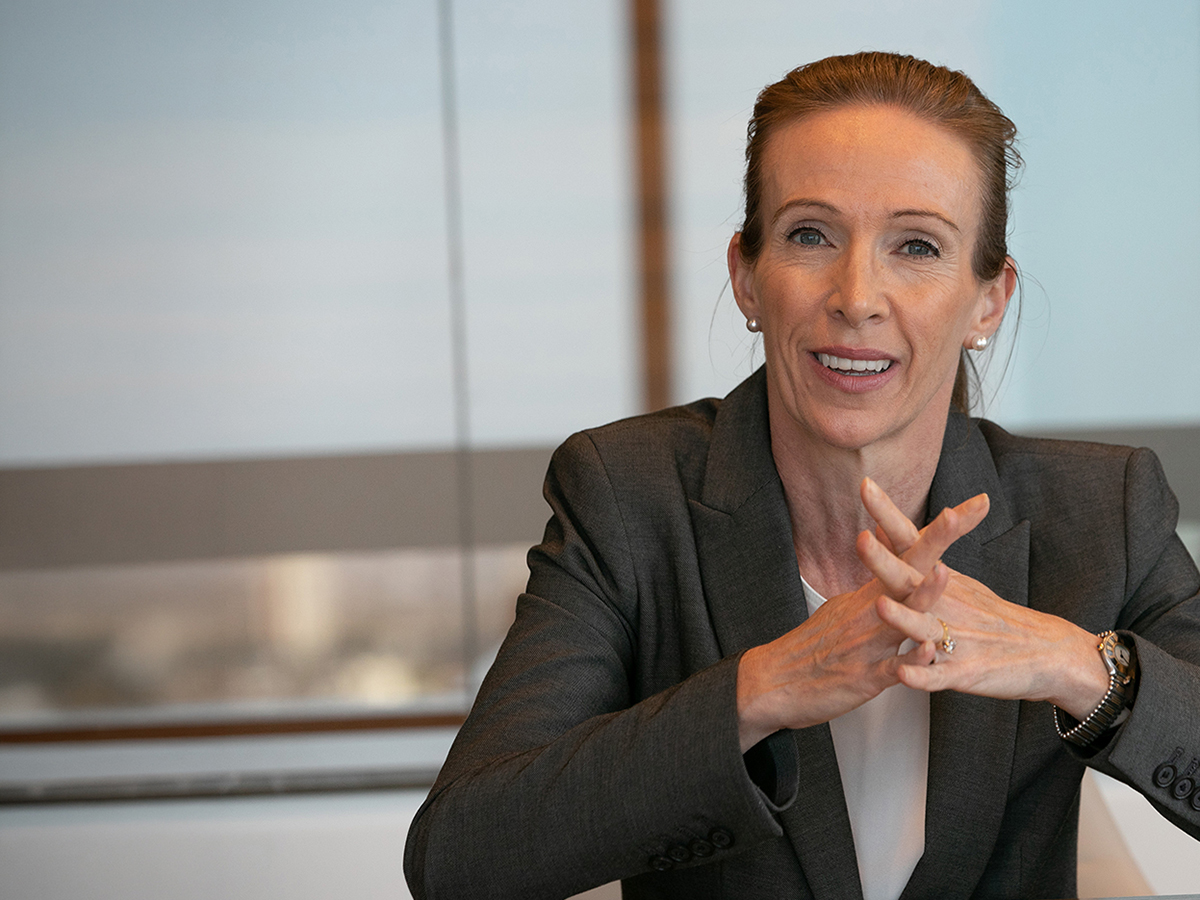
After a tough start to the year, REITs are starting to look a lot more interesting. Pendal portfolio manager JULIA FORREST discusses the key contributors to this trend
IT’S been a tough year for property, pushing valuations lower. But that creates new opportunities for investors, says Pendal portfolio manager, Julia Forrest.
“Around May this year, the property sector got to the point where it was cheap, trading around 13 times earnings”, Forrest explains. “It was absolutely compelling value, compared to the rest of the market.
“We started to see physical transactions at or above book value and we saw some REITs upgrading their earnings. Even though the sector was depressed, the earnings outlook was quite robust.”
Watch the full video to learn more
Find out about
Pendal Property Securities Fund
Julia Forrest, Portfolio Manager
About Julia Forrest and Pendal Property Securities Fund
Julia Forrest is a portfolio manager with Pendal’s Australian Equities team. Julia has managed Pendal’s property trust portfolios for more than a decade and has 25 years of experience in equities research and advisory, initial public offerings and capital raisings.
Pendal Property Securities Fund invests mainly in Australian listed property securities including listed property trusts, developers and infrastructure investments.
About Pendal Group
Pendal is an Australian investment management business focused on delivering superior investment returns for our clients through active management.
Here are the main factors driving the ASX this week, according to analyst and portfolio manager ELISE MCKAY. Reported by portfolio specialist Jonathan Choong
- Find out about Pendal Focus Australian Share fund
- Find out about Pendal Horizon Sustainable Australian Share Fund
LAST week was a quiet one in markets with holidays in full swing and little in the way of major economic releases.
Markets were driven more by positioning than new information, with a rotation out of momentum winners and a broadening of leadership across other sectors.
Investors continued to look through geopolitical risks, with attention turning to US earnings and next week’s key inflation data.
The S&P 500 rose 1.3% over the last week and the Nasdaq 1.7%, while the S&P/ASX 300 slipped 0.4%.
Brent crude gained 5.4% as US-Iran tensions re-escalated, and with further escalation over the weekend around the Strait of Hormuz, the week ahead could prove bumpy.
The Middle East
Geopolitical tensions re-escalated after US President Donald Trump declared the ceasefire with Iran had ended, followed by renewed Iranian attacks on shipping vessels and a deterioration in negotiations.
The US subsequently launched further strikes on Iranian targets, while diplomatic efforts continued through Oman to prevent a broader regional conflict.
Tensions then intensified on Sunday, when Iran announced the closure of the Strait of Hormuz.
Energy markets were the clearest transmission channel as Brent rose 5.4% and the ASX energy sector gained 3.9%.
Oil traded back towards US$80 a barrel as attacks on tankers resumed, once again slowing shipment traffic within the Gulf.
The move was amplified by positioning: crude markets had built a sizeable short base against a backdrop of weak physical pricing and softer market structure.
As prices rose, short covering accelerated and physical differentials recovered sharply.
The supply backdrop has also tightened beyond the Middle East.
Continued Ukrainian attacks on Russian refining have restricted product exports, pushing diesel crack spreads (the margin refiners earn turning crude into diesel) above US$60 a barrel despite a resumption of Chinese exports.
Persian Gulf exports have fallen to around 63% of pre-war levels, from roughly 80% in late June, and with global inventories still low the market is exposed to any further disruption to Hormuz flows.
Natural gas markets appear even more vulnerable as LNG traffic through the Strait has stalled again.
This has interrupted Qatar’s tentative restart of loadings from Ras Laffan and forced Europe to compete harder with Asia for cargoes. European gas storage sits just above 50%, the lowest for this point in the year since 2022.
The market is therefore entering this phase of geopolitical uncertainty with a thinner inventory cushion than during the initial June shock.
Despite the rally, positioning suggests investors still expect the escalation to remain contained: managed-money crude positioning is near the 11th percentile of its recent range and options markets have begun fading the volatility spike.
This results in an unstable equilibrium – consensus believes neither the US nor Iran wants an escalation; however short positioning, constrained flows and tight markets mean any further disruption could produce another outsized move higher in oil and gas.
Macro and policy
Minutes from the June meeting of the Federal Open Market Committee (FOMC) reinforced a cautious, data-dependent stance.
Policymakers were divided, weighing scenarios in which inflation continues towards the 2% target against outcomes where tariffs, AI demand and geopolitics keep prices elevated.
While the committee views policy easing as appropriate if inflation resumes its decline, the minutes flagged a willingness to keep policy restrictive, or tighten further, if it proves persistent.
For markets, the message was clear: the Federal Reserve is setting a high bar for policy easing.
Rate markets still price in a meaningful probability of the next move being a hike rather than a cut, and two-year Treasury yields have stayed elevated despite the retracement in oil.
Focus now turns to next week’s CPI release and the start of second-quarter earnings.
Elsewhere, labour market conditions remained resilient but softened gradually.
Initial jobless claims edged down to 215,000 (consensus of 217,000) and still below year-ago levels, while continuing claims drifted up in line with consensus to around 1.814 million.
These numbers are consistent with workers taking longer to find new roles rather than rising layoffs.
Consumer credit growth also moderated in May, suggesting households remain cautious about taking on debt despite a labour market that supports spending.
On housing, US housing data continues to point to a subdued residential market.
Mortgage applications were flat as 30-year rates held around 6.6%, and existing home sales fell from 4.19 million in May to 4.09 million in June.
With inventories rising alongside further price appreciation, affordability rather than supply remains the key constraint, suggesting residential investment looks likely to remain a modest drag on growth.
This is unhelpful for housing-related names in Australia such as James Hardie and Reece.
El Niño
Over the weekend, the National Oceanic and Atmospheric Administration (NOAA) declared the onset of El Niño, with a 62% chance of a “very strong” event developing into the year end.
While El Niños typically occur every two to seven years, strong and very strong events are more unusual, occurring only eight times in the past 75 years.
The longer-term outlook points to elevated drought risk across parts of Australia and Asia, though recent rainfall across Australian cropping regions has improved soil moisture and alleviated near-term concerns.
Investor focus remains on whether a drier pattern emerges into the 2026/27 summer and translates into higher global food prices, a potential further headwind for inflation if passed through to the end consumer.
Hyperscaler debt issuance
Meanwhile, debt issuance by the large cloud “hyperscalers” has become a notable force in bond markets, totalling around US$194 billion year to date.
That is roughly 20% of total US investment-grade supply and well above the US$108 billion raised across all of 2025.
The scale has widened hyperscaler credit spreads and contributed to a rise of around 20 basis points (bps) month to date in the 30-year Treasury yield.
ETF flows
ETF flows also continue to provide a supportive backdrop for equities.
US-listed ETFs have attracted more than US$1 trillion year to date, with assets under management above US$15.6 trillion and volumes around 50% higher than a year ago, concentrated in mega-cap technology, semiconductors and AI.
The ETF ecosystem is also increasingly influencing market behaviour: US-listed ETFs now outnumber individual listed companies, and of the more than 770 launched this year over half use derivatives and around a third are leveraged or inverse.
Although leveraged ETFs hold just US$175 billion in assets, they generated close to US$3 trillion of gross trading exposure in June, around 40% of all US ETF notional volume.
Global equity ETF trading volumes are now running around twice last year’s pace, with particularly strong activity in thematic exposures including mining.
This growing dominance of passive and systematic vehicles reinforces momentum-driven trading and accelerated rotations, which can amplify volatility but also widen the opportunity set for active managers to identify mispriced companies.
Find out about
Pendal Focus Australian Share Fund
Crispin Murray, Head of Equities
Markets
US equities recovered despite the renewed Middle East tensions, supported by a rebound in the AI trade and a stabilisation in momentum following the sharp factor unwind seen in recent weeks.
Hedge funds were net buyers of US equities for the first time in four weeks, though driven largely by short covering rather than fresh long buying.
Information technology led inflows as investors rotated back into semiconductors, while financials, particularly banks, saw profit-taking ahead of earnings.
The shift in positioning looks like stabilising sentiment rather than a wholesale return to risk-taking.
Leverage rose only modestly, and the largest single-stock de-grossing in almost three months highlights that investors continue to trim exposure through both long sales and short covering.
Momentum and AI positioning is now materially cleaner after recent drawdowns, improving the risk-reward for quality technology names into earnings.
In contrast, hedge funds continued rotating from banks towards capital markets, exchanges, insurance brokers and information services, reflecting concerns that much of the anticipated strength in bank earnings is already priced in.
Despite improving equity flows, investors are also increasingly focused on downside protection as event risk builds: Goldman Sachs noted a marked rise in index hedging demand, and implied volatility for the average S&P 500 stock has risen to the 98th percentile of the past 15 years.
This suggests investors are willing to selectively rebuild equity exposure but are increasingly using options to manage the heightened macro and earnings uncertainty.
In Australia, the S&P/ASX 300 declined modestly as investors navigated a slowing economy, renewed Middle East tensions and uncertainty around inflation, rates and earnings.
The overall tone was defensive, with low-volatility and yield factors outperforming and momentum under pressure, particularly in materials.
By sector, energy led (+3.9%), financials and technology (helped by software) were also strong, while materials fell more than 4% and gold eased.
Three of the five best-performing large caps were oil-linked, and nine of the 10 worst were resource stocks.
Looking ahead, investor attention is expected to shift from geopolitics toward fundamentals, with next week’s US CPI release and the commencement of second-quarter earnings season likely to determine whether markets can extend their recent resilience despite higher energy prices and a still-restrictive Federal Reserve/RBA.
About Elise McKay and Pendal Australian share funds
Elise is an investment analyst and portfolio manager with Pendal’s Australian equities team. Elise previously worked as an investment analyst for US fund manager Cartica where she covered a variety of emerging market companies.
She has also worked in investment banking and corporate finance at JP Morgan and Ernst & Young.
Pendal Horizon Sustainable Australian Share Fund is a concentrated portfolio aligned with the transition to a more sustainable, future economy.
Pendal Focus Australian Share Fund is a high-conviction equity fund with a 16-year track record of strong performance in a range of market conditions. The Fund is rated at the highest level by Lonsec, Morningstar and Zenith.
Pendal is an independent, global investment management business focused on delivering superior investment returns for our clients through active management.
Pendal investment analyst CALLUM SINCLAIR explains why getting ahead of an earnings rebase can be critical in small caps — and how early research can uncover opportunities before the market catches on.
- Small caps offer early earnings opportunities
- IPO market slowly regains momentum
- Find out about the Pendal Smaller Companies Fund
For Pendal investment analyst Callum Sinclair, small-cap investing is less about calling macro trends and more about finding bottom-up opportunities early.
“We’re not trying to make money from macro bets — that can be a fool’s errand in small caps — but we are conscious of them. We won’t go fully long consumer into a downturn, and vice versa.”
While the ASX Small Ordinaries Index delivered positive returns in FY26, Sinclair says performance has been highly uneven.
Contractors, defence and resources — particularly gold — have done much of the heavy lifting.
“Performance in FY26 has shown significant dispersion across and within sectors,” he says.
“The materials sector has been the top performer, up nearly 40 per cent, with industrials close behind before performance tails off sharply.
“Consumer-exposed stocks are at the bottom of the table. Even within industrials, dispersion has been wide.
“Some industrial stocks are down 30 to 50 per cent while gains have been skewed towards a handful of contractors.”
Two beneficiaries have been Southern Cross Electrical (ASX:SXE) and NRW Holdings (ASX:NRW), which Sinclair says have gained from contract wins and data-centre build-out tailwinds and more than doubled in value over FY26.
The Pendal Smaller Companies Fund holds positions in both companies.
Some of these investments were identified by the small-caps team years ago, but Sinclair says FY26’s narrow market leadership is creating new opportunities.
“We have a five-person team on the road all the time,” says Sinclair. “Lewis Edgley, co-portfolio manager of Pendal Smaller Companies Fund and Pendal MicroCap Opportunities Fund, has just returned from two weeks in the UK.
“Several of us have been interstate in the past three months, meeting companies and assessing how conditions have changed.
“The aim is to work out what is happening before it becomes obvious. By the time companies tell the market, it can already be too late.
“We’re trying to do the work and find companies before earnings inflect. That way, investors can benefit from both the earnings uplift and the re-rate as the market discovers these companies and recognises growth can continue.”
IPOs staging a comeback
The IPO market is also starting to recover, with several successful ASX listings this year and more expected.
Online furniture retailer Koala (ASX:KOA) debuted in March, body-piercing chain Skin Kandy (ASX:SK1) listed in May, and FDC Consolidated (ASX:FDC), a diversified construction company, became Australia’s largest IPO this calendar year.
“We’re seeing the IPO market slowly thaw,” says Sinclair.
“There are expectations of more IPOs in the second half of the calendar year.”
The team takes a selective approach to IPOs, participating in the FDC and SkinKandy listings.
“In both cases, we invested because they have strong returns or unit economics and balance sheets that can fund continued organic growth,” Sinclair says.
Find out about
Pendal Smaller Companies Fund
Patrick Teodorowski & Lewis Edgley,
Portfolio Managers
About Lewis Edgley and Patrick Teodorowski
Lewis and Patrick are co-managers of Pendal Smaller Companies Fund.
Portfolio manager Lewis Edgley co-manages Pendal’s Australian smaller companies and micro-cap funds and conducts analysis on a range of smaller companies. He joined the Pendal Smaller Companies team in 2013 as an analyst, before being promoted to the role of portfolio manager in 2018. Lewis brings 20 years of industry experience with previous roles spanning equities research, as well as commercial and investment banking roles at Westpac and Commonwealth Bank.
Portfolio manager Patrick Teodorowski co-manages Pendal’s smaller companies and micro-cap funds and conducts analysis on a range of smaller companies. He joined Pendal in 2005 and developed his career as a highly regarded small cap analyst. Patrick holds a Bachelor of Commerce (1st class Honours) from the University of Queensland and is a CFA Charterholder.
About Pendal Smaller Companies Fund
Pendal Smaller Companies Fund is an actively managed portfolio investing in ASX and NZX-listed companies outside the top 100. Co-managers Lewis Edgley and Patrick Teodorowski look for companies they believe are trading below their assessed valuation and are expected to grow profit quickly. Lewis and Patrick together have more than 40 years of investment experience.
Find out about Pendal Smaller Companies Fund
Find out about Pendal MicroCap Opportunities Fund
Find out about Pendal MidCap Fund
About Pendal Group
Pendal is a global investment management business focused on delivering superior investment returns through active management.
In 2023, Pendal became part of Perpetual Limited (ASX:PPT), bringing together two of Australia’s most respected active asset management brands.