
The Reserve Bank of Australia (RBA) may be on hold, but the inflation fight is far from over. Pendal head of cash strategies STEVE CAMPBELL breaks down the latest commentary and what it means for future rate moves
- RBA watches data as inflation persists
- Business activity complicates inflation outlook
- Find out about Pendal’s cash funds
THE RBA left the cash rate unchanged at 4.35% at its August meeting. The decision was unanimous. No surprises there.
After the weaker inflation data in late July the market removed any likelihood of further tightening.
The key points from the RBA’s statement today are:
- Headline inflation is still too high and trimmed mean inflation remains elevated;
- The labour market has eased by a little more than expected although leading indicators point to only limited easing;
- Momentum in the housing market has shifted and new housing loans have declined noticeably;
- Historically weak productivity growth continues to constrain potential growth; and
- Inflation is not expected to return to the target band until the end of 2027
Also released today were the RBA’s updated set of economic forecasts via its Statement on Monetary Policy.
The latest set of forecasts are as follows: –
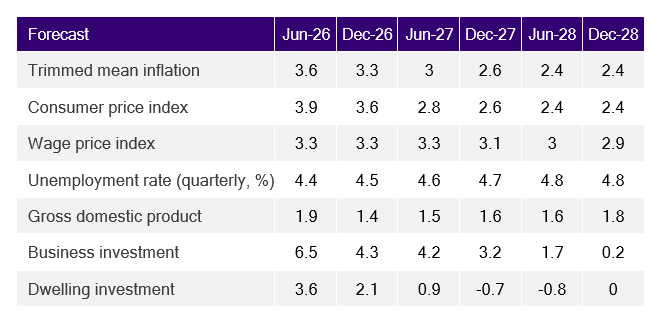
Some high level observations here are: –
- Inflation is not forecast to move back in the band until the end of next year. The RBA also noted that there are upside risks to this projection.
- Data centres are having an impact with business investment forecasts for 2026 revised 3.5% higher to 4.3% and for 2027 revised 1.4% higher to 3.2%. The benefit to economic growth is more subdued due to the imported components required detracting from the net trade position.
- Dwelling investment has been revised lower, with the 2027 forecast reduced by 0.4% to -0.7%. No surprises there either – if those building are no longer getting the price they need to be warrant building, then the tools go down
Productivity growth remains a key concern for the RBA, which sees the economy running with demand ahead of supply currently, and a period of weaker growth is required to bring this back into balance.
If demand was to pick up for whatever reason, then it is likely to feed through more quickly into higher inflation outcomes. The RBA does not want to see higher inflation expectations becoming embedded in the economy.
NAB Business Survey – picking up, slightly
The NAB monthly business survey showed both capacity utilisation and labour costs picking up – not something the RBA would welcome.
Deputy Governor Andrew Hauser has spoken about capacity utilisation previously. The economy did not have the excess capacity to handle the pickup in demand in the second half of 2025 without generating inflation.
According to the NAB survey, capacity utilisation picked up from 81.9% in May to 83% in July.
Another piece of data – household spending – released in early August was also much stronger than expected.
According to the Australian Bureau of Statistics (ABS), household spending rose 0.8% in June taking annual household spending growth to 6%.
So where to from here?
There are plenty of moving parts in the inflation equation.
Data centre building will offset the decline from dwelling investment in the nearer term.
It is not without inflation consequences. Competition for labour along with the energy required to maintain those centres, for example.
Inflation remains uncomfortable for the RBA. Further policy tightening can’t be ruled out. Each monthly inflation data will be closely watched.
Find out about
Pendal Managed Cash Fund
Steve Campbell, Head of Cash Strategies
If you’d like to hear more about how Pendal’s Income & Fixed Interest team is positioning for this environment, please contact us through your account manager by reply email.
About Steve Campbell and Pendal’s Income and Fixed Interest team
Steve Campbell is Pendal’s head of cash strategies. With a background in cash and dealing, Steve brings more than 20 years of financial markets experience to our institutional managed cash portfolio.
Find out more about Pendal’s cash funds:
Short Term Income Securities Fund
Pendal Stable Cash Plus Fund
Pendal Managed Cash Fund
Pendal’s Income and Fixed Interest boutique is one of the most experienced and well-regarded fixed income teams in Australia.
June CPI data has eased expectations of another rate hike in August, although inflation remains above target and the RBA’s tightening bias is likely to stay in place. Pendal’s head of cash strategies STEVE CAMPBELL explains
- Softer inflation lowers August hike expectations
- RBA likely to retain tightening bias
- Find out about Pendal’s cash funds
THE June CPI release has led to an easing in expectations of a further rate hike by the Reserve Bank of Australia (RBA) in August.
The data showed second quarter trimmed mean inflation rising by 0.8% taking the annual trimmed mean to 3.6%.
Consensus was for 0.9% and 3.7%. The result was also lower than the RBA’s May forecast of 3.8%.
Monthly headline inflation data was also released and fell 0.1% resulting in annual headline inflation of 3.8%. Consensus was for +0.2% and 4%.
The following graph shows the contribution by sector to annual inflation against the RBA’s 2 to 3% target band: –

Where does this leave the RBA ahead of its August meeting?
The market had ascribed around a 20% chance of a hike leading into today’s numbers and the cash rate peaking at 4.60% in early 2027.
Post the data, the market is saying zero chance of a hike next month and 50/50 on whether the RBA has finished tightening.
Prior to today’s release Governor Michele Bullock spoke at the Anika Foundation on the 28th July. Among the key points in her speech was that the housing market has been weaker than expected since the last set of forecasts in May.
The labour market has also been a bit softer than expected. Today’s monthly inflation data may have reflected some of the softening in housing extending into second round effects. Furniture prices for example fell over 5% in June and major household appliances dropped 2.5%.
Governor Bullock did also point out that the RBA retains a tightening bias and that “if it looked like inflation was not coming down, the board would have a difficult decision to make with respect to raising rates”.
With inflation below the RBA’s forecast, it is not facing a difficult decision in August. No change and see how the inflation data evolves.
Inflation does however remain above the RBA’s 2 to 3% target band. Governor Bullock pointed out that demand was still exceeding supply.
Should demand pick up, the RBA would expect inflationary pressure to resurface. To keep inflation under control requires an improvement in productivity, something that has been missing for a while.
A period of weaker growth that brings the economy back into balance is still required before the RBA will be comfortable that inflation is heading the right way.
Until that occurs, and with inflation still running 0.6% above their target band, it is likely that the tightening bias remains in the near term. A softening in the RBA’s language may occur when inflation starts moving back towards 3%.
Find out about
Pendal Managed Cash Fund
Steve Campbell, Head of Cash Strategies
If you’d like to hear more about how Pendal’s Income & Fixed Interest team is positioning for this environment, please contact us through your account manager by reply email.
About Steve Campbell and Pendal’s Income and Fixed Interest team
Steve Campbell is Pendal’s head of cash strategies. With a background in cash and dealing, Steve brings more than 20 years of financial markets experience to our institutional managed cash portfolio.
Find out more about Pendal’s cash funds:
Short Term Income Securities Fund
Pendal Stable Cash Plus Fund
Pendal Managed Cash Fund
Pendal’s Income and Fixed Interest boutique is one of the most experienced and well-regarded fixed income teams in Australia.
Cash might not be the “rock-star” of asset classes, but it does have a place in portfolios, explains Pendal’s head of cash strategies, STEVE CAMPBELL
- Cash provides liquidity and capital preservation
- Returns have improved over 2026
- Find out about Pendal’s cash funds
“Cash is always going to be the boring asset class. But with the Reserve Bank tightening monetary policy, cash is giving investors more income,” Campbell explains.
“And it provides investors with liquidity in their portfolios. Liquidity is first and foremost when it comes to cash.”
Higher benchmark interest rates have pushed cash returns higher in 2026, and Campbell says it has become a more appealing investment class for all investors.
But cash isn’t just about liquidity. It is also about capital preservation, he explains.
“All the assets we look at, in addition to being highly liquid, are also short dated in tenure.
“That helps ensure that investors’ capital is preserved.
“They need to be comfortable that they are getting their dollars back at the end of the day.”
Managing yield curve exposure
Pendal actively manages its yield curve exposure, which is important in 2026 given the uncertainty around monetary policy.
“The inflation environment can change. We had tailwinds in the economy over the second half of 2025,” Campbell says.
“Inflation picked up, household consumption was picking up because we had tax cuts. Real disposable household income was picking up as commodity prices came off.
“Then this year, tensions were rising in the Middle East.
“Inflation expectations picked up not only domestically but abroad, and at one point the market was pricing in a cash rate that may have been closer to 5 per cent.
“It is a quickly moving environment and investors need to be in liquid assets to make the most of those opportunities as and when they arise.”
Find out about
Pendal Managed Cash Fund
Steve Campbell, Head of Cash Strategies
If you’d like to hear more about how Pendal’s Income & Fixed Interest team is positioning for this environment, please contact us through your account manager by reply email.
About Steve Campbell and Pendal’s Income and Fixed Interest team
Steve Campbell is Pendal’s head of cash strategies. With a background in cash and dealing, Steve brings more than 20 years of financial markets experience to our institutional managed cash portfolio.
Find out more about Pendal’s cash funds:
Short Term Income Securities Fund
Pendal Stable Cash Plus Fund
Pendal Managed Cash Fund
Pendal’s Income and Fixed Interest boutique is one of the most experienced and well-regarded fixed income teams in Australia.
Cash and short-duration assets are playing an increasingly important role in diversified portfolios, explains Pendal head of cash strategies STEVE CAMPBELL
With inflation still above target and policy settings remaining tight, Pendal head of cash strategies Steve Campbell explains how cash can offer liquidity, capital preservation and a more attractive income profile than in previous years.
In this video podcast, Steve also discusses how active management across yield curve and credit exposures can help investors capture opportunities in a fast-moving rate environment.
Watch the full video to learn more
Listen to the audio only version
Find out about
Pendal Managed Cash Fund
Steve Campbell, Head of Cash Strategies
About Steve Campbell and Pendal’s Income and Fixed Interest team
Steve Campbell is Pendal’s head of cash strategies. With a background in cash and dealing, Steve brings more than 20 years of financial markets experience to our institutional managed cash portfolio.
Find out more about Pendal’s cash funds:
Short Term Income Securities Fund
Pendal Stable Cash Plus Fund
Pendal Managed Cash Fund
Pendal’s Income and Fixed Interest boutique is one of the most experienced and well-regarded fixed income teams in Australia.
One more RBA rate hike, but the real story is what comes next as Middle East risks reshape Australia’s inflation outlook. Pendal’s head of cash strategies STEVE CAMPBELL explains
THE Reserve Bank of Australia (RBA) tightened monetary policy by 25 basis points, taking the cash rate to 4.35%.
The vote to hike was 8-1. The one dissent was for no change.
The vote to tighten at their March meeting was 5-4.
This was the third consecutive meeting where the RBA tightened policy and was widely expected. The market priced a 75% probability that the RBA would hike leading into today’s decision.
Much of the language in the statement revolved around events in the Middle East. With 3 consecutive hikes the RBA see themselves in a good position to deal with the challenges that lay ahead.
Their language did not set up expectations for another hike in late June as being more than likely.
The Reserve Bank of Australia’s Statement on Monetary Policy (SoMP), released alongside today’s decision, included an updated set of economic forecasts.
Not surprisingly there have been significant revisions given their previous forecasts were made to prior to the Middle East conflict. The RBA’s baseline forecast assumes that the conflict is resolved soon.
The following tables show the RBA’s latest forecasts and the forecast changes from their February SoMP.


Starting with inflation, and no surprises to see upward revisions in the nearer term.
In their previous forecasts annual trimmed mean inflation was seen to peak at 3.7% in mid-2026.
Trimmed mean for 2026 was forecast at 3.2%, before returning to within the 2-3% target band in 2027.
The updated forecasts have pushed this further out, with inflation hitting 3.1% for the year ending June 2027.
It is then expected to be 2.6% for 2027, 0.1% lower than previously forecast.
The following graph shows the RBA’s annual trimmed mean inflation forecasts since August 2024:

As can be seen there were significant upward revisions in late 2025.
This was in response to a pickup in private demand, a tight labour market and the economy running with little spare capacity.
The RBA had an inflation problem prior to the Middle East conflict. The upward pressure on fuel prices has only added to those pressures.
Inflation is expected to moderate further out as weaker growth leads to the unemployment rate rising.
Economic growth for 2026 was revised 0.5% lower to 1.3%, weighed down by the fall in real household disposable incomes.
The unemployment rate is forecast to hit 4.7% in 2 years’ time.
Where to next for RBA?
The key focus will be on the second-round inflationary effects. The RBA noted in their statement that ‘there are early signs that many firms experiencing cost pressures are looking to increase prices of their goods and services’.
The RBA’s fear is that inflation expectations become embedded.
Those fears would be alleviated somewhat if the labour market slackens and the unemployment rate moves higher. It is too tight at the moment.
If the conflict ends up becoming more protracted, they will favour containing inflation over supporting economic growth. That means further policy tightening.
The market ended today pricing a further rate hike occurring in the third quarter this year.
If you’d like to hear more about how Pendal’s Income & Fixed Interest team is positioning for this environment, please contact us through your account manager by reply email.
About Steve Campbell and Pendal’s Income and Fixed Interest team
Steve Campbell is Pendal’s head of cash strategies. With a background in cash and dealing, Steve brings more than 20 years of financial markets experience to our institutional managed cash portfolio.
Find out more about Pendal’s cash funds:
Short Term Income Securities Fund
Pendal Stable Cash Plus Fund
Pendal Managed Cash Fund
Pendal’s Income and Fixed Interest boutique is one of the most experienced and well-regarded fixed income teams in Australia.
Australia’s inflation pulse quickened further, and it will likely see the RBA announce a third consecutive rate hike. Pendal’s head of cash strategies STEVE CAMPBELL explains
MARCH inflation data was up 1.1%, and 4.6% on a 12-month basis.
Economists were expecting an annual increase of 4.8%. First-quarter trimmed mean inflation rose 0.8%, resulting in the annual trimmed mean rising 3.5%. Consensus was for increases of 0.9% and 3.5% respectively.
Going into the data, the market had priced the odds of the Reserve Bank of Australia (RBA) tightening policy by 0.25% at its May meeting at over 80%.
Post the release the odds dropped back to 70%. The market still has a full two hikes priced in by the end of the year. The RBA will provide an updated set of forecasts via their Statement on Monetary Policy, which will see upward revisions to their inflation numbers where they already had trimmed mean inflation outside of the band for 2026.
The upward revisions will most likely see them tighten policy at their May meeting, taking the cash rate to 4.35%.
Looking at the latest numbers and the following graph shows the annual contribution to inflation by groups for February and March. Month-on-month annual inflation rose by 0.9% from 3.7% to 4.6%.

So what changed from February to March in relation to annual headline inflation?
Looking at the subgroups and not surprisingly the transport group recorded the largest moves, driven by the 32.8% increase in automotive fuel prices. Petrol prices rose by around 30% and diesel prices were up 41%.
Following the surge in fuel prices the transport group is now the second largest contributor to annual inflation, adding 1% to the 4.6% result. The following graph shows the changes to annual inflation by group from February to March:

It was also interesting to see the housing group fall. The RBA had noted the inflation in this group as picking up over the second half of 2025. In mid-2025 this group added 0.3% to overall annual headline inflation. In February 2026 it added around 1.5%.
There are two key areas within this group that has driven the increase. The first is the ‘New dwelling purchases by owner-occupiers’ sub-group. The second is ‘Utilities’, with electricity prices being the key swing factor.
Starting with electricity prices first, and a large part of the increase since mid-2025 is due to the base effect from rebates and state subsidies rolling off from the annual numbers. The annual contribution to inflation from electricity in February was around 0.75%.
In March the annual contribution fell to around 0.55%. So ex-electricity and the housing group still rose. And the area of growth here is ‘New dwelling purchases by owner-occupiers’ sub-group. In mid-2025 this subgroup was adding almost zero to the annual headline inflation number. In February its contribution was around 0.3%. In March this rose further to 0.34%.
There are a few factors at play here. One of them is the labour market is tight, which has been an increasing concern for the RBA. The second is that builders are passing through higher input costs. That will only increase further.
The other group to mention was the 0.2% fall from the Recreation subgroup. This was driven by the domestic holiday travel and accommodation component reflecting a fall in demand from the peak summer holiday period.
What was also noticeable was the lack of contribution from the food group. That will change in the coming months as the second order effect from higher fuel prices start to feed through. Inflation is already above the band and yet to peak. And that is likely to see the RBA tighten for a third consecutive meeting in May.
If you’d like to hear more about how Pendal’s Income & Fixed Interest team is positioning for this environment, please contact us through your account manager by reply email.
About Steve Campbell and Pendal’s Income and Fixed Interest team
Steve Campbell is Pendal’s head of cash strategies. With a background in cash and dealing, Steve brings more than 20 years of financial markets experience to our institutional managed cash portfolio.
Find out more about Pendal’s cash funds:
Short Term Income Securities Fund
Pendal Stable Cash Plus Fund
Pendal Managed Cash Fund
Pendal’s Income and Fixed Interest boutique is one of the most experienced and well-regarded fixed income teams in Australia.
Inflation was already too high before the Middle East conflict for the RBA not to act. The knock-on effects from higher oil prices only intensify the inflation risks, explains Pendal’s head of cash strategies STEVE CAMPBELL
THE Reserve Bank tightened monetary policy by 25 basis points for the second consecutive meeting, taking the cash rate to 4.1%.
It was a close call with five members voting to tighten and four calling for no change.
Leading into the decision the market had priced a 70% likelihood of a hike. This had changed quickly from February, when the market priced the probability of a hike at around 10%.
So, what changed? Several things.
First, the RBA had been deliberately emphasising March as a live meeting.
The probability of an increase rose to around 35% after a March 3 speech by RBA governor Michele Bullock. Her comments put a March move firmly in focus.
Earlier, there had earlier been a view that the RBA was more likely to change policy after the next quarterly inflation data was released in late April.
At the time Bullock shot this view down: “I am not making a prediction about March, but it will be a live meeting.”
On March 10, comments by RBA deputy governor Andrew Hauser saw market expectations move above 60%.
The comments came on a podcast, suggesting the RBA was already doing some preparation for the likely heavy criticism a hike would bring.
“If we fail to act decisively enough to prevent inflation staying high or even rising – and expectations of inflation dis-anchor – it will be bad for everyone.
“It’s worth us continuously reminding ourselves just how toxic inflation is.”
These comments changed market pricing. Alongside rising inflationary concerns, the market in Australia moved to price in multiple hikes by the end of the year, as shown in the following graph:

Secondly, hostilities in the Middle East encouraged a focus on a stagflation scenario.
In 2022 it took two weeks for bonds to lose the “risk off” bid and gain a very strong “inflation on” offer.
This time it took less than two hours – and again it is the “inflation”, not “stagnation”, part of stagflation driving interest-rate markets.
So, what happened on the domestic economic data front since the RBA’s February meeting?
January employment data showed a labour market that remained too tight for the RBA, with the unemployment rate staying at 4.1%.
The monthly inflation series showed annual inflation at 3.8% and trimmed mean at 3.4%, both marginally higher than market consensus.
Fourth-quarter economic growth rose by 0.8%, resulting in growth of 2.6% for 2025. The RBA’s forecast was for 2.3%.
None of this data would have comforted the RBA.

Find out about
Pendal’s Income and Fixed Interest funds
Inflation?
In her speech, Bullock noted that while there were temporary factors at play, some of the inflation pressure was due to demand exceeding the economy’s supply capacity.
The RBA is concerned that the longer inflation stays above the target, the greater the risk that people expect inflation to stay high.
Growth?
Australia’s economic growth over the second half of 2025 surprised the RBA.
Private demand was stronger, the global economy held up better than expected and financial conditions were seen as easier than previously thought.
Throw into the mix the supply side of the economy that is now seen as having less excess capacity to absorb the pickup in demand.
The conflict in Iran?
Obviously this puts upward pressure on inflation and threatens economic growth both in Australia and with our major trading partners.
Both Bullock and Hauser did make a point on the effect of a higher oil price.
Australia is a net energy exporter and “if you assume that the oil price is well correlated with the price of gas and other outputs that we export, there will be some positive demand effect for Australian exporters that offset some of those effects on activity”.
The issue for the RBA was that inflation was already forecast to be above its target band for 2026 prior to the Iran conflict.
The move higher in the oil price only increased the risk that higher inflation expectations become more embedded.
Today’s decision ended up being a close call.
Inflation remains too high.
That was the case before the conflict in the Middle East. Events in Iran only added to inflation risks and the RBA responded. Just.
Where to next for the RBA is anyone’s guess. The next meeting is on May 5. As shown since its last meeting, six weeks is a long time and things can change quickly. Buckle up
If you’d like to hear more about how Pendal’s Income & Fixed Interest team is positioning for this environment, please contact us through your account manager by reply email.
About Steve Campbell and Pendal’s Income and Fixed Interest team
Steve Campbell is Pendal’s head of cash strategies. With a background in cash and dealing, Steve brings more than 20 years of financial markets experience to our institutional managed cash portfolio.
Find out more about Pendal’s cash funds:
Short Term Income Securities Fund
Pendal Stable Cash Plus Fund
Pendal Managed Cash Fund
Pendal’s Income and Fixed Interest boutique is one of the most experienced and well-regarded fixed income teams in Australia.
Rates are on hold, but the market is pricing in a 30 per cent chance of a hike in the March quarter. Pendal’s head of cash strategies STEVE CAMPBELL explains what’s changed
THE Reserve Bank left the cash rate unchanged at 3.6% at its December meeting.
No change was expected.
At today’s meeting the RBA acknowledged that inflation had picked up recently – though some of the increase was due to temporary factors.
A new monthly inflation series from the Bureau of Statistics (more on that later) won’t be relied upon by the RBA for a while, but some components are showing a more persistent rise.
A year ago a noticeably dovish twist in the RBA’s December 2025 meeting set up market expectations for a February 2026 rate cut – which was ultimately delivered.
Today a hawkish twist was expected based on the RBA’s November meeting. On Cup Day two options were discussed for nearer-term monetary policy decisions: no change or a rate cut.
At that point, rate hikes didn’t come into it.
The case for a cut was based on a materially weaker labour market or a pull-back in spending and dampened growth due to increased household caution.
If either had eventuated, the potential increase in excess capacity may have warranted further easing.
A change in market pricing
So what’s happened since Cup Day?
Market pricing has moved significantly. Rate cut expectations are gone, replaced by potential hikes.
A rate hike in the March quarter is priced around a 30% chance. The following graph shows market pricing for the RBA cash rate following the November meeting and pricing leading into this week’s meeting:

What was the catalyst for change?
It wasn’t the stronger labour market data which saw unemployment fall to 4.3%.
It wasn’t the better household consumption spending in the quarterly accounts released in early December.
It was the new monthly inflation data released in late November, which saw yields move sharply higher.
The data showed annual trimmed mean of 3.3%. That is outside the RBA’s 2-3% target band and is moving in the wrong direction!
What is the new monthly inflation series and why does it have this impact?
The new ABS series covers the monthly move for 87% of the inflation basket.
The remaining 13% have one-off annual changes for items such as school fees, council rates and health insurance premiums.
There will be some volatility in this new series. It will take time to bed down seasonal adjustments before the RBA uses it to determine if changes to the cash rate are required.
For now, the quarterly inflation series remains the key inflation data input into decision making.
The new monthly data caused some concern but it will be more volatile in its infancy.
To hike or not to hike?
The RBA would be one of the few outliers among most central banks if it was to hike early next year.
Or, indeed, if it hiked at all in 2026.
The other outlier is the Bank of Japan, which is expected to tighten policy at its meeting on December 19.
Other central banks are expected to ease further or remain on hold for most of 2026.
In the United States, the Federal Reserve is priced for around three cuts by the end of 2026.
The Bank of England has two cuts for the same period.
If market pricing was to eventuate it would leave Australia with the highest policy rate among developed market economies by the end of next year.

As you can see, while we’ve had the highest rates at various points we also have tended to move in the same direction as other central banks.
What’s driving the change?
The issue this time – particularly relative to the US – comes down to labour market slack.
Both countries are above their inflation targets.
In the US, expected weakness in the labour market is seen as exerting downward pressure on inflation, providing scope for the Fed to remove some policy tightness.
In Australia, inflation momentum is going the other way at a time of high uncertainty in the labour market.
The RBA looks at the unemployment rate as well as a host of other indicators when assessing the labour market – job ads, vacancies, business liaison.
The labour market has been assessed as remaining slightly tight.
The NAB’s business survey also shows capacity utilisation remaining at elevated levels.
The RBA’s deputy governor Andrew Hauser commented on this in a speech in November, observing that this time around we may not have much excess capacity in the economy.
If economic growth picks up with no improvement in productivity, then inflation outcomes will be less than desirable.
That means rate hikes are coming.
What’s next
What are the key data releases that will determine what’s next for the RBA?
The ABS’s next monthly inflation series is released on January 7, but the fourth-quarter inflation data released on January 28 will be the major factor.
The RBA doesn’t want to swim against the tide. One more upside inflation surprise means the RBA may be close to hiking in the first half of next year.
If you’d like to hear more about how Pendal’s Income & Fixed Interest team is positioning for this environment, please contact us through your account manager by reply email.
About Steve Campbell and Pendal’s Income and Fixed Interest team
Steve Campbell is Pendal’s head of cash strategies. With a background in cash and dealing, Steve brings more than 20 years of financial markets experience to our institutional managed cash portfolio.
Find out more about Pendal’s cash funds:
Short Term Income Securities Fund
Pendal Stable Cash Plus Fund
Pendal Managed Cash Fund
Pendal’s Income and Fixed Interest boutique is one of the most experienced and well-regarded fixed income teams in Australia.
Where to next after the Reserve Bank kept rates on hold at its Melbourne Cup Day meeting? Pendal’s head of cash strategies STEVE CAMPBELL explains
THE Reserve Bank left the cash rate unchanged at 3.6% on Melbourne Cup Day.
The result was as expected with the market pricing in a less than 10% probability of a rate cut.
Expectations for a cut had increased significantly following labour market data released in mid-October which saw the unemployment rate increase from 4.3% to 4.5%.
The result was driven by an increase in the participation rate rather than a fall in employment growth and saw the market move to price in around an 80% chance of a cut.
That all changed following the release of the third-quarter inflation in October.
Preceding the release, RBA Governor Michele Bullock was asked what would constitute a miss on the inflation forecast.
The RBA had forecast third-quarter trimmed mean inflation of 0.6% – and 0.3% would have been seen as a miss.
The actual result came out at 1% for the quarter, resulting in annual trimmed-mean inflation of 3%.
The result effectively killed any chance of a rate cut on Cup day.
So where does the RBA see things going forward? The RBA provided an updated set of forecasts via their Statement on Monetary Policy, as shown in the following table:

The most noticeable revision is to the trimmed mean in the nearer term.
It is not surprising there were upward revisions given the third-quarter inflation forecast miss.
The December 2025 and June 2026 forecasts were revised 0.6% higher to 3.2%.
There is clear concern from the RBA around housing and market services – key drivers of the higher third-quarter inflation.
Should there be less spare capacity in the economy than the RBA thought, it would leave them in an uncomfortable position if economic growth picked up.
What about the labour market?
The 4.5% unemployment rate indicates more slack and some prospect of a rate cut.
In her press conference, Governor Bullock pointed to a host of other labour market indicators which suggest the labour market is tighter than the unemployment rate implies.
The RBA’s updated forecasts showed only modest changes to unemployment forecasts.
Where next for the RBA?
If the RBA’s inflation forecast is realised, it is difficult to see any easing from the RBA until the second half of 2026.
Inflation at 0.7% above the mid-point of the target band – and disinflationary pressures not as imminent – don’t support a case for a further rate cut.
If you’d like to hear more about how Pendal’s Income & Fixed Interest team is positioning for this environment, please contact us through your account manager by reply email.

Find out about
Pendal’s
cash funds
About Steve Campbell and Pendal’s Income and Fixed Interest team
Steve Campbell is Pendal’s head of cash strategies. With a background in cash and dealing, Steve brings more than 20 years of financial markets experience to our institutional managed cash portfolio.
Find out more about Pendal’s cash funds:
Short Term Income Securities Fund
Pendal Stable Cash Plus Fund
Pendal Managed Cash Fund
Pendal’s Income and Fixed Interest boutique is one of the most experienced and well-regarded fixed income teams in Australia.
Where to next after the Reserve Bank kept rates on hold at its September meeting? Pendal’s head of cash strategies STEVE CAMPBELL explains
THE Reserve Bank left the cash rate unchanged at 3.6% at its September meeting.
No change was expected.
Market expectations for further easing were pared back following a stronger-than-expected monthly inflation data released prior to today’s meeting.
The monthly series showed annual headline inflation of 3% and trimmed mean at 2.6%.
Components of this number did cause some upward revisions to economists’ forecasts for the more comprehensive third-quarter inflation data due for release on October 29.
(For more details please refer to this article from our head of government bond strategies Tim Hext.)
Yields moved higher in the front end of the curve following the RBA’s decision.
In their statement the RBA noted that “private demand is recovering a little more rapidly than expected”, and the housing market is strengthening.
The market now has around a 40% chance priced in for a rate cut on Melbourne Cup day.
At the start of September it was priced as all but certain.
The RBA has scope to ease policy further – if required.
With 75 basis points of easing so far – and signs of life emerging from household consumption – the case is building for the RBA to remain on hold for the rest of 2025.
Inflation may come in a bit higher than expected in October, but it should not derail further easing.
The RBA seems comfortable with the end destination at the moment – it may just take a little longer to get there.
Should that occur, the meeting in early February would be the next opportunity.
If you’d like to hear more about how Pendal’s Income & Fixed Interest team is positioning for this environment, please contact us through your account manager by reply email.
Find out about
Pendal’s
cash funds
About Steve Campbell and Pendal’s Income and Fixed Interest team
Steve Campbell is Pendal’s head of cash strategies. With a background in cash and dealing, Steve brings more than 20 years of financial markets experience to our institutional managed cash portfolio.
Find out more about Pendal’s cash funds:
Short Term Income Securities Fund
Pendal Stable Cash Plus Fund
Pendal Managed Cash Fund
Pendal’s Income and Fixed Interest boutique is one of the most experienced and well-regarded fixed income teams in Australia.