
Managing through the current volatility takes perspective and patience. Pendal’s MICHAEL BLAYNEY has a few tips
- Rapid pace of rate hikes triggered failures
- Investors need to manage through volatility
- Hold cash. Be ready for opportunities
- Find out about Pendal’s multi-asset funds
THE past few weeks have demonstrated the need for perspective as investors manage portfolios through increased volatility, says Pendal’s head of multi-asset Michael Blayney.
As the graph below shows, the CBOE Volatility Index spiked to its highest levels for the year after crises involving Credit Suisse and Silicon Valley Bank.
CBOE Volatility Index so far this year

“We are not at extreme panic right now,” says Blayney. “But we are starting to see problems emerging.
“Central banks have raised interest rates at a rapid pace over the last year. By doing so it was always a possibility, or even a probability, that they’d break something.
“That’s what we are now seeing, and regulators are coming out and playing a game of whack-a-mole.”
Investors shouldn’t underestimate the extent to which policymakers will act faced with a crisis, he says.
“Regulators aren’t sitting on their hands for long periods of time – they’re dealing with each problem as it arises.”
Is it a buying opportunity?
Investors need to decide if the recent sell-off in equities is a buying opportunity, or whether markets are mid-crisis, and there’s further to fall.
A big positive this time around, compared to 2007, is that the financial system has been de-risked,” Blayney says.
“The fact that banks are generally better capitalised should give investors a little bit more confidence.
“There’s less downside risk than there was in 2008.
“Last year was poor in markets and that’s made valuations cheaper. Right now you are starting at fair value, so your downside risk is less than if you start at expensive valuations, like markets did in 2007.”
Find out about
Pendal Multi-Asset Funds
However higher interest rates are affecting corporates and consumers — and tighter lending standards are having an effect, Blayney says.
“This adds weight to the argument that the US is heading for a recession, which would trigger a fall in corporate earnings, and in share prices.
Outlook for equities
“In equities, while we are cautious, we are not massively underweight,” says Blayney.
“Valuations are relatively OK and trend-oriented components of our investment process are not bearish.
“But there are economic downside risks.
“If we do see economic weakness but inflation remains entrenched – the stagflation scenario – that’s going to be very difficult for equities.”
“In that sort of environment you want to make sure you have some assets with decent inflation hedging cash flows in your portfolio to give you that defensiveness,” he says.
Time for bonds?
Bonds have been volatile not only in recent weeks, but for much of this year.
“In the US you are starting to see the market price in cuts later this year,” Blayney says.
“The market has shifted its concern to the economy and financial stability, rather than simply higher inflation and rates
“It’s a conundrum for central banks because inflation is still running too high. The consumer price index is certainly not within the US Federal Reserve’s target range yet.
“But central banks also need to maintain financial stability.
“It puts central banks in a very difficult position and creates a very uncertain backdrop for investors.
“From a portfolio perspective, if we see a more significant economic downturn and a tightening in the availability of credit, then bonds should be a pretty good place to be.
“But there is a caveat — because bond yields are below the cash rate, markets are already pricing some economic weakness ahead.
Currency exposure
Another thing that can help a portfolio, particularly for Aussie dollar investors, is currency exposure, says Blayney.
“In times of crisis, particularly if you see falling prices for key commodities, then the Australian dollar can sell off too. Foreign currency exposure can act as a bit of a stabiliser.
“From a portfolio perspective, take a slightly cautious approach. Don’t panic. Hold a little bit more cash. And be ready for a buying opportunity.”

Adviser Sam is invested
in making our world
A better place.
Watch as Sam meets a
mum rebuilding her life
thanks to responsible
investing
About Pendal’s multi-asset capabilities
Pendal’s diversified funds provide investors with a variety of traditional and alternative asset classes and strategies.
These include Australian and international shares, property securities, fixed interest, cash investments and alternatives.
In March 2024, Perpetual Group brought together the Pendal and Perpetual multi-asset teams under the leadership of Michael O’Dea.
The newly expanded nine-strong team will manage more than $6 billion in AUM and create a platform with the scale and resources to deliver leading multi-asset solutions for clients.
Michael is a highly experienced investor with more than 23 years industry experience, including almost a decade leading the team at Perpetual.
Find out more about Pendal’s multi asset funds
Contact a Pendal account manager here
This is an archived article.
In 2024, Perpetual Group brought together the Pendal and Perpetual multi-asset teams under the leadership of Michael O’Dea.
Michael is a highly experienced investor with more than two decades of industry experience, including a decade leading the team at Perpetual.
The newly expanded team provides a platform with the scale and resources to deliver leading multi-asset solutions for clients.
You can find out more information about the changes here.
A recession is still looking likely for major economies — but it may be further out, says Pendal’s head of multi-asset MICHAEL BLAYNEY
- Full impact of inflation, rates yet to hit economies
- US recession is still likely
- Disciplined investing will reap rewards
- Find out about Pendal’s multi-asset funds
WHY hasn’t the US already fallen into recession?
Why haven’t corporate earnings been crushed given inflation and the number of interest rate hikes?
Does it mean the United States, Australia and other major economies might escape a recession?
The short answer is no. The long answer involves lags in the economy, says Michael Blayney, head of multi-asset investments at Pendal.
“We know from history that it takes a while for inflation to flow through and hit earnings, and we know that monetary policy works with a lag,” Blayney explains.
The recently completed ASX earnings season demonstrates the lag effect, he says.
“Earnings haven’t massively disappointed, but they haven’t been awesome either.
“The word to use is ‘tepid’, both domestically and offshore. There’s been pressure on margins, but not at recessionary extremes.”
Turning points take time
Turning points in economic cycles take time and normally involve plenty of “noise” – information that can often be contradictory and not always conducive to good investment decisions or policy making.
That’s because changes in economic variables, like high inflation and interest rates, take time to hit the real economy, Blayney says.
Another variable in this unusual economic cycle is that consumers have been sitting on piles of cash saved during COVID.
Also, many corporates have fixed rate debt and it will take time for higher repayments to flow through. That is, consumer and corporate balance sheets have been pretty healthy to date.
Find out about
Pendal Multi-Asset Funds
“As a result you have to be very careful when saying all is good post earnings season,” Blayney says.
Adding to the argument that a recession is on the way, is the growing view that central banks won’t stop interest rate hikes any time soon.
“Bond yields have been rising, and equity markets falling, because people just have a few more questions around the narrative that inflation is moderating,” Blayney says.
Recession likley — but further out
“The odds are still reasonably good that the US will fall into recession,” he says.
“The playbook says rates go up the escalator and down the elevator. But in the last year, rates have gone up the elevator and that creates a lot of risk.
“While there are things that might delay it – COVID savings for example – ultimately if inflation pressures persist, central banks have to make a choice to beat inflation over short term economic growth.
“A recession is still likely, but it’s going to be pushed further out.”
What does it mean for portfolio construction?
Investors should remain calm and try and look beyond the noise.
“If you look at the lead story on the television every day and invest on that back of that, you probably won’t get a good result,” Blayney explains.
“But if you have our own disciplined process and follow it consistently through time, you should make money in the long term.”
“We are ever-so-slightly on the defensive side of neutral, holding a little more cash than usual and waiting for opportunities.”
Adviser Sam is invested
in making our world
A better place.
Watch as Sam meets a
mum rebuilding her life
thanks to responsible
investing
About Pendal’s multi-asset capabilities
Pendal’s diversified funds provide investors with a variety of traditional and alternative asset classes and strategies.
These include Australian and international shares, property securities, fixed interest, cash investments and alternatives.
In March 2024, Perpetual Group brought together the Pendal and Perpetual multi-asset teams under the leadership of Michael O’Dea.
The newly expanded nine-strong team will manage more than $6 billion in AUM and create a platform with the scale and resources to deliver leading multi-asset solutions for clients.
Michael is a highly experienced investor with more than 23 years industry experience, including almost a decade leading the team at Perpetual.
Find out more about Pendal’s multi asset funds
Contact a Pendal account manager here
This is an archived article.
In 2024, Perpetual Group brought together the Pendal and Perpetual multi-asset teams under the leadership of Michael O’Dea.
Michael is a highly experienced investor with more than two decades of industry experience, including a decade leading the team at Perpetual.
The newly expanded team provides a platform with the scale and resources to deliver leading multi-asset solutions for clients.
You can find out more information about the changes here.
The RBA is getting close to pausing, but another rate rise is probable in May, says Pendal’s head of cash strategies STEVE CAMPBELL
THE Reserve Bank lifted the cash rate for a tenth consecutive meeting today – up 0.25 percentage points to 3.6%.
“When and how much further interest rates need to increase” would depend on “developments in the global economy, trends in household spending and the outlook for inflation and the labour market”, the RBA said.
The next Australian labour market data is due on March 16.
Unless the data is exceptionally strong, it’s unlikely to be the sole catalyst for the RBA to move again in April.
The RBA made reference to recent wage inflation data which suggests a lower risk of a wages-prices spiral.

The key data release that will determine the next move is first-quarter inflation, due for release on April 26.
This will be the RBA’s own version of two-up played a day earlier on Anzac Day.
At this stage a rate hike looks less likely in April, but probable in May.
The RBA is getting close to pausing, particularly with the large amount of fixed rate mortgages rolling off from mid-year.
Household balance sheets have withstood policy tightening to date reasonably well, drawing on accumulated reserves and benefitting from a tight labour market.

Find out about
Pendal’s
cash funds
The risk to the system though is the tail.
Many households that took out a mortgage in 2020 and 2021 have little or no buffer to fall back on.
The key factor here is the labour market.
The unemployment rate will rise as the participation rate increases with an influx of foreign workers.
It’s when the hiring turns to firing that true stress in the market from policy tightening will emerge. Already for some it’s been a case of heads I win, tails you lose.
About Steve Campbell and Pendal’s Income and Fixed Interest team
Steve Campbell is Pendal’s head of cash strategies. With a background in cash and dealing, Steve brings more than 20 years of financial markets experience to our institutional managed cash portfolio.
Find out more about Pendal’s cash funds:
Short Term Income Securities Fund
Pendal Stable Cash Plus Fund
Pendal Managed Cash Fund
Pendal’s Income and Fixed Interest boutique is one of the most experienced and well-regarded fixed income teams in Australia.
The market’s turnaround from last year’s pessimism is a short-term reaction to a “perfect storm” of positive events – and investors should take a cautious approach, says Pendal’s ALAN POLLEY
- Perfect storm of positive news buoying markets
- Medium-term outlook less clear
- Find out about Pendal’s multi asset funds
THE monetary policy outlook and the effect of higher rates on households and business earnings will dictate how markets trade over the rest of the year, after a strong start to 2023 that leaves more room for downside than upside, says Pendal’s Alan Polley.
Polley believes recent rising markets are the result of a “perfect storm” of positive news, with softening rhetoric from central banks, China’s reopening, mild weather in Europe and better-than-expected corporate earnings.
But he cautions that much of the 15 per cent-plus gains in equities so far this year can be explained by near-term events like investors closing out last year’s short positions — and there is less clarity about the medium-term prospects for shares.
“We’ve been fading some risk exposure here and there into the strong rally and the reason for that is we think the cumulative effect of higher interest rates is still out there on the horizon,” says Polley, a portfolio manager with Pendal’s multi-asset team.
“We’re still concerned. Markets have pretty much priced out a deep recession but while conditions are better than what you may have thought a few months ago, there is still the risk of recession. Yes, less than before — but it is still a material risk.
“We think the market went too far and has been too optimistic.”
Markets have staged a remarkable turnaround from last year’s pessimism.

Find out about
Pendal
Multi-Asset
Funds
“Last year, we had a massive bear market — top to bottom was about a 25 per cent drawdown.
“So going into the end of last year, there were a lot of people short — if there’s all these fundamentally positive events in quick succession, they have to cover their shorts.
“That’s a big reason why equity markets have rallied — 15% is a big rally.”
But short-term gains mean markets no longer offer the value they did a few months ago, meaning the risk is tilting to the downside.
“This is a short term, exuberant rally. Yes, some fundamentals were better than expected which gave it some credence, but positive short-term sentiment has compounded the rally beyond a point that is consistent with the fundamental outlook.
“There is a significant accumulated increase in interest rates that will affect the real economy at some point in the near to medium term.”
Polley says the effect of accumulated rate rises could take a year or more to be fully reflected in the real economy.
“That’s why we think there’s more downside than upside.”
He says investors should pay close attention to corporate earnings, which is where the effect of higher rates on household spending and business activity will start to show up.
So far results are mixed in the current ASX half-year reporting season.
“There’s downside risk on earnings. If earnings are further adjusted down, then equities have more downside risk than upside so there’s not much rationale for material gains at this point, especially after we’ve had markets rally 15%.
“We don’t see reason to have a lot of risk. Our signals are suggesting being reasonably neutral.”
About Alan Polley and Pendal’s Multi-Asset capabilities
Alan is a portfolio manager with Pendal’s multi-asset team.
He has extensive investment management and consulting experience. Prior to joining Pendal in 2017, Alan was a senior manager at TCorp with responsibility for developing TCorp’s strategic and dynamic asset allocation processes covering $80 billion in assets.
Alan holds a Masters of Quantitative Finance, Bachelor of Business (Finance) and Bachelor of Science (Applied Physics) from the University of Technology, Sydney and is a CFA Charterholder.
Pendal’s diversified funds provide investors with a variety of traditional and alternative asset classes and strategies.
Markets are around fair value, economic data is contradictory and market momentum is patchy — so it’s a good time to be close to neutral, argues Pendal’s MICHAEL BLAYNEY. But be ready for opportuities
- Inflation still high but moderating
- US rates likely to rise another 50 basis points
- Investors should be neutral in equities and bonds
- Find out about Pendal’s multi-asset funds
INTEREST rates are set to rise again after this week’s US CPI figures, though the data shows some heat is coming out of inflation.
The January headline rate of inflation in the US was 6.4 per cent higher than a year earlier. Core inflation was up 5.6 per cent.
It was “pretty much as expected”, says Pendal’s head of multi-asset Michael Blayney. “Inflation is too high but it’s coming down.”
How should investors react?
“There are always risks,” says Blayney. “It’s a natural feature of the economic/market cycle. Inflation, interest rates, earnings and the potential for a recession are all in focus.
“For investors, that means sticking to their plan.
“Markets are fair value at the moment and it’s a good time to be a bit like Switzerland – neutral. It’s time to be patient and wait for an opportunity.”
Market expectations matter
While the absolute CPI numbers matter, markets tend to react relative to expectations, notes Blayney.
Find out about
Pendal Multi-Asset Funds
Market reaction to this week’s CPI print was relatively muted.
“For the market, it’s not what the number is,” says Blayney. “It’s what the number is relative to what the market expected.”
“The US inflation figures reinforce the high probability of a 25-basis point hike to 5 per cent in March.
“But it doesn’t change the overall picture of high-but-moderating inflation.
Futures markets are implying the Fed Funds rate will peak around 5.25 per cent mid-year.”
Inflation will fall before rates
One difference this cycle is that the Fed will be determined to see inflation falling before cutting interest rates – having learnt from past experiences, Blayney says.
He notes that market volatility after an inflation print or Fed rates decision has lessened in recent months.
“Those factors remain very important, but markets have shifted their attention somewhat to recessionary risks and corporate earnings.”
Recession outlook
In terms of recessionary risks, Blayney says leading indicators have been weakening over the past year, though there has been a small bounce recently.
“They’re still bad, but less bad – and that usually makes markets reasonably happy.”
And while corporate earnings have been downgraded, things aren’t as poor as first feared.
Blayney adds a caveat: “Historically spikes in inflation and the related Fed hiking cycles have flowed through to earnings with a lag.”
Another factor is Pendal’s in-house market stress indicator, which has been falling for a number of months as markets start to see a turning point for inflation.
Finally, China reopening, and Europe emerging from winter much better than expected in economic terms, has mitigated global recession risks.
Where to look for opportunties
Blayney says it’s a good time for investors to be Switzerland – neutral.
“Markets are around fair value. Economic data is contradictory and market momentum is patchy so it’s a good time to be close to neutral.
“But there are still some reasonable relative value opportunities.
“For example in equities, small caps all around the world are cheap relative to large caps. In the US for example, small and mid-caps as a percentage of market cap are near 20-year lows.
“That doesn’t necessarily mean they outperform in the short term if there is a recession, but it does mean they have a great set-up for the next decade.”
Bond holdings should be around investors’ strategic long-term level.
Adviser Sam is invested
in making our world
A better place.
Watch as Sam meets a
mum rebuilding her life
thanks to responsible
investing
“They will still be helpful in the case of a recession, and are now generating much better yields,” Blayney says.
“It’s hard to make a compelling case for credit at the moment given spreads have shrunk. Right now you simply aren’t paid well to take on credit risk.”
Stay diverse
As always, it’s about having a diversified portfolio, Blayney says.
“You need to own some assets that will do well if growth is better than expected, like equities, and some assets that will do better in a recession, like bonds.
“And you should hold some assets with cash flows that are indexed to, or resilient to, higher inflation.
If market pricing is wrong and there’s persistent inflation, investors are going to want this because historically inflation has tended to be bad for earnings and bad for bonds.”
About Pendal’s multi-asset capabilities
Pendal’s diversified funds provide investors with a variety of traditional and alternative asset classes and strategies.
These include Australian and international shares, property securities, fixed interest, cash investments and alternatives.
In March 2024, Perpetual Group brought together the Pendal and Perpetual multi-asset teams under the leadership of Michael O’Dea.
The newly expanded nine-strong team will manage more than $6 billion in AUM and create a platform with the scale and resources to deliver leading multi-asset solutions for clients.
Michael is a highly experienced investor with more than 23 years industry experience, including almost a decade leading the team at Perpetual.
Find out more about Pendal’s multi asset funds
Contact a Pendal account manager here
This is an archived article.
In 2024, Perpetual Group brought together the Pendal and Perpetual multi-asset teams under the leadership of Michael O’Dea.
Michael is a highly experienced investor with more than two decades of industry experience, including a decade leading the team at Perpetual.
The newly expanded team provides a platform with the scale and resources to deliver leading multi-asset solutions for clients.
You can find out more information about the changes here.
Don’t be fooled by the allure of higher term-deposit rates – you can do better, says our head of cash strategies STEVE CAMPBELL
IT’S a bad take on Amy Winehouse, but ‘no, no, no’ is bang-on when it comes to investing in term deposits right now.
The TD question is increasingly coming up as the Reserve Bank moves closer to pausing monetary policy tightening.
In early 2022, after being starved for yields over an extended period, investors were awestruck with the 1%+ yields on offer for 12-18-month tenors.
At the time it looked great.
I doubt those who locked in are feeling so happy now about the decision to tie liquidity up in a lower yielding asset.
We can expect the Reserve Bank to hike rates twice more in the near term, taking the cash rate to 3.85%.
Find out about
Pendal’s
cash funds
For vanilla cash funds, we expect a return in the 4.1% to 4.3% range and higher again in Pendal Short Term Income Securities Fund.
Yes, our vanilla cash funds and the Short Term Income Securities Fund do carry other risks compared to term deposits including a higher credit risk.
Term deposits up to $250,000 carry a government guarantee under the Financial Claims Scheme, something that our funds do not benefit from. Widening credit spreads can also detract performance on the Short Term Income Securities Fund.
The advantage? Access to liquidity on a same-day or t+1 basis.
Last year we had no lack of volatility in financial markets, as shown by the VIX index below:
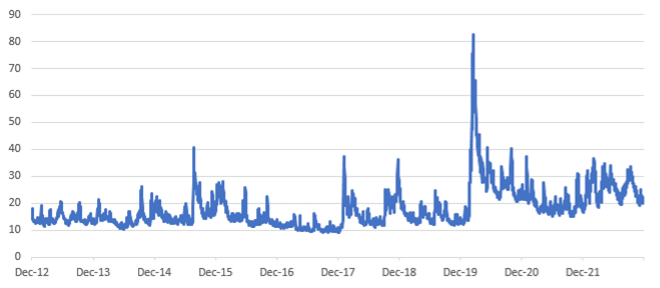
This year may not be as volatile, but I doubt calm waters lay ahead for the rest of 2023.
The effect of large monetary policy tightening is still to be felt.
Inflation has proved to be more persistent than expected. Labour markets continue to surprise globally with their recent strength.
In this environment why lock up liquidity in a term deposit?
The marginal return is not that different to highly liquid funds and TDs can only be broken in extreme circumstances – none of which anyone wants to experience.
Higher liquidity is something that should be increasingly valued in the year ahead.
TDs? No, no, no.
About Steve Campbell and Pendal’s Income and Fixed Interest team
Steve Campbell is Pendal’s head of cash strategies. With a background in cash and dealing, Steve brings more than 20 years of financial markets experience to our institutional managed cash portfolio.
Find out more about Pendal’s cash funds:
Short Term Income Securities Fund
Pendal Stable Cash Plus Fund
Pendal Managed Cash Fund
Pendal’s Income and Fixed Interest boutique is one of the most experienced and well-regarded fixed income teams in Australia.
The RBA today tightened monetary policy by another 25 basis points, with the promise of more to come. Pendal’s STEVE CAMPBELL explains what it means for investors
THOSE looking for the Reserve Bank to provide some respite from higher rates will be left disappointed after today’s decision and hawkish accompanying statement.
The RBA tightened monetary policy by a further 25 basis points to 3.35%, with the promise of more to come.
Ahead of updated economic forecasts later this week, the RBA today revealed some of its projections including:
- Headline inflation falling to 4.75% in 2023 and 3% by mid-2025
- Economic growth dropping to 1.5% over 2023 and 2024. The post-Covid spending spree that benefitted growth in 2022 has run its course, buffers have been drawn down and economic growth will suffer
- Unemployment forecast to increase to 3.75% by the end of 2023 and 4.5% by mid-2025. The labour market remains tight, though there are signs these pressures are easing slightly
The statement concluded with: “The Board expects that further increases in interest rates will be needed over the months ahead…
“…In assessing how much further interest rates need to increase, the Board will be paying close attention to developments in the global economy, trends in household spending and the outlook for inflation and the labour market.
“The Board remains resolute in its determination to return inflation to target and will do what is necessary to achieve that.”
The December-quarter inflation data released in late January exceeded the RBA’s expectations and clearly has it concerned.
The market now has a follow-up hike of 25 basis points priced in at around 70% probability and a full hike priced in for April.
The terminal cash rate is now priced at almost 4% later this year.
Inflation remains the priority
The market had been looking for a softer statement, perhaps following the lead of other central banks recently.
Two weeks ago The Bank of Canada explicitly stated it would pause on policy action as it assessed “the impact of the cumulative interest rate increases”.
The European Central Bank and Bank of England both tightened policy by 50 basis points, but delivered statements that saw yields rally further out the curve.
In the US, the Federal Reserve delivered a 25 basis point hike. The market priced the terminal peak as almost reached — until the “wow” non-farm payroll number and better-than-expected ISM services data released last Friday.
Find out about
Pendal’s
cash funds
The RBA is more than aware of the risks posed by the fixed rate mortgage cliff from the middle of the year.
But inflation remains its priority in the near term. Until it heads south they will be on tenterhooks.
The lack of a monthly inflation data series with a long history does the RBA no favours.
The next quarterly inflation release is not due til late April.
The next key releases in February are the labour and wage price index data due on the 16th and 22nd.
Consumption data from retail sales — along with consumer confidence — will also be closely watched.
What it means for investors
With higher yields and steeper curves in the short end of the curve, investors will benefit from their cash portfolios returning closer to 4% in the coming months.
I keep getting questions about investing in term deposits.
Why do this in a rising interest rate environment — in a period where volatility is elevated?
Cash funds offer comparable returns but provide liquidity. It can be quicker to sell a house and get your money rather than waiting for a term deposit to mature.
About Steve Campbell and Pendal’s Income and Fixed Interest team
Steve Campbell is Pendal’s head of cash strategies. With a background in cash and dealing, Steve brings more than 20 years of financial markets experience to our institutional managed cash portfolio.
Find out more about Pendal’s cash funds:
Short Term Income Securities Fund
Pendal Stable Cash Plus Fund
Pendal Managed Cash Fund
Pendal’s Income and Fixed Interest boutique is one of the most experienced and well-regarded fixed income teams in Australia.
If the US falls into recession, investors should be ready to buy falling equities and take advantage of higher bond yields, says Pendal’s head of multi-asset MICHAEL BLAYNEY
- US economy likely to fall into recession
- Investors should be ready for opportunities
- Find out about Pendal’s multi-asset funds
IT’S probable the US Fed’s rate hikes will push the world’s biggest economy into recession this year.
“Some of the forward-looking indicators in the US like the ISM’s Purchasing Managers Index are showing signs of weakness,” says Blayney.
“There have also been some broker earnings downgrades, though history tells us that the more significant downgrades tend to happen after the event.
“Overall, this has been one of the most forecast US recessions ever.”
How should investors respond?
How to invest in a recession
Sticking to a long-term strategy is critical, Blayney says, though at the edges there is room to move.
That means holding a little more cash than usual, he says.
Find out about
Pendal Multi-Asset Funds
“At this point it pays to be a little cautious, so we are a little underweight US equities.
“Last year the most important thing was to be underweight both bonds and equities in aggregate.
“At present we prefer taking relative value positions since markets are much less expensive than they were, effectively pricing in some of the bad news.
“While we are underweight the US, we maintain overweights to some of the cheaper, more ‘value’ equity markets like Australia and the UK.”
Investors should have some “dry powder” ready to use if valuations fall as a result of a recession, Blayney says.
“If the US goes through a recession and earnings are hit and markets fall, there will be an opportunity to buy equities. Markets do tend to over-react – both when times are good and when times are bad.”
Bonds look reasonable
Bond yields are now at “reasonable” levels, Blayney says.
The critical point is when the US Fed stops lifting interest rates, and potentially changes course and starts cutting.
Adviser Sam is invested
in making our world
A better place.
Watch as Sam meets a
mum rebuilding her life
thanks to responsible
investing
“If there is a recession, having some bonds in a portfolio will be a good thing because the Fed will have to step back from lifting rates.
“But it’s likely the Fed will want to make sure inflation is beaten before moving to cut rates.”
“In terms of momentum, the trend has been against bonds even if their valuations are now okay.
“But the cycle is turning a little bit towards government bonds in the sense that the economy is weakening.
“We are still slightly underweight, but I think government bonds are now reasonable value.
“If you look at corporate bonds, they got a bit cheaper last year.
“But credit spreads have come in as equity markets have risen. So compared to government bonds, corporate bonds are not offering great regward for risk if there’s a recession on the way.”
It’s not about forecasting recession
Good portfolio construction is not necessarily about trying to forecast recessions, Blayney says.
“It’s about maintaining balance, having a long-term strategy, at times dialling down the risk, and at other times dialling up the risk.”

Why bonds, why now
Ausbiz’s Nadine Blayney interviews CBA chief economist Stephen Halmarick and Pendal head of bonds Tim Hext
ON-DEMAND WEBINAR
About Pendal’s multi-asset capabilities
Pendal’s diversified funds provide investors with a variety of traditional and alternative asset classes and strategies.
These include Australian and international shares, property securities, fixed interest, cash investments and alternatives.
In March 2024, Perpetual Group brought together the Pendal and Perpetual multi-asset teams under the leadership of Michael O’Dea.
The newly expanded nine-strong team will manage more than $6 billion in AUM and create a platform with the scale and resources to deliver leading multi-asset solutions for clients.
Michael is a highly experienced investor with more than 23 years industry experience, including almost a decade leading the team at Perpetual.
Inflation data due in January will set the scene for another rate hike in February. But from there the pace should slow, says Pendal’s head of cash strategies STEVE CAMPBELL
THIS week’s 25-point rate rise probably won’t be the last — but the Reserve Bank’s pace of tightening is likely to move from monthly to quarterly increments next year.
The cash rate will now sit at 3.1% for the summer. The RBA’s next monetary policy statement is due on February 10.
Between now and then we will see fourth quarter inflation data released on January 25.
It will be high. The annual headline inflation rate will be around 8% for 2022.
This will set the case for another hike in February.
Tuesday’s RBA statement contained nothing new. The central bank remains data dependent while the global outlook has deteriorated.
Domestically the labour market remains tight. Economic growth has been strong and household spending will start to slow due to policy tightening delivered so far.
For some this is yet to occur, given the higher-than-usual number of fixed-rate mortgages that are yet to reset.
This is the reason why the RBA doesn’t need to be as aggressive. Fixed-rate mortgages at rates around 2% will be resetting closer to 5.5% mid next year.
The RBA acknowledges they are walking a tight rope.
Find out about
Pendal’s
cash funds
“The path to achieving the needed decline in inflation and achieving a soft landing for the economy remains a narrow one.”
The further they push policy, the harder the landing becomes.
The RBA doesn’t want to cause a recession. But given a choice of embedded higher-inflation expectations or better growth, the former wins out for any central banker.
The longer-term task is no simpler.
Policy action to date “has been necessary to ensure that the current period of high inflation is only temporary”, the RBA statement said. “High inflation damages our economy and makes life more difficult for people.”
In a speech late last month RBA governor Phil Lowe pointed out that variability in inflation outcomes was more likely to increase than what we’ve become accustomed to.
He cited four key areas where supply issues in the longer term will occur:
- Reversal of globalisation
- Demographics
- Climate change
- The energy transition in the global economy.
The RBA has under-shot or over-shot its 2-3% target band more often than not over the past 15 years.
More variability in inflation outcomes? Who would want to be a central banker.
Central banks have tightened policy significantly over 2022 — and that will weigh on demand over 2023.
The current Christmas spendathon — where we are let loose for the first Christmas in three years — will hold activity up for now. But it’s unlikely continue into the new year hangover.
The supply side of the global economy is also likely to see capacity increase and downward inflationary pressure next year.
The supply issues that have resulted from the pandemic and Russia’s invasion of Ukraine will resolve over time.
But with it comes another set of challenges. And those are more likely to be skewed towards higher inflationary pressure in the longer term.
About Steve Campbell and Pendal’s Income and Fixed Interest team
Steve Campbell is Pendal’s head of cash strategies. With a background in cash and dealing, Steve brings more than 20 years of financial markets experience to our institutional managed cash portfolio.
Find out more about Pendal’s cash funds:
Short Term Income Securities Fund
Pendal Stable Cash Plus Fund
Pendal Managed Cash Fund
Pendal’s Income and Fixed Interest boutique is one of the most experienced and well-regarded fixed income teams in Australia.
An annual strategic asset allocation review has led Pendal’s multi-asset team to make some recent adjustments to portfolios. Pendal’s ALAN POLLEY explains
- Strategic asset allocation process takes a long-term view
- Key factors are renewable energy, higher inflation and geo-political risk
- Find out about Pendal’s multi asset funds
THE build-out of renewable energy infrastructure, persistent higher inflation and geo-political risk will characterise investment markets in coming years.
But the threat of low returns related to zero interest rates is in the past as central banks revert monetary policy to more normal levels.
These are some of the findings from an annual strategic asset allocation review by Pendal’s multi-asset team.
“The strategic asset allocation process is where you forget about the day-to-day noise and think about the long term,” says Alan Polley (pictured below), a portfolio manager with the team.
“Investing, by definition, is long term. But we all get caught up in short-term, random happenings that tend to get averaged out over the long term.
“The strategic asset allocation process is that annual time to think about the long-term investment views, how you’re thinking about markets and asset classes and how to get the best outcome for your investors over their investment time horizon.”
Six major, long-term themes
Polley says six secular themes will likely characterise investment markets in coming years:
- The ongoing importance of ESG themes (from a risk and opportunities perspective)
- Better productivity
- Ageing demographics
- High debt and deleveraging
- Enhanced geo-political risk
- Higher inflation and spike risk
“One of the secular themes we have dropped this year is the risk of a low-return world.
Find out about
Pendal
Multi-Asset
Funds
“For the past decade everyone’s been talking about expected investment returns being low.
“The main reason was because central banks had pushed down real rates to negative and market valuations to stretched levels.
“But that’s normalised. Cash and real rates are at reasonable levels.
“And now that markets have sold off as well, forward-looking returns are looking pretty good — probably the best they have for a decade.”
The other risk that is no longer hanging over markets is the prospect of a shock from the withdrawal of easy monetary policy.
“It’s been difficult this calendar year, but rates normalisation has effectively occurred.”
Inflation risk remains
Remaining as a risk is inflation, which will be a theme investors have to deal with for some time, says Polley.
“Investors consume real assets and so they’re interested in real returns. Over the last decade you’ve had this tug of war between deflation and inflation.
“Inflation will be higher than it was in the last decade and central banks are more likely to achieve their inflation objectives (as opposed to undershooting them).
“But we also think there’s more chance of inflation spikes.”
Portfolio adjustments
Weighing up the themes has led the multi-asset team to make some adjustments to portfolios.
“We’re increasing our exposure to bonds. They are offering attractive yields and have material diversification benefits again.
“This will also help defend against a potentially more volatile long-term outlook with more geo-political risk and less-supportive central banks.
“Another change we’ve made is moving some capital into listed, sustainable listed investment companies. With the secular theme of higher inflation, you want more real assets.
“The way we’re looking to get that real asset exposure is via renewable and sustainable companies with underlying real assets.”
Emerging Markets risk
“The other major change is we’re reducing exposure to emerging markets. The emerging markets index has a very high exposure to China that’s increased materially over the years to circa 30 per cent.
“Taiwan is another 15 per cent in emerging markets — so if there’s conflict, that’s almost half of the emerging markets index at risk.”
“China also appears to be transitioning to more authoritarian and nationalistic policies at the expense of market-based reforms.
Compounded by increased global national security concerns and politically driven onshoring preferences, deglobalisation could reduce China’s global manufacturing dominance. “
About Alan Polley and Pendal’s Multi-Asset capabilities
Alan is a portfolio manager with Pendal’s multi-asset team.
He has extensive investment management and consulting experience. Prior to joining Pendal in 2017, Alan was a senior manager at TCorp with responsibility for developing TCorp’s strategic and dynamic asset allocation processes covering $80 billion in assets.
Alan holds a Masters of Quantitative Finance, Bachelor of Business (Finance) and Bachelor of Science (Applied Physics) from the University of Technology, Sydney and is a CFA Charterholder.
Pendal’s diversified funds provide investors with a variety of traditional and alternative asset classes and strategies.