
After the evolution of Coalition fiscal spending habits during the pandemic, Australia’s new Labor government won’t be a big change, says Pendal’s Anna Hong
ON THE economic front, Australians will be largely unaffected by the change of federal government — at least in the near term, says Pendal’s Anna Hong.
That’s because key economic policies between Australia’s two major parties are mostly aligned, says Hong, an assistant portfolio manager from Pendal’s Income and Fixed Interest team.
However, there will be an increase in fiscal spending by the Albanese government.
Labor will increase fiscal spending by a net $7.4 billion in areas such as home equity schemes and electric car discounts, as you can see in this table:
Labor’s Fiscal Plan
| Net Budget Impact | -$7.4bn | |
| Revenue + Savings | $11.5bn | |
| Spending | $18.9bn | |
| Key Spends | Childcare subsidies | $5.4bn |
| Aged care | $2.5bn | |
| Medicare | $0.75bn | |
| Electric car discount | $0.47bn | |
| Home equity scheme | $0.31bn |
“This will prop up demand without fixing the supply issues, nudging inflation higher,” says Hong. “It will make the RBA work harder to counter the loose fiscal policy.”
The federal budget will remain in deficit for the rest of the decade — under either party.
“The stumbling block to Labor’s policies may be in generating planned revenue and savings.
“Many items on their list — such as multinational tax revenue — are easy to promise but notoriously difficult to achieve.
“Overall, the change of government is more of the same for the economy and the budget.
“The difference will be in the changes many Australian voters are focused on – climate policy, federal integrity, and gender equity — as Pendal’s Rajinder Singh outlines here.
“Australians want action and will watch this space closely.”

Find out about
Pendal’s Income and Fixed Interest funds
About Anna Hong and Pendal’s Income and Fixed Interest team
Anna Hong is an assistant portfolio manager with Pendal’s Income and Fixed Interest team.
Pendal’s Income and Fixed Interest boutique is one of the most experienced and well-regarded fixed income teams in Australia. In 2020 the team won the Australian Fixed Interest category in the Zenith awards.
With the goal of building the most defensive line of funds in Australia, the team oversees A$22 billion invested across income, composite, pure alpha, global and Australian government strategies.
Find out more about Pendal’s fixed interest strategies here
About Pendal Group
Pendal is an independent, global investment management business focused on delivering superior investment returns for our clients through active management.
Has inflation peaked and if so, what’s next for fixed interest investors? Here’s a view from our head of government bond strategies TIM HEXT
AMONG the many adages I’ve heard in my career “sell in May and go away” always sticks in my mind.
The quote apparently originated in London and said in full: “sell in May and go away and come back on St Leger Day” (in September). The “go away” referred to very long summer holidays enjoyed by rich stockbrokers.
In the US equity market November-to-April outperforms May-to-November over time.
Going back more than a century the Dow’s average return is apparently 5.2% for November-to-April, compared to 2.1% for May-to-October.
In Australia the numbers are 5.1% and 2.4%. The term could be recoined as “buy in November and sit back”, but that wouldn’t rhyme.
The calm in the storm
This May has been the calm in the storm. But no one can agree if it’s the eye of the storm or if we’re actually through it.
Markets are clutching at any sign inflation has peaked.
In the US it likely has on both on a monthly and year-on-year basis — but will be slow to come down.
In Australia we are unlikely to see a repeat of the Q1 2.1% quarterly CPI number. But base effects mean annual inflation will peak closer to 6% (currently 5.1%) in Q3 (released in late October).

Find out about
Pendal’s Income and Fixed Interest funds
We have just finished a deep dive into inflation which we will release shortly as part of our Australian Investor Quarterly newsletter.
As the inflation narrative settles down, all eyes will turn to the impact of inflation and interest rates on growth.
Share markets remain vulnerable to earnings downgrades and weakening growth numbers.
This becomes reflexive, though, as equity weakness in turn causes confidence to fall which may eventually take some pressure off rising interest rates thereby supporting equities.
We may well spend the northern summer rolling around in this cycle of volatility, heading eventually nowhere as the dynamics try to work themselves out.
What it means for investors
As a fixed interest portfolio manager it means we must look to harvest more tactical trades than big-picture moves for the next few months.
We continue to think short-dated inflation bonds are cheap in outright real yields but also in break-evens (inflation expectations).
The picture for duration and credit is less clear though we do have some positions based on cash rates “only” getting to 2% this year as opposed to markets pricing closer to 2.75%.
With both bond markets and equity markets trashed in the last four months I will ignore the “sell in May and go away” advice as coming way too late — wishing someone had instead advised me this year to “Sell on New Years Day and go away.”
About Tim Hext and Pendal’s Income & Fixed Interest boutique
Tim Hext is a Pendal portfolio manager and head of government bond strategies in our Income and Fixed Interest team.
Tim has extensive experience in banking, financial markets and funding including senior positions with NSW Treasury Corporation (TCorp), Westpac Treasury, Commonwealth Bank of Australia, Deutsche Bank, Bain & Co and Swiss Bank Corporation.
Pendal’s Income and Fixed Interest boutique is one of the most experienced and well-regarded fixed income teams in Australia.
Find out more about Pendal’s fixed interest strategies here
About Pendal
Pendal is a global investment management business focused on delivering superior investment returns for our clients through active management.
In 2023, Pendal became part of Perpetual Limited (ASX:PPT), bringing together two of Australia’s most respected active asset management brands to create a global leader in multi-boutique asset management with autonomous, world-class investment capabilities and a growing leadership position in ESG.
Here are the main factors driving the ASX this week according to our head of equities Crispin Murray. Reported by portfolio specialist Chris Adams.
Find out about Crispin’s Pendal Focus Australian Share Fund
Find out about Crispin’s sustainable Pendal Horizon Fund
THE MARKET is at an interesting near-term juncture.
The S&P 500 has lost ground seven weeks in a row and is now off about 20% from its peak. It has re-tested and held recent lows.
Expiring options may reduce volatility and we may see some month-end rebalancing towards equities in a low-liquidity environment due to next Monday’s US Memorial Day holiday.
A near-term bounce may be possible and counter-trend moves can be material.
However we don’t think we’ve seen the low point for this cycle. The market is yet to work through the effect of a slowing economy on corporate earnings.
The S&P 500 fell 3% last week as the market continued to worry about the potential for recession.
This was compounded by some poor earnings results out of US retailers. The issue here was not weaker consumption, but the mix shift from goods to services and a rising cost impost.
This emphasises the market’s vulnerability should a slowdown occur and begin to affect earnings.
US 10-year government bond yields fell 14bp. The positive correlation between bonds and equities appears to have broken down as the focus moves to risk aversion and a flight to safety.
We also saw a fall in the US dollar. This was probably a consolidation after a big run. It helped commodities and resource stocks, as did more signs of Chinese easing.
Australia again remains the market for these times.
The S&P/ASX 300 was up 1.2% for the week. It’s down only 2.5% for the calendar year to date, versus -17.7% for the S&P 500 and -27.2% for the NASDAQ.
Two key issues driving the market
We see two primary issues driving the outlook for markets.
The first issue is whether the US economy slows down or slips into recession.
Looking at recent bear markets, a recession has tended to lead to bigger drawdowns – such as in 2000-2002 and 2007-2009.

Pendal Focus Australian Share Fund
Now rated at the highest level by Lonsec, Morningstar and Zenith
Current investor surveys indicate a 50-55% probability of recession.
This comes down to views on what the Fed sees as acceptable inflation and what they will need to do to achieve it. There are two scenarios here:
- The positive scenario: Financial conditions have tightened enough, the economy is already slowing, inflation pressures are beginning to ease and therefore bonds have peaked and aggressive monetary tightening (and therefore recession) will not occur. A variant of this view is that the Fed will live with inflation in the mid to high 2s — rather than go for 2% — to avoid pushing the economy into recession
- The negative scenario: The economy will prove more resilient to rising rates, with consumers bolstered by excess savings and the labour market remaining tight. This will force the Fed to do more tightening and ultimately “break” the economy to control inflation. Proponents point to unemployment of 3.5% needing to rise to around 4.25% to create sufficient slack to ensure wages don’t reinforce inflationary pressures. The US has never been able to engineer such a rise in unemployment without it being associated with a recession.
The second major issue is whether the Chinese economy deteriorates or sees a policy-driven rebound.
Again, there are two scenarios:
- The positive view: China is close to peak Covid lockdown and the combination of re-opening and additional infrastructure stimulus will trigger a recovery, generate good commodity demand, and underpin resource stocks.
- The negative scenario: The economy is in far worse shape than the market realises. Lower rates reflect the financial vulnerability of property developers, stimulus will be ineffective due to low confidence, high input costs and inability to execute due to Covid restrictions.
Economics and policy
There is a lot of debate about whether we have seen peak inflation and peak bond yields.
Official data such as retail sales is signalling that the consumer remains strong, though there are signs the economy is slowing. For example, the Economic Surprise index – which shows the degree to which economic data is beating or missing estimates – is deteriorating in most countries. Consumer confidence is also weak and is at 40-year lows in the UK.

Sustainable and
Responsible Investments
Fund Manager of the Year

The combined effects of higher mortgage rates and fuel prices have reached levels consistent with previous consumer slowdowns. This indicator tends to lead by around 12 months.
Total financial conditions – which includes rates, equities and credit spreads – have tightened to a reasonable degree and should lead to a headwind of 1.3% of US GDP growth by Q3 2022.
We are also seeing signs that corporate pricing power – while still at high levels – may be easing.
There are signs that consumers are under some stress – particularly at the lower income end – with credit outstanding rising rapidly. This may support current consumption but is unsustainable.
Freight shipping rates are beginning to drop and there are early signs of a fall in US trucking rates.
That said, the freight rate may be a misleading signal due to a drop-off in Chinese exports. It’s unclear how much of this is a genuine de-bottlenecking of supply chains.
All this indicates the economy is responding to tighter financial conditions. It is slowing down and this is beginning to reduce inflation pressures.
This belief can be seen in forward pricing of inflation, where both break even yields and the 5-year inflation swap have rolled over since late April.
This could be positive for the equity market since it’s in line with the first scenario outlined above.
However there are still two key unknowns:
- This slowing could be the prequel to a recession. A slow-down and a recession will look the same initially. It will also probably result in negative earnings revisions, which the market will not like as we saw last week in the US.
- The second unknown is whether this will equate to inflation falling enough to allow the Fed to declare victory.
Fed Chair Powell has stressed that the labour market is resilient enough to weather tightening policy.
While this sounds reassuring, the question is whether a resilient labour market is consistent with inflation falling to target levels. If it is not, policy needs to tighten even more.
The labour force is very tight and this is driving wage growth. Some measures suggest we need to see employment decline by at least 1% to reduce wage pressure.
China
Economic surveys indicate the Chinese economy is weak. Q2 GDP is expected to decline 1.5% to 2%, with growth for the year coming in between 3% and 4%.
Beijing has responded with a larger-than-expected cut in its 5-year loan prime rate.
China bears see this as a move to prop up private developers who are facing a funding squeeze, thereby preventing deterioration rather than providing stimulus.
The more bullish view is that while this may not be a sizeable move, it is a very strong signal that the government will support property, similar to November 2014. Then it was the precursor to a big bounce in Chinese growth sentiment in 2015.
We remain cautious on a China recovery.
The property market appears to be deflating, but prices remain very high and developers are still too leveraged. At best the market stays flat, but the risk is to the downside, so any infrastructure related stimulus will only be offsetting this.
The other challenge is the lack of transparency over the extent of Covid and the real level of restrictions.
Europe
The ECB struck a more hawkish tone in response to poor inflation data. The market is now being primed for a first rate rise in July, with a possible 50bp move straight up. This is unlikely, but helped the Euro bounce off its lows against the US dollar.
Australia
There is little to read into the election outcome at this point. A majority government provides more clarity than a minority.
We are also likely to see more emphasis on reducing carbon emissions in coming years, which will have an impact on corporate disclosures and investment.
US earnings
Overall quarterly earnings were good. Full-year earnings lifted from about 5% to 11% growth.
However the outlook looks overly optimistic, with 9% eps growth expected in CY23 despite a slowdown.
Last week demonstrated the impact earnings headwinds can have. Broadline retailers missed earnings expectations as a result of freight costs and the mix shift in consumption.
Walmart and Target have joined Amazon in highlighting material gross margin pressure.
Underlying sales have not been particularly disappointing. But the impact of the unexpected mix shift caused problems as spending moved away from home, consumer electronics and sporting goods to travel, toys and luxury goods.
Inventories are also building in areas such as home furnishings and consumer electronics, while unit demand growth is dropping. This crimps a company’s ability to push through price rises.
The share of “private label” sales are rising. This is partly due to improved product availability as labour issues improve. It may also indicate consumers are “trading down” as real income falls – potentially a signal of softer consumption.
The overall impact were large hits to stocks in the previously defensive consumer staples sector.
This highlights the difficulty in identifying defensive pockets in this environment
Markets
We may be seeing a near-term low in the US equity market.
Historically, bear market bounces average a 15% gain over 30-40 days.
This does not signal the market has hit its lows for the cycle. Most technical signals have not indicated a degree of panic or capitulation. For example put/call ratio data has not yet moved into 99th percentile level – a usual indicator of capitulation. Nor have we seen high volumes in stocks being sold down.
Retail investors are yet to give up on the bull market.
The triple-leveraged NASDAQ ETF is still seeing large net inflows – despite being down over 60% year-to-date. Interestingly energy-related ETFs – among the best performing year to date – are seeing negligible inflows by comparison.
The high proportion of “buy” ratings on the market leaders of the past few years is another sign that we are yet to see capitulation.
We see scope for short, sharp bear-market rallies, but remain defensively positioned overall. We don’t believe it is yet the time to reload on high beta, illiquid names.
The Australian market last week saw a good bounce in the resource sector (+3.8%) on China optimism. The Technology (+5%) sector bounced as Xero’s management clarified a post-result message and emphasised confidence in improved margins and cash flow over time. Consumer staples (-3.3%) lagged, following the US lead.
About Crispin Murray and Pendal Focus Australian Share Fund
Crispin Murray is Pendal’s Head of Equities. He has more than 27 years of investment experience and leads one of the largest equities teams in Australia. Crispin’s Pendal Focus Australian Share Fund has beaten the benchmark in 12 years of its 16-year history (after fees), across a range of market conditions.
Pendal is an independent, global investment management business focused on delivering superior investment returns for our clients through active management.
The latest wages data shows surprisingly modest growth in some sectors. But wages are the ultimate lagging indicator and that will soon change, says our head of government bond strategies TIM HEXT
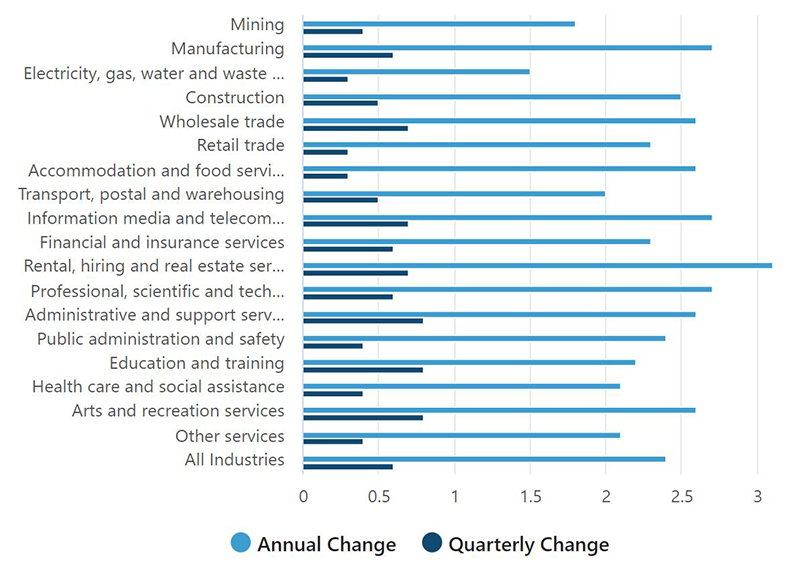
DESPITE increasing anecdotal evidence of rising wages, the latest data shows the price of labour grew a modest 0.7% in the March quarter.
Over the year wage growth was 2.4%, according to the Wage Price Index (WPI) released yesterday.
Only one sector nudged over 3% annually and none grew at or near 1% for the quarter.
In some areas this was not surprising. But in industries such as construction and retail trade this flies in the face of worker shortages.
This will change, since we’ve really only fully opened up this year.
Wages are the ultimate lagging indicator — and patience is required.
Annual and quarterly changes, WPI Mar 2022 (total hourly rates of pay excluding bonuses, per industry):
Earlier this year the Reserve Bank had WPI front and centre when trying to ignore rising inflation and pressure to raise rates.
Unless we got strong wage growth, inflation would eventually come back, the RBA said.
But in May — as they threw in the towel and hiked rates — the RBA referenced broader measures of wages:
“The outlook for broader measures of labour costs had also been revised up; average earnings were expected to increase at a faster pace than the WPI, as firms turned to bonuses, allowances and other measures to attract and retain workers,” the RBA said in its May board minutes.
They also highlighted the great inertia of wage growth:
“While the inertia arising from multi-year enterprise agreements and current public sector wages policies would continue to weigh on aggregate wages growth in the near term, a period of faster growth in labour costs overall was in prospect.”
The main battleground this year will be public sector agreements across the big employment areas of health, education and transport.
Find out about
Pendal’s Income and Fixed Interest funds
The public sector employs around 20% of the workforce. These are state government responsibilities and for now at least the governments largely have a 2.5% wage cap.
However unions quite rightly point out that a 5% inflation rate is seeing real wages fall. With staff shortages in key areas they are in a good position to extract wage rises closer to 5% than 2.5%.
Maybe for teachers and nurses they can offer 2.5% and a “thank you” bonus of 2% for their efforts through Covid, keeping their policy “intact”.
The RBA expect the WPI to hit 3% by year end and 3.5% by the end of 2023.
Chances are we hit these levels sooner.
Let’s remember this is a good thing overall. It does however add to the narrative that inflation will struggle to fall back to target anytime in the next few years.
What it means for fixed interest investors
Investors should still be looking to inflation bonds ahead of nominal bonds.
In our portfolios we have been adding inflation risk, which has cheapened up in May.
Inflation will moderate next year but levels above 3% look like being more entrenched over the next two to three years, helped by wages eventually nearing 4% growth.
About Tim Hext and Pendal’s Income & Fixed Interest boutique
Tim Hext is a Pendal portfolio manager and head of government bond strategies in our Income and Fixed Interest team.
Tim has extensive experience in banking, financial markets and funding including senior positions with NSW Treasury Corporation (TCorp), Westpac Treasury, Commonwealth Bank of Australia, Deutsche Bank, Bain & Co and Swiss Bank Corporation.
Pendal’s Income and Fixed Interest boutique is one of the most experienced and well-regarded fixed income teams in Australia.
Find out more about Pendal’s fixed interest strategies here
About Pendal
Pendal is a global investment management business focused on delivering superior investment returns for our clients through active management.
In 2023, Pendal became part of Perpetual Limited (ASX:PPT), bringing together two of Australia’s most respected active asset management brands to create a global leader in multi-boutique asset management with autonomous, world-class investment capabilities and a growing leadership position in ESG.
Where are the opportunities emerging in fixed interest? Here are the latest insights from Pendal’s head of government bond strategies TIM HEXT
SO FAR 2022 has been an extraordinary year for markets.
This past week was perhaps the first where you could draw breath.
I am normally hesitant to forecast too far ahead given elevated uncertainties. “Conviction” is generally a positive word, but at times like this the negative simile of “entrenched” can be dangerous.
So let’s summarise where we are up to (at end of Monday, May 16):
| Data point | Market Pricing |
| Cash rates — Dec 2022 | 2.7% |
| Cash rates — Dec 2023 | 3.6% |
| 3-year govt bond | 2.83% |
| 10-year govt bond | 3.38% |
| 5-year inflation break-even (implied inflation) | 2.55% |
| 10-year inflation break-even | 2.35% |
Several things stand out in the above numbers.
Find out about
Pendal’s Income and Fixed Interest funds
First and most importantly the RBA is tightening because inflation is now well above its target band — and likely to stay there until mid-2024.
Below are our best guesses for the headline inflation rates going forward. They are conservative and risks are probably to the upside.
| Period | Estimate Quarterly Headline CPI | Estimated Annual Headline CPI |
| Current (Q1 2022) | 2.1% (actual) | 5.1% (actual) |
| Q2 2022 | 1.2% | 5.6% |
| Q3 2022 | 1.1% | 5.7% |
| Q4 2022 | 1.3% | 5.7% |
| Q1 2023 | 0.9% | 4.5% |
| Q2 2023 | 0.8% | 4.1% |
| Q3 2023 | 0.8% | 3.8% |
| Q4 2023 | 0.7% | 3.2% |
The fuel excise relief pushes Q2 2022 down 0.4%. But Q4 2022 gains back 0.4% when the full-rate duty returns (if indeed it ever does).
Clearly forecasting inflation over a year out involves some guesswork.
We assume goods prices moderate with some supply chain easing but service prices continue to rise above target with wages and strong employment.
When we look at the two tables above, the most glaring mispricing or opportunity is in 5-year inflation bonds.
Current breakeven pricing — ie the inflation rate that would make you neutral about owning them versus nominal bonds — is near the RBA target of 2.5%.
However for at least the next two years CPI is averaging close to 4.5%.
Unless you think inflation in the following three years will be around 1%, this is just wrong. And we haven’t even included the extra carry from owning these bonds.
A brief lull in inflation concerns has seen these 5-year inflation bonds cheapen and we have been adding them to our nominal portfolios.
Market expectations
As for market expectations on cash rates, like most observers I think they are a bit too high.
I think they will get to 2% this year, not 2.7%.
By mid next year inflation should be moderating, so it’s unlikely they will need to push above 3%.
Needless to say the mortgage fixed-rate cliff and variable rates 3% higher should be enough to drop the economy down a few gears. We get wage and employment data in the days ahead which will again recalibrate expectations.
About Tim Hext and Pendal’s Income & Fixed Interest boutique
Tim Hext is a Pendal portfolio manager and head of government bond strategies in our Income and Fixed Interest team.
Tim has extensive experience in banking, financial markets and funding including senior positions with NSW Treasury Corporation (TCorp), Westpac Treasury, Commonwealth Bank of Australia, Deutsche Bank, Bain & Co and Swiss Bank Corporation.
Pendal’s Income and Fixed Interest boutique is one of the most experienced and well-regarded fixed income teams in Australia.
Find out more about Pendal’s fixed interest strategies here
About Pendal
Pendal is a global investment management business focused on delivering superior investment returns for our clients through active management.
In 2023, Pendal became part of Perpetual Limited (ASX:PPT), bringing together two of Australia’s most respected active asset management brands to create a global leader in multi-boutique asset management with autonomous, world-class investment capabilities and a growing leadership position in ESG.
Here are the main factors driving the ASX this week according to portfolio manager Jim Taylor. Reported by portfolio specialist Chris Adams
WE SAW more of the same last week in terms of the market’s thematic drivers.
Inflation persists, the Ukraine conflict grinds on, Chinese lockdowns remain in place, parts of the crypto space are unwinding and global growth is slowing.
Market participants remain on edge as a result. The US inflation print didn’t serve as a circuit breaker. The headline number declined, but less than expected.
The S&P 500 fell 2.35% and the NASDAQ lost 2.77%. The S&P/ASX 300 was off 1.73%. The week’s falls were softened by a strong rebound on Friday.
Commodity prices have given up recent gains. Mega cap growth names in the US have also rolled over, now adding to index weakness now rather than holding things up.
The withdrawal of liquidity is making itself felt in speculative, profitless business models. Last week this manifested in the crypto market.
While details, exposures and implications are likely to be revealed in coming weeks, the issue is the potential for any second-order impact on the broader system.
US Treasury Secretary Janet Yellen said it did not count as “a real threat to financial stability”, but this needs to be watched.
The quarterly reporting season in the US shows consensus annual earnings for the S&P 500 remain intact for FY22 and FY23.
That said, the market has become a bit narrower in this regard, with energy doing a lot of the heavy lifting.
Find out about
Pendal Focus
Australian Share Fund
Crispin Murray,
Head of Equities
It is also notable that on the back of this reporting season, corporate activity in buybacks and capex spending is up strongly for the US.
Fed policy
The Fed continued to reinforce the expectations of a series of 50 bp hikes.
Fed Governor Powell said tackling inflation would “include some pain” as the impact of higher interest rates was felt — but that was preferable to prices continuing to rise.
The Fed was “prepared to do more” if data turned the wrong way, he added.
That said, Altanta Fed President Bostic noted that a 75bp hike was still a low probability outcome. There were signs of improvement in a number of supply chain issues, he said.
For example, trucking companies are no longer turning down business and shipping bottlenecks are easing. He sees as yet unrealised downside risks to demand from the squeeze on finances.
US Inflation
The inflation rate fell, but not as far as some hoped.
The April CPI measure rose 0.3% month-on-month, ahead of the 0.2% consensus. Core CPI (excluding food and energy) rose 0.6% month-on-month versus 0.4% expected.
Headline inflation fell from 8.5% to 8.3% and core from 6.5% to 6.2%, helped by base effects.
While we have passed the peak, price growth remains very elevated and consumer expectations conflating “peak inflation” with falling prices may cause some consternation.
Overall, it was a disappointing set of numbers, with core elements of inflation proving to be sticky.
Some details worth considering:
Used vehicle prices fell only 0.4% and new car prices rose by 1.1%.
Rents rose 0.5% and are proving very resilient.
Plane tickets rose 19%, reflecting booming demand and airlines successfully passing through fuel price increases.
Overall the number of CPI components seeing price growth remains very broad by historical standards. While inflation is starting to decline in some goods, it is just starting to pick up in services.
This is feeding through to measures of consumer sentiment, which have ticked down.
The petrol price, which is important to consumer hip pockets and inflation prints, continues to remain very high.
There are some signs of pressure in the labour market easing, with the initial unemployment claims 4-week average climbing 22,000 to 193,000 over the last month.
The EVRISI Trucking survey, historically a good measure of economic pulse, also continues to track down, which suggests softer economic growth.
Australia
At this point the implied path of rate rises in Australia is similar to the US — despite our goods and wages inflation being nowhere near the US experience.
Sustainable and
Responsible Investments
Fund Manager of the Year
We are seeing private sector wage growth come through in Australia, but it is well below the US and is expected to peak at 3.7% in 2024.
We are keeping an eye on the New Zealand economy, where rate increases have led to falls in house prices. The question is whether this causes an air pocket in consumer spending at some stage in the remainder of 2022.
Markets
We saw significant dislocation in crypto markets as stable coin TerraUSD, with US$18 billion of value, lost its peg to the dollar. The events that precipitated the crash appear to be analogous to a traditional bank run in the non-digital world, coupled with a good old-fashioned short squeeze.
Sentiment wasn’t helped when crypto exchange Coinbase quarterly reported a loss of US$430 million, citing 20% fall in monthly transacting users.
Elsewhere, commodity price falls on the back of further China lockdowns and increased prospects for a European recession saw resource stocks giving back a lot of the recent gains.
Value continues to win out over growth. The mega cap tech names in the US are at last reflecting the pain felt elsewhere across the market.
The bond market stabilised and is no longer going down in lockstep with equities. US 10-year government bond yields fell 21bps. The Australian equivalent fell 7 bps.
The Australian equity market held up better, but less so than in past weeks as the resource sector saw some pressure.
Weakness across the technology, lithium, gold, base metals and REITs sectors contrasted to financial strength on the back of some recent results.
About Jim Taylor and Pendal Focus Australian Share Fund
Drawing on more than 25 years of experience investing in top-performing Australian companies and a background in accounting, Jim manages our Long/Short Fund and co-manages our Imputation Fund. He is a Chartered Accountant with membership of the Australian Institute of Chartered Accountants.
Pendal Focus Australian Share Fund is managed by Crispin Murray. The fund has beaten its benchmark in 14 years of its 18-year history (after fees), across a range of market conditions. Find out more about Pendal Focus Australian Share Fund here.
Pendal is an independent, global investment management business focused on delivering superior investment returns for our clients through active management.
How can responsible investors tell if a company has a robust plan for dealing with climate change? Regnan’s head of research ALISON GEORGE offers a four-point checklist
- Investors need comfort that companies have robust climate action plans
- Regnan has a four-step checklist for analysis
- Find out more about sustainable investing leader Regnan
HOW can you tell if a company has a robust plan for dealing with climate change?
It’s a complicated question, says Alison George, head of research at sustainable investing leader Regnan.
But it’s important that investors have confidence that company climate action plans are appropriate and on track.
“Investors need to have confidence that climate risks are being managed well by the companies in their portfolios,” says George.
“And it is increasingly being brought to the fore in AGM season with an increase in shareholder resolutions and now the introduction of formal ‘Say on Climate’ votes initiated by companies themselves.”
The ‘Say on Climate’ initiative calls on companies to hold an annual vote on their emissions reduction progress. Regnan provides its clients with specific voting recommendations for ASX-listed companies on their climate-related activities.
George says it’s important to be aware that climate expectations vary between companies — some sectors need to move faster, given that there are technological barriers that will make it more difficult for other sectors to decarbonise.
Sustainable and
Responsible Investments
Fund Manager of the Year
But she says a broad four step approach can help investors and companies alike understand if plans are on track
1. Is the plan credible?
The first step is assessing whether a plan is credible.
This includes ensuring it comprehensively covers the most material issues for the company and is clearly disclosed with credible and current sources for the analysis undertaken.
But it also means the plan should show evidence of broader considerations of the impact of the transition to net zero, including on the capabilities of the workforce and impacts on the wider community.
2. Is it ambitious?
An ambitious plan shows clear, comprehensive targets in the short, medium and long term on all material aspects of climate change, including emissions in an organisation’s value chain and physical risks to the business of a changing climate.
Ambition should be judged within the context of the sector and with an understanding of the magnitude of the task ahead.
This recognises that some decarbonisation pathways are not yet fully known, so where they are it is reasonable to expect that net zero be achieved ahead of 2050.
3. Is it real?
It is all very well to have a plan, but it must also be activated in the real world.
This means that it must be backed by sufficient resourcing and capability, appropriate organisational structure, capex plans and effective board oversight.
But it also means the company has provided evidence of progress to date and shown that its climate plan is embedded in governance and risk processes and has informed strategy development and decision making.
This also covers companies that aim to achieve emissions reductions through divestment.
The key question becomes whether overall reductions can be achieved or reasonably expected from the divestment? Or are the emissions simply being moved elsewhere.
4. Is the company acting against change?
Finally, and most critically, look for evidence that a company is not merely paying lip-service to climate action while actually lobbying against change.

Find out about
Regnan Global Equity Impact Solutions Fund
Policy is crucial to drive meaningful climate action and there is a risk that companies may undertake activities aimed at swaying public sentiment and policy outcomes.
“This is a pre-eminent question,” she says.
“For those companies where there may be a vested interest in the status quo, voting deliberations should be especially attentive to this area as a threshold requirement for endorsement of the plan.”
Regnan says it expects to see evidence that the company is not involved in activities or lobbying that would delay decarbonisation efforts. It also seeks transparent reporting of positions and evidence of effective and ongoing board governance over this issue.
The upshot?
George says a company that passes all four of these tests is likely to have a solid climate action plan.
About Alison George
Alison George is Regnan’s head of research. She has deep experience in ESG, responsible investment and active ownership. Alison oversees Regnan’s research frameworks, processes and outputs, ensuring it remains at the forefront of industry practice and meets evolving clients needs.
About Regnan
Regnan is a responsible investment leader with a long and proud history of providing insight and advice to investors with an interest in long-term, broad-based or values-aligned performance.
Building on that expertise, in 2019 Regnan expanded into responsible investment funds management, backed by the considerable resources of Perpetual Group.
The Regnan Global Equity Impact Solutions Fund invests in mission-driven companies we believe are well placed to solve the world’s biggest problems.
The Regnan Credit Impact Trust (available in Australia only) invests in cash, fixed and floating rate securities where the proceeds create positive environmental and social change. Both funds are distributed by Perpetual Group in Australia.
Find out about Regnan Global Equity Impact Solutions Fund
Find out about Regnan Credit Impact Trust
For more information on these and other responsible investing strategies, contact Head of Regnan and Responsible Investment Distribution Jeremy Dean at jeremy.dean@regnan.com.
A monthly insight from James Syme and Paul Wimborne, managers of Pendal’s Global Emerging Markets Opportunities Fund
INFLATION has continued to push higher in developed and emerging economies.
It certainly does not look transitory. There is a definite sense that central banks are behind the curve, which has caused significant declines in risk assets globally.
However higher global interest rates are not necessarily a negative for Emerging markets (EM) equity as an asset class.
US headline consumer price inflation in the year to March was 8.5%, a level previously seen in 1981 (when the Federal Reserve’s policy interest rate was 12%).
As the Fed slowly moves to tighten monetary policy, bonds have reacted. The 10-year UST has risen from 1.5% at the start of the year to 3.1% at the time of writing.
About three quarters of the increase is from higher real interest rates and only a quarter from higher inflation expectations.
Other developed market central banks are also slowly tightening in the face of rampant inflation data.
The Bank of England last week accepted that inflation was likely to reach double digits later this year — a level not seen in 40 years.

Find out about
Pendal Global Emerging Markets Opportunities Fund
Emerging markets are largely countries that are dependent on capital flows.
Domestic demand economies (such as India and Turkey) require capital inflows to finance their current account deficits.
Export economies (such as Korea and Taiwan) are exposed to EM capital flows through their partial dependence on end demand from emerging markets (eg Korean companies selling to Latin American consumers); international financing of corporate borrowing in export economies (eg Brazilian companies borrowing in US dollars); and portfolio flows generally into emerging markets.
The US effect
When we talk about capital flows, we mean US dollar capital flows.
As Bank of England governor Mark Carney noted in 2019, the dollar represents the currency of choice for at least half of international trade invoices. That’s about five times greater than the US’s share in world goods imports and three times its share in world exports.
This gives the US dollar a massively outsized role in the global economy.
Carney said: “Given the widespread dominance of the dollar in cross-border claims, it is not surprising that developments in the US economy, by affecting the dollar exchange rate, can have large spill-over effects to the rest of the world via asset markets… The global financial cycle is a dollar cycle.”
A tightening of US monetary policy can have a drag on emerging economies and markets.
In the 1990s the US rate-hiking cycle began in April 1994 and finished in February 1995, which marked the end of the rally in EM equity.
This was a time, however, of fixed exchange rates. That accelerated the transmission of US monetary policy into emerging economies and is a poor analogue for today’s global financial system.
In the 2000s, with floating exchange rates in most of the emerging world, the Fed’s first hike was June 2004 and the last was June 2006.
Sustainable and
Responsible Investments
Fund Manager of the Year
EM equities (as measured by the MSCI EM Index) peaked in October 2007, having returned more than 230 per cent in USD terms from that first hike.
This strong performance was supported by the global economy which remained strong, with consequent support for the main exports of emerging economies.
In that cycle — from the first rate hike to the cyclical peak — commodity prices (as measured by the S&P GSCI Index) trebled, while Korean exports doubled.
The economic cyclical sensitivity of emerging market equities substantially outweighs their sensitivity to risk-free rates.
The view from here
The current cycle does resemble the 2002-07 cycle in some ways, with very strong commodity prices and many key emerging economies recovering from extended downturns.
The pattern of overlooking traditional industries in favour of high-tech business is another similarity.
There are also differences — for example the strength of the Chinese economy in the 2000s and its weakness now. Overall, though, it’s important to remember that in the last extended EM bull market the Fed hiked 17 times — from 1% to 5.25% — without stopping the strong returns from EM equity as an asset class.
About Pendal Global Emerging Markets Opportunities Fund
James Syme and Paul Wimborne are senior portfolio managers and co-managers of Pendal’s Global Emerging Markets Opportunities Fund.
The fund aims to add value through a combination of country allocation and individual stock selection.
The country allocation process is based on analysis of a country’s economic growth, monetary policy, market liquidity, currency, governance/politics and equity market valuation.
The stock selection process focuses on buying quality growth stocks at attractive valuations.
Find out more about Pendal Global Emerging Markets Opportunities Fund here
Pendal is an independent, global investment management business focused on delivering superior investment returns for our clients through active management.
It’s not an about-face, but there are signs the relentless pace of bearish bond news may be moderating, says Pendal’s head of government bond strategies TIM HEXT
THIS WEEK there’s no sign of volatility slowing down.
But something strange happened in the past few days: equity weakness finally seemed to give bonds a slight bid.
Normally equity weakness means worries about a slowdown — which means a bid for bonds. But with high inflation as the driver they have largely been moving together this year.
So what has gone on the past few days?
Well, there have been a few very early green shoots of easing pressure on inflation. Not enough to change the narrative, but enough to question the relentless moves higher in rates.
Find out about
Pendal’s Income and Fixed Interest funds
Firstly, Friday’s US job numbers showed that Average Hourly Earnings had a modest 0.3% increase in April. The last 3 months have now had an annualised equivalent rise of 3.7% — the lowest since March 2021 and down from a 6.3% pace late last year.
Secondly, commodity prices have started to better reflect the lockdowns in China.
Thirdly, the Goldman Sachs Financial Conditions index has finally hit 99 — the level where it spent most of 2018 and 2019.
This is a lot higher than the 97 last year which triggered the Fed’s concerns of conditions being too loose at the start of 2022, as this Bloomberg graph shows:
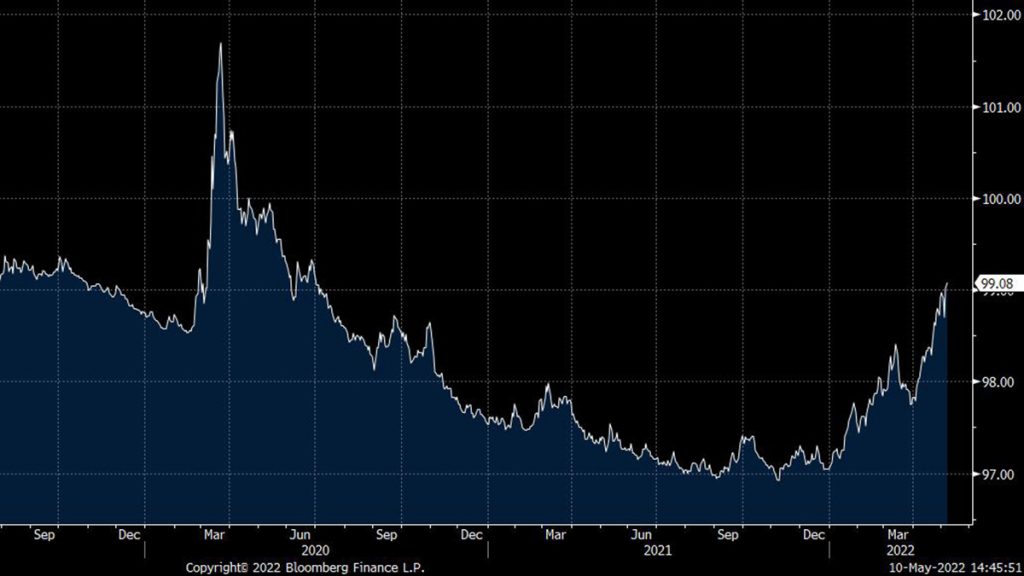
Clearly these do not represent an about-turn, but rather a moderating of what has been a relentless pace of bearish bond news so far in 2022.
This week’s US CPI numbers will be watched closely.
With the market pricing cash rates in Australia at 2.75% by the end of this year — and 10-year bonds at 3.5% — there is a lot priced in. So any signs central banks can ease the pace of tightening will lead to a significant fall in yields.
We will keep a close eye on equities and commodities in the week ahead to see if this is just a correction or has more legs.
About Tim Hext and Pendal’s Income & Fixed Interest boutique
Tim Hext is a Pendal portfolio manager and head of government bond strategies in our Income and Fixed Interest team.
Tim has extensive experience in banking, financial markets and funding including senior positions with NSW Treasury Corporation (TCorp), Westpac Treasury, Commonwealth Bank of Australia, Deutsche Bank, Bain & Co and Swiss Bank Corporation.
Pendal’s Income and Fixed Interest boutique is one of the most experienced and well-regarded fixed income teams in Australia.
Find out more about Pendal’s fixed interest strategies here
About Pendal
Pendal is a global investment management business focused on delivering superior investment returns for our clients through active management.
In 2023, Pendal became part of Perpetual Limited (ASX:PPT), bringing together two of Australia’s most respected active asset management brands to create a global leader in multi-boutique asset management with autonomous, world-class investment capabilities and a growing leadership position in ESG.
Here are the main factors driving the ASX this week according to our head of equities Crispin Murray. Reported by portfolio specialist Chris Adams.
Find out about Crispin’s Pendal Focus Australian Share Fund
Find out about Crispin’s sustainable Pendal Horizon Fund
TIGHTENING monetary policy prompted further market falls last week.
The issue is not so much the rate hikes — which have been well flagged — but widespread scepticism that central banks can tame inflation without causing recession.
Inflation is presented as a material issue. But in the same breath central banks are saying rates only need to get back to neutral levels to contain it.
The market is concerned that the goal of a “soft landing” is wishful thinking.
Negative sentiment was compounded by the Bank of England warning of recession as they increased rates, raising the risk of stagflation. China’s reiteration of Covid-zero adherence also weighed last week, as did weaker US productivity data and the need to rebuild oil reserves.
The positive correlation between equities and bonds continued.
US 10-year Treasury bond yields rose 19bps, breaking through 3%. Meanwhile the S&P 500 failed to maintain a mid-week bounce, finishing the week down 0.2%. It is now off about 11% since March 29 and down 13.1% for the calendar year to date.
Growth continues to do worse. The NASDAQ is given up 17% since Mar 29 and 22.2% year to date.
The S&P/ASX 300 could no longer maintain its previous disconnection, falling 3.2% for the week as REITs joined growth stocks in underperforming under the weight of higher bond yields.
Resource stocks also declined as commodity prices weakened on concerns over future demand.
Confidence in the RBA’s inflation credentials appears low — 10-year yields rose 35bps to 3.47%, versus 1.6% at the start of the year.
We continue to remain cautious on markets in the near term.
Pendal Focus Australian Share Fund
Now rated at the highest level by Lonsec, Morningstar and Zenith
Economics and policy
The US Fed raised rates 50bp and indicated moves of the same size at the next two meetings, with 25bp per meeting likely thereafter.
Chair Powell said a 75bp move would not be necessary. This initially reassured markets. But it was later viewed as an unnecessary constraint on the Fed’s ability to react to inflation, and bond yields continued to sell off.
Powell continues to soothe market concerns, saying he can bring inflation back to target without causing a recession. He noted the risk of recession was below what the market was pricing. He was also non-committal on the need to raise rates above the neutral level, which he puts at 2-3%.
However, the market is far more sceptical. There is a view – reflected in comments from recently retired Fed member Richard Clarida – that rates need to go well above neutral to reduce inflation.
Clarida estimates at least 3.5%. Others are saying 4%.
The way to think about policy is that financial conditions need to tighten to a level which brings growth materially below the trend of 2%.
Based on historic relationships this requires equities to fall further, higher rates, wider credit spreads and a stronger US dollar.
This is all consistent with weaker markets. As long as it remains orderly we are unlikely to see the Fed intervene.
Another way to think about this paradox is that unemployment is probably running 50bp below sustainable levels.
To dampen wage inflation unemployment needs to increase by at least that amount, which history indicates is consistent with a recession.
Sustainable and
Responsible Investments
Fund Manager of the Year
The latest employment data was broadly neutral.
Payrolls were a touch better than expected at 428,000 new jobs versus 380,000 expected. However the previous two months were revised down 39,000, offsetting the gap. Average hours worked were +0.3% vs expectations of 0.4%. All this signals the rate of expansion in jobs is slowing.
The household survey saw a significant drop in jobs (-353,000) — but this needed to be -559,000 to be considered statistically significant.
The participation rate also declined, reversing positive signs of people returning to work in the last couple of months.
All up, none of this shifts the dial for the Fed in terms of resolving the fundamental problem of too few people available for each vacancy.
There are signs that inflationary pressures are beginning to moderate. Average hourly earnings are plateauing, some commodity prices (including copper) have stalled and money supply growth has decelerated.
This is not enough to dampen fears around the level of required tightening.
The market is also mindful of:
- Higher oil prices
- A stronger dollar
- Higher nominal yields
- High mortgage rates
- Tighter policy
All this suggests markets will remain under pressure in the near term.
Market outlook
The positive correlation between bonds and equities remains, which encourages portfolio de-risking.
Looking at technical indicators, there is a lot of focus on sentiment being at levels consistent with a market low.
However we counsel caution on this view, since flows into the equity market have remained strong. This suggests we have not yet seen the capitulation on equities – particularly on the retail side – which could signal a true trough in sentiment.
We may need to see the FAANGs roll over for this to occur – and there are signs that this may be in train.
Australia participated in the sell-off. This was partly due to concern over the impact of slowing growth on commodity prices. The big move in bond yields also weighed on REITs and the growth names. Energy is remaining defensive, with oil prices proving resilient.
There has been large sector divergence across the ASX300 in the calendar year to date.
From the best-performed to the worst:
- Energy: Positive fundamentals, making it the most defensive
- Consumer staples: Supported by predictability and lack of cyclicality
- Financials: Becoming less defensive in the past two weeks, probably as the market has started to focus on the prospect of a domestic economic slowdown
- Property: The break-out in Australian bond yields has turned this sector from defensive to under pressure in last two weeks.
- Healthcare: Has lagged due to growth characteristics, but becoming more defensive recently
- Discretionary: Has been under pressure due to cyclical concerns and the unwind of Covid benefits
- Tech: Remains the weakest
Last week we saw some bank half-yearly results and a number of company updates.
The bank results were reasonable, but cost pressures seem to be emerging as an offset to the benefit of higher rates. The issue going forward is that they are domestic cyclicals.
We do not expect a major bust in the housing market. A softer outlook is likely to weigh on sentiment but corporate updates were generally positive.
But the market is increasingly looking through the near term and focusing on the reality that the RBA — like the Fed — needs to engineer a material economic slowdown which will not be good for cyclical earnings.
About Crispin Murray and Pendal Focus Australian Share Fund
Crispin Murray is Pendal’s Head of Equities. He has more than 27 years of investment experience and leads one of the largest equities teams in Australia. Crispin’s Pendal Focus Australian Share Fund has beaten the benchmark in 12 years of its 16-year history (after fees), across a range of market conditions.
Pendal is an independent, global investment management business focused on delivering superior investment returns for our clients through active management.